What's the difference?
Do you remember when you first saw an Audi TT? I can go first. It was 1998 and I’d been backpacking through Europe for months and had arrived in Paris just as all my money had run out.
Anyway, as I was beating myself up for spending way too much on a fridge magnet in a souvenir shop (it had a built-in thermometer) when one drove past me.
I saw the Audi badge but before I could work out what it was it turned the corner and was gone.
The mysterious Audi was silver and it looked like it was from the future, but actually it was the original TT, the first one, and being about October ‘98 it would have only just come out.
I would never have believed you if you’d told me at the time that 25 years later I’d be a motoring journalist and that I’d be reviewing the final Audi TT ever.
And here we are with the Audi TT Final Edition. That’s right, Audi has decided to discontinue this sports car after 25 years of production and it’s made this commemorative TT Final Edition that adds unique fettling and some nice features.
So, is the TT Final Edition worth buying? What’s so good about it? And how much more does it cost over a regular TT?
I found out after spending a weekend on some great roads to say goodbye to this icon. Oh, and I still have the fridge magnet.
For many, Chevrolet’s repositioning of the engine in its Corvette from the nose to behind its passengers was a shock, although Chevy had seemingly been itching to make the shift since showing its XP-880 Astro II concept car close to 60 years ago.
But the idea of an electric motor in ‘America’s Sports Car’ was probably even more confronting.
However, when you add the critical detail that the petrol-electric hybrid E-Ray version of the current C8 Corvette puts out 488kW (655hp) and 806Nm, surely fears the end is nigh for muscle car enthusiasts ebb away.
The C8 ‘Vette has been with us for five years, blurring the line between traditional US-style performance and mid-engine Euro exotics, maintaining good ol' boy naturally aspirated V8 power but locating it between the axles, and in the E-Ray, hooking it up with a chunky electric drive unit up front.
There are potential changes on the horizon, with the even more thunderous Corvette Grand Sport X hybrid lurking in the wings. But right now, this is Chevrolet’s hybrid hero.
Could this cut-price supercar be your next four-wheeled piece of mechanical pride and joy?
Audi is finally saying hooroo to this model which has made the world stop and stare like I did on that Parisian street all those years ago.
The Final Edition is a fitting tribute to this iconic sports car and I’m glad Audi didn’t go ‘OTT’ and deck it out with gimmicky features.
At the same time the Final Edition’s big rear wing, blacked out badges, wheels and interior colour coding hint that this is not just any ordinary TT and those that know will know.
Farewell Audi TT, we hope something just like you but probably electric appears to stop us in our tracks again.
The Chevrolet Corvette E-Ray offers hypercar-level performance, aggressive design and brilliant dynamics at a bargain-price relative to similarly-configured Euro exotics. Blending raw V8 grunt with front-axle electric power it delivers an exhilarating drive experience.
While things like ingress and egress are a challenge and warranty coverage is modest, the car’s immense capability makes it an attractive option for anyone wanting a high-performance mid-engine machine without the astronomical price tag of a ‘traditional’ supercar.
The Audi TT’s shape has morphed over the past 25 years from the cute, rounded bubble car that first appeared in the late 1990s to the more aggressively and sleek looking sports car with the sharp creases we see today.
Still, there are the familiar pumped-out wheel arches and, while not as prominent as it used to be, that arching roof and the way it flows down to those tail-lights and stumpy tail remains so true to the original TT.
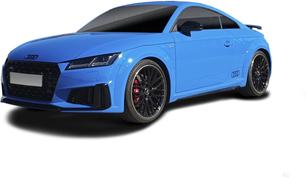
The TT Final Edition has a more menacing and athletic look than the regular 45 TFSI its based on thanks to the S Line Competition Plus exterior package.
So you’re getting the big fixed wing, an aggressive front bumper, and the 19-inch alloy wheels in gloss black.
There’s a black package, too, which add the decals down the side, the blacked-out badges, the black exhaust tips and black wing mirrors.
My test car’s paint colour was Turbo Blue and you can see in the images of the cabin how Audi matches interior elements in the same colour. The contrast stitching on the seats also lifts the sporty feel into high-end territory.
It’s a simple cabin, though, free from busy buttons and giant screens and the incorporation of climate controls into the air vents is genius.
If you’re wondering what the TT Final Edition’s dimensions are its 4191mm long, 1832mm wide and 1376mm tall.
If you asked primary school me to draw a ‘supercar’ I’d likely hand you a roughly hewn, multi-coloured wedge in Egyptian frieze-style 2D that could be interpreted as a prescient rendering of the current Corvette E-Ray.
GM has confessed that a big part of its motivation for going mid-engine with the current-gen Corvette is to help it appeal to a younger target market (maybe not under-10s) and Chevrolet has enthusiastically embraced the low nose, wide high-tail stance. You’re not going to miss it.
The E-Ray, like its track-focused Z06 sibling, is longer (+58mm) and wider (+92mm) than the standard Corvette Stingray, with huge air intakes in the nose and deep gills behind the doors.
Its distinctly angular design retains enough Corvette DNA to keep the C8 in the family. The headlights are reminiscent of the C7 that preceded it and the dual tail-light design is a neat reinterpretation of that signature element. A clear engine lid showcases the longitudinally mounted V8’s bright red engine cover.
Far from a clean or curvaceous shape, the E-Ray is all business with function driving its fighter jet form. And that carries over to the interior with the driver-focused cockpit making no apologies for concentrating almost exclusively on the person behind the wheel.
Multiple screens wrap around the instrument binnacle with the flat top and bottom steering wheel affording a clear view of them all.
The jagged lift-up gear selector controls would be right at home in an F-22 Raptor and despite the layout’s relatively fussy look it works super-well ergonomically, with clearly marked buttons (haptic and physical) easy to sight and operate.
The Audi TT isn’t going to cut it as a family car, but it’s more practical than a lot of people might think.
First this is a '2+2' sports car meaning those two rear seats are there for the odd occasion when you might need them, because the space back there is limited.
But for most of the time having a place to throw a jacket or extra luggage and not have to ask your co-plot to rest it on their lap will feel like absolute luxury.
Up front head and legroom is good, even for me at 189cm tall. Being a coupe the doors are long and although the car is low I found getting in and out easy.
There’s a pretty clever use of space when it comes down to cabin storage. You’ll find door pockets, a glove box, a covered centre console box and a hidey hole/wireless phone charger in the dash.
Back seat passengers have built-in shelves near their armrests. Surprisingly there are four cupholders - two of which fold out of the dash.
The boot isn’t huge at 305 litres but you can fold the rear seats down to open up the cargo capacity to 712 litres.
So, compared to its two-seater sports car rivals, the TT is relatively and pleasantly practical.
Practicality is a relative concept when you’re looking at a two-seat, mid-engine sports car, which means the Corvette E-Ray is not functional in the Kia Carnival sense. But there are some concessions to the need to store things inside it.
In terms of storing people, getting in and out of a C8 Corvette isn’t exactly straightforward. The car sits close to the ground, which despite decent door apertures, means to gain access you’re lowering yourself across and into the heavily bolstered seats using an ungainly, vaguely yoga-style technique. Same goes on exit with more than a little grunting required to hoick yourself out of the car. Not an easy proposition for a daily driver.
Once inside, headroom for me at 183cm is good and for storage there are slim pockets in the doors (with no scope for bottles), two cupholders in the centre console and an oddments tray ahead of them. The glove box is a good size, a lidded box between the seats houses USB-A and USB-C outlets and there’s an awkward-to-use upright wireless phone charging slot between the seat backrests.
Boot volume is 204 litres, unless you’ve removed the roof panel and clipped it into its storage position there. A surprisingly easy process, by the way. If that’s the case you’ll be leaning more heavily on the 142-litre frunk. Overall storage capacity of around 350L is pretty handy for a car of this type.
Not surprisingly, given the scale of this car’s wheel and tyre package, there’s no spare. The Michelin Pilot Sport 4S tyres are run-flats.
And substantial practicality points go to the front lift system which, via the press of a console button, rapidly raises the car’s nose by 50mm to help avoid driveway and speed bump scrapes.
Audi has taken the $84,000 TT Coupe 45 TFSI quattro and created this TT Final Edition with extra features for a list price of $88,749.
Here’s what you’re getting. First there’s the 'S Line Competition Plus' exterior package which beefs up the TT’s looks with the big, fixed rear wing and 19-inch Audi Sport wheels in gloss 'Anthracite Black' with red brake calipers.
There’s also the black exterior package which brings the black Audi rings badging, black chunky exhaust tips, black side trims and Audi logo decals.
Inside there’s Nappa leather S sport seats; an Alcantara and leather flat-bottomed steering wheel with paddle shifters; while the armrests, door handles and the centre console are covered by the 'Leather Package' which includes contrasting stitching.
Metallic paint is also included as part of the Final Edition’s features. Ours was 'Turbo Blue'.
Much of the rest of the Final Edition’s features are shared with the TT Coupe 45 TFSI quattro and includes a 12.4-inch 'Virtual Cockpit' digital instrument display, sat nav, CD and DVD player, eight-speaker stereo, digital radio, Apple CarPlay and Android Auto, wireless phone charging and proximity unlocking.
Our car had a couple of options fitted - the privacy glass which is $950 and the 20-inch gloss black alloy wheels for $1600.
Rivals to the TT include BMW’s Z4 which lists for $99,200, and its Toyota GR Supra twin for $87,380, while the Nissan Z Coupe is also part of that sporty coupe club at $75,800.
You might already know this but the TT doesn’t have a central media screen and that can appear odd in a new car world where big screens dominate the dashboard.
In the US the Corvette E-Ray is offered in three imaginatively titled trim levels - 1LZ, 2LZ and 3LZ in coupe and power-folding hardtop convertible form.
Australia takes the top-spec 3LZ coupe only, priced at $292,990, including GST and LCT but before on-road costs.
If your heart’s set on a full-convertible Corvette you’ll need to opt for the non-hybrid Stingray ($232,990, BOC), but the coupe’s targa-style, lift-out roof panel gets you most of the way there, anyway.
Aside from the safety tech we’ll get to shortly, that figure gets you a heap of standard fruit, the highlights including:
Other, similarly-configured ways to accelerate from 0-100km/h in less than three seconds cost twice as much as the E-Ray. Ferrari 296 GTB? Prepare to part with $604K. Lamborghini Temerario? You’ll need to cough up $534,169. Porsche 911 Turbo S Coupe? It’s $577,300.
On that basis, this Corvette is a supercar bargain.
The TT Final Edition has the same 2.0-litre, four-cylinder, turbo-petrol engine as the regular 45 TFSI TT Coupe with the same 180kW and 370Nm outputs.
The TT is light, though, at only 1460kg and that grunt is enough to slingshot it from 0-100km/h in 5.1 seconds.
The transmission is an eight-speed dual-clutch automatic which sends drive to all four wheels.
Sure, the TTS has more grunt and the TTRS is nothing short of wonderful with its five cylinder powerplant, but the 2.0-litre engine in the Final Edition feels perfectly suited to what is a fun and engaging sports car.
The Corvette E-Ray is powered by a mid-mounted 6.2-litre, naturally aspirated ‘LT2’ V8 featuring dry sump lubrication, a billet steel crank, forged conrods and variable valve timing for 369kW (at 6450rpm) and 637Nm (at 5150rpm).
It sends drive to the rear wheels via an eight-speed dual-clutch auto transmission with (carbon) paddles on the steering wheel for manual shifting.
A single 119kW/170Nm electric motor on the front axle contributes to total outputs of 488kW/806Nm and delivers ‘eAWD’.
Claimed 0-100km/h acceleration time is a sizzling 2.9 seconds.
Audi says that after a combination of open and urban roads the TT Final Edition should use 7.0L/100km.
My own testing took in a combination of the best country roads and worst city traffic and at the fuel pump I measured 10.9L/100km.
But most of my time was spent in 'Dynamic' drive mode with the fuel-saving idle stop system switched off.
The TT's 55-litre fuel tank means you should have a range of about 785km.
The Corvette E-Ray’s official fuel consumption figure for the combined (urban/extra-urban) cycle is 11.5L/100km.
The car’s Active Fuel Management system is able to subtly drop four cylinders under light loads, a small V4 (rather than V8) light on the dashboard the only clue this sleight-of-hand trick has been performed.
Auto stop-start is also standard, although we admit to switching it off (via a haptic button on the dash) most of the time. And purely in the name of science and fully exploring the car’s performance potential we may have leaned into the E-Ray’s dynamic abilities more than once.
Overall, across a week of mainly city and suburban running with some freeway sections thrown in, we recorded an on-test average of 13.5L/100km, which is still more than acceptable for this type of performance car.
Brim the 70-litre tank with minimum 95 RON premium fuel and using our real-world figure you can expect a driving range of around 520km.
The E-Ray features a 1.9kWh lithium-ion battery, self-replenished from coasting and braking, allowing an EV-only (and neighbour-friendly) ‘Stealth Mode’ for four to six kilometres at a maximum of 72km/h.
And there’s a ‘Shuttle Mode’ (not suitable for public roads) which also engages just the front axle on electric power for moving silently around a driveway or into a garage to a speed of 24km/h.
There are plenty of sports cars out there which are dynamically superb yet uncomfortable to sit in.
But the TT’s cabin is as ergonomic as it is stylish with a great, low sitting position and good pedal feel, a steering wheel that can be adjusted to be just right and still with plenty of space underneath for long legs like mine.
The shifter feels the right distance away, good visibility even out the rear window and plenty of ventilation. And we haven’t even started driving yet.
The TT Final Edition felt to me how a TT should. Fun. Not overpowered nor brutally firm and not ridiculously loud.
Instead, my drive in the Final Edition, which took me along some of my favourite country roads, was one of the most enjoyable runs I’ve had in any car.
This is a car which ‘listens’ to you and replies with exactly what you’ve asked for in the way it turns into corners and accelerates out of them, and pulls up when you need it too.
There’s so much connection to the road, you can hear the sticks and stones flying up into the guards, you can feel the coarse chip bitumen through the steering wheel.
But it’s all so easy, too. The suspension is firm but soft enough that you can drive this daily. The steering is light but still with great feedback.
Some sports cars leave you feeling exhausted, like you’ve just wrestled a bear but the TT Final Edition just leaves you feeling like you've been on a ride and all you want to do is run back around to line up and get back on it again.
Let’s get the acceleration thing out of the way. The Corvette E-Ray is obscenely fast. If you’re determined to bend the space-time continuum, it’s keen to assist.
Claimed 0-100km/h time is just under three seconds but on a closed track using launch control we’ve previously recorded a time of 2.4sec, which is hypercar territory.
The big V8’s furious roar is amplified by the standard performance exhaust and the dual-clutch auto is a slick, positive, high-quality unit. Manual shifts via the wheel paddles are rapid-fire.
Suspension is by forged alloy double wishbones front and rear with magnetic adaptive damping standard, the latter allowing you to dial in Sport, Touring, Track and Weather modes as well as two customisable settings - MyMode for everyday driving and the performance-focused Z Mode.
Weather optimises the car’s systems for slippery conditions, as its name implies, and Track is best left for the circuit as it’s unbearably harsh on anything less than a billiard table smooth surface. Sport is more liveable but the pick is Touring which retains the car’s fundamental agility while providing excellent compliance.
Shudder over patched suburban roads in Sport then switch to Touring to illustrate an amazingly forgiving ride.
Despite its aluminium-rich space frame, the E-Ray still weighs in at 1800kg but it responds like a lightweight. The steering is brilliantly precise without being overly sharp and road feel is superb. In terms of cornering, the C8 Corvette is the quintessential apex predator.
Thanks in no small part to an electronic limited slip differential the E-Ray puts its power down on corner exit with impressive force and grip from the monster Michelin Pilot Sport 4S rubber is prodigious.
The tyres measure 275/30x20 at the front and no less than 345/25x21 at the rear, bearing in mind a current F1 car’s rear tyres are 375mm across the tread.
Brakes are also professional grade with carbon ceramic rotors (398mm fr / 391mm rr) clamped by Brembo six-piston alloy calipers at the front and four-piston units at the rear. While some carbon set-ups need to be at a high temperature for optimal performance there are no such worries here. The E-Ray washes off speed with prodigious yet satisfyingly progressive power.
Worth noting if you’re a track day demon, there’s an ‘Enhanced Performance Data Recorder’ and ‘Performance App’ that jointly provide everything from side-by-side video analysis and graphical data displays to tyre temp and pressures and even coaching tips.
‘Performance Traction Management’ also allows you to fine-tune traction and stability controls to suit specific track conditions.
Under the heading of miscellaneous observations; the GT2 seats are grippy yet supremely comfortable, an 11.1m turning circle is sizable and over-the-shoulder rear three-quarter vision is limited, although there’s enough camera coverage to minimise the problem for parking.
This could be a deal breaker for you. The Final Edition, like all Audi TTs, falls short in terms of safety equipment compared to its rivals.
This third generation TT only managed four ANCAP stars out of a maximum of five when it was assessed in 2015.
This was due to the model not having AEB or lane keeping assistance or rear cross-traffic alert.
The only assistance features it has are blind spot warning and self parking (which is handy). It doesn’t even have adaptive cruise control.
There are two top tether points for child seats in the second row but please be aware that the TT was also scored low by ANCAP for child occupant crash protection.
If you do have children and are looking for something safer but still small and sporty, the BMW 2 Series Gran Coupe or Mercedes-Benz A-Class are excellent choices.
Something to think about.
No surprise, given the Corvette’s relatively low volume, it hasn’t been assessed by ANCAP but active (crash-avoidance) safety tech includes:
The airbag count is four, front and side for driver and passenger, which is fair enough for a two-door sports car.
For the record, no child seat top tether or ISOFIX anchor for the passenger seat.
The TT Final Edition is covered by Audi’s five-year, unlimited kilometre warranty.
Serving is recommended every 12 months or 15,000km and although Audi doesn't have capped price servicing there is a five-year/75,000km plan which will cost about $3000 in total for regular maintenance. Yep, that's $600 per workshop visit.
GMSV’s warranty cover for the Corvette sits at three years/100,000km which is woefully under-done, even in the context of high-dollar sports cars.
For example, Aston, Ferrari, Lambo, McLaren and Porsche, while still at three years, offer unlimited-kilometre cover.
Service is recommended every 12 months/12,000km, the average annual price for the Corvette coming in at around $1100 over the first few years, largely because the first and every second service thereafter is a major one, including things like a transmission fluid change.
That’s way lower than most mid-engine Euros and it’s important to note service price will vary according to the car's use, different state and territory labour rates and other factors.
There are around 55 GMSV dealers in Australia focused on capital cities as well as major regional and rural centres.