What's the difference?
The Audi SQ8 has had a mid-life refresh but this upper large SUV still offers luxury with its powerful V8 engine that fans know and love, as well as the features you would expect in a top model.
It competes against the Mercedes-AMG GLE and Porsche Cayenne but we’re family testing the SQ8 to see how it handles domestic life.
Keep reading to see what we’ve discovered.
GWM’s top-spec Cannon, the XSR, is a dual-cab 4WD ute worth checking out.
At a little more than $50,000, drive-away (nationwide), with twin lockers, a snorkel, underbody protection and Cooper Discoverer AT3 all-terrain tyres, this off-road-focussed Cannon variant also now has a 2.4-litre four-cylinder turbo-diesel engine rather than the previous-generation’s 2.0-litre four-cylinder turbo-diesel.
Lower-spec Cannons have undergone a refresh of sorts, including a revised front, but the XSR’s major change is the new engine. No matter, because there’s enough on offer in this top-shelf package for it to retain its value-for-money appeal.
But does the new engine make a difference to the XSR’s off-road performance?
Read on.
The Audi SQ8 isn’t your typical performance SUV. It’s more refined and less flashy. The tech can be more complicated than it needs to be and if you’re wanting that V8 soundscape, you won’t find it here.
However, the handling and on road experience are superb plus you can comfortably haul the family around and look good doing it.
The GWM Cannon XSR is a twin-locked 4WD ute that’s reasonable on-road (it’s getting better all the time) and very capable off-road.
It certainly has enough gear onboard – including front and rear diff locks, a snorkel and all-terrain tyres – to be taken seriously as a 4WD, but it could still be better and more refined in other aspects, even at this price-point.
There are some issues with the Cannon’s general driveability but ultimately it has plenty going for it, not least its appeal as an impressive value-for-money purchase.
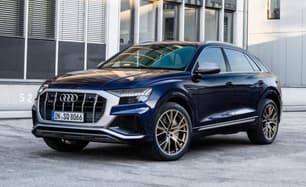
The SQ8 is a gorgeous coupe-style SUV that looks purposeful and poised with its balanced proportions and wide stance. It’s stands apart from its siblings thanks to the S-styled nose treatment and our test model's black accent package makes the honeycomb grille look even sportier.
The update sees new air intake vents at the front, matrix LED headlights and new chrome exhaust tailpipes.
The upgraded 23-inch alloys with red calipers behind them hint at what’s under the bonnet, as does the Sakhir (sack-heer) Gold paintwork which is aptly named after the one-off Grand Prix race circuit.
The interior looks luxuriously appointed with the black Valcona leather upholstery and the dash is headlined by three high-end technology screens. The SQ8 also gets sport seats featuring a quilted design and 'S' badging but there’s not much else separating it from its siblings.
Audi fans will love the the SQ8's more understated interior but newcomers might be surprised it's not as flashy as some of its rivals.
The XSR is 5439mm long (with a 3230mm wheelbase), 1958mm wide and 1893mm high. Official kerb weight is listed as 2230kg.
This is a substantial ute that resembles an amalgamation of Ford Ranger, Isuzu D-Max and Toyota HiLux.
The wide wheel track gives the XSR a squat stance and its snorkel, sports bar, bash plates, chunky all-terrain tyres and red brake calipers add to this ute’s presence.
Inside, a steering-wheel design tweak (it’s now three spokes) and refreshed dashboard layout help to give the cabin a low-key classy look and feel.
It may lack the all-around polish of something like the Ford Ranger, but the XSR’s much lower price negates that perception.
The XSR holds its own in the looks department across the dual cab ute category.
The upper large SUV tag certainly makes sense when it comes to cabin space because there's a lot of it. Both rows enjoy ample head- and legroom and access is great thanks to wide door apertures and high ground clearance.
Comfort is high with well-padded seats and thanks to the Sensory Package all but the middle back seater get some luxury extras.
The centre rear position has compromised legroom courtesy of the transmission tunnel, so it's best for a kid. However, the front seats take the cake with their massage, heat and cooling functions and adjustable supports.
Amenities are great throughout the car and the extendable sun visors, rear electric sunshades, soft-close doors and four-zone climate control clinch the practicality deal.
Individual storage is a bit sparse up front with two cupholders, a drink bottle holder in each door and a shallow middle console that realistically only fits a phone.
The glove box is a great size. I can fit my handbag in it, but there are not a lot of areas to pop your smaller items in.
Individual storage is a bit better in the rear as you get two big map pockets, a drink bottle holder in each door, plus two cupholders in the fold-down armrest - so it feels like you have more places for your bits and pieces.
Technology looks amazing but overwhelming to use until you wrap your head around it all. The haptic feedback also gets tired fast. The built-in satellite navigation is super simple while the head-up display and digital instrument cluster feature pull through directions, which is handy.
Charging options are good with each row getting two USB-C ports and a 12-volt socket but the front also enjoys a wireless charging pad. The pad is slow to charge, though, and left my iPhone feeling super hot whenever it was used.
The boot is a good size at 605L and easy to access, too. The sloping roof means larger items have to sit flush with the seats but you shouldn’t have to worry for road trips.
The back seat has a 40/20/40 split which opens up storage options and this model has a powered tailgate.
The XSR’s five-seat interior is neat and spacious but there are parts, such as some buttons, dials and switches, that feel a bit flimsy and cheap.
Up front there are two USB ports, a wireless charging pad, a 12V plug and a deep centre console.
The new 12.3-inch touchscreen multimedia system includes wireless Apple CarPlay and Android Auto and has been improved by increments.
The front seats are power adjustable (driver’s six-way, passenger four-way) and both are comfortable without being too plush.
Second-row passengers get a firm but comfortable seat and amenities include USB charge ports, a 220V plug, air vents, and a fold-down centre armrest (with cupholders). There’s plenty of head, knee and legroom, unless you’re stuck in the middle where knee and foot room is pinched.
The second-row seat base can be folded out of the way to make room for more gear if no one’s in the back seat.
The second-row seat has top-tether points and there are ISOFIX anchors on the outboard seats.
The XSR’s load space (1520mm long, 1520mm wide and 540mm deep) has a durable tub liner, four tie-down points, as well as a pop-out step hidden in the top of the tailgate, and a step-up indent at each corner of the rear bumper.
This Cannon offers just as much all-round practicality and load-space flexibility as the likes of Isuzu D-Max, Mitsubishi Triton and Toyota HiLux.
There are three fuel-based variants for the Q8 and the model on test is the top-spec SQ8 TFSI quattro. Its mid-life refresh has seen a price hike of $10,015, bringing it's before on-road costs price to $178,815.
Our test vehicle has also been fitted with a few extras, like a 'Sensory Package' ($14,400) which includes a black headliner, upgraded 23-speaker Bang & Olufsen 3D surround sound system, massage function for the front seats, heat function for the rear outboard seats, electric sunshades for the rear row and an air-quality perfume function.
Also fitted are various black and matt carbon accents across/inside the body for a total of $5400, optioned 23-inch alloy wheels ($3000) and specialised 'Sakhir Gold Metallic' paintwork for $1600. Which brings the total MSRP price tag to $203,215.
Even with all of these extras, the SQ8 is still the most affordable performance SUV compared to its nearest rivals as the Porsche Cayenne GTS starts from $212,600 MSRP and the Mercedes-AMG GLE 63 outstrips them both at $272,300 MSRP.
As you'd expect the standard features list is robust for the SQ8 and includes premium features like a panoramic sunroof, electric front seats with heating/cooling and memory functions, full-leather upholstery, soft-close doors and a heated steering wheel.
There is a bunch of high-end technology throughout which includes a colour head-up display, 10.1-inch touchscreen multimedia system, 8.6-inch climate control panel, 12.3-inch digital instrument cluster, satellite navigation, wired/wireless Apple CarPlay and Android Auto, digital radio, four USB-C ports, three 12-volt sockets and a wireless charging pad.
Practical features include keyless entry and start, rain-sensing windscreen wipers, dusk-sensing LED headlights, a powered tailgate, adaptive air-suspension and four-zone climate control.
Overall, not a bad list of features for this part of the market and you won't be left wanting.
The XSR is the top-spec variant in the Cannon line-up and as such has a price-tag of $50,990, drive-away (offered nationwide).
Standard features include 18-inch alloy wheels, a chrome sports bar, automatic LED headlights, spray-in tubliner, keyless entry, leather-accented upholstery, 12.3-inch touchscreen multimedia system (with wireless Apple CarPlay and Android Auto), a six-way power-adjustable driver's seat and four-way power-adjustable front-passenger seat, ambient lighting, a black sports bar and matt black exterior trim.
Exterior paint choices for the XSR include the standard 'Pearl White', or 'Crystal Black', 'Lunar Red', 'Stealth Grey', 'Sapphire Blue' and 'Pittsburgh Silver'.
This Cannon compares favourably to rivals such as the Isuzu D-Max, Mitsubishi Triton and Toyota HiLux, in terms of standard features offered for the price.
Our test vehicle has a 4.0-litre, twin-turbo petrol V8 engine that produces 373kW and 770Nm. That means it sits in the middle of its rivals in terms of outputs with the Mercedes being top-dog with its 450kW/850Nm combo.
Still... the SQ8 is no dainty flower when it comes to power delivery and has an impressive 0-100km/h sprint time of just 4.1 seconds.
The SQ8 is a full-time all-wheel drive with an eight-speed auto transmission and the whole engine combo delivers a powerful but elegant on-road experience.
The new 2.4-litre four-cylinder turbo-diesel engine produces 135kW at 3600rpm and 480Nm at 1500-2500rpm. It's tractable and well suited to the demands of 4WDing.
Don’t get me wrong, the previous-gen Cannon’s 2.0-litre four-cylinder turbo-diesel engine (120kW/400Nm) was no slouch, either. It’s just that this bigger and more powerful engine is better.
The new engine can easily muster more than enough power and torque on- and off-road when needed. However, there are enough instances of substantial lag at crucial moments – punching off the mark from a complete stop to safely merge into traffic, for example – that when compounded threaten to mar the overall driving experience.
Another thing. The automatic transmission, now a nine- rather than eight-speed, while generally okay, proves patchy in daily driving, not upshifting as slickly as it should and sometimes hunting for the sweet spot, rather than hitting it.
In terms of all-round powertrain performance, the XSR is on par with four-cylinder, turbo-diesel rivals such as the Ford Ranger 2.0L (125kW/405Nm), Isuzu D-Max 2.2L (120kW/400Nm), Mitsubishi Triton 2.4L (150kW/470Nm) and Toyota HiLux 2.8L (150kW/500Nm).
The official combined (urban/extra-urban) fuel cycle figure is 11.9L/100km, which is lower than its rivals.
My real world usage sits at 12.3L/100km after a mix of open-road and urban driving.
This result is decent for a performance SUV but expect it to be thirsty in an urban environment as the on-board gauge hit the mid-20s in the city.
Based on the large 85L fuel tank theoretical driving range is 714km and around 690 using our real-world result. Respectable for a performance SUV but not as good as some family SUVs.
Listed fuel consumption is 8.4L/100km on a combined (urban/extra-urban) cycle, which is better than the 9.4L/100km offered by the previous 2.0-litre four-cylinder turbo-diesel engine and eight-speed auto.
I recorded on-test fuel consumption of 10L/100km which is ahead of the 11.2L/100km I recorded in a Cannon XSR with the 2.0-litre four and eight-speed.
The XSR has an 78-litre tank, so, going by my on-test fuel figure, you could reasonably expect a driving range of about 780km from a full tank of diesel.
The SQ8 delivers on power because it’s effortless to get up to speed and the pick up is super responsive when the start/stop function is turned off (otherwise there can be some lag).
The engine doesn’t sound like a big and grumbly V8, though. There are some growls but it’s mainly when you turn the engine on and not to be obnoxious about it but if you're in a V8, you want to hear it as it’s part of the fun of having a big bruiser engine like this!
What doesn’t help the V8 soundscape is the fact the cabin sounds like a noise-cancelling headphone inside. There is a small hum from road noise but it’s pretty darn quiet. Almost EV quiet at times but that means the driving experience leans more towards refined and elegant rather than sporty and fun.
The SQ8's handling is great - super direct steering, stable in corners and well-rounded passenger comfort when it comes to suspension.
You still get road feedback, which I like as a driver, but it’s not too stiff thanks to the adaptive suspension.
The SQ8 is a large car but you wouldn’t know it when it comes to parking. The 360-degree view camera is clear and the dynamic guidelines help you to position this big unit even the smallest of car parks.
As noted above, there are some issues with the Cannon’s general driveability, but all in all it’s not atrocious. And if it’s a potential buy for you, you’ll always come back to the value-for-money rationale.
On- and off-road, the new engine has plenty of punch about it, but patchy delivery through the transmission sometimes works against it.
It’s a not a dynamic vehicle. No surprise, it’s a ute after all. But that point has to be made here because some people still drive these vehicles expecting sports car-like ride and handling.
The good news is the XSR’s touchy throttle and too-loose steering of days gone by have been mostly sorted out. But its thrashy transmission, stiff ride and unwieldy 13.7m turning circle remain.
Its bigger engine doesn’t carry over the previous-gen’s underdone feeling when pushed hard and it has a relaxed feel when you’re cruising along on the highway.
Some concerns have been raised over the years about driver-assist tech in Chinese-built vehicles. To the company’s credit, GWM seems to have addressed those issues… at least to some extent.
Suffice it to say, I’ve experienced a few tricky situations as a result of driver-assist tech in GWM vehicles. From annoyingly intrusive traffic sign recognition and jarring adaptive cruise control through to one particularly hair-raising AEB-related incident. (For more, read my yarn)
Overall, the XSR remains okay on sealed surfaces, but it’s not as refined or compliant as it could or should be.
As for off-roading…
On dirt tracks the XSR is jittery over corrugations and tends to thump through deeper potholes. Otherwise it is reasonably composed.
But with twin differential locks, decent underbody protection and Cooper Discoverer AT3 all-terrain tyres, this Cannon handles low-range 4WDing with ease.
The new bigger engine delivers on promised grunt in the dirt, giving the Cannon plenty of punch when the going gets tough.
Ground clearance of 228mm, wading depth of 700mm and off-road angles of 30 degrees (approach) and 26 degrees (departure; rampover is not listed) don’t hurt its 4WDing potential, either.
Off-road traction control and other driver-assist systems including hill descent control are adequate without being as smooth as the equivalent systems in more expensive vehicles.
It has 'Crawl Mode' (allowing for no-pedal, low-speed driving) and 'Turn Assist' (which brakes the XSR’s inside rear wheel to reduce the ute’s turning circle on traction-compromised surfaces).
While 4WDing, swapping between high- and low-range, changing off-road modes or switching diff locks on or off has been at times a clunky process, with the transition taking on a feeling not unlike shunting trains. No big deal, I reckon, but worth mentioning.
Wheel travel is adequate and this ute’s Cooper Discoverer AT3 all-terrain tyres perform well in the dirt and mud.
The Cannon XSR has towing capacities of 750kg (unbraked trailer) and 3000kg (braked).
All in all, off-roading is the one area in which the Cannon eclipses something like the BYD Shark 6 or Kia Tasman and matches, if not bests the Ford Ranger.
The SQ8 has a maximum five-star ANCAP safety rating from testing done in 2019 and features eight airbags, including side chest airbags for both rows. It's common to only find the latter in the front – so that’s great for a family car.
The SQ8 scored well across its ANCAP individual protection segments, scoring 93 per cent for adult occupant, 88 per cent for child occupant, 71 per cent for vulnerable road user and 75 per cent for its safety assist.
The SQ8 has a long list of safety features including blind-spot monitoring, safe exit warning, driver attention monitor, fatigue reminder, matrix LED lights, SOS call, forward collision warning, rear collision warning, rear cross-traffic alert, lane keeping/departure aids, tyre pressure monitoring, adaptive cruise control (with stop & go and lane keeping), park assist and a 360-degree reversing camera plus front and rear parking sensors.
The rear row features two ISOFIX child seat mounts and three top tether anchors.
The SQ8 has AEB with car, pedestrian, and cyclist detection and is operational from 10 – 250km/h but it is usual to see this system operate from as low as 4.0km/h.
All GWM Cannons, except the 'untested' XSR, have had the maximum five-star ANCAP safety rating since 2021.
Standard safety gear on the XSR includes seven airbags (dual front, front centre, front side and full-length side curtain), AEB (with cyclist and pedestrian detection), adaptive cruise control, blind-spot monitoring, lane-departure warning, traffic sign recognition, rear parking sensors, a 360-degree camera and tyre-pressure monitoring.
The top-spec XSR misses out on emergency lane keeping, rear collision warning, blind spot monitor, lane change assist, and rear cross traffic alert (with braking).
The SQ8 comes with a five-year/unlimited km warranty, which is a normal term for the class.
It also comes with capped servicing for five years or up to 75,000km and averages $920 per service, which is very good for the segment.
Servicing intervals are reasonable at every 12-months or 15,000km, whichever occurs first.
The XSR is covered by a seven-year/unlimited km warranty and five years of free roadside assistance.
The first service is scheduled at the 12 month/10,000km mark, then services are scheduled for every 12 months or 15,000km.
Capped price servicing is available and for a Cannon with a warranty start date on or after January 1, 2026, the costs are $365, $470, $515, $520, and $685 per service. That’s a total of $2555 (and an average of $511 per workshop visit), which is more expensive than some of the Cannon’s rivals on the market.