What's the difference?
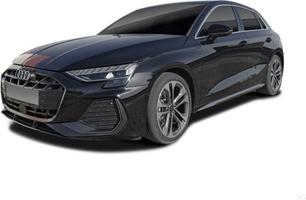
In a world where car upgrades often feel like saying, “Can I upsize that?”, it’s refreshing to hop into the updated Audi S3 Sportback.
The flagship RS 3 may still be the holy grail of hot hatch dreams, but with boosted engine outputs and upgraded tech, the S3 is stepping up.
Is the S3 Sportback the smarter pick over pricier rivals? It delivers serious performance and polish without stretching into RS 3 territory. With fierce competition in the segment, let’s see what this contender brings to the table.
Throughout its history Volvo has been known for a lot of things. Being a safety leader, dorky but endearing station wagons, ‘bloody Volvo drivers’, and more recently, a trailblazer in minimalist premium design.
The C40 is the first step in a next chapter for Volvo, with the brand wanting to be known next for its leadership in the electric space. For the first time for Volvo, it’s a fully electric offering
But in a world of Teslas, Polestars, and Mercedes Benz EQs, where does the C40 sit, and is it worth considering in an increasingly congested premium small SUV space?
We went to its Australian launch to find out.
The updated Audi S3 Sportback is a fun-sized dynamo with impressive outputs and athletic road manners. It’s missing a few premium features, but its compact size paired with a gutsy engine makes it a compelling option for drivers who don’t want to compromise on performance (just space).
The C40 becomes a compelling option in the electrified small SUV space, offering a premium look and feel, great range and tech inclusions at the price, as well as awesome on-road dynamics.
Its main downsides are the rear seat, which is compromised by its platform and design-led roofline, and the overwhelming power and added traction of the dual-motor makes the single motor less attractive on the value front.
Still, regardless of variant chosen, the C40 looks to offer a stand-out balance of price, range, and performance, against its traditional rivals and newcomers alike.
The S3 Sportback may be a small car, but its S design features, like the stylised blackout grille, matrix LED headlights, and 19-inch alloys with red brake calipers, give it a distinctly athletic and fun-loving vibe. It’s compact, but definitely not diminutive and carries serious road presence. It’s hot hatch meets fun-size.
Inside, the S3 looks fabulous. Integrated ambient lighting, a sharp dashboard treatment and a driver-focused cockpit all lend it a premium feel.
The front seats look properly sporty with their integrated headrests, and the quilted Nappa leather upholstery feels great, especially with the eye-catching red contrast stitching.
As for technology, it’s as high-end as you’d expect with a 10.1-inch touchscreen multimedia display and 12.3-inch digital instrument cluster taking centre stage.
The only drawback? No sunroof. Combined with the black headliner and compact cabin, it can feel a little gloomy at times. Still, it’s a cabin you’ll enjoy spending time in.
Volvo has become a brand with a distinctive and consistent design language which embodies the kind of beautiful minimalism normally associated with Scandinavian brands.
I have always liked how Volvo says more with less design elements, with only gentle touches of chrome or gloss black, and a lack of over-the-top sporty pieces avoiding the temptation to over-sell the sporty potential of the brand’s range.
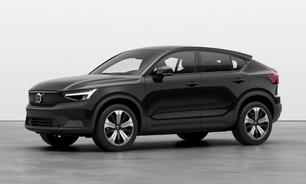
The C40 takes the small SUV formula, well established by its XC40 relation, and gets a bit weird and experimental. It’s slightly lower and has a more coupe-styled rear, with a strongly raked rear window giving it a sportier and more aggressive look than the rest of Volvo’s SUV range.
The styling is sold by an angular spoiler piece running atop the boot, and the rear light clusters have gone all minimalist, constructed of individual pieces rather than a single transparent housing, and they give a nod to the C30 hatchback which this car is the spiritual successor to, by name and nature.
The interior offers up no surprises, sticking to the formula Volvo has established across all of its current models. An effortlessly premium space with, again, a minimalistic dash dominated by the portrait touchscreen, the C40’s premium nature is confirmed by its finely patterned inlays, simple chrome pieces, and abundance of soft-touch surfaces.
The big upright vent fittings with clever rhomboid patterns on their adjustment dials are always a highlight piece of modern Volvos, and the pattern work is continued on the central volume adjust dial and even on the little rotating pieces of the light and wiper stalks. Clever.
Even the software is paired back on the multimedia suite and digital dashboard, with easy to use shortcuts and simple menus which suit the car.
Volvo might turn off some buyers with the more unconventional shape of the C40. But for those looking for a more traditional SUV it also offers the XC40 in the same two variants, and the Polestar 2 caters to those not looking for an SUV at all.
Like most hatches, the front row enjoys the most space. While it’s cosy, it never feels cramped. The seats are firm yet comfortable, thanks to their adjustability and expandable under-thigh supports. Access is fairly easy with wide door apertures, though the low seating position might earn a few grunts, especially from taller folks.
Storage up front is well sorted, with a glove box, a small centre console, a dedicated phone cradle and a couple of cup and bottle holders. It’s about what you'd expect for a car this size, but it's enough to keep things tidy.
There are plenty of charging options, with two USB-C ports in each row and a wireless charging pad up front.
The multimedia system is intuitive and easy to use. The touchscreen is responsive, and wireless Apple CarPlay connected without fuss and stayed connected all week. Wireless Android Auto is available, too.
Built-in sat nav is clear, and I love the way directions pull through to the digital instrument panel. The Sonos sound system? Pretty darn good. My son and I had more than one mini-concert on the school run.
As for the rear row, it definitely reminds you this is a small car. At 168cm, I found it on the cramped side of cosy and my husband just laughed when I asked him to try it! The wheel arch also cuts into the door aperture, making access a little awkward. Best to think of it as occasional adult seating. But given the size, that’s no surprise.
Amenities in the back are decent with a couple of map pockets, cup and bottle holders, as well as a fold-down armrest, those USB ports and rear temperature control (but curiously, no fan control). The seats are comfortable enough, but space is limited. Realistically, it’s best suited for two passengers, not three.
Boot space is quite practical. The wide opening and manageable load lip height make it easy to slide items in and out. It offers 325L of space, less than its key rivals, but expands to 1145L with the rear seats folded flat. The handy 40/20/40 split also adds versatility. Under the boot floor, you’ll find a tyre repair kit.
The C40 is essentially a XC40 with a cropped down roofline, and there are some obvious downsides which this new shape brings.
The front seat throws no surprises, though, offering plenty of room for two adults with a welcome level of adjustability for the seat and wheel. The seats could be more comfortable, though, with a notable lack of padding in the base compared to some luxury (or even non-luxury) rivals.
I’m a fan of the fabric trim which comes on both grades, bucking the trend of needing to have leather or leather-like trim for a car to feel ‘premium’.
The ample window space up front, including the massive glass roof helps the C40’s cabin feel spacious, but the view out the rear with its aggressive design is all but a very limited letterbox aspect, particularly if the rear seat headrests are in the upright position.
While some controls are exclusively via touch interface, there is a physical volume dial, and shortcut buttons for the defogger functions.
Temperature is controlled by touch, however, and the detail settings have some smaller toggle adjustments. Tricky to jab at when you’re on the move.
The digital dash is refreshingly simple, but minimally adjustable, with the choice of either a nifty navigation screen, a blank screen, or trip details being the only options.
Cabin storage is good but not stellar. There are bottle holders and big pockets in the doors, a set of two cupholders in the centre (beats the Polestar 2’s single cupholder), a small tray with a wireless charger under the multimedia screen, and a smallish console armrest box.
The rear seat is where the real problem exists. Unlike the XC40, the C40’s cropped roofline means my head was hard up against the roof (I’m 182cm tall).
I did have decent knee room behind my own seating position, however the seat comfort in the back still isn’t as good as some rivals.
The middle position is also compromised, thanks to the raised centre floor piece the C40’s platform needs to facilitate all-wheel drive in its combustion relations.
A bottle holder appears in each door pocket, and in a rare inclusion, there are heated outboard rear seats, adjustable air vents, and USB-C charging ports.
The boot has a quoted capacity of 413 litres with the rear seats up. The floor is comparatively high suggesting a smallish space when loaded with luggage cases, for instance. Stay tuned for a follow-up review so we can see how well it holds our three-piece demo set.
The floor itself has an adjustable, pop-up divider and multiple luggage hooks, making it quite versatile, and there is a cavity beneath which can hold your charging cables as well as the inflator kit in place of a spare wheel.
The A3 Sportback comes in three trim levels, with the S3 technically sitting in the middle, just below the performance-focused RS 3. It's priced from $78,800, before on-road costs, and it shares the same platform and underpinnings as the Volkswagen Golf R. Surprisingly, our test vehicle isn’t significantly more expensive than its Golf R rival which comes in at $70,990 MSRP.
That makes it a more affordable option when compared to premium rivals like the BMW M135 xDrive which starts at $83,600 MSRP and the Mercedes-AMG A35 which comes in at $89,700 MSRP.
The update sees engine outputs improve with it gaining 17kW and 20Nm of torque, resulting in a total of 245kW and 420Nm.
Feature highlights include 19-inch alloy wheels, red brake calipers, electrically-adjustable and heated front seats (with expandable under-thigh support), rear privacy glass, quilted Nappa leather upholstery and 'S Sport' suspension with damper control which lowers the ride height lowered by 15mm.
The updated technology is well-rounded and now comes with wireless Apple CarPlay and Android Auto. There's also three-zone climate control, a 10.1-inch touchscreen multimedia display, a 12.3-inch digital instrument cluster, digital radio, four USB-C ports, a wireless charging pad, built-in satellite navigation and a 15-speaker Sonos 3D sound system.
Still, despite its premium hot hatch status, this grade skips a few luxury touches. Ventilated front seats, a heated steering wheel, heated rear outboard seats and a sunroof are all missing. The BMW M135 xDrive, notably, includes all of these as standard.
Even the powered tailgate with kick-functionality is an optional extra here, adding $660 to the price. At this level that should be standard.
When it comes to electric vehicles, it’s impossible to consider price alone, as you also have to consider driving range, and the C40 manages to impress on both fronts.
Its refreshingly simplified range consists of just two highly-specified variants, a single motor which starts from $74,990, offering a 434km driving range, or a dual motor starting from $82,490 which offers a 420km driving range.
There’s much more devil in the detail, but to set the scene there are now quite a few direct rivals in this price-bracket, including everything from the Tesla Model Y (from $72,300), Mercedes-Benz EQA (from $78,513), Polestar 2 (from $63,900) and even the Kia Niro which is similarly sized and specified (from $65,300).
Interestingly, the C40 is closely related to the Polestar 2, but has a much higher base starting price. Volvo says this is because it carries a higher standard specification, and offers the C40 without option packs.
Standard gear on the base single motor C40 includes 19-inch alloy wheels, a 9.0-inch portrait multimedia touchscreen (running a Google-based always-online software suite), LED headlights, dual-zone climate control, a fixed panoramic sunroof, electrically adjustable front seats, heated seats for the front two and outboard rear seats, a powered tailgate, as well as keyless entry with touch-free ignition.
Interestingly, Volvo also told us some 90 per cent of customer interest so far has been for the more expensive dual-motor variant, which is particularly impressive for doubling the power output while adding 20-inch alloy wheels, a 360-degree parking suite, premium Harmon Kardon audio, and an alternate interior trim.
Both variants score safety equipment and items which are otherwise part of expensive option packs in the Polestar 2 range. We’ll take a look at the full safety gear later in this review.
Overall, the C40 impresses on the premium car value front compared to rivals, bolstered by solid range and impressive performance.
The S3 Sportback wears the quattro badge proudly, meaning it’s all-wheel drive and it pairs a tweaked seven-speed automatic transmission with a 2.0-litre turbocharged, four-cylinder petrol engine.
This update brings a bump in performance over the previous model, including the addition of a rear torque splitter. Power is now up to a gutsy 245kW and 420Nm of torque, launching the S3 from 0 - 100km/h in just 4.7 seconds. That’s proper hot hatch territory.
Great news here, the C40 can be chosen with two powerful layouts, either a front-wheel drive 170kW/330Nm set-up, or a dual-motor all-wheel drive arrangement, able to make use of nearly double the power at 300kW/660Nm. The dual-motor is capable of sprinting from 0-100km/h in just 4.7 seconds.
The front-drive is backed by a 69kWh battery allowing it a 434km range, while the dual motor ups the battery size to 78kWh to allow a 420km driving range.
The S3 Sportback has an official combined fuel consumption figure of 7.9L/100km and a 55-litre fuel tank, giving it a theoretical driving range of up to 696km.
Its key rivals hover around similar numbers, so it's right on the mark for the segment. After a mix of long-distance drives and my usual urban errands, my real-world figure came in at 8.0L/100km - very close to the claim, which I’m pretty happy with.
Surprisingly, energy consumption is quite high for both C40 variants. The single motor is the more efficient of the two, consuming 16.8kWh/100km on the more lenient ADR testing schedule, while the dual motor officially consumes 22.2kWh/100km to the same standard. I saw around 23kWh/100km overall in my short test of the dual-motor variant.
Energy consumption could be better for both, as I have achieved more consistently impressive results particularly from Hyundai and Kia electric cars.
Where the C40 is more impressive though is its charging specs, which are exactly where they need to be for a car this size. On a rapid DC charger, the C40 can charge at a rate of 150kW meaning a 10 - 80 percent charge in 40 minutes for the dual motor, or 32 minutes for the single motor.
On the slower AC standard, the C40 charges at a rate of 11kW. Expect a 10 - 80 percent charge time of around five or six hours on this standard.
The C40 uses a European-standard Type 2 CCS charging port, although it misses out on the handy two-way charging feature offered by some rivals.
The S3 Sportback sounds as mean as it looks, and it delivers on that promise with effortless grunt. Acceleration is immediate, with plenty of power on tap when you need it. It’s just fun all around.
The lowered sports suspension and wide tyres do bring some extra noise into the cabin, even at lower speeds. You might find yourself repeating things to rear passengers now and then, but it never feels overwhelming.
Steering and suspension are on the firmer side, so yes, you’ll feel the bumps but the payoff is sharp, responsive handling. Quick lane changes and winding coastal roads are where this car shines.
Visibility is about what you’d expect from a low-slung hot hatch. The pillars don’t obstruct the view, but sitting beside a towering SUV at the lights can make you feel a bit... compact.
Cornering is a strong suit, thanks to the car’s wide stance and AWD system. It feels confidently planted in most conditions. That said, I noticed the occasional wobble through the rear frame on rough sections in heavy rain.
Its compact size makes parking a breeze, especially with the help of multiple sensors. The reversing camera is crisp, but at this price point, the lack of a 360-degree camera view feels like a missed opportunity.
If you’ve driven any kind of XC40 or even a Polestar 2 before, the C40 will offer no surprises. It’s pretty much exactly the same from behind the wheel with a few subtle tweaks.
This is a very good thing. The C40 is quiet, easy to drive, and its electric motor and regen system offer a smooth single-pedal experience.
It is also alarmingly, overwhelmingly, rapid. While its massive set of batteries under the floor make it feel heavy off the line in stop-start traffic, sticking your boot into the accelerator will remove any doubt, particularly in the dual-motor variant, that this Volvo means business.
The dual-motor also has an incredible torque-vectoring system, making it extremely difficult to elicit so much as a squeak from its tyres. It also feels as though torque is distributed quite evenly between its two driven axles, making it feel neither prone to over- or understeer.
This has the effect of making the C40 feel somewhat indestructible in the corners, with absurd levels of grip.
The same feeling is present in top-spec versions of the Polestar 2, only the feeling of ever-present weight is more noticeable in the higher-riding C40, which can make it unsettling to take corners at the kinds of speeds it is capable of.
The steering tune is interesting. Volvo offers two software-controlled modes, either heavy or standard, and the standard mode is heavy enough.
Despite its electrical assistance, the wheel does continue to offer some organic feedback, making the C40 a pleasure to steer on countryside roads.
The ride is also surprisingly good, despite massive wheel options. I was impressed how easily the C40 handled most bumps and undulations, communicating little to the cabin.
The ride can approach its limits with such big wheels and the weight of its batteries, generally these are communicated via unsettling thuds from underneath the car. Regular undulations at higher speeds also had the C40 bouncing around a little.
On the whole, though, the cabin is kept relatively insulated and serene, adding an element of total confidence, similar to that offered by Teslas, whilst offering better ride quality with a softer edge. At higher speed, at least on the 20-inch wheels, road noise does pick up, however.
In terms of electric driving, there is a single adjustable setting for regen. The car either offers a full single pedal mode with maximum regenerative braking to bring the car to a halt with the motor alone, or a ‘standard’ mode which tones the regen down and offers it blended in via the brake pedal.
Single pedal mode is more efficient. I suggest you stick to it if you want to make the most of this car’s efficiency.
I was surprised to have so few complaints about the C40’s drive experience. This is a balanced and capable EV which is yet another example of how even vehicles which use combustion platforms are improved out of sight by full electrification.
The S3 isn’t covered by its 2WD sibling's maximum five-star ANCAP safety rating but it is well-equipped with safety features all the same.
Safety equipment includes blind-spot monitoring, side exit assist, rear cross-traffic alert, lane departure alert, lane keeping aid, park assist, reversing camera, front/rear parking sensors, forward collision warning, autonomous emergency braking and adaptive cruise control with stop and go function.
It also has six airbags but misses out on a front centre airbag. None of the driver assist systems are intrusive to daily driving, which I always like.
The rear row has ISOFIX child seat mounts and three top-tether anchor points but only two child seats will fit.
Sticking to its brand promise, Volvo offers the full range of active safety equipment on the C40 regardless of variant.
This includes freeway-speed auto emergency braking, rear auto braking, lane keep assist with lane departure warning, blind spot monitoring with rear cross-traffic alert, and one of the best adaptive cruise control systems on the market.
The only item the single motor misses out on is a 360-degree parking camera, which is exclusive to the dual motor variant.
It is notable how the adaptive cruise control, blind spot monitoring rear cross-traffic alert, and rear auto braking are on the options list for the Polestar 2.
These active systems combined with eight airbags (the standard dual front, side, and curtain, as well as a driver’s knee and centre airbag) make for a five-star ANCAP safety rating to the latest 2022 standards.
Audi backs the S3 Sportback with a five-year/unlimited kilometre warranty, which is on par with its European rivals. A five-year pre-paid servicing plan is available for $2890 which is cheaper than pay-as-you-go and reasonable for the class.
For those looking to go the extra mile, the 'Audi Advantage' package lets you extend the warranty and capped-price servicing by an additional two years, which represents solid value overall.
Servicing intervals are every 12 months or 15,000km, whichever comes first.
The C40 is covered by Volvo’s five year and unlimited kilometre warranty, with a separate eight-year, 160,000km warranty for the battery. There is also eight years of roadside assistance attached.
It is pleasing to see the service intervals for the C40 are long, as they should be for an electric car with so few moving parts, set at two years or 30,000km.
The first 24 month service is free of charge, and Volvo tells us service pricing after this period will average out to around $100 a year ($200 per visit).