What's the difference?
Spoilt. That's what we are. If you're in the market for a hot hatch, you can have your pick of German-built and French ones from as little as $27,000. There isn't a dud among them now that the VW Polo GTI has had a bit of an update and you can pick and choose your style. Audi's S1 is aiming to be king of the kids with its stiffly-priced S1.
Set the finances aside and consider for a moment what's on offer. As it turns out, a lot.
If you know anything about superheroes, you'll know the biggest and best are always born out of adversity. And while it might not be wearing a cape (though the big rear roof spoiler makes it look a bit like Superman in flight), Polestar is very much hoping its new electric SUV will be the hero it has been waiting for.
Cursed to commence life in Australia with the good but compromised Polestar 2, which launched as a lift-back sedan (remember those?), and which felt a lot like a repurposed internal-combustion engine (ICE) vehicle inside, complete with a bulky transmission tunnel that cut rear-seat legroom in half, it has long felt like the second wave of Polestar vehicles would be the one to put the brand on the map.
That wave has at last broken in Australia, with the Polestar 3 finally here. It's a large SUV (good start), but it promises not to drive like one (even better). And in the Long Range Single Motor guise we've tested here, it promises to travel more than 700km on a full charge.
So, is this the vehicle that will kick off the Swedish brand's run in Australia?
Cars this small shouldn't be this fast and useable at the same time, but the Audi S1 is. It isn't without its problems - the ride is harder even than the Fiesta ST which might weary some prospective buyers.
It's also a bit difficult to justify the price - in its basic form it's missing a few creature comforts that you'd expect in a $50,000 car - reversing camera, high-res screen, that sort of thing.
However, in the hot hatch world, those things don't matter. It has the bragging rights, the tech and the outright blinding speed to take on the bonkers Focus ST and equally zany Megane RS. And even the Audi S3.
With the kind of driving range, dynamics and comfort that could convince even the EV doubtful to give it a crack, the Polestar 3 – and specifically this Long Range Single Motor – feels like it was worth waiting for.
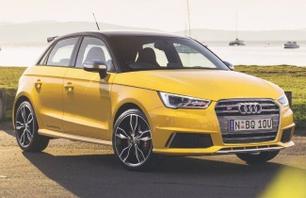
The A1 is so small it starts to strain Audi's design language. When you cram on the S-style bumpers and raccoon-eyed trim on the hatchback, it's starts to look a bit busy.
It isn't quite a shrink-wrapped A3 - Ingolstadt's designers know better than that - but it's full of Audi design cues, such as the strong, light-catching character lines, distinctive LED daytime running lights and fondness for big wheels.
Inside is along the themes of the A3, with what are becoming Audi's trademark; round eyeball air-con vents, the manual fold-down screen familiar to Q3 owners (but smaller) and a good clear dash. The handbrake jars slightly as it feels cheap to hold and wobbles a bit.
The S Sport seats are big and comfortable, and the top half of the backs are capped in plastic, which was colour-coded on our car. The rear passengers will certainly get an eyeful of whatever terrifying hue you've chosen, so choose wisely.
Despite the five doors, the back seats are occasionals, like the Mini the A1 is gunning for, and the boot is very small, but okay for shopping for couples or singles.
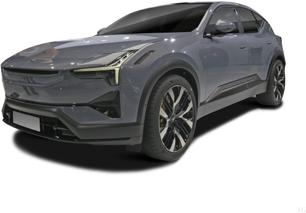
I think the Polestar 3 looks great – big, but not looming, and still somehow svelte enough to look sporty.
The brand takes a unique approach to marrying design and aerodynamics, with a lip at the edge of the bonnet that allows for airflow. But it doesn't look like a purely functional element.
Instead it accentuates what Volvo would call the 'Thor's Hammer' (but I think Polestar calls them 'Twin Blade') headlights, which are mirrored below with black venting.
In fact, looking at the 3 front-on is a bit like looking into a reflection in a crystal-clear lake, with the lighting signature perfectly reflected in the lower half of the front end.
If it sounds like I'm waxing lyrical, it's because I am. I think the Polestar 3 is among the best looking vehicles in its segment and one of the better looking SUVs, period.
Inside, though, it's a study in minimalism, which while very neat and tidy, makes it feel a little less luxe than you might expect from a vehicle at this price point. In fact, at a quick glance, it doesn't look that far removed from the relatively cheap-as-chips MG4's cabin.
The materials are thoughtful and lovely, though. Leather-like materials are used sparingly, replaced by what Polestar calls "Bio-Attributed MicroTech Charcoal with Repurposed Aluminium Deco". A far easier way to describe it, though, would be as reminiscent of a wetsuit.
Elsewhere, it's a fairly pared-back affair, with just the huge portrait-style central screen and the landscape driver screen grabbing your attention. Dig deeper, and there are some really nice, gentle details, like the ambient interior lighting that illuminates a little strip along the door panel, including the Bowers & Wilkins logo. A similar line of light spans the entire dash, too.
And I love the metallic-look panel along the dash which, one can only assume, is the 'Repurposed Aluminium Deco'.
Starting at $49,900, Audi S1 is by far the priciest of the small-hatch based hotties, at least until Mini's madcap JCW arrives. This price is just almost double that of VW stablemate's forthcoming 2015 Polo GTI.
Standard on the manual-and-five-door-only S1 is a ten speaker stereo, climate control, ambient lighting, remote central locking, cruise control, satnav, headlight washers, auto headlights with xenon low beams, partial leather seats, leather-bound steering wheel, auto wipers and rear parking sensors.
Our Misano Red ($990 option) came with two extra packs. The Quattro Exterior Package ($3990) adds bi-xenon headlights with red trim, red brake calipers, spoiler, quattro logos on rear doors (ahem!) and five-spoke 18-inch alloys that are part matt black, part polished.
The Quattro Interior Package ($2490) adds S Sport front seats with Nappa leather and red backrest capping with quattro logo (ugh), more nappa around the cabin with contrast stitching, flat bottom steering wheel and red rings on the air vents.
There's an S Performance Package that brings the best of these two packs together for $4990, saving about $1500 and the embarrassment of the quattro logos.
Our test car also had aluminium air vents ($220), black contrasting boot lid ($300) and black roof ($720).
The A1 is so small it starts to strain Audi's design language
The grand total is a sobering $58,610. There's a couple more options that'll easily pop you over $60,000.
Audi's MMI is dash-mounted in the A1 as there's no room on the narrow centre console. As ever, it works well and doesn't take much getting used to. The satnav is a bit grainy on the smaller screen but is otherwise a competent unit.
Sound is from a ten-speaker stereo and you can stream across Bluetooth or plug in a memory card. The sound was good but the system did take a while to find the phone whenever we came back to the car.
I'm going to get this out of the way early. I am a touch surprised with the pricing on the Polestar 3 range.
With Tesla having now stepped on a million metaphorical rakes, and with a leader now slightly less popular than actual skunk musk, the stage seemed set for a rival brand to steal its crown, and its customers.
But I can't see too many making the leap from the $60K-$70K Tesla Model Y to the $118,420 asking price of the admittedly bigger Polestar 3 Long Range Single Motor - which is the cheapest way into the brand's large SUV.
Instead, Polestar will be taking aim at brand's like BMW, Mercedes-Benz, Porsche and Cadillac, leaving its Chinese corporate cousins (think Zeekr and Geely) to chip away at Tesla's market share.
So, premium product, then. But do you get premium stuff?
Ours gets the 20-inch 'aero' alloys, but you can spec those up to 22-inch wheels if you don't like your spine very much, along with Brembo brakes. Plus there's is LED lighting all around, a big glass roof and retractable door handles.
Inside, the Long Range gets heated front seats, triple-zone climate control, wireless device charging, and a big 14.5-inch central screen with Apple CarPlay and Android Auto (run by Google built-in) joined by a second 9.0-inch driver information screen above the steering wheel.
Our car was also equipped with what Polestar calls the 'Plus Pack', a cool $9.0K on top, which adds things like a 25-speaker Bowers & Wilkins for Polestar stereo (replacing the standard 10-speaker set-up) , a head-up display, heating for the rear seats, steering wheel and wiper blades as well as soft-close doors.
The as-tested price for our car, by the way, is $131,640, before on-road costs.
This is where the action is. The S1's tiny body packs a 2.0-litre turbocharged four-cylinder producing 170kW and 370Nm of torque. The S1 will streak to 100km/h in 5.9 seconds thank to the traction aid of quattro all-wheel drive.
All Audi S1s come with a six-speed manual
Despite a pretty solid hammering during its week with us, including more time than we'd have liked in Sydney traffic, the stop-start function helped deliver a pretty reasonable 10.2L/100km, however that's a long way over claimed 7.1L/100km.
All Audi S1s come with a six-speed manual, so dual-clutch haters can save the whining. The only downside from not having a self-shifter is the ECU can't deliver the boy racer farts, parps and crackles of the other S cars.
The Long Range Single Motor tag hints at what's powering this Polestar 3, with a single, rear-axle mounted (so, rear-wheel drive) motor producing 220kW/490Nm and a fairly sedate sprint from zero to 100km/h of 7.8 seconds.
If you're buying the S1 as a comfortable urban runabout with a cool badge, you're half right. While the seating for front passengers is certainly supportive, the hard suspension tune will ensure you're well aware of road surface imperfections.
The S1 is a rocket
Thankfully, what it missed out on in the ride department it makes up for in every other way - the S1 is a rocket. The 2.0-litre turbo jammed under the bonnet has almost no lag and is paired with a slick six-speed manual that is terrific fun to manhandle through the gears.
The way the S1 picks up speed when it's on boost is addictive and licence-endangering. A flattened accelerator in second or third will obliterate just about anything this side of $100,000 and you'll be having more fun in this than big brother S3 because the chassis is more adjustable and there's a bit more life.
You can hear the turbo sing to accompany the bassy exhaust growl. Hit the massive brakes hard and the car remains stable even over rutted roads. Turning the wheel brings almost-instant turn-in, mashing the throttle again a fun little wriggle. It's superb.
It's tremendous fun point-to-point on a twisty road
You'll have to be a bit patient with the throttle to get the wriggle, though - give it too much too early and it will want to push wide, the quattro system shuffling power around to try and quell understeer while the electronic diff fiddles with the braking system to do the same thing. It gets there in the end, but you're better off meting out the power with your right foot for maximum rewards.
It's tremendous fun point-to-point on a twisty road - despite being a bit heavy for its size (1415kg), it's as chuckable as the next best thing, the Fiesta ST.
The Polestar 3 is that rarest of beasts – a big and sumptuous SUV that's genuinely engaging to drive.
This is going to sound odd given we're talking about 2.5-tonnes of Swedish metal but I reckon the fact it's not lightning-fast makes it more fun to drive. It somehow (and yes, this is a crazy thing to say) gives off Mazda MX-5 vibes, in the sense that, while some EVs feel utterly scientific in the way they accumulate speed, this rear-drive Polestar feels fun, perky and like you're actually driving it.
Don't get me wrong, there's more than enough power on offer here to get the 3 up and moving, especially the way it accelerates from low to mid speeds, but it's more than powerful enough to feel like you can push it a little bit harder without risking a visit to the undertaker.
The ride is good, too, leaning into its sporty nature without vibrating your eyeballs through suspensions stiffness, and the steering is direct and predictable. Speaking of which, you can dial up the sportiness of the accelerator (responsiveness) and steering (weight), too.
I also like the three-stage brake regeneration (off, medium and full 'one-pedal' driving) accessed through a permanent button at the base of the screen, and I prefer that it isn't as brutal as it can be in other vehicles. The cabin is also impressively quiet, though how much of that is owing to the Plus Pack's upgraded stereo arriving with active noise cancellation is a mystery.
There is no shortage of weight on board, though, and get too aggressive with the steering wheel and you'll get that disconcerting top-heavy tipping feeling so common with big SUVs.
I'm not convinced by the Polestar 3's software, either, with a couple of weird warnings popping up during my time with the car. The first warned that the driver assistance systems had failed, and told me to book a service, and the second even weirder issue is it liked to warn me there was "no valid key detected" despite it being in the centre console, and that "restart would not be possible".
Neither warning seemed accurate, to be fair, as the safety one went away on its own after a while and I had no problem starting the car.
Six airbags, stability and traction control, ABS, brake assist and distribution all add up to a five star ANCAP rating.
The Polestar 3's safety story is a good one, and it begins with nine airbags covering all seating rows. The grille of the 3 is home to what the brand calls its 'SmartZone', which is where it hides the cameras, sensors and radars necessary for its AEB (with cyclist and pedestrian detection), cross-traffic alert with braking, blind spot alert with steer assist, lane departure warning and assist and active cruise control. The list goes on and on.
In the cabin, two infrared cameras monitor the driver, while four motion-sensing radars scan the rest of the interior for left-behind pets or children.
It scored the full five stars in Euro NCAP testing, and scored the highest child occupant protection rating of any passenger car tested by Euro NCAP in nine years.