What's the difference?
The Audi A4 allroad is the off-roader of the A4 line-up. I’m using the term ‘off-roader’ loosely here because this wagon is obviously best suited to daily duties in a city and suburbs, with perhaps an occasional foray into very light off-roading, i.e. driving on a well-maintained gravel or dirt road with few, if any, corrugations, and in dry weather only.
But that’s not a negative factor because the great thing about adventures is that they can be scaled to suit you, your lifestyle and your vehicle of choice.
However, is this allroad your best option for a comfortable, nice-driving all-rounder? Read on.
It’s big, it’s fast, it’s luxurious, Volkswagen’s Touareg has always been a stand-out large SUV.
This one, the full-fat R is the latest take on the halo Volkswagen model. It has big shoes to fill.
See, top-spec Touaregs in the past are hardly rivals to the Toyota LandCruisers and Hyundai Palisades of this world. They’re a different breed, with the first-generation Touareg powered by a variety of engines up to a 5.0-litre turbo-diesel V10, and the second-gen version packing petrol and diesel V8s in its upper levels.
They were the ultimate sleeper family SUV, ridiculous engines with rich VW Group lineage in a seemingly mainstream family-friendly package.
But this third-generation version can’t quite replicate the over-engined craziness of its predecessors. It has to think outside the box as emissions regulations crack down the world over.
This Touareg R is a plug-in hybrid. A performance-focused one at that. Can it hope to replicate the unhinged nature of its forebears and find an appropriate place atop the hierarchy of Volkswagen’s R models? Let’s find out.
The Audi A4 allroad 40 TDI quattro S Tronic is a nice-looking wagon that’s fun to drive.
It’s packed with tech, adequately functional for daily life and it’s also capable enough off-road as long as the driving surface is nothing more challenging than well-maintained gravel or dirt tracks in dry weather, and you’re not planning a rough-and-tumble expedition into remote bushland.
As I mentioned earlier, the great thing about adventures is that you can scale them to suit you and your vehicle and the allroad offers a nice stepping-stone for people who’d like to experience the outdoorsy lifestyle, before perhaps diving deeper into it.
A car as impressive as it is frustrating, the Touareg R is a vehicle for a very specific buyer. Someone whose daily commute consists of limited distances, someone who can always charge at home overnight and someone who appreciates the subtlety of the performance and luxury the Touareg brings.
For everyone else - there are better options. Performance-focused PHEVs can be tricky to charge and extract the full benefit from, and at this price you have access to some serious performance-oriented combustion SUVs or the choice of going fully electric.
While this R-badged VW might be the most mind-bending of the lot then, it also has the most 'specific' appeal.
The allroad’s overall look is part of a range-wide refresh and it certainly fits in with the line-up’s updated aesthetic.
Because I’m a bloke who spends the bulk of my time in 4WDs – traditionally bulkier vehicles rather than slim city-friendly wagons – I’m not totally enamoured of the Audi’s style, especially in terms of trip-packing practicality. However, I can certainly appreciate the appeal of its quite low, sleek and streamlined appearance, which its tweaked chunkier grille adds some gravitas to. It’s just not my cup o’ tea.
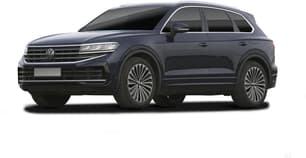
The Touareg, as always, screams big Volkswagen. It’s more subtle than the Porsche Cayenne and Audi Q7 with which it shares its underpinnings, yet looks as slick as either up close.
It’s defined in its face by a massive black grille, integrated light fittings, and as usual with Volkswagen, some pretty subtle highlights and tail-lights in attractive LED patterns.
The wheels sell the vibe of an R. They’re enormous and gloss black, matching the theme and style of its smaller siblings, black highlight trims replace chrome or body colour bits to set it apart from the rest of the range.
It doesn’t look quite as modern as something like Kia’s Sorento or EV9, and it doesn’t look as elegant as the Volvo XC90 or as defined as the Land Rover Defender, all in the same price bracket.
This helps the Touareg maintain a certain mainstream appeal, and a sporty edge, without being too egregious.
Still, some might want some more overt visual flourish to indicate they’re driving a vehicle which is capable of sprinting to 100km/h from a standstill in 5.1 seconds.
Perhaps I’m in a different camp, one which appreciates the ‘sleeper’ nature of a giant family SUV capable of incredible driving feats when pushed.
Inside is always a pleasant surprise in a Touareg. While it might be the most affordable of the giant SUVs on this platform, it maintains the air of luxury and plush nature of its more expensive counterparts from Audi and Porsche.
You’re met by nicely trimmed leather seats and a chunky VW R steering wheel, massive screens and lavish amounts of padded leather surfaces everywhere. It feels every bit the luxury SUV the price indicates, in case you were worried you’d be getting something which feels more like a T-Roc than an Audi. For what it’s worth I quite like all the Volkswagen switchgear.
I’ll answer that question as a politician would – without actually answering the question.
The allroad’s interior looks good and certainly feels open and spacious, although the driver’s seat tends to feel a bit more snug as the dash is angled towards that position.
The new 10.1-inch touchscreen, home for most upfront functions, dominates the dash, in a good way.
The front seats are electrically adjustable with lumbar and driver memory.
There are plenty of places in which to put your everyday bits and pieces (including a decent storage bin/arm-rest), as well as charging points, including two USB ports, for your devices.
Need somewhere to put a cold beverage, mate? There are two cup-holders between driver and front-seat passenger, two in the fold-down centre arm-rest for the back-seat passengers, and bottle holders in all doors.
Back-seat passengers also get air vents, climate control, mesh seat-back pockets and grab handles.
There is a 495-litre cargo space when the rear seats are in use, but that increases to 1495 litres when those seats – 40:20:40 split folding – are stowed away in the floor.
It’s a big SUV with big interior dimensions. It feels spacious and wide on the inside with a large centre console area for spreading out and a highly adjustable driver’s seat.
The seats are plush and comfortable, and visibility is pretty solid out of the cabin. Again, you're greeted by excellent touchpoints, from the steering wheel to the door cards and there’s even lashings of padded leather trim down the sides of the centre console for your knee to rest on.
Volkswagen’s screens are usually some of the best in the business and that continues here. They’re bright, sharp and served up with attractive and mostly functional and easy-to-navigate software.
The hardware behind them is also enough to keep them lightning fast when reacting to inputs, with satisfyingly smooth animations, too.
The one thing I like a bit less is how a few of the menus can be confounding. It took me a while to figure out I needed to set the default battery level higher than its current charge to get the engine to stay on, and I’d also love a button to simply switch between EV and hybrid mode.
In fact, the lack of buttons is one of the major issues in this car. Sure, the enormous centre screen is an impressive feature, syncing up with the dash design nicely, but you’re also forced to negotiate with touch elements for key climate functions. No matter how fast or slick the software is, there’s no compensating for a toggle or dial you can easily reach while you’re focused on the road.
For what it’s worth, the wireless Apple CarPlay worked seamlessly with the car in my time with it (and looked good too) while the wireless charger is rubberised and in a good location so your phone will be able to at least maintain its state of charge on the go.
Storage is plentiful up front, with large pockets with integrated bottle holders in each door, a large dual cupholder set-up in the centre console with variable edges and a large armrest console box.
In the back seat I have enough room for myself behind my own driving position at 182cm tall. It’s plenty wide and tall, but I don’t feel as though I had an enormous amount of legroom considering the size of the vehicle.
Still, the width will give you space for three adults across in relative comfort. Yes, there’s a large raise in the floor in the centre position to accommodate the all-wheel drive hardware underneath, but the width of the floor should allow a centre passenger to put their feet on either side.
Big door openings and the wide cabin make for easy child seat fitting, and there's even built-in window shades alongside two rear climate zones with physical controls, large bottle holders in the doors and a drop-down armrest, with some flimsy nets on the backs of the front seats to round things out.
Boot space is allegedly enormous at a quoted 810 litres, but the shape of it is less than ideal. Sure it’s nice and wide and oblong shaped at the base, but the rake of the boot quickly eats into the amount of height available, making it tricky to fit larger objects.
The space accommodated our CarsGuide three-piece luggage set with ease, but it didn’t leave much room to spare. It doesn’t feel like it’s double the 400 litre space typical of a one size-down SUV.
There’s also a needlessly complex two-piece shelf, which lifts with the tailgate, but the boot wouldn’t completely close with the luggage set present unless you removed it. To the Touareg’s credit, the second row seats hinge forward significantly to expand space by a fair bit.
Under the floor there’s only a repair kit, as the huge PHEV battery takes up the rest of the space. A decidedly less than ideal flat tyre option.
The Audi A4 allroad 40 TDI quattro S Tronic has a MSRP of $69,900 (plus on-road costs).
It has a 2.0-litre four-cylinder turbo-diesel engine unit (140kW/400Nm), a seven-speed S tronic automatic transmission, and Audi’s quattro all-wheel drive system.
In standard guise this allroad’s features list includes a new 10.1-inch touchscreen (with Apple CarPlay and Android Auto), DAB+ digital radio, an Audi 10-speaker stereo, wireless charging for Qi-enabled smartphones, Audi’s Virtual Cockpit (a 12.3-inch digital display), smart key with push-button start, leather trim, three-zone climate control, as well as LED headlights, 18-inch alloy wheels, illuminated door sills, and overall tweaked exterior and interior styling.
It also has AEB with pedestrian detect, lane change warning, rear cross-traffic alert, front and rear parking sensors and a reversing camera.
But our test vehicle has a few different features and a fair few extras. Our allroad has a ‘price as tested’ of $75,681 (plus on-road costs), because it has Assistance plus package ($2900), which includes a raft of driver-assist tech, such as adaptive cruise control, active lane assist, collision avoidance assist, high beam assist, head up display, park assist (helps to steer the vehicle into a parallel or perpendicular parking space), as well as a 360-degree-view cameras
It also has 19-inch Audi sport alloy wheels in 10-Y-spoke design ($1350), instead of the standard 18-inch alloy wheels in 5-V-spoke design, and metallic paint (Mahattan grey, $1531).
Note: when we were conducting this test, Audi announced that, among other things, it would release a new-gen A4 allroad quattro 40 TDI in early 2021 that would have an extra 10kW more than our test vehicle, so it’ll be a 150kW/450Nm machine.
For those of you into hot laps, the current-generation achieves 0-100km/h times of 7.9 seconds; the new A4 allroad quattro 40 TDI is claimed to achieve that mark in 7.3 seconds.
Pricing for the upcoming 150kW A4 allroad quattro 40 TDI as standard was set to be $70,700.
Is the Touareg R good value? Seems like a silly question doesn’t it?
One school of thought says, of course it isn’t. Nobody needs a giant $129,990 (before on-road costs) SUV which is this fast. What the halo Touareg variant has always offered is excess with a modest exterior wrapper.
On the other hand, the Touareg R is great value when you consider you’re getting much the same hardware as a Porsche Cayenne S E-Hybrid ($188,600) with a Volkswagen badge.
In its size and price-bracket, the Touareg R directly rivals the Land Rover Defender 110 PHEV ($126,184), Lexus RX HEV ($127,434), Range Rover Velar PHEV ($131,536) and Volvo XC90 Ultra T8 PHEV ($128,390).
I see two problems with this. Firstly, all of those price rivals are premium brands, and secondly, at the circa-$130K price-tag there’s also the awkward reality you could be choosing one of a few very appealing fully-electric options, from the Kia EV9 GT-Line ($121,000), to the Polestar 3 ($131,054), Mercedes-Benz EQE ($134,900) and BMW iX ($136,900).
So, it’s great value from one perspective, but not so much from a few others. Then again, this is the biggest, baddest Volkswagen you can currently buy, so whether you’re in the market for an R-badged car or a PHEV of this size, you’re likely familiar with a six-figure price-tag.
Do you at least score good equipment for the money? Aside from all the complex drivetrain hardware, this VW is an impressive place to be, with extensive plush leather interior trim in the seats and doors, power adjust for the front two positions with heating and ventilation, a 12.0-inch digital dash with Volkswagen’s slick-as-ever digital cockpit software, a head-up display, a massive 15.0-inch multimedia touchscreen (with wireless Apple CarPlay and Android Auto), matching wireless phone charger and quad-zone climate control.
Outside, there’s the brand’s signature matrix LED headlights, massive gloss black 22-inch alloy wheels, enormous ventilated disc brakes and a sports exhaust with air suspension hiding below.
It’s a lot of kit for a mainstream SUV, and performance, which we’ll talk about later, is impressive (with a few caveats).
The Audi A4 all road 40 TDI quattro S Tronic has a 2.0-litre, four-cylinder turbo-diesel engine, producing 140kw at 3800-4200rpm and 400Nm at 1750-3000rpm.
It has a seven-speed S tronic automatic transmission and all wheel drive.
The Touareg offers a performance-focused plug-in hybrid (PHEV) drivetrain. Usually this means a little turbo four-cylinder engine and an electric motor, but instead this big SUV offers a 100kW electric motor and a 3.0-litre V6 turbo-petrol engine which combine for a whomping “total system power” of 340kW/700Nm.
This allows a 0-100km/h sprint time of just 5.1 seconds. Power is sent to all four wheels via an eight-speed automatic transmission and Torsen central differential. Up to 70 per cent of power can be sent to the front wheels, with up to 80 per cent of power going to the rear.
It is capable of driving at up to 135km/h under electric power alone, with the V6 kicking in beyond that speed.
It’s a rare set-up for two reasons. Firstly, it’s a plug in which maintains a large six-cylinder engine, and it runs even electric power through the transmission to all four wheels.
Some PHEV rivals, for example, use front combustion-drive only with no mechanical connection between the engine and the rear axle, which is driven purely electrically.
When it comes to towing specs, the Touareg offers solid official figures of 750kg for an unbraked trailer and 3500kg braked, although the maximum towball download is 220kg.
It has claimed fuel consumption of 5.2L/100km (combined), but we recorded actual fuel consumption on test of 8.4L/100km – driving in soft sand likely negatively impacted that figure.
It has a 61-litre fuel tank.
Like other plug-in hybrids, the official combined (urban/extra-urban) cycle fuel efficiency number for the Touareg R is an eyebrow-raisingly low figure which you know won’t be achievable in the real world, but is probably technically feasible in lab-style conditions.
In this case, it’s 3.3L/100km. When I picked up the car it had a low charge level, and the next day I was able to top it up to just 50 per cent because I don’t have a power point in my garage, and the achingly slow 3.6kW maximum AC charging speed is severely limiting if you need to rely on the public network, as the 17.9kWh battery is relatively large.
This should bring you to the obvious conclusion the Touareg R is not a good hybrid if you can’t charge at home, as you’ll never extract the full benefit of the electric set-up. Perhaps adding evidence to this is its official energy consumption which comes in at a painful 21.1kWh/100km.
As for hydrocarbons, in my week of driving (in which I tried to pick up charge wherever I could) I saw over 14L/100km. Makes sense for a heavy petrol V6 SUV. I’d say you’re likely to see a figure like this on a longer journey or if you drive it with enthusiasm as the R badge encourages. To add additional pain, it requires 98RON premium unleaded fuel.
With a realistic maximum pure-electric range of closer to 40km compared to the official WLTP-rated 51km (more on this in the driving section of the review), the R is also best for people whose daily commute is relatively short.
I can’t imagine, for example, the best benefit of this car will be extracted from someone who lives in the urban sprawl and commutes to the city every day with distances in excess of 50km for a return journey.
Additionally, the hybrid mode is very EV-heavy, draining the battery relatively quickly unless you manually put it in preservation mode.
For nerds who could be bothered, this mode is potentially a nifty feature allowing retention of some EV range at the end of a long freeway journey. But it takes a certain buyer to even be bothered with this.
Can you see why plug-less hybrids are the Australian new car buyer’s electrification configuration of choice?
For a bloke who spends a lot of time in big, tall and bulky 4WDs, I felt like I was driving a go-kart. It’s that low, but it’s also that much fun – and it’s a very different driving experience to what I’m used to.
The allroad is 4762mm long, 1847mm wide and 1430mm high, and has a listed kerb weight of 1720kg. So relative to the 4WDs I usually steer around, this is light and low slung. It’s more car than SUV, that’s for sure.
Acceleration is rather punchy (the engine and auto are a decent match-up), steering is light but precise, and you can cycle through drive modes (efficiency, comfort, auto etc) to set up vehicle characteristics to suit your driving style and conditions.
The quattro all-wheel drive system helps to keep the allroad planted and composed at all times.
Ride is on the sharpish side of firm and you do tend to feel every irregularity in the road surface – it is long and low and on low-profile rubber afterall.
The virtual cockpit plus – a 12.3-inch high-resolution colour display – offers a comprehensive read on all things to do with the allroad.
Throw around your superlative of choice – “sporty” and “dynamic” fit this allroad well – but I’m loathe to gush about its on-road performance much more than that because I reckon if any motoring journos are reading this – many of whom spend the lion’s share of their time swanning about in sports cars – they would have already choke-spat out their dirty chai with surprise by now.
Here’s where things get a bit frustrating, and your experience will vary dramatically depending on how you use this car.
One thing we can get out of the way immediately is the Touareg is deeply technically impressive when you attack a few corners. Its immediate electric thrust is capable of propelling this large object forward with eye-widening speed, and the air suspension, wide grippy tyres, Torsen centre differential and tidy steering tune conspire to make it mind-bending to carve corners in.
It’s flat, stable, and far more accurate and agile than expected. The only hint as to the sheer physics of wrangling the Touareg around bends is the tyres screaming out in agony as the suspension and all-wheel drive system work their magic to keep it all under control.
Once the electric torque pushes you out from the corner, the deep satisfying thrum of the 3.0-litre petrol V6 quickly takes over as you lurch forward on the almost fluid-feeling suspension. It’s laugh-out-loud satisfying and certainly enough to capture passengers' attention.
In this sense, the R fulfils its mission of transforming the big Touareg into a handling and acceleration hero, but despite all the cleverness it doesn’t feel as sharp or lean as the Golf R, T-Roc R or Tiguan R.
There’s still a massive battery, as well as huge complexity and weight to deal with, no matter how technically fast it is. There’s always the unsettling feeling of this amount of weight moving around, and the occasional slight delay from the transmission as it figures out what’s going on between the electric motor and big engine.
Then there are the compromises. Normally, I’m a huge fan of how plush and luxurious the Touareg feels. It’s usually such a step above its station in the VW Group, occasionally even feeling preferable to its platform relations, but the R has some issues.
For a start, the enormous 22-inch wheels and low-profile tyres ruin the day-to-day ride quality, crashing over bumps and road imperfections, despite the fact there’s also air suspension supposedly providing a buffer between you and the tarmac.
Even in the more comfort-oriented drive settings you can hear and feel every bit the moment the wheels contact a pothole or bump. Clearly, it’s tuned more toward handling than maintaining the same luxury feel as the rest of the range.
The transmission is also occasionally hesitant, either from a standing start or when switching between electric thrust and the engine. This is much better when the battery is charged up from the reserve level, as there isn’t enough charge when driving around as a hybrid to push a big, heavy (and always) all-wheel drive very far.
But hybrid driving is also frustrating, for reasons mainly related to the software. With the battery charged, the 51km of claimed driving range feels a tad ambitious. I was able to charge it to about 50 per cent (the battery is huge, at 17.9kWh, and I could only pull about 3.5kW from a local AC charging unit) and scored about 20km of driving range.
It drains quickly, even in the hybrid driving mode, as it relies on the electric motor a lot for initial take-off.
This means unless you set the battery preserve mode manually in the hybrid settings screen, it will likely run the battery dry before you’re even able to get it somewhere where it can take full advantage of the extra electric thrust.
As an electric vehicle it’s also only alright. The short time I was able to spend in full EV mode proved the battery will drain faster than advertised, and the regen is so-so for assisting in braking.
Other more performance-focused PHEVs suffer the same issue. For example, I felt largely the same way about the much-maligned four-cylinder PHEV Mercedes-AMG C63.
While hybrids like this may be impressive when conditions are ideal, they’re ultimately frustrating to use in reality. It’s a shame, because I wanted to like it more but it doesn’t quite capture the same magic of its R-badged forebears and siblings.
The Audi A4 all road 40 TDI quattro S Tronic has the maximum five-star ANCAP safety rating.
It has eight airbags (dual front, front side, side bags front and rear, and curtains front and rear), as well as AEB with pedestrian detection, lane change warning, rear cross-traffic alert, a reversing camera, and front and rear parking sensors.
All of the safety kit is standard and present on the Touareg R, including autobahn-speed auto emergency braking, lane keep assist with lane departure warning, front and rear cross-traffic alert, blind spot monitoring, road sign recognition, driver fatigue detection, a surround view camera and adaptive cruise control.
The best part is these systems not only work, but they’re well calibrated so they generally don’t interfere with the core driving experience.
Additionally, the Touareg has a suite of eight airbags and maintains a maximum five-star ANCAP safety rating achieved in 2018.
This Audi has a three-year/unlimited km warranty. Service intervals are recommended every 12 months or 15,000 km, whichever comes first.
The standard five year, unlimited kilometre warranty features with one year of complimentary roadside assistance provided (renewed for another year with each service at an authorised dealer).
Servicing is required once every 12 months or 15,000km and the most affordable way to do it is with pre-packaged service plans bundled in with purchase. These come in at $3400 for five years (a saving of $668 over the a-la-carte program) or $2050 for the three year plan (a saving of $222).
Even in its most affordable form this makes servicing average $680 a year which is a far cry from most affordable brands, but it could be worse considering the complexity of the powertrain.