What's the difference?
Even though it’s expected to be superseded by a sixth-generation model next year, we're reviewing the fifth-gen Toyota RAV4 Hybrid Cruiser 2WD model to see if its hybrid powertrain and features still secures its position as top-selling medium SUV for families.
Aussies love mid-size SUVs in part because they're a tad more practical than their larger cousins, especially in the city.
You also have a better chance of fitting one inside your garage (unless you use your garage for storage, like me).
Among the many strange new car brands and names we're increasingly confronted with Subaru is an established and trusted beacon along with Honda, Hyundai, Mazda and Toyota. And Subaru’s Crosstrek SUV competes against rivals such as the Honda HR-V, Hyundai Kona, Mazda CX-30 and Toyota Corolla Cross.
So, what does the Crosstrek give you for your money and what’s different or better about the Crosstrek compared to those rivals?
We tested the mid-grade Crosstrek 2.0S and rediscovered what this small SUV does so well and what could probably be improved.
The Toyota RAV4 Cruiser Hybrid 2WD model reaffirms why the RAV4 is so popular in Australia. It offers families space, convenience and features in a well-priced and handsome package. The cabin noise might be an ick for some but for everything else this model offers it could be overlooked.
The Crosstrek is good to drive with great ground clearance and an excellent all-wheel drive system for light off-road adventures. I’m also a fan of the styling and features for the money. But The letdowns comes in the form of limited boot space and cabin storage, a short warranty and pricey servicing. Still, it’s great to see Subaru has updated the car's safety systems, the most important part of any car.
In anticipation of the next-gen model, there hasn't been any design changes for the RAV4 - it remains a good-looking family SUV despite being a little heavy-handed with its angles.
Some external design highlights include garage friendly dimensions and a host of black accents across the body, including 18-inch alloy wheels that help to create an edgy kerb-side appeal.
Head inside and the RAV4 Cruiser offers a premium cabin-feel with its leather upholstery and large tech screens that headline the dashboard.
As always, there is a sense that design is based on functionality rather than style, which is typical of Toyota, but the simplicity makes the cabin relaxing to be in.
You’re not overwhelmed by touchpads or gadgets as can be the case in other new cars and there is a certain charm about that.
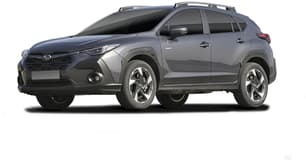
While SUVs tend to come in either a tall and boxy or coupe-like shape, the Crosstrek has a uniquely sleek and sporty wagon look that has stayed much the same over three generations.
Also while the Crosstrek competes with the Honda HR-V, Hyundai Kona, Mazda CX-30 and Toyota Corolla Cross the Subaru is the most off-road suitable thanks in part to its high 220mm ground clearance
As if to signal those adventurous aspirations the Crosstrek has a more rugged appearance with robust-looking plastic guards and chunky roof rails.
Inside the Crosstrek looks so much the same as most other new Subarus it's hard to work out which one you’re in. The materials are dark and soft, there is not much in the way of glitzy trimmings but there’s a high quality feeling throughout.
The RAV4 continues to impress with its practicality.
Access and comfort for both rows is excellent. The heat and cool functions for the front seats are perfect for all seasons and the two-position memory function on the driver’s side is handy if you often share driving duties with your partner.
The rear row seating is well-padded and middle seaters will love the legroom the lower transmission tunnel offers. Head- and legroom is good in both rows, even for taller adults.
Amenities and storage are also great throughout the car.
Front rowers enjoy a decently sized middle console which I can squeeze my small handbag into, a glove box, two cupholders, two drink bottle holders, a phone tray and two shelves in the dashboard. You also get a sunglasses holder!
In the rear you get a single map pocket, two cupholders and two drink bottle holders, which is enough for my little family of three.
In terms of technology, you get a bunch and the usability is great.
The 10.5-inch touchscreen multimedia system looks really nice and is now the same system that Lexus uses, which is a big plus as it’s much easier to use than the previous Toyota one. The next-gen model should see this upgraded to a 12.3-inch system, which is more in line with its rivals.
You also get built-in satellite navigation, wireless Apple CarPlay and wired Android Auto. CarPlay maintains a strong connection.
There's a multitude of charging options throughout, including a USB-A port, four USB-C ports, a 12-volt socket and a wireless charging pad.
Rounding out the cabin is a boot that offers plenty of space with its 580L capacity and you get a temporary spare tyre, as well as, a retractable cargo cover.
However, the quality of the cargo cover isn't the best and it would be easier to use if it had a handle to grip onto.
The Cruiser model comes with a powered tailgate, which is always handy but the 'warning' alert as it opens or descends is very loud. Truck-reversing-beeping loud. Everyone will know when you open the boot!
The Crosstrek is a small SUV but its low and sleek shape doesn’t do it any practicality favours in terms of exiting and entering or storage in the boot.
Boot capacity is 291 litres which is very small compared to its rivals which have capacities closer to 350 or 400 litres.
People space inside, however, is good, and even for a tall (189cm) person like me there’s plenty of space up front and behind my driving position.
Storage space is passable with three cupholders and thin door pockets and a decent-size console bin.
Given the Crosstrek’s adventurous intent, the cabin should be more reflective of that rugged aspiration.
The model line-up for the RAV4 consists of five variants with each available in front- or all-wheel drive.
The model on test for this review is the Hybrid Cruiser 2WD, which sits second-from-the-top in the line-up and is priced from $51,410 MSRP.
This price tag nudges it to the top of its rivals, the GWM Haval H6 Ultra Hybrid ($45,990 MSRP) and Nissan X-Trail e-Power ST-L ($50,490 MSRP) but the standard equipment for the Cruiser highlights its overall good value.
Premium features include leather-appointed upholstery, electric front seats with heat and ventilation functions, two-position memory function for the driver's seat, a sunroof and carpet mats.
Technology has had a good look in recently with the 10.5-inch touchscreen multimedia system now powered by the Lexus system (much easier to use) and a customisable 12.3-inch digital instrument cluster.
Other tech includes built-in satellite navigation, a nine-speaker JBL sound system, USB-A port, four USB-C ports, a 12-volt socket, a wireless charging pad, digital radio, digital rear view mirror, and a 'Toyota Connect' app with over-the-air updates.
Practical items include keyless entry and start, rain-sensing wipers, dusk-sensing LED headlights, dual-zone climate control, a powered tailgate and directional air-vents in the rear.
For the grade level and compared to its rivals, the Cruiser more than holds its own.
The Crosstrek range is divided into three petrol variants and two hybrids. With a list price of $43,990, our test Crosstrek 2.0S sits at the top of the petrols and second from the top of the line-up under the Crosstrek AWD Hybrid S flagship.
Standard features on our 2.0S include 18-in alloy wheels, roof rails, LED headlights and tail-lights, dual-zone climate control, push-button start, proximity unlocking , 10-speaker audio, wireless phone charging, Apple CarPlay and Android Auto, an 11.6-inch media touchscreen and leather-trimmed seats.
If you’re looking to save a few thousand dollars the 2.0R is almost as well equipped.
Is it worth stepping up to the hybrid? Not in my opinion. The hybrid is the 'mild' kind and doesn't offer a great deal in terms of real-world fuel savings. You can read more on fuel efficiency below.
All RAV4 models have a continuously variable automatic transmission and the same hybrid combination of a 2.5L four-cylinder petrol engine and electric motor which combine to produce up to 160kW of power and 221Nm of torque for front-wheel-drive models.
The combo delivers decent power for an SUV of this size.
The Crosstrek 2.0S uses a 2.0-litre, four-cylinder, horizontally-opposed 'boxer' petrol engine which makes 115kW and 196Nm. A continuously variable transmission (CVT) with eight 'speeds’ isn’t the most exhilarating automatic but all Subaru now use CVTs.
The boxer engine has advantageous in terms of a lower centre of mass and helps deliver better driving feel thanks to more adept handling. Boxer engines also sound better to my ears with their throaty burble.
The Toyota hybrid powertrain produces the lowest official combined fuel cycle figure compared to its rivals at just 4.7L/100km and the best theoretical driving range of up to 1170km courtesy of its 55L fuel tank.
After covering a mix of open-road and urban driving this week, the on-test figure is 5.5L/100km, which proves Toyota does hybrids well.
The Crosstrek 2.0S's combined cycle (urban/extra-urban) fuel consumption is 7.2L/100km which aligns closely with our real-world test average of 8.7L/100km returned over mainly urban and city driving. That’s not bad, but given the price of fuel as well as the availability of EVs and excellent hybrids from other brands the Crosstrek is seriously behind the times.
Yes, yes, there is a hybrid Crosstrek, but it’s a mild-hybrid and the electric motor doesn't drive the wheels and doesn’t save much fuel. The hybrid Crosstrek has a claimed combined cycle consumption figure of 6.5L/100km, so there’s not much difference between the efficiency of the two. When you consider the price premium you need to pay it’s not worth stepping up into the hybrid.
The RAV4 Hybrid Cruiser 2WD is stupidly easy to drive which is one of its best qualities.
The driver is front and centre for design, so you don’t have to take your eyes off the road to twiddle with climate controls or changing your music. That makes the driving feel… well, cruisy.
Power delivery is mostly smooth and offers decent punch when you need to put your foot down. However, it can be laggy off the mark from a cold-start, so take care when crossing traffic.
Suspension feels well-tuned for our Aussie roads, even the regional ones, but never feels floaty. This is well-grounded but you do get some roll in corners.
A drawback is the cabin is annoyingly loud once you hit the open-road and there is a wind-whistle near the driver that drove me nuts.
There are also a lot of squeaky/rubbing noises when you hit bumpy roads. However, it is a refined experience around town, when engine noise is all but nil. The urban environment is where it shines.
The steering is direct with a tight 11.4m turning circle, which makes the RAV4 easy to park. It also helps that the 360-degree view camera set-up is top-notch, which is not always the case for Toyota, and you get front and rear parking sensors too.
I’ve never met a new Subaru that wasn’t good to drive, apart from that time a friend sent me his 30-year old Brumby minus brakes. But even that was fun, until it was time to stop… Anyway, in my view the Crosstrek is better than its rivals in multiple areas except one, which I’ll get to in a moment.
The Crosstrek 2.0S is comfortable to sit in and its ride and handling balance is exceptional for a vehicle in this class. Honestly, the ride quality, body control and steering outshines the HR-V, Kona, CX-30 and Corolla Cross in my view.
A big call out has to go to the Crosstrek's all-wheel drive system, which is exceptional. I have tested this vehicle in some pretty adventurous settings and the kind of terrain it can devour would frighten its rivals.
But the one area that lets the experience down is the CVT auto. I feel this way about this type of transmission in any car and I’m not alone. CVTs provide smooth acceleration and deceleration but if you’re hoping for an engaging, sporty experience you’ll be left wanting.
That said, my wife also drove the car and thought it was perfect for city traffic. And I agree, it’s just on the motorway where you might notice the lack of oomph when overtaking.
Visibility is good and you sit quite high for a little SUV. That small size makes it easy to park and manage in the city’s tighter spaces.
The RAV4 has a maximum five-star ANCAP rating from testing done in 2019 and has seven-airbags but doesn’t have a front-centre airbag yet.
It has high individual scores for protection, scoring 93 per cent for adult, 89 per cent for child, 85 per cent for vulnerable road-user, and 83 per cent for its safety assist systems.
The RAV4 has AEB with car, pedestrian and cyclist functions, operational from 10-80km/h (180km/h for car) but it is usual to see the system operational from 5.0km/h.
Standard crash-avoidance safety kit includes blind-spot monitoring, an SOS call button, emergency steering assist, driver attention alert, a rear occupant alert, rear and forward collision warning, rear cross-traffic alert and lane departure alert.
There's also lane keeping aid, traffic sign recognition, an intelligent seatbelt warning, adaptive cruise control with stop/go functionality, a 360-degree view camera system as well as front and rear parking sensors.
You also get a digital rear view mirror, which is great when you have compromised vision out the back window.
There are ISOFIX child seat mounts and three top tethers in the rear row. You might be able to get three seats across but two will fit best.
Part of the reason we're testing the Crosstrek is because it was updated with more safety tech and equipment towards the end of last year. This safety boost means the Crosstrek continues to boast a maximum five-star ANCAP rating.
The big change was to the 'Eyesight' sensor system with better traffic sign recognition and enhanced AEB systems. An emergency vehicle stop system has also been added to bring the car to a halt if the driver becomes unresponsive.
The rest of the Crosstrek’s features carry over including AEB, lane-keeping assistance, front and rear cross-traffic alert (with braking) and blind-spot warning.
For child seats there are two ISOFIX points and three top tether anchor mounts across the second row.
There is a spare where but it's a temporary type which will get you to a repair place.
The RAV4 is offered with a five-year/unlimited km warranty, but you add two more years if you service exclusively with Toyota and on schedule.
There is a five-year capped-priced servicing program and it costs just $260 per service, which is very competitive for the class.
Servicing intervals are reasonable at every 12-months or 15,000km whichever occurs first.
Subaru’s five year united kilometre warranty is becoming less appealing as other brands offer seven or even 10 years of coverage.
Servicing is recommended every 12 months/15,000km and a capped schedule is pricey relative to its competitors at more than $2400 over five years or about $400 on average per service.
The brand is represented by a long-established and stable network of close to 130 dealers covering metro, rural and regional locations across every state and territory.