What's the difference?
Toyota Australia is on the record as saying it doesn't want to push one form of electrification over another, and to that end wants the market to choose whether it wants hybrids, plug-ins, full battery or hydrogen vehicles.
While hybrid options have well and truly arrived in models like the RAV4, Corolla and Camry, and we’re all still waiting for the full-electric and plug-in vehicles, Toyota has now brought in its second-generation Mirai hydrogen FCEV.
But with Toyota, and Hyundai with its Nexo, the only brands pushing hydrogen into the mainstream, is it good enough to hold its own against battery electric models like the Tesla Model 3 and Nissan Leaf?
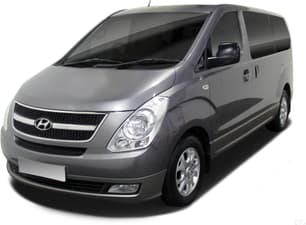
Hyundai’s contender in the under-$60,000 people mover segment boasts a heritage spanning a full decade. During that time it has built a loyal customer base that appreciates its spacious and airy eight-seater cabin, ease of driving, proven durability and five-year warranty.
Even so, the iMax and other well-established people movers are getting clobbered by Hyundai’s sister company Kia and its widely acclaimed Carnival, which with four model grades across a broad pricing spectrum currently boasts a dominant market share of more than 50 per cent.
There are numerous reasons for the Carnival’s popularity but that should not stop a potential buyer from also giving the iMax serious consideration. Its most recent upgrade to Series II specification in 2016 brought styling revisions and new features which made a good people mover even better.
Believe it or not, the Mirai represents a pretty big gamble for Toyota, a company who has been known in the past for being relative conservative with its vehicles.
In recent years though, with models like the GR Yaris and even the RAV4 Hybrid, it seems like Toyota is more willing to go out and take a chance on something that would not be considered a safe bet.
The Mirai represents this willingness to experiment, but it is still too early to say whether it will a winner or a failure.
It drives well, looks good and its powertrain is a potential gamechanger for electric cars in Australia, but whether hydrogen takes off locally with customers is beyond Toyota’s control and up to those willing to invest in refuelling infrastructure.
It looks a bit old-fashioned in a ‘Tarago’ sort of way and is starting to show its age with a five-speed transmission and in lacking some of the latest safety features. However, if you need to regularly transport up to eight people and expect good comfort, economy, performance, practicality, reliability and warranty as part of the deal, then the iMax still has more than enough going for it to justify top three positioning on any people mover shopping list.
Remember your awkward teenage years when you were still a little uneasy in your own skin and tried to find your way in terms of your own style? (I certainly do!).
Now remember bursting on the scene in your 20s with the confidence and swagger of a Calvin Klein model after working out your niche? (I’m still waiting for this to happen).
Well, the Mirai certainly remembers because the inelegance of the first-generation car has given way to a much more confident and handsome model.
From the outside, there is no denying its Toyota-ness and from certain angles the new Mirai even looks a bit like its Camry cousin, with a bit more flair.
The split front lighting signature and massive grille direct your eye to the blue-tinged Toyota badge, which the Mirai wears proudly, while the puffed-up bonnet and lower-bumper chrome accent add a touch of sportiness and class, respectively.
Move to the profile and you will see 19-inch wheels filling the arches, as well as a sloping rear roofline and silhouette that echoes the best of the premium German sedans.
From behind, the body-wide tail-light design and subtle spoiler adds to the Mirai’s strong road presence without looking over the top, but I especially like the way the lines of the former continue down the bumper to break up the body panels.
If you can’t tell already, I'm a fan of the exterior looks of the Mirai, and I bet if the Toyota badge was swapped out for a Lexus one, no one would think it looked out of place.
Step inside the Mirai and there are familiar Toyota appointments like the way the dashboard sweeps away from the driver, as well as a shifter design lifted from a Prius.
The surfaces are all soft-touch, though, and the mix of leather and gloss-black materials combine to elevate the interior ambience.
The interior of the Mirai might not be as stunning as the exterior, but it is certainly no drab and depressing place to spend some time.
Compared to the Kia Carnival, which looks like tomorrow’s people mover today, the iMax is looking more like yesterday’s as its tall and minibus-like dimensions are immovably defined by its iLoad commercial van birth twin. Even so, there is still plenty of practicality and ease-of-use inherent in this traditional design, including a bright and airy cabin with generous headroom for all.
The iMax rides on the same 3200mm wheelbase as the iLoad and shares many of its key dimensions along with power-assisted rack and pinion steering and four-wheel disc brakes. However, to provide better ride quality than the van’s leaf springs, for human cargo the iMax’s multi-link live rear axle rides on plusher coil springs. The Series II upgrade also includes restyled 16 x 6.5-inch alloy wheels shod with 215/70 R16C tyres and a full-size steel rim spare.
The large front doors open wide for easy entry and exit and with no console between the front seats the driver and front passenger can literally walk through to the passenger area. Sliding doors on each side, with large windows that can be propped open for extra ventilation, allow generous access to the second and third row seating. These bench seats provide ample head room and adequate shoulder and legroom for medium-sized adults, even with three across the back row, which is a refreshing change from many SUVs that treat third-row adults as extra baggage.
There’s also ample ventilation, with roof and floor-mounted air vents for the second and third rows linked to a separate control panel which allows passengers to adjust the fan speed and air-con temperature independent of the driver. Combined with generous headroom and large rear passenger side windows which can also be propped open, the iMax succeeds in minimising claustrophobic feelings particularly for those in the back row.
Measuring 4975mm long, 1885mm wide, 1470mm tall and with a 2920mm wheelbase, the second-generation Mirai is comparable in size to a mid-size sedan like the Camry and Mazda6.
However, it is a little longer, wider and lower, with an elongated wheelbase, and is in fact larger in all dimensions (save for height) than a Honda Odyssey people mover!
You’d think this would afford passengers heaps of room, but all the whizz-bang cutting-edge technology has to go somewhere.
Based on Toyota's new GA-L platform, the second-generation Mirai is fitted with three hydrogen tanks – two smaller ones positioned laterally behind the rear seats and one large one mounted longitudinally where a traditional transmission would sit.
What this means is that rear seat room is compromised, and the hydrogen tank eats into the middle seat’s legroom so much that the new Mirai might as well be a four-seater.
Leg- and shoulder-room in the second row are adequate, but the sloping roofline means it can be hard for taller passengers to get comfortable. I'm 184cm (6'0") and had trouble.
Move to the front seats though, and it’s a different story with comfortable and supportive seats offering plenty of adjustability for drivers/passengers of any size.
Storage options are also ample, with a door pockets, a centre storage bin, two cupholders and a tray for your phone/wallet.
Opening the boot reveals a cavity large enough for just 272 litres (VDA) of volume – less than the smaller-sized Corolla sedan (470L) and well-down on the similarly-sized Camry (524L).
Like the rear seats, boot space is compromised by powertrain components, the culprit being the battery and electric drive motor found above the rear axle.
The rear seats in the Mirai are also fixed, which means they won’t fold down to open up more volume.
The iMax’s hefty kerb weight of 2230kg and GVM (gross vehicle mass) of 3030kg allows for a payload of 800kg and up to 125kg of that can be carried on the roof with a three-rack system. Eight average-sized adults on board would use up most of this payload capacity, so if they need to bring luggage it could easily surpass the payload limit.
It’s also rated to tow up to 1500kg of braked trailer and with a GCM (gross combined mass) of 4530kg it can carry its maximum payload while doing it. However, you also need to keep in mind that the 150kg tow-ball download limit is included in the total payload, leaving 650kg rather than 800kg to play with. Even so, any vehicle that can tow its maximum trailer weight with a full payload gets a big tick from us, particularly one with a cavernous (VDA) 842 litres of cargo volume available behind the third row of seats.
An impressive array of storage solutions includes dual map pockets and a single bottle holder in each front door, a dash top storage compartment, dual glove box compartments, central dash dual retractable cup holders and an overhead felt-lined sunglass holder. Those seated in the second row get dual map pockets and single bottle holders in each sliding door plus mesh-type storage pockets on the rear of each front seat, while third row outer passengers get storage recesses and cup holders.
With only 20 examples available in Australia, and none offered to the public to buy, it’s hard to judge exactly how much value you get with the car.
Toyota has released pricing, though, sort of.
The 20 units are available to organisations who might want to trial the hydrogen powertrain, costing $63,000 for a three-year lease.
The cost of refuelling over that period is included in the price, too, but Toyota is restricting the lease to Victorian organisations as its Altona refuelling station in Melbourne’s west.
The Mirai comes fitted with LED exterior lighting, rain-sensing wipers, auto-folding and heated exterior mirrors, 19-inch alloy wheels, rear privacy glass, synthetic leather interior, leather-wrapped multi-function steering wheel, power-adjustable front seats, dual-zone climate control, keyless entry and push-button start.
Handling multimedia duties is a 12.3-inch touchscreen system with satellite navigation, digital radio, Bluetooth connectivity, Apple CarPlay/Android Auto functionality and a 14-speaker JBL sound system.
There's no wireless smartphone charger, though, which is a big miss in our book for a car that is so future focused.
No doubt the bulk of the cost of the car is due to its cutting-edge powertrain (which we will cover further below), but the levels of equipment would be on par with high-end mid-size sedans like the $46,990 before on-road costs Camry SL Hybrid, $51,390 Mazda6 Atenza and $50,990 Hyundai Sonata N Line.
It's also hard to compare the Mirai against Hyundai's Nexo hydrogen SUV, which has no pricetag in Australia but its Korean price can be converted to around $A84,000.
Our test vehicle was the premium grade with 2.5 CRDi turbo-diesel four cylinder engine and five-speed automatic transmission at $47,290 plus on-roads, with metallic paint an extra $695.
The Series II upgrade features minor styling tweaks and new equipment including driver and front passenger side (thorax) airbags, driver-front passenger climate control, an upgraded 7.0-inch touchscreen multimedia interface with connectivity including Bluetooth, 'Siri Eyes Free' (iOS) and 'Google New' (Android) but no Apple CarPlay, electric folding door mirrors, premium steering wheel and gear-knob, rear view camera and cruise control (on diesel auto only).
These upgrades boost what was already a well-appointed package including numerous passive and active safety features, tilt-adjustable steering wheel with audio controls, one-touch power front windows and a 12 volt dashboard power outlet to name a few.
What even is a hydrogen fuel-cell electric vehicle? Well, we're not scientists but the way we understand it is that there is a special component in FCEVs - the fuel cell - which combines incoming air with hydrogen to produce electricity, with the only bi-product being water.
The single electric motor driving the rear wheels of the Mirai outputs 134kW/300Nm, which enables a 0-100km/h acceleration time of 9.2 seconds in the 1900kg sedan.
Top speed is also pegged at 175km/h – or well and truly above the road-legal limit – and the electric motor is paired with a single-speed auto transmission.
Performance may seem underwhelming, especially when mainstream electric cars like the Nissan Leaf and Hyundai Kona Electric can hit triple digits in a much faster 7.9s time, but the Mirai is designed for efficiency and smoothness, not performance.
Hyundai's Nexo meanwhile, makes 120kW/395Nm from its electric motor.
The iMax shares the same 2.5 litre common rail four cylinder turbo-diesel found in the iLoad and it’s just as well suited to moving people as it is to shipping heavy cargo. With 125kW at 3600rpm and a bountiful 441Nm of torque peaking at 2000-2250rpm, this refined and torquey engine uses its variable vane turbocharger (VGT) to good effect with great flexibility through the rev range.
The five-speed automatic with sequential manual shift option is the only transmission available with this engine and they are well matched. The torque converter’s stall speed and low 3.730 first gear combine with the 2.929:1 diff ratio to provide lively response from standing starts, making it well suited to stop-start city and suburban duties. The overdriven fifth gear allows economical cruising at highway speeds.
Official consumption figures for the Mirai are published at a combined 0.7kg of hydrogen per 100km… which doesn’t really mean much without a frame of reference.
The 2021 Mirai is fitted with three hydrogen for a combined capacity of 5.6kg (or 141 litres) that enables a driving range of 650km when tested on the WLTP (Worldwide harmonized Light vehicles Test Procedure) standards.
Okay so a 650km range is pretty good and comparable to diesel SUVs of a similar size, but that’s moot if refuelling costs more.
Because hydrogen refuellers are not yet readily available, the cost of refuelling is still a little unclear, but Toyota has said it works out to be around $70-80 to fully refuel the second-generation Mirai, making it comparable to filling up a petrol or diesel car.
The new-generation car also features three hydrogen tanks instead of two, which means during range is up 30 per cent compared to the first-generation Mirai.
Meanwhile, the Hyundai Nexo features a 6.33kg hydrogen tank, enough to propel it around 666km before needing a refuel.
Hyundai claims a combined figure of 9.0 litres/100km but our numbers based on trip meter and fuel bowser readings came in at 11.8L/100km. Based on these ‘real world’ figures expect a fuel range of around 640km from its 75-litre tank.
Toyota is positioning hydrogen as a potential future fuel source that is – crucially – sustainable and eco-friendly, which means the Mirai has a lot riding on its shoulders.
And behind the wheel the new-generation Mirai drives just fine.
The Mirai uses hydrogen to create electricity to drive its wheels, which means it feels very much like a battery electric car from the driver’s seat.
That’s not necessarily a bad thing, but keep in mind Toyota’s potentially revolutionary drivetrain won’t feel so revolutionary behind the wheel.
Like all EVs, torque is available instantaneously for a quick and peppy pick-up off the line, but the Mirai won’t demolish the 0-100km/h sprint like the Porsche Taycan or Telsa Model S.
Designed for efficiency rather than pace, the Mirai will accelerate briskly to 60km/h, but takes 9.2s to hit 100km/h – not that we got to test the latter in the extremely short drive loop in Melbourne’s West.
Despite tipping the scales at over 1900kg, the Mirai’s ride is soft, supple and extremely compliant, almost to a fault.
Steering feels light and effortless, while 19-inch wheels do nothing to upset the serene and comfortable interior ambience – it’s seriously good enough to be a Lexus.
What’s so striking about driving the Mirai though, is how much it could appeal to motorists who travel long distances (as is often the case in Australia) and can’t afford the sometimes 10 hours required to recharge a battery electric vehicle.
Refuelling the Mirai is as quick and easy as a conventional petrol or diesel car. Australia just needs more hydrogen stations to make use of the technology and open up electrification to those that may not have considered it (or deemed it unfeasible for their needs) in the past.
Impressive comfort, refinement and low NVH (noise, vibration and harshness) levels ensure the task of moving people is not a chore. The iMax is well designed for its specific role in life and gets the job done with a minimum of fuss. Loads varied from driver only up to six adult passengers during our test.
Although fitted with rear coil springs the tail stills feel a bit jittery over smaller bumps.
In city and suburban traffic it’s a surprisingly agile and energetic performer that belies its 2.2 tonne-plus kerb weight, with nicely-weighted steering, responsive braking and a sharp 11.22 metre turning circle.
Although fitted with rear coil springs the tail stills feel a bit jittery over smaller bumps and road irregularities when empty or lightly loaded, as those thick coils are designed to cope with a GCM of more than 4.5 tonnes. In other words, ride quality is at its best with a decent load on board.
Wind, tyre and engine noise are well suppressed. The resulting low cabin noise is a big bonus, particularly at highway speeds where conversations between front seat passengers and those in the third row can be conducted at normal voice levels. Along with its comfortable bench seating, this quietness makes longer journeys less tiring and more engaging for all passengers no matter where they’re seated.
Driver and front passenger comfort is excellent with all controls and dash contours thoughtfully placed.
The iMax’s tall highway gearing results in only 1800rpm at 100km/h and 2000rpm at 110km/h where maximum torque also resides. Driver and front passenger comfort is excellent with all controls and dash contours thoughtfully placed, plus supportive seating with inboard fold-down armrests. Those front seats provide a commanding view of the road and all external angles thanks to large door mirrors and a rear view camera.
Our only major gripes are that in wet weather the swept area of the left-hand wiper leaves the front passenger with more than half of their forward view obscured by unswept glass. It also shares the iLoad’s terrible static interference on AM band radio at times. And one iLoad feature we would like to see shared with the iMax is its automatic central-locking mechanism which locks all doors when vehicle speed exceeds about 5 km/h
The 2021 Toyota Mirai has not been crash tested in Australia or in Europe, and as such does not carry an assessment rating from ANCAP or Euro NCAP.
However, Toyota has fitted its hydrogen-powered sedan with its 'Safety Sense' suite, which includes autonomous emergency braking (AEB) with pedestrian and cyclist detection, adaptive cruise control, lane-keep assist, lane departure warning, automatic high beam and traffic sign recognition.
Other features include blind-spot monitoring, rear cross-traffic alert, seven airbags, surround-view monitor and rear-seat ISOFIX anchorage points.
The Mirai’s hydrogen tanks are also stronger than before thanks to a new multi-layer construction.
The iMax falls one star short of the maximum five-star ANCAP crash safety rating. Even so it’s equipped with numerous passive safety features including front (and now) side airbags for driver and front passenger, full lap-sash seatbelts and head restraints for all passengers, ISOFIX child restraint anchorage points for the two outer seats on the second row and three top-tether child restraint anchorage points.
There’s also the usual electronic active safety features including brakeforce distribution (important for load luggers), rear parking assist and rear view camera with guidelines, but no auto emergency braking (AEB), blind spot detection or collision alert.
Unlike new Toyotas on sale now, the Mirai does not come with a warranty because is only available on a three-year/60,000km lease.
There are servicing costs though, with Toyota charging a one-off $2693 fee for maintenance of the Mirai over that lease period.
Scheduled service periods are every 12 months/15,000km, whichever occurs first, though it is unlikely every Toyota dealership will ultimately be able to service the Mirai.
Standard warranty is five-year/unlimited km, with scheduled service intervals of 12 months or 15,000km, whichever comes first.
A capped-price servicing scheme is in place, with $349 the standard rate ($499 for 60,000km service only).
Roadside Assist is complimentary for the first 12 months, plus there's an optional Roadside Support Plan for up to 10 years, 'Lifetime Service Plan' and 'Sat Nav Update Plan'.
You can also expect a dedicated Customer Care Centre and the ‘myHyundai’ exclusive owner website.