What's the difference?
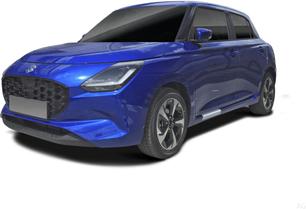
Few cars have had the sheer staying power of the Suzuki Swift.
Except for a four-year hiatus as the original Ignis from 2001, the Japanese supermini has been a segment mainstay since 1983, winning over consumers worldwide as an inexpensive, economical and reliable yet fun option in the Toyota Yaris class.
In Australia, its impact has been even more profound, providing Holden with its famous “beep-beep” Barina for two early iterations from 1985, while also introducing us to the pocket rocket decades before the Volkswagen Polo GTI, with the Swift GTi of 1986.
Now there’s this – the sixth-gen model in 41 years if you exclude that Ignis – doing what the little Suzuki has always done: offering buyers a great budget alternative. But this time, in this new-electrification era, where precious few attainable choices remain.
Is it any good? Let’s dive straight in.
Hybrid campers tread the line between caravan comfort and camper trailer-manoeuvrability and are touted as somewhat of a new thing; almost an evolution of comfort as more people look for a perfect camping experience.
But camper-trailers like the Cub Longreach LE prove that the concept has been around for decades.
It hasn't always been called the Longreach, but this high-walled, super-sized, off-road camper-trailer was one of the first to offer caravan-like comfort and space in a product that'll go anywhere off-road*. (* In terms of reasonable use and having obviously scrutinised your camper's warranty conditions before setting off to make sure you're covered for that sort of usage.)
The 2019 LE takes the comfort levels even further, so we grabbed one for a night to check it out.
So, there you have it. A brief look at the new, sixth-gen Swift.
Better where it needs to be, the supermini survivor still remains competitively priced, with loads of new efficiency and safety tech that buyers will appreciate.
But, most of all, the Suzuki still feels, drives and rewards like the old model used to. It just does so with more sophistication.
As inexpensive city cars continue to fade, the new Swift continues 41 years of providing a fun, affordable and dependable solution, in a vibrant and desirable package.
This isn’t the camper for everyone – my guess is that plenty of people look at this and find it too sparse, too basic. I kinda get it.
But there are very few campers which offer the same amount of open, internal space, or that are as easy to set up.
That the Longreach, albeit with a few different names, has lasted so long on the Cub Campers' product roster is a testament to its versatility and ability to accommodate a small family on off-road camper trips.
It's arguably one of the forerunners of the hybrid camper scene, and it's now starting to evolve with campers' desires for more comfort.
From a packaging perspective, the latest Swift carries on from before, and that’s no bad thing. It remains exceptionally roomy as well as practical.
To that end, entry and egress are easy, there’s a sense of spaciousness thanks to deep windows, a high ceiling and lofty seating, while the latter also helps provide an agreeable driving position. Storage and ventilation are provided in abundance.
For many people, the dash redesign reflects a big change in attitude, having finally grown up and away from the previous cheap and cheerful look. Highlights include pleasing seat fabrics, interesting textures and a sense of quality craftspersonship, within a stylish and sweeping design. After 41 years, the Swift has matured gracefully.
It’s also worth pointing out the super-clear analogue instrumentation dials, supported by a digital speedo and configurable trip computer data; actual buttons for the heating and air-conditioning system and – joy of joys – a handbrake lever.
Plus, if you want to turn off the various beeps from the driver-assist systems, physical buttons are but a simple press away. No distracting sub-menu searches within fiddly touchscreens here, thanks.
Except if you want to change the volume because you’ll need to prod the screen after all. The knob is always the better option, Suzuki.
What else? The rear bench area is a little plain but surprisingly roomy for this class of light car. Probably more so than a Corolla provided back in the early 2000s, with a decent level of cushy support for two people or three at a squeeze.
Given the extra specification, even the cheapest grade is all the Swift you’ll need. A sign of a democratic car.
But keep in mind the base variant no longer comes with a driver’s seat adjuster, passenger vanity mirror and multiple USB ports found in the Plus and GLX versions, while it is alone with a clammy plastic rather than leather-sheathed steering wheel rim.
At least cargo capacity edges up, by 23 litres to 265L (VDA), and that’s just under the luggage cover, thanks to some clever repackaging of a now-lower boot floor and internal tailgate panels. Drop the rear backrests and that expands to 569L.
Note, however, that for the Swift to achieve its sensationally low kerb weight that starts from just 919kg (up around 50kg), it now uses a fiddly and frankly-inadequate tyre repair kit. Thankfully, Suzuki offers that space-saver spare, at extra cost (and mass) of course.
Still, keeping those kilos low pays high dividends when it comes to performance and economy.
For a rear-fold camper-trailer, the space inside couldn't be more practical. The long body and high sides mean that when the camper is open and set up, it has a lot more space than most. Behind the bed, for instance, there is enough space for Cub to have fit a small dinette.
The dinette has cushioned benches for two and a swivel table that can also become a counter over the rear floor area.
The camper's length also means that the rear floor area is massive. It is easily big enough to lie a couple of kids on, or if your nest is empty, to set up some camp chairs and a table to enjoy a covered living area.
It is still a rear-fold camper-trailer, though so, despite the fact it has nearly twice the space of other hybrid-style campers, it's very sparsely furnished. There's no internal kitchenette or anything like that.
No Swift since 2004’s new-millennium redesign has been anything less than fun to punt around. A focus on driving pleasure and superior dynamics has helped make each version a cut-above most rivals.
Losing the smooth old 1.2-litre four-cylinder engine in the name of low consumption and emissions is a noble move. But how does this translate out in the real world, especially with a Swift fan behind the wheel?
It's mostly great, actually.
Losing a cylinder results in a slightly less creamy power delivery, especially as it’s accompanied by a distinctive three-cylinder exhaust-note thrum. But that’s still in keeping with the Swift’s endearingly sporty character.
Better still, even with all the examples we tested showing barely more than delivery mileage on the odometer, there seems to be more than enough grunt to please driving enthusiasts.
While not wanting to tax engines that weren’t even run-in yet, the charming revvy eagerness and instant throttle response remains, along with a discernible extra kick when accelerating away from standstill.
Even being so new, our Swifts proved to be lively, lusty and surprisingly rapid performers. We can’t wait to test run-in examples!
The five-speed manual is deliciously well-oiled and precise, immersing the driver into the Swift experience on another level compared to the CVT auto, which still manages to impress by responding quickly and effortlessly, without feeling laggy or droney. A lot like the old version.
Suzuki is making a lot of noise over how agile yet comfortable the newcomer’s handling and ride qualities are, as a result of improved rigidity and noise-dampening measures.
The Swift’s MacPherson-style front struts and torsion beam rear suspension systems have been revised with stronger and quieter mounts for better performance, while the electric steering has been retuned for greater feel and linearity.
The result? Even our limited time behind the wheel revealed tactile and precise steering, composed handling and extraordinary isolation from the road below for a car barely weighing 950kg (at most).
Combined with the nuanced driver-assist safety tech that rarely interrupted the fun, the latest Swift is a cheerfully animated, nimble and rewarding experience... and one that stands out all the more for evolving while so many other like-minded rivals like the Ford Fiesta have sadly fallen away.
Bravo, Suzuki. Generation Number Six remains the enthusiast driver’s choice, and a hybrid bargain to boot.
Cub Campers are famously good to tow, and even the largest of them lives up to the reputation.
As big as it is, the Longreach LE is quite light thanks to the effort Cub puts into engineering. As a result, it's not a strain, even for older dual-cabs like the D22 Navara.
And because it isn't any higher or wider than a modern SUV, there was very little wind-drag or buffeting as we cruised along the highway.
Cub developed the camper's Australian-made and -designed independent, coil-spring suspension and the set-up yields excellent ride in any conditions.
For the LE, Cub has added an extra shock-absorber each side to improve its performance even on the most corrugated roads.
An AL-KO off-road ball hitch is standard but can be upgraded to the Click-Lock version if you'd prefer that or need a more low-profile hitch.
In reverse, the long drawbar makes it an easy camper to manoeuvre around a campsite, plus it has enough size that the tow-vehicle driver never really loses sight of it while positioning it.