What's the difference?
For over thirty years, the Subaru Impreza has been an icon on Australian roads.
If you’re a member of the ‘PlayStation generation’ like me, there’s a very good chance you slapped P plates on one as your first car.
For Subaru the Impreza is more than that. Along with its WRX performance variant, it's the car which put Subaru on the map, raising it from a relatively unknown Japanese automaker to a global household name.
Things change, though, and despite 30-plus years of history as a beloved nameplate, the Impreza has gone from a best-seller to tumbling down the sales charts as buyers shuffle into small SUVs rather than hatchbacks or small sedans.
The question we’re looking to answer today is what this new-generation Impreza has to offer in 2024, and whether it is still worth a look.
Read on to see what we found.
Remember when Lexus design was about as adventurous as a warm cup of tea and a good lie down?
The Japanese luxury brand (and Toyota’s more expensive little brother) wasn’t exactly famed for taking risks on boundary-pushing looks. And that's not even me being mean - its own executives say they favoured conservatism over all else when working on an a new model. And thus everything looked like it was designed by a 75-year-old Japanese man, largely because it had been.
But gazing upon the angry, jutting jawline of the Lexus RX, those play-it-safe days suddenly feel a long time ago. If this RX isn’t the most striking (for better or for worse) SUV in its premium field, it’s got to be pretty darn close.
The cheapest and most youth-oriented model in the RX family is the 200T, making use of a 2.0-litre turbocharged petrol engine to propel the big SUV. And the one you see in these pictures is the F-Sport model, which scores a bespoke bodykit, unique alloys and other styling stuff to make it look even more aggressive on the road.
Having received its last major update in 2015 (but with a mid-life tweak just around the corner) this RX is starting to get on a little bit. So we spent a week in the 200T to see if it's still able to mix it with the best in the segment.
The 2024 Impreza delivers on all the key things which have made the nameplate so well regarded for the last 30-odd years.
The issue is, buyer expectations have moved on. Hatchbacks need to do more than ever to compete with small SUVs, and with today’s fuel prices it’s far more valuable to offer hybrid rather than all-wheel drive.
This is why, despite the sixth-generation Impreza being a tidy high-tech offering with an admirable commitment to safety, I think it will ultimately continue to shrink its market share. This Impreza really is one for the fans.
Big, practical and comfortable, the Lexus RX 200T F-Sport deserves its place in the premium SUV pantheon. And don't let the little engine fool you, the turbocharged four-cylinder unit serves up plenty of poke to get the RX moving. But if it's fancy new technology that really excites you, prepare for mild disappointment, with the RX's in-cabin tech feeling a little underwhelming.
Over the years the Impreza has changed in its design and intention so much.
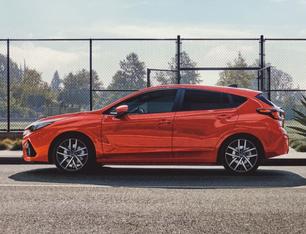
Once known primarily for its sporty sedan variants, today’s Impreza is a far more contemporary hatchback, forgoing the once wagon-like shape for something with the traditional bubble silhouette to align with its rivals.
For better or worse, it also syncs up with the rest of Subaru’s range, with the brand’s current design language on full show, but it also barely evolves from the previous-generation version from the outside.
It trades the chunky square light fittings from the previous car for something a bit more refined this time around, with a similar look and feel to the WRX and Outback.
Inside also gets a similar fit-out to other Subarus in the range, complete with a raised centre console, shapely dash, and the same huge screen from the Crosstrek and Outback which dominates the space and helps simplify things compared to the busy interior and multiple screens of the previous car.
It’s a cosy space with chunky comfortable seats and the signature bumper car steering wheel is a stand-out bit of Subaru design.
Even the base car with its plastic trimmed wheel and basic cloth trims in the door is basic in an almost refreshing way, but unlike some rivals manages to be comfortable, too, thanks to soft trims for your elbows in the doors.
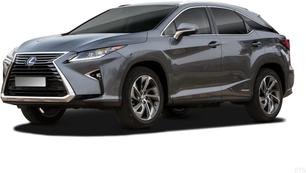
Angry, aggressive and very un-Lexus, with a jaw that looks like Ivan Drago somehow transformed into an SUV - that pretty much sums up the RX.
Lexus is already on record as saying its designers had mistakenly tried to make their cars appeal to everyone in the past, and so they ended up boring and tame as a result.
Now they're happy if one person in 10 really loves them. Exactly where you sit on that scale is up to you.
Up front, that 'Spindle Grille' (shaped a little like the Predator’s mouth) serves up plenty of road presence, while the sharply angled fog-light housings and deeply domed bonnet give it a more powerful stance than perhaps is justified by its 2.0-litre engine.
Side on, the big and shining alloys, deep curve above the base of the doors and flared, squared-off wheel guards add plenty of personality to what could have (and in the past, would have) otherwise been a long and featureless stretch of metal.
Step inside and the cabin is premium-feeling, if a little busy, with the doors and dash covered in a combination of soft-touch materials and padded leather. The brushed aluminium-look central tunnel that separates the front seats is super wide, as it houses the the cupholders, drive-mode selector and the strange mousepad that controls the entertainment system, but feels nice under the touch and becomes a kind of focal point in the cabin.
Living up to the adventure-ready Subaru promise, the Impreza's interior is quite functional.
Even though many controls have moved to the big central screen, there are individual buttons for temperature adjustment and a permanent touch function for fan speed on the lower third of the screen.
It would be nice to see a full set of physical buttons for climate functions, but this seems like a decent compromise.
Elsewhere there are large bottle holders in each door with a small accompanying pocket, two more rigid bottle holders in the centre console, a small tray behind them, and a huge armrest console box.
Under the multimedia screen there is a bay with a wireless phone charger, but like the Crosstrek, it is finished in a hard plastic material, which means your phone will easy slide around and out of the charging area in the corners, which seems like an oversight.
Adjustability is great, even in the base car, with flexible seats and a wide range of movement for the wheel, letting you easily find a suitable seating position. Width in the cabin is okay, but headroom is excellent.
The back seat offers a solid amount of room for myself behind my own seating position, at 182cm tall, but the middle position is no good for an adult thanks to the presence of a large raise in the floor to allow for the all-wheel drive system underneath.
Amenities for rear passengers are only okay in the base car, with a large bottle holder in the door and a further two in a drop-down centre armrest. There are no adjustable rear air vents or USB power outlets in the L, but outlets are added in the R and S.
Boot space is on the small side, with only 291 litres (VDA) on offer. The high floor means a limited amount of space with the luggage cover in place, although I was surprised to find we could fit the full three-piece CarsGuide luggage set once it was removed, so long as you’re okay not being able to see out the rear window.
Under the floor, the Impreza sports a space-saver spare wheel - a must-have for long-distance regional travellers.
Australia’s laser focus on small and city-sized SUVs has been so intense that’s it’s easy to forget the joys of our bigger cars. Stretch out in the 4890mm long and 1895mm wide Lexus NX and it all comes flooding back.
There’s plenty of space for up-front riders (even with the football pitch-sized centre console), as well as two cupholders and extendable pockets in each of the front doors. The cubby that splits the front seats is ridiculously deep, too, and is home to two USB connections, a power outlet and and aux-in point.
Step into the back seat and you’re greeted by plenty of space in each of the window seats, although the central stack that houses the air vents and another power outlet does jut out into the legroom of the middle-seat passenger. There are two bonus cupholders hidden in a pulldown divider that drops from the middle seat, and two ISOFIX attachment points, one in each window seat in the back.
Rear seats in place, the RX serves up 453 litres of luggage space, although you can stretch that to 924 litres by folding the backseats flat.
Now in sixth-generation form, the 2024 Impreza range has been trimmed down to just one hatchback bodystyle and three trim levels - the base L, mid-spec R, and top-spec S.
True to Subaru form these variants are all priced quite close together, and the base L comes with pretty much all the kit you’ll need, with the R and S grades adding mainly luxuries to the equipment list.
Now starting from $31,490, before on-road costs, the Impreza is not as affordable as the previous-generation version, and while it manages to pack a relatively high level of standard equipment, some of its key rivals are a bit cheaper in a segment where every dollar matters.
For example, you can get into a hybrid version of Toyota’s Corolla (Ascent Sport Hybrid - $32,110) for similar money to the entry level 2.0L, the Kia Cerato can be had for under $30,000 (Cerato S Auto - $27,060) while the outgoing Hyundai i30 is significantly cheaper in its most basic trim level (i30 Auto - $26,000).
What might make you think twice is the Subaru’s standard all-wheel drive, where all of its rivals are front-wheel drive, but in an environment where fuel costs are high, I can understand why people would prefer to see a hybrid version instead.
Unlike the Impreza’s Crosstrek small SUV relation, there’s no ‘e-Boxer’ hybrid variant.
Still, standard equipment is high even on the base 2.0L. Included are 17-inch alloy wheels, LED headlights, a massive 11.6-inch multimedia touchscreen with wireless Apple CarPlay and Android Auto and you even get a matching wireless phone charger.
Elsewhere the base car gets cloth seats with manual adjustment, a plastic steering wheel, analogue instrument cluster with a small digital display, and importantly, the majority of Subaru’s very good active safety equipment is standard.
So, what do you get for stepping up the range? At $34,990, the 2.0R adds premium cloth seat trim, additional charging ports in the rear, eight-way power adjust for the driver, heated front seats, a leather steering wheel and shifter, steering responsive LED headlights, and LED fog lights.
At the top of the range, the $37,990 2.0S adds a 10-speaker audio system, built-in sat-nav, an electric sunroof, and synthetic leather seat trim.
The cabin tech, safety, and standard all-wheel drive are the real draws, but you have to want them. The Impreza isn’t the stellar value buy it once was.
You’ll part with $86,551 for the Lexus RX 200T F-Sport - about $12k more than the non F-Sport model. And that’s not chump change. But your money does buy you 20-inch alloy wheels, proximity unlocking, LED head and tail-lights, roof rails, a powered boot and a huge powered sunroof.
In the cabin, you can expect leather seats, dual-zone air-con and push-button start, while technology is handled by a nav-equipped 12.3-inch screen that partners with a 15-speaker Mark Levinson stereo that's standard on this F-Sport-stamped model (the cheaper version makes do with a smaller screen and fewer speakers).
The Impreza is equipped with just one engine and transmission for its sixth-generation, a 2.0-litre (FB20) four-cylinder horizontally-opposed ‘boxer’ engine mated to a continuously variable automatic transmission, driving all four wheels via the brand’s signature ‘symmetrical’ permanent all-wheel drive system.
The FB series is a development of the successful EJ series engines which lasted from 1989-2021. This more recent engine has new material science, heads, and seals which have helped the brand push service intervals out to 12 months rather than six, and should address issues which the older engines developed over time.
Power is on-par, but not a stand-out in the segment, with peak outputs of 115kW/196Nm.
There was a time not so long ago when the thought of fitting a four-cylinder, 2.0-litre engine to a near two-tonne SUV would be truly torturous.
But turbocharging has become so clever that the smallest engine in the RX range never feels underpowered. It'll serve up 175kW at 5600rpm and 350Nm at a low 1650rpm - enough to push the big Lexus from 0-100km/h in just 9.2 seconds. That power is fed through the a six-speed automatic and sent to the front wheels.
One issue with having a non-turbo, non-hybrid 2.0-litre engine with all-wheel drive is relatively high fuel consumption. The Impreza has an official combined cycle fuel consumption figure of 7.5L/100km which is less than impressive in today’s market of hybrids and downsized turbocharged engines.
In my week of mostly stop-start city driving, the test example drank 11.1L/100km, which is disappointing.
Mercifully, it is capable of running on 91RON unleaded. For those who care, the CO2 output is officially 170g/km which is well above the 140g/km it would need to be at to avoid the wrath of incoming vehicle emissions regulations.
Lexus claims a 8.1 litres per 100km on the claimed/combined cycle (though we returned a much less happy number - one that started with an 11...).
Emissions are pegged at 189g/km of CO2 on the combined cycle, and the big Lexus' 72-litre fuel tank requires 95RON fuel.
Have you driven a Subaru in the last 10 years? The drive experience here is pretty much uniform with the rest of the automaker’s range.
This means a lot of very appealing traits. For example, the new Impreza has a comfortable, compliant ride, really nicely weighted steering, and solid handling even on slippery surfaces courtesy of the all-wheel drive system.
The FB series engine also has a good bit of pull fairly early in the RPM range which makes it deceptively spritely, although power really hollows out the more you push it.
This makes it nice to drive around town, but less impressive when it comes to overtaking on the freeway.
This is reinforced by the continuously variable automatic which lends the engine a thrashy, rubbery character when pushed, but is nice and predictable at lower speeds.
The rev-happy engine is also quite noisy when a lot is asked of it, and like a lot of Japanese cars, but Subarus in particular, tyre roar picks up in the cabin above 80km/h.
It’s a comfortable and family-friendly drive, and I particularly like the way the plethora of active safety systems sit by the wayside and don’t interfere with the overall experience.
It is just a bit of a shame it doesn’t move the drive experience forward by a huge amount. The current Impreza doesn’t feel meaningfully different from the fifth-generation version which debuted in 2016.
Your love for the RX will likely depend on your priority list. Do you want the latest gadgets, a seamless multimedia interface and the kind of cool technology you can show off to your passengers?
Well, um, perhaps best keep looking, then. The in-cabin tech here feels a little off the pace now, and that cursed mouse-style controller still frustrates the bejeezus out of me.
But if a smooth, easy and quiet drive sits atop your list, then the RX 200T will grab you in all the right places. Probably most impressive, it doesn't feel overly large and cumbersome, and is equally at home in the cramped inner city as it is eating up kays on the freeway.
The gearbox is silky-smooth seamless, switching between cogs without you even noticing, and the cabin is commendably quiet - especially when you're coasting though the ‘burbs - locking the worst of the outside word out of the cabin. The ride has clearly been engineered to iron out small, sharp road imperfections, but you can bounce around a bit in the cabin over speed bumps.
There was a time not so long ago when the thought of fitting a four-cylinder, 2.0-litre engine to a near two-tonne SUV would be truly torturous.
You can spice things up a little by selecting Sport or Sport + via the central dial and, while there’s no noticeable change in exhaust, the accelerator gets noticeably more sensitive and the gearing more aggressive; more wiling to hold a lower gear for longer, squeezing the most out of that little engine.
It can feel a little heavy when you first brake into a corner, but beyond that the steering is smooth, predictable, and without a lot of dead-air play. It’s not a sports car by any measure, but it doesn't feel like you’re constantly dragging a big, heavy SUV around, either.
But be warned, it’s not the most engaging of drives. This is not a car you'd ever wake up excited to run out to. It’s comfortable, capable and engaging enough, sure, but it never really stirs your emotions.
The majority of active safety equipment is standard across all three Impreza variants including auto emergency braking up to freeway speeds with reverse auto braking, lane support systems, blind-spot monitoring with rear cross-traffic alert, traffic sign recognition, lead vehicle start alert, driver attention alert, and adaptive cruise control.
Stepping up to the 2.0R or 2.0S nets you the front parking camera for a 360-degree parking suite, and high-beam assist for the LED headlights.
Expect the usual traction, brake, and stability controls, alongside the more modern torque vectoring system and an impressive suite of nine airbags. The new Impreza is yet to be rated by ANCAP.
There's no shortage of cushioning safety in the RX, with 10 airbags as standard. They join a parking camera, front and rear parking sensors and rear cross-traffic alert.
Lane-departure warning and assist, blind-spot monitoring, active cruise and AEB join the list, too. All of which were enough for the Lexus RX to nab the maximum five-star crash rating when tested in Europe - a score that has since been adopted by ANCAP in Australia.
Subaru offers its fairly standard five-year and unlimited kilometre warranty on the Impreza, with 12 months of roadside assist included.
There is also a five-year fixed-price service program covering the first 75,000km, although it’s nowhere near as affordable as the Corolla or i30, coming in at an average annual cost of $464.64.
The Impreza needs to be serviced once every 12 months or 15,000km, whichever occurs first.
Expect a four year/100,000km warranty, with a trip to the service centre required every 12 months or 15,000km. And when the car does have to go back for a service, Lexus has received much praise from owners for offering a choice between a loan car, or a pick-up and delivery service from your home or office.