What's the difference?
Another day, another China-backed EV brand launches in Australia. This one, though, should be at least be vaguely familiar, with Smart having previously operated in Australia about 15 years ago, back when it was a Mercedes-Benz sub-brand rocking the tiny and clever Smart ForTwo and ForFour.
Mercedes is still involved, though now as a 50/50 joint venture partner with Chinese giant Geely, though the new Smart family is not being delivered by either company, and are actually being distributed by Mercedes’ biggest global dealer group, LSH Auto.
All of which is a load of information you don’t really need. But you should know, as a result of all that, the brand is promising a fleet of semi-premium EVs designed in Germany and built in China, with the Smart #1 the first to touch down in Australia.
Oh, and they pronounce the “hashtag” part of the model name, but I just can’t see that strategy becoming part of the Australian lexicon.
Anyway, part-Chinese, part-German and all electric. So should the #1 be on your EV shopping list?
Smart is back.
Not with the classic ForTwo two-seater city car, oddball four-seater ForFour hatch or dinky Roadster targa top. Those were yesterday’s cars.
Today, Smart – as a 50/50 joint-venture between Germany’s Mercedes-Benz (the brand’s originator) and China’s Geely – is all about SUVs. Electric SUVs.
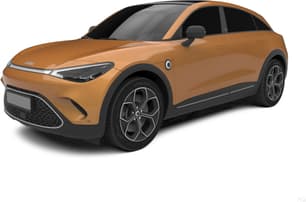
The boxy #1 (pronounced “hashtag-one”) is a small SUV and the sleeker #3 is the coupe-esque performance crossover version. Both are made in China and use Geely technologies.
We take a long, hard look at the range-topping #3 Brabus, the speediest, sexiest and exxiest of the lot. Let’s go.
It’s easy to get lost in marketing hype, but — based on first impressions — the Smart #1 does what it says on the tin. This is a Chinese-built SUV that feels more premium than most, and one which is priced to tempt you from one of the German big three. The warranty isn’t good enough, though, and the multimedia screen can be infuriating, but it drives very nicely, especially on suburban roads.
Note: CarsGuide attended this event as a guest of the manufacturer, with travel, accommodation and meals provided.
The #3 Brabus is very nearly one of the great bargains of 2024, with the sort of style, luxury, features, performance and grip you’d expect from the much-more-expensive GLA AMG 45. It’s that good.
What would make it great is a sunblock for the hot glass roof on a sunny day, Australian road tuning for the infuriating ADAS tech and a revised steering tune that didn’t make it feel inconsistent at times.
See past these, though, and the #3 Brabus exceeds expectations.
We’re glad Smart is back.
There is an impossibility pretty model in Smart’s new line-up, but the #1 ain’t it. While the #3 — which has also just launched — is a sleek-looking, coupe-style SUV, the #1 is a top-heavy small SUV that doesn’t shine from every angle.
Front-on, or from a front three-quarter angle, the #1 definitely works, with the brand setting out to remove unnecessary fussiness from the design, leaving smooth and rounded bodywork in its place.
There are no body creases or weird angles here, instead it’s a smooth, fluid-like design that flows from the front LED lights bar to the smooth shoulder lines to the matching light treatment at the rear.
But it’s at the rear where, for mine, the design begins to fall over. From that angle, the #1 looks skinny and top-heavy, especially when wearing the red hat of the Brabus model.
Still, eye of the beholder and all that.
Inside, though, the #1 kicks all sorts of goals, presenting as a properly premium-feeling EV space that’s swimming with technology and lovely cabin materials.
I particularly love the letterbox-style screen that replaces the traditional dashboard. It’s not distracting or overbearing like some twin-screen set-ups, but clearly shows you the key driving stuff you need when you’re on the road.
Side note, though, the massive central screen is super clear and lightning fast, but as usual you need to spend some (a lot) of time with it to figure out where all the functions are hiding, with most of the car’s key controls hidden within its labyrinth.
And side note two, the background graphics look like they were designed by a cordial-addled child, it is busy, cartoonish and out of keeping with the calm, grown-up nature of the #1’s cabin.
Smart says Mercedes designed the #3 and it shows.
In silhouette, or when glanced peripherally, it could be the love child of the A-Class and EQA. Only the friendly face betrays its non-Benz heritage.
Longer and wider than the #1, it is also 80mm lower – achieved via a lower ride height, flatter seats and a thinner floor.
Helped by a 35mm wheelbase stretch, it provides a nicely-balanced and proportioned crossover, with a decent drag coefficient of 0.27. The Brabus’ big wheels also fill out the arches very nicely.
Key length/width/height/wheelbase dimensions are 4400mm/1844mm/1556mm and 2785mm, respectively.
Unusually for a coupe/crossover mash-up, there’s slightly more room inside compared to the upright donor model.
Let’s take a longer look in there.
The Smart #1 measures just under 4.3m long, just over 1.8m in width and around 1.6m in height, and it rides on a 2.75m wheelbase. And the perk of the Smart’s EV powertrain, the brand says, is Mercedes-Benz E-Class levels of space in the back seat, despite the #1’s diminutive footprint.
It’s a big claim, and while I didn’t break out the tape measure I can say the backseat feels plenty generous, and because the rear pew slides forwards or backwards by 15cm, you can choose whether you want more legroom or more luggage space.
Speaking of which, pop the auto-opening boot (by hitting the ‘a’ in the ‘Smart’ lettering, which I couldn’t figure out without help) and you’ll find 323 litres of space with the back seat as far back as it goes, growing to 411 litres with it pushed all the way forward. There’s also a 15-litre frunk.
Smart says the #1 weighs 1800kg, adding it will tow 1600kg — but I’m sure you can imagine the impact a heavy load will have on your driving range.
On first approach, you ask yourself whether the #3 is a crossover or a small-to-medium SUV. The low roof and cool frameless doors certainly suggest the former, as do the comparatively small apertures.
That said, with the windows down, those sash-less doors help entry and egress.
Once ensconced inside a long if slightly narrow cabin, the #3 offers ample room for even the tallest adults up front, as well as a reasonably spacious back seat area, though you’d call that more of a '2+1' seater given the lack of girth for three. Most folk shouldn’t struggle to find the right driving position, either.
Presumably keen to impart a generic Mercedes vibe, the #3’s interior is somewhat reminiscent of a GLA’s, albeit from last decade – down to the pronounced T-shape dash featuring a trio of circular vents in the middle, a standalone screen above and (unconvincing) metal-look plastic trim below.
Understandably, like so much of the Brabus, this might appeal to aspiring A45 AMG owners, but it seems oddly dated, given the advanced electrification going on underneath.
Likewise, none of the minimalism cleverness of the ForTwo city-car original is referenced, even digitally. A lost opportunity, really. The OG Smart is an icon.
Meanwhile, ahead of the driver, a narrow digital strip looks twee and cheap, as if ripped from a Japanese 'Kei' car. It’s a strange design detail for a $71K SUV.
Still, the #3’s cabin layout is largely a success, and much of that is due to the first-class quality and finish. Unlike some of the aforementioned Benzes of the previous decade, squeaks and rattles are notable by their absence.
Depending on your body, the racy sports seats up front are either perfectly bolstered or far-too snug, but they provide a decent level of comfort and support. And they position you just right for controlling the centre display, which dominates all.
The 12.8-inch touchscreen feels slick, responsive and right-sized for the car. At first, it can also seem like info-overload and perhaps a bit cheesy with its animal animations, but real thought has gone into it to provide an extraordinary level of functionality.
Across the top are icons for access to media, sat-nav, apps and camera view settings, while the bottom row is for various climate and trip info. While somewhat logically presented, the charging-station list seemed outdated and/or at-times incorrect in our test car.
Mercifully, the Smart has a row of short-cut buttons for 'Vehicle Modes' (including turning off the infernal lane assist and one-pedal accelerator/braking), 'Driving Mode' ('Eco'/'Comfort'/'Sport'/'Brabus'), glass demisters, climate and display-off.
Annoyingly, the latter is closest to reach, revealing the #3’s left-hand drive market bias, as the driver must stretch across to access the first two (and more important) settings.
There are also several handy screen-activated modes including 'Entertainment Mode' that temporarily leaves the accessories and climate control on; 'Rest Mode' reclines the driver’s seat down flat and dims the interior lights; 'Energise Mode' is designed to pep you up; and 'Pet Mode' keeps a climate-controlled atmosphere while deactivating all buttons that a stray paw might press. Clever.
There’s lots more besides, and using the touchscreen is better in this than most other Chinese vehicles, but it remains fiddly and distracting.
It’s also worth pointing out that the fixed glass roof needs a blockout for Australia. A Smart spokesperson said an aftermarket cover is available, but as supplied to us, sitting under it over a run of hot days is almost unbearable without a hat. This is not good enough.
Thankfully, the other basics are all A-OK.
The climate system coped well the hot sun bearing down through the glass, plenty of useful storage makes up for the disappointingly shallow glove box, while the chilled centre console and massive door bins proved especially handy.
USB access is easy, the wireless Bluetooth/Apple CarPlay performed more consistently than in any recent test vehicle and the standard Beats audio brings brilliant sound.
Out back, most people under 180cm should at least avoid scraping that glass ceiling, and there’s a reasonable amount of room for boots and long knees if the front occupants are sympathetic, but you’d be stretching the truth calling the rear seat packaging SUV-esque.
On the other hand, it’s beautifully presented, boasts a comfy and supportive backrest/cushion for outboard passengers and even a do-able centre pew for shorter-distance riders.
And it provides every expected amenity, including air vents, USB-C ports, door storage, a folding centre armrest with cupholders, and overhead handles/lighting/coat hooks.
And while we’ve already complained about the glass roof, it floods the cabin with light, to make it seem airier than it is. Narrow front seats with a see-through slit further enhance this feeling.
Further back, the 370-litre boot is reasonably long and surprisingly deep thanks to a removable upper floor that’s good for stuffing the optional home charging cables in.
And, of course, it can be extended to 1160L via the split-fold backrests to provide extra loading practicality. And there’s even a small (15L) amount of storage under the bonnet.
Maximum towing capacity is 1600kg for a braked trailer.
The #1 is available in three trim levels — the Pro+, Premium and Brabus — and pricing (before on-road costs) climbs from $54,900 to $58,900 and $67,900.
Brabus, by the way, was a lesser-known Mercedes-Benz tuning arm, a little like AMG, which should give you some idea of what to expect from the performance-badged models.
Anyway, that pricing is good enough to undercut key rivals, including the Volvo EX30 (from $59,990) and BMW iX1 ($78,900), and it’s drastically less than Mercedes-Benz's EQA 250 ($84,900), all before on-road costs.
Also firmly in the Smart’s favour is that there isn’t a cheap-feeling model among them, with even the Pro+ feeling properly well-equipped and premium.
Entry-level cars score 19-inch alloys, a panoramic roof, LED lighting, a powered tailgate and a 12.8-inch central screen with wireless Apple CarPlay and Android Auto, and a 9.2-inch digital dashboard. There’s wireless device charging and a decent stereo, too.
The Premium then adds matrix LED headlights, leather trim, a huge head-up display and a better Beats stereo, while the Brabus scores a unique interior and exterior treatment, better suspension and a launch control function.
Though originally brought to market by Mercedes, Smart was never pitched as a premium brand, as it is now.
Back in the late ‘90s, Smart was an early attempt at better urban mobility. The ForTwo was a tad over 2.5 metres long by 1.5m wide and 1.5m tall.
Today, the #1 and #3 share their modular EV platform with Geely’s other small crossovers, including the Volvo EX30 and Zeekr X, while a stretched version underpins the related Polestar 4.
While the #1 starts from a sharp $54,900 (all prices are before on-road costs) for the Pro+, at the other end of the spectrum, the #3 Brabus flagship, with dual motors for all-wheel drive (AWD) and Porsche 911-style acceleration, will set you back $70,900.
Not bad, given it also includes a body kit, extra driving modes, beefier suspension, stronger brakes and retuned traction controls.
Now, that might sound steep against the growing choice of more-affordable EV alternatives out there, but consider that most of the cheaper ones are significantly slower, less sporty and/or not as highly equipped, including the Hyundai Kona Electric, Jeep Avenger and Mini Countryman.
The #3 Brabus’ fiercest foe, the bestselling Tesla Model Y in top Performance guise, is more powerful but costs $12K more and is slightly slower from 0-100km/h.
The $70K Volvo EX30 Twin Motor Performance Ultra costs $1K less and matches the Smart performance-wise as they share the same tech, but it’s considerably smaller.
Meanwhile, the closely-related Zeekr X is $6K cheaper but looks bizarre and is still largely unknown in Australia. At least Smart has that long-time Merc association to fall back on.
In fact, it is distributed by the latter’s biggest dealer group globally, LSH Automotive.
Speaking of which, how does the #3 Brabus stack up against the similar Mercedes EQA and other luxury EV rivals? The less-powerful Merc 250+ is $14K more, has less kit and is nowhere near as powerful. Same goes for BMW iX2, Lexus UX300e and Volvo C40 Recharge (alias EC40).
The #3 Brabus seems to be in a goldilocks zone of premium, performance EV SUVs. The most expensive Smart offers thoughtful value for money. For a change, the car actually lives up to its name.
Predictably, it’s also well stocked, with matrix LED headlights, electric heated/vented front seats, a 12.8-inch touchscreen, head-up display, 640W Beats audio, a foot-actuated powered tailgate, 360-degree camera views, the full advanced driver-assist safety enchilada, auto parking assist, 20-inch alloys and a panoramic glass roof.
Unfortunately, fitted on every Smart, that last one does not come with a factory built-in sunblock, which is completely unacceptable under our hot Australian sun. And no crossover or SUV should be without a spare wheel, either.
These are the #3’s only real deal-breakers.
There are two drivetrains on offer here - one shared across the Pro+ and Premium, and another delivering the prodigious power of the #1 Brabus.
The first shared option is a single rear motor that delivers 200kW and 343Nm, which is enough to knock off the sprint to 100km/h in 6.7 seconds. Top speed for all models is listed as 180km/h.
The Brabus, though, adds a motor at the front axle, giving it AWD, which ups the outputs to a punchy 315kW and 543Nm, dropping the sprint to 100km/h to a very fast-feeling 3.9 seconds.
It’s a single-speed EV transmission in each, which means smooth, constant power delivery with no traditional ‘steps’, and all get 'Eco', 'Normal' and 'Sport' drive modes, though the only thing they impact is the accelerator response.
You can add weight to the steering, but that’s a separate item accessed elsewhere in the screen’s sub-menus.
The #3 Brabus employs one permanent magnet synchronous electric motor per axle, for dual-motor, all-wheel drive performance via a single-speed ‘transmission’.
They provide plenty of poke, totalling 315kW of power (115kW front, 200kW rear) and 543Nm of torque (200Nm front, 343Nm rear).
Tipping the scales at 1910kg, this means the Brabus delivers an impressive power-to-weight ratio of 165kW/tonne – enough for it to scoot from zero to 100km/h in 3.7 seconds, on the way to a 180km/h top speed.
To put those figures in perspective, the similarly-priced VW Golf R only manages 156kW/tonne and 4.8sec to 100.
All Smart #1 models share the same 66kWh battery, but how far you can travel between charges comes down to the trim you choose, with the WLTP driving range either 400km, 420km or 440km. The Brabus, of course, covers the least ground between charges, owing to its dual-motor set-up and amped up power outputs.
When it comes time to plug in, all models are equipped with 150kW DC fast-charging capability, and when plugged into said charger, you can expect to go from zero to 80 per cent charged in less than 30 minutes.
There’s also 22kW AC charging on board in the Premium and Brabus models, which means you can use three-phase power, but plugged into a regular 7.4kWh home wallbox should see you go from zero to 80 per cent charged in 7.5 hours, which means overnight charging should work a treat.
All #3s headed to Australia for now are fitted with the larger of the two battery packs available – a 66kWh lithium nickel cobalt manganese (NCM) item.
In the Brabus, it is rated to average up to 415km of WLTP-certified range, which is between 20-40km shy of the mid-spec Premium version.
Smart says the WLTP average energy consumption is 17.7kWh/100km. Our 3000km-old test car’s trip computer displayed a life-cycle average of 14.6kWh/100km since delivery.
During our week with the Brabus, we managed an average of 19.4kWh/100km, and that was over a 95km period of sustained highway driving at 114km/h with cruise control on and climate control set at 18 degrees (to combat the radiant heat from that glass roof).
With a big 22kW AC charger and 150kW DC charger capability, the former will replenish that 66kWh battery in about 32 hours using a home plug or 10 hours with an optional 7.0kW Wallbox, while the latter will need just over an hour from 10-80 per cent with a common 50kW DC charger.
The #1 and its sister car, the #3, might share powertrains and batteries, but they are designed to drive very differently. The #3 is the sporty one (always code for a firmer ride), while the #1 is supposed to be softer, more comfortable and more city-friendly.
That’s the theory, at least. In practice, I have no idea. My time behind the wheel of the #1 was limited to its most fire-breathing model — the Brabus, which also scores its own suspension components — and soft is not a word that comes to mind once you’re strapped in behind its bright red seatbelt.
It begins with those bonkers power outputs, 315kW and 543Nm, which deliver genuine push-you-back-in-your-seat acceleration every time you stand on the go pedal.
Better still (well, I think so, at least), is that activating its sportiest 'Brabus' mode also unlocks a deep Abarth-style burbling soundtrack that rises and falls with your inputs.
But like most performance EVs, you can also dial the drive experience right back. In its softer drive modes the #1 Brabus feels calm and comfortable and not overly reactive, which makes sense, given the only thing the Brabus mode changes is accelerator sensitivity.
The result, though, is a car that you can tootle around in silently when you want to but hides a nuclear weapon under your right foot when you want to unleash that part of its personality.
Downsides? It’s got plenty of point-and-shoot power, but in the few corners we managed to find in it, it didn’t quite live up to the all-out-performance badge. There’s a bit too much movement in the body — a symptom of its near-2.0-tonne weight — and it doesn’t feel entirely engaging.
A couple of important caveats, though. We didn’t get long behind the wheel of the #1, and the dull-as-dishwater prescribed drive program revealed little about its true performance potential. So, we’ll have to wait until the model is properly through the CarsGuide garage to give you a deeper dive on this one.
Whatever notions ‘Smart’ might evoke, the #3 Brabus obliterates them. This is no buzzy little city-car runabout, but a surprisingly mature and athletic driving machine. This is a seriously rapid performer.
A trio of driving modes give you a hint of what you’re in for. Eco is lightness and fluff. Not very Brabus, but smooth and calm enough for relaxed commuting. And it’s far from slow, scooting off the line with zip and zest. Enough for most.
Comfort is actually a good all-round setting to be in, with an eager yet controlled level of performance. Strong acceleration and instant accelerator reaction show you mean business – if you’re in the mood. Still civilised and serene otherwise.
Sport ups the ante, as you’d expect, providing a decent whack of speed and immediate response. Actually, this is enough to keep up with most sports car costing thrice the price, while maintaining the driver-assist safety net. Fun without the fear.
Brabus mode is off-the-leash fury, turning the #3 into a convincing AMG alternative thanks to blistering thrust and a powerful punch across the spectrum. More (artificial) noise, more drama, more speed, more fireworks. The 'Launch Control' pins you to your seatback.
Yet even in the latter setting, the Smart behaves with a maturity beyond the brand’s reputation, capable of quick corners with exceptional (AWD-enhanced) body control and roadholding grip, without a punishing ride.
Underneath, a unique suspension tune for the MacPherson-style struts up front and multi-link rear end keep the Brabus hunkered down more effectively at speed.
And even in pouring rain, there are no complaints about the Brabus’ assured and confident handling. Yes, the suspension is firm, but it’s far from uncomfortable, so, an acceptable trade-off.
Plus, though not strictly one-pedal driving, the regenerative braking pressure is enough for slowing down and speeding up in the ebb and flow of traffic in its strongest mode.
Where we’re less happy is in the #3’s steering. It brings three weight modes to the table – but only two are useful, 'Light' and 'Standard'. Super-easy yet not totally devoid of substance, Light is great for around town and general commuting.
But when you lean on it at speed, the steering, whilst crisp and reactive, is not always linear in feel or motion, especially when accelerating at the same time, as you might when coming out of a fast corner.
Depending on how hard you are on the accelerator, there can be a visible step when turned from the straight ahead that can be quite disconcerting. It’s a bit like when slurping in a lumpy bit in a smoothie.
So, what about 'Sport' mode? Here, the steering is just as described above, but with added weight and not much more. Not worth it. Best is Standard mode.
Another disappointment is the advanced driver-assist safety (ADAS) tech’s state of tune. It’s in a state, literally.
The intrusive and apparently non-permanently switch-off-able lane-keep systems, especially, end up resisting what the driver intends, and even fight to steer the car where it thinks it needs to be. This is frustrating and potentially dangerous.
It’s been reported that Geely, and not Mercedes, undertook the development of these ADAS systems. We’re getting sick of (mostly Chinese) manufacturers rolling the arm over and imposing this sort of nannying and ultimately counter-intuitive driving interference tech.
This needs to be fixed. It stops the #3 Brabus from being a great performance bargain.
Full credit to Smart on this one, because the #1 comes with a pretty stacked active (crash avoidance) safety tech list, and though our test drive was far from exhaustive, only the speed limit warning (which you can switch off) felt overly intrusive, with the rest just sort of humming away in the background.
The full package includes things like adaptive cruise control, lane keeping assist, traffic-sign recognition and the aforementioned speed limit warning. There’s also AEB, along with seven airbags, all of which has earned the #1 a five-star Euro NCAP safety rating.
The #3 range scores a maximum five-star ANCAP crash-test safety rating. It managed high-80s to 90 per cent in all disciplines – Adult Occupant Protection, Child Occupant Protection, Vulnerable Road User and Safety Assist systems.
A full suite of ADAS is fitted, from Autonomous Emergency Braking (operable from 5.0-150km/h car-to-car) with junction, cross-path, pedestrian, cyclist and motorcyclist detection (5.0-85km/h), lane-keep assist (from 65-180km/h) and cross-traffic alert (front and rear), to blind-spot warning and traffic-sign recognition tech.
You’ll also find adaptive cruise control (with stop/go function), highway and traffic jam assist, automatic parking assist, front and rear parking sensors, 360-degree camera and adaptive high beam assist.
Included, too, are seven airbags (dual front, side chest, side head and front-centre), along with two ISOFIX child-seat fixtures and child-seat anchorage points in the back seat.
Warranty is a definite soft spot, with LSH Auto offering five years or 150,000km, whichever comes first. For reference, other Chinese newcomers include Chery (seven years) BYD (six years) and GWM (seven years), while MG has just shifted to a 10-year warranty.
Still, service intervals are 12 months/20,000km, and you should be able to take your Smart to any LSH Auto Mercedes dealership (in Melbourne, Brisbane and Sydney) or either of the Smart dealerships in Sydney or Brisbane.
Service cost for the first four years averages $611 per workshop visit for the Pro+ and Premium (worth noting the fourth service is a big one) and $780 for the Brabus. Not particularly small numbers.
The #3 offers a (decidedly-average) five-year or (disappointing) 130,000km warranty, whichever comes first. There is also roadside assistance available for free during this period.
Given other EV manufacturers are going seven and even 10 years in the case of MG, with most including unlimited kilometres, this could be better.
Scheduled maintenance is every 12 months or every 20,000km.
Smart provides a pre-paid four-year/80,000km service plan for $3120, which comes to $780 annually. This seems quite expensive for an EV, even a premium one.