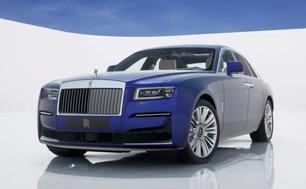
What's the difference?
It’s finally happened: Rolls-Royce has become so divorced from the everyday world of common folk that it's no longer even sharing the previously agreed meanings of words. Rolls has its own meanings, possibly its own language, which must be spoken with a plum on the tongue.
They’ve been heading here for a while. For example, at Rolls, “affordable” means the car we're driving today, the Rolls-Royce Ghost Series II, which is yours for just $680,000 (an indicative price, bumping to $800K for the Black Badge). And “iconic British marque” means, obviously, “BMW bought us in 2003, so there might be some German bits”.
It turns out that “driver-focused” means something different at Rolls-Royce, too. Thanks to a smattering of chassis innovations, Rolls says this updated 2025 Ghost is “the most driver-focused V12 Rolls-Royce ever”. Which is “a side of Ghost’s character that our clients increasingly and enthusiastically embrace”.
Don’t fall for it. The Ghost’s extra focus is not actually very focusy, and its additional dynamism is really only more dynamic in the way that a bed that could corner at all would be more dynamic than a normal bed. None of that matters.
The reason it doesn’t matter is because the Ghost Series II is wonderful. Indeed, it is very nearly perfect. Which is a word that even Rolls won’t quibble over.
Renault chairman and CEO Carlos Ghosn may look like a Bond villain, but rather than threatening to end the world he's intent on saving it.
In October last year he launched Groupe Renault's 'Drive the Future 2022' strategic plan, which included a commitment to "eight pure electric and 12 electrified models as part of the [Renault] range" within five years.
But he didn't mention the head start, because Renault already had several pure electric vehicles in its line-up at that point, including the subject of this review.
In fact, the Renault Zoe has been on sale in France since 2012, and stands as Europe's best-selling electric vehicle.
In late 2017, Renault Australia dipped its toe in the electrified waters (risky...) by bringing the Zoe here within a "business-to-business and business-to-government framework."
And in July this year, due to allegedly popular demand, it was made available to private buyers through "selected dealerships"; currently two in Melbourne, and one each in Sydney, Adelaide, Perth and Brisbane.
Just under $50,000 for a city-sized hatch is hardly cheap, but it's entry-level territory for electric vehicles in this market. And what price can you put on helping to save civilisation as we know it?
Let's find out.
In a disruptive era when the coachbuilder has pivoted to SUVs like the Cullinan, a sort of London black cab that’s been dipped in opulence, and succeeds despite itself, and the brand’s grand, million-dollar EV, the Spectre, the Ghost is a safe and familiar space.
A beautiful, long, broad, immaculate land boat. It’s a space Rolls inhabits with relish.
The Ghost Series II feels nothing like a track-day option when you’re behind the wheel. But it might do if you were stepping out of a Phantom. Or a Cullinan. Or a Wraith. Especially if you’re stepping out of the back doors.
It’s the perfect driver’s car. As long as all your other cars are also Rolls-Royces.
The Renault Zoe is a fun to drive, ultra-efficient, practical little hatch. But the dollar-shaped elephant in the room is its price. Without the government ZEV subsidies offered in other markets, it's wickedly expensive, and with fresh competition in the shape of a new 'normalised' Nissan Leaf coming soon it'll have to work hard to wean more than a handful of small-car buyers off their fossil-fuel addiction.
Yes, its exterior is more monolithic than before. The previous iteration was hardly fiddly, but the (apparently client driven) evolution here edges ever so gracefully towards what Rolls-Royce might secretly think of as brutalism.
The Ghost Series II’s generous 2148mm width is further emphasised up front, stretched across its upright prow, with slimline headlights adding definition and — surprisingly — a touch of villainy.
New, Spectre-inspired tail lamps and a discreetly inscribed double ‘R’ monogram add a reserved flourish from behind, and buyers can choose from two new 22-inch, nine-spoke wheel designs.
It’s subtle, no doubt. But it’s also impeccable.
Renault claims no less than 60 patents came out of the Zoe's development, but while BMW's i3 is as hip as Kendrick Lamar on his third encore, and even Toyota's long-serving Prius hybrid still looks ready to roll onto the set of the next Avengers movie, this little hatch isn't shouty at all.
It seamlessly merges into the automotive landscape. A cute, small car with a few flashy blue bits in its head and tail-lights giving the only clue to its distinctly unusual internals.
Underpinned by the same platform as the Clio (with an identical wheelbase) the Zoe is slightly longer (+21mm), fractionally thinner (-2mm) and quite a bit taller (+114mm) than its conventionally powered sibling.
Lead exterior designer Jean Sémériva has literally left his mark on the car, with a full-size thumb print applied in low-relief to the rear door handles. Nice touch.
And monsieur Sémériva has shown admirable restraint in a cool design combining soft curves around the nose, front guards and rear end, with sharp character lines top and tailing the car's flanks.
Vaguely diamond-shaped tail-lights mix a clear lens cover with those nifty blue highlights and brilliant LEDs for an arresting brake and indicator display.
Open the door and a similar blend of tech and tradition creates a clean and simple interior, with strategically placed bright-metal finishes highlighting key elements.
A broad TFT digital instrument screen sits under a minimalist hood, with the 7.0-inch 'R-Link' multimedia screen dominating a central stack lifted by a shiny black face and an illuminated blue keyline around the heating and ventilation controls.
A printed circuit pictogram on the front headrests and left-hand side of the dash is a creative reminder of the Zoe's means of propulsion. And the front seats feature a decorative curved panel, defined by dark piping on each side of the backrest.
Tech highlights include the TomTom Live nav system's ability to describe a circle showing the car's operational radius on current charge, determining whether you can reach a nominated destination. It also taps you into weather updates, traffic danger zones and Renault Assistance.
Plus, the drive-management system can report on energy usage and assess driving behaviour, so lead foots have nowhere to hide.
Inside, yes, there are bonkers touches in this most refined of automotive spaces, such as upholstery pinpricked by 107,000 'Placed Perforations' of 1.2mm in diameter, each individually examined, that replicate the shape of some clouds spotted over Rolls-Royce's Goodwood HQ.
Beside those flourishes of lunatic opulence, the more practical features feel pedestrian, but they’re comprehensive. The wireless Apple CarPlay and Android Auto, the seamless 'Central Information Display' and the 18-speaker 1400-watt audio, the upgraded Wi-Fi hotspot and the unobtrusive USB-C ports. The rear-seats flush with giant, streaming-optimised screens and heated and ventilated massaging seats.
Rolls acknowledges the generational movement of its clientele from back seat to front, with over 90 per cent of buyers now opting to — gasp! — steer themselves in a Ghost. But with back-seat savoir faire in its DNA, Rolls simply extends its hospitality to every seat.
Like most compact hatches the Zoe offers plenty of space up front and gets a bit squeezy in the back. Although the first surprise is that there's no height adjustment for either front seat.
Happily that wasn't a big issue. At 183cm I was still able to find a good driving position, with storage running to two cupholders (one small, one laughably tiny), plus a pen slot and two oddments trays in the centre console. The second of those trays houses a 12-volt outlet, SD card slot, 'aux-in' jack and USB port.
There are small bottleholders and storage pockets in each front door, a medium-size (7.0-litre) glove box with an open tray above it, and a small tray on the lower part of the dash on the driver's side.
Rear head and legroom is passable for a car of this size, but storage is limited to modest door bins and a single cupholder at the back of the centre console.
However, it's cargo space where the Zoe really raises eyebrows, with 338 litres available (to the parcel shelf) with the single piece rear seatback (as in, it doesn't split-fold) upright.
That's enough to easily swallow our three-piece hard suitcase set (35, 68 and 105 litres), or the CarsGuide pram. In fact, we were able to fit the largest suitcase and the pram at the same time, which is mighty impressive for a city-sized hatch. Push the rear seat flat and space grows to 1225 litres (to the roof), which is heaps.
Carpeting for the boot has been sourced from the cheap 'n' cheerful bin, but there are D-shaped anchor shackles, decent lighting and handy bag hooks back there.
The boot's unlikely volume is partly due to the absence of a spare of any description, a repair/inflator kit being your only option. And in case you were wondering, towing is "prohibited" (Renault's word, not mine).
The Ghost Series II is yours for an indicative price of just $680,000 (or $800K for the Black Badge) plus substantial on-road costs. The Ghost Series II extended (which we didn’t drive at the international launch in Provence) will slip in at around $20K less than the Black Badge before additional charges.
If they seem like big numbers, you’re probably the sort of person who looks at price tags, or who shops in shops that put price tags on things. These are not common traits of Rolls-Royce buyers, who may only be vaguely aware of the actual price of their vehicle, and whose historical impression of guillotines is generally unfavourable.
So, high six-hundreds is table stakes.
But you might also think the ‘standard’ Ghost, like all Rolls-Royces, is considered by most buyers to be a mere starting point, from which they’ll typically up-spec their ride from a sumptuous and expensive options list.
Spending another 10 percent of the purchase price on customisation is a bare-bones outlay for most owners, but even so, the evolved Ghost’s out-of-the-box features are so comprehensive as to be almost overwhelming.
First, because the Ghost has been Rolls-Royce’s driver’s car since the first (modern) generation arrived in 2010, specifically to cater to a weird (for Rolls clientele) new generation of buyers who wanted to drive their Rolls themselves.
So that price gets you, above all, that proven but superb 6.75-litre twin-turbo V12 engine, massaged via an eight-speed transmission and an AWD system that’s as rich and viscous as Crassus’s last libation.
There’s its subtly tinkered 'flight on land' 'Planar Suspension System' (note the unspoken dissonance between the terms ‘flight on land’ and ‘driver-focused'), with an ingenious 'Satellite Aided Transmission' system that uses GPS to pick the ideal gear with which to launch out of turns.
It works hand-in-velvet-glove with Goodwood's 'Flagbearer' camera system, which tracks the road ahead to chide potholes into submission in advance.
Because it’s a Rolls, though, that’s barely even the start of the story.
The coachwork is extraordinary, with new trim options including natural open-pore 'Grey Stained Ash' design elements, a sumptuous new bamboo rayon textile called 'Duality Twill'.
There a night-sky inspired illuminated fascia that apes elements of time-lapse celestial photography, part of the central glass panel that stretches the length of the dash.
Sure, you might expect that level of detail for the outlay. But for the outlay it’s far from missing anything you’d expect.
Built at Renault's Flins plant, 40km west of Paris, on the same line as the Clio, the Zoe's offered in two grades; Life ($47,490, before on-road costs), and Intens ($49,490 BOC) as tested here.
That's big bucks for a little car. At just under $50,000 you're looking at internal-combustion competitors like the Audi A3, BMW 1 Series, and Merc A-Class. And while the Zoe's a long way from spartan, it's an equal distance away from luxurious.
That said, the standard features list includes, climate control (with remote 'pre conditioning' activation), 16-inch 'Black Shadow' alloy rims, cruise control, 3D Arkamys audio (with DAB radio, voice recognition, two 'boomer' speakers, two rear bi-cone speakers, and two tweeters), 'Renault Smartkey' keyless entry and start, auto headlights, and rain-sensing wipers.
Plus, you also get rear parking sensors, a reversing camera, the 7.0-inch 'R-Link' multimedia system (with 'Text to Speech' function), one-touch driver's window (the base Life grade misses this), a leather-trimmed steering wheel and gear knob plus black and grey cloth trim (with snazzy contrast stitching).
The DRLs may be LED but the headlights are halogen (a sure sign of this car's age), Apple CarPlay and Android Auto are MIA, and metallic paint, as per 'our' car's 'Zircon Blue' finish is $550 extra. 'Glacier White' is the only no-cost option from six available shades.
Rolls doesn’t like acceleration figures — too gauche, darling — but armed with that proven 420kW and 850Nm V12, the Ghost Series II has serious heft. Delivering max torque from 1600rpm — just 600rpm above idle — the effect is genuinely of one endless surge, a wafting cloud of momentum that subtly slips between gears as it exudes itself across the countryside.
The Black Badge edition, like all of its, er, ‘disruptive’ ilk offers a ‘Low’ button (‘Low’ means ‘Sport’ in Rollspeak), which bumps gearshift speeds by 50 percent when you plant your foot, and delivers a distinctly non-Rolls-like pop and burble on overrun. It also provides an extra 21kW and 50Nm, because Black Badge is mean and tough.
The Zoe is powered by Renault's R90 synchronous electric motor, producing 68kW from 3000-5000rpm and 225Nm from step-off. Drive goes to the front wheels through a single reduction gear auto transmission.
Claimed acceleration for the city-specific 0-50km/h run is a handy 4.0sec, with the more grown-up 0-100km/h sprint taking a leisurely 13.2sec. Flat biscuit is 135km/h.
Provence is not entirely a driver’s paradise, with every stretch of slightly twisty tarmac only a counterpoint to a motorway lined with Marseille lorries, Depardieu-esque men in tractors who refuse to move to the verge, and small villages where each kerbside corners sit millimetres from the foot of an adjacent boulangerie.
Which is to say it’s neither a place for economy runs, nor a location at which to run up the consumption numbers with a madcap series of impromptu hill climbs.
Our Ghost II drive returned around 16L/100km, which feels about right with that gorilla-in-a-tuxedo 6.75L V12, and is only slightly above the official figures of 15.8L/100km. Not great, could be worse.
None. Next question...
You can have the argument about fuel consumed and source emissions produced in generating the energy required to charge the Zoe's battery, but the fact is this car doesn't consume any fossil fuel and produces zero tailpipe emissions. Helped by the fact it doesn't have a tailpipe.
When launched in 2016, the Zoe's upgraded 41kWh 'Z.E. 40' high-energy lithium-ion battery ranked as the highest energy density automotive unit available.
Developed in collaboration with LG Chem in South Korea, it houses 12 modules (of 16 cells each) for a total of 912 individual cells and weighs in at 305kg.
Renault lists a driving range of 403km for the New European Driving Cycle (NEDC), with a real-world number of 300km a more realistic estimate. And that's almost exactly the range we achieved over a mix of city, suburban and freeway running in seven days with the car. Using overnight electricity rates, a full charge should average less than $8.00.
The Zoe's on-board 'Chameleon' charger allows it to be charged using different power levels (single or three-phase) through the same socket, from 3kW up to 22kW. A Type 2 charging cable (6.5m) for wall box and public charging points (in a natty canvas Z.E. bag) is included with the car.
According to Renault, a wall-box charger (not included with the car) is typically $1600 to $2000 for a residential installation and a mid-range 11kW unit will allow you to charge up in around four hours. High-powered 'Fast' and even juicier 'Rapid' charging points would reduce that time appreciably.
The dash indicator displays charge level and remaining range calculated over the last 200km of driving. A reset function can drop that to an average of the last 30km.
We'll touch on it further in the Driving section but regenerative braking, low-rolling resistance tyres, and 'Eco' mode (reducing air-con load and motor output) are big contributors to maximum range.
And while cabin cooling comes courtesy of a conventional a/c unit, heating is far more exotic. The Zoe's 'Heat Pump' system traps calories in the ambient air outside the car, with a pump compressing and heating them, then directing the heated air into the car, with no impact on range. Super clever.
The Ghost Series II drives like a magic carpet, serene and untroubled; in almost any stable other than that of Rolls, calling it a ‘driver’s car’ would have you throttled by their skunkworks. Everything is relative.
Still, it hides its considerable dimensions well. There’s never any doubt that you’re in a large saloon, as you white-knuckle the Ghost’s impeccably appointed steering wheel, but there’s always enough power to deliver creamily instant throttle response, even in the case of initially misjudged cambers.
Nor can the Black Badge hide the shimmy of that characteristic ‘flight on land’ body drift. The upside is that its manners are impeccable, even through the worst possible pieces of corrugation Provence can deliver.
If anything, the Ghost Series II’s big-hearted bulk adds to the fun factor, especially in some of Rolls-Royce’s more garish colour options, when gasping South of France MAMILs stare in amazement as a bright yellow, five-and-a-half metre Rolls passes them on the outside, scattering their various baguettes and garlands of onions.
Some believe cars have a soul, but the Renault Zoe expresses its feelings with a distinctive accent, the car's 'Z.E. Voice' function giving an audible warning to pedestrians up to 30km/h (when wind and tyre noise take over).
The whirring hum sounds like The Beach Boys warming up the theremin for a rendition of 'Good Vibrations'. Spooky and fun in equal measure.
Like all electric cars the Renault Zoe accelerates quickly from rest, thanks to the motor's ability to deliver maximum torque (225kW) from step off.
At 1480kg (battery 305kg) the Zoe is 177kg lighter than an equivalent Clio, so it's snappy in its natural city habitat, but thrust begins to taper off markedly around the 55-60km/h mark.
The single-speed, reduction gear automatic transmission combines with the motor's sewing-machine smoothness to provide close to perfect drive delivery.
Sitting on the same 'B platform' as the Clio (and 20 other Renault–Nissan–Mitsubishi Alliance models) the Zoe features a strut front, beam rear suspension set-up.
Ride comfort is surprisingly good for such a small hatch, and the battery's location under the floor sets up a centre of gravity 35mm lower than the Clio's, so despite a 59 per cent front/41 per cent rear weight distribution, the car feels well planted in corners.
...the dash graphic – a blue AA-style battery surrounded by rising rings of energy – is reminiscent of 'the machine man' animating in Fritz Lang's Metropolis.
The standard 16-inch alloy wheels are shod with Michelin Energy E-V low-rolling-resistance tyres (195/55), which won't win you pole on a qualifying lap, but are commendably quiet.
There are three driving modes, with the dash graphics aligning to each – Eco (green), Neutral (blue), and Dynamic (violet).
But ECO mode should be reserved for hardcore environmental warriors only. Press the console-mounted button and power from the motor is reduced and air-con output is limited.
It may increase range by a claimed 10 per cent, but what price your sanity? This setting sucks out the car's will to live, and thankfully a second press of the button or pinning the throttle pedal to the floor sees full-strength service resumed. Phew.
The regenerative deceleration and braking system distributes braking force between the clamping of the brake pads and the engine on over-run to maximise battery charge.
While the BMW i3's regen system will have you head-butting the steering wheel (not really) when you get off the throttle, the Zoe's system is more subtle, and watching the dash graphic – a blue AA-style battery surrounded by rising rings of energy – is reminiscent of 'the machine man' animating in Fritz Lang's Metropolis.
Speaking of brakes, the fronts are relatively delicate 258mm vented discs and the 9.0-inch rear drums look like miniature versions of the elaborately fluted units found on 1920s Grand Prix racers. They're beautiful and work well.
Some niggles. The wipers skip and stutter in light rain, the lightweight doors feel clangy when you close them, and the R-Link multimedia system is annoyingly flaky when recognising content (or not) via Bluetooth or USB from a mobile device.
You get airbags, ESC, adaptive cruise, parking sensors and auto parking, and a rear camera. But don’t expect Rolls-Royce to allow the blighters at ANCAP to wreck one.
The Zoe hasn't been assessed by ANCAP but was awarded a maximum five-star ranking by EuroNCAP in 2013, with annual reviews allowing it to maintain that score through to April this year.
Active crash prevention tech includes ABS, EBD, EBA, ESC, traction control, tyre-pressure-loss sensors, rear parking sensors and a reversing camera.
But forget about more recent systems like AEB, lane-keeping assistance, blind-spot monitoring, cross-traffic alerts or adaptive cruise.
Interestingly, the Zoe continuously monitors the state of each cell in the battery pack and will switch off current immediately if it senses an overheating-style abnormality.
If an impact is unavoidable the airbag count runs to six - driver and passenger front, front side (head and thorax), and full-length side curtain.
There are three top tethers and two ISOFIX positions for child seats/baby capsules across the back row, and all seats feature Renault's 'Fix4Sure' anti-submarining design.
According to Renault, the R90 motor is "maintenance-free", waterproof and requires no lubrication, with servicing costs "20 per cent lower than an equivalent ICE (internal combustion engine) vehicle."
Despite that, servicing is recommended every 12 months/30,000km for an estimated cost of $231 each time.
Warranty is three years/unlimited km with 24-hour roadside assist included for the first year, and three after that if you have your car serviced at an authorised Renault dealer.
The battery is covered by a separate five year/100,000km warranty.