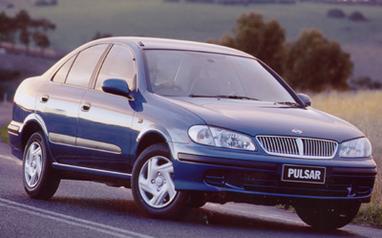
Nissan Pulsar 2001 Problems

Are you having problems with your 2001 Nissan Pulsar? Let our team of motoring experts keep you up to date with all of the latest 2001 Nissan Pulsar issues & faults. We have gathered all of the most frequently asked questions and problems relating to the 2001 Nissan Pulsar in one spot to help you decide if it's a smart buy.

Used Nissan Pulsar N16 review: 2000-2006
By Graham Smith · 03 Jul 2009
You have to wonder about car companies that dump a name that has become popular and replace it with a name that no one knows. Ford did it with the Laser, a top selling small car, and then had to watch as its small car sales dropped dramatically, and Nissan did it when it replaced the popular Pulsar with the oddly named Tiida.The Pulsar nameplate dates back to 1980 and over the years earned a reputation for solid reliability, good value for money and economy of operation. By the time the N16, the last of the line, was released in 2000 it was a well-equipped, good-sized small car that performed well, was economical and gave little trouble.If it had a problem perhaps it was that it had become tired. It was a car for those of us with grey, or no, hair, and not hip enough to appeal to younger buyers.MODEL WATCH The N16 Pulsar sedans were built in Japan and were the first launched in 2000, while the five-door hatchbacks came from England and arrived in the middle of 2001. It was no beacon of contemporary style, admittedly, but it was good looking with pleasant proportions and clean lines. Perhaps it was too ‘nice’ and didn’t have the sort of edge young buyers wanted.There were four versions of the sedan at launch, starting with the LX and working up through the ST, sporty Q and luxury Ti. When the hatchback came a year later it added ST and Q versions to the range.Like all cars the Pulsar grew larger over time and the N16 was quite a bit bigger than the models that went before it, but that extra size translated into decent interior room. Rear passengers may have suffered a little for space, but those in the front seats enjoyed generous room. Like the exterior there was nothing flashy about the Pulsar’s interior. It had everything you wanted, was laid out logically, and was comfortable.Mechanically the Pulsar was quite a conventional front-wheel drive model. There were two engines on offer. The LX entry-level model had a 1.6-litre double overhead camshaft four with fuel injection, which gave 83 kW and 140 Nm.It was an economical engine, but the 1.8-litre engine that powered the rest of the range had a little more zip and made the best buying. With more performance, thanks to its 92 kW and 161 Nm, the 1.8-litre enabled the Pulsar to stay on the pace in the heavy going around town. Both engines were available with either a five-speed manual gearbox or a four-speed auto.On the road the Pulsar was light and nimble making it a breeze around town and easy to park. Out on the road it was quite composed with a supple suspension that was able to soak up most of what was thrown at it without being upset. The ride was compliant and comfortable for a small car, and its handling was well balanced and secure. It was a good all-rounder.IN THE SHOP The Pulsar has a good reputation for build quality and reliability. Nothing serious seems to go wrong with them, which makes them a good used car buy. When checking look for a service record to make sure of a regular maintenance routine. The Pulsar engines have a chain taking care of the cam timing so there’s no servicing needed.Many Pulsars were used by the rental industry, which usually means they accumulated kilometres quickly and were sometimes driven by uncaring drivers. Bear it in mind that any Pulsar with a higher than normal odometer reading could well have been a renter. Negotiate hard to lower the asking price on a car that appears to have a rental background.IN A CRASH All models have a driver’s airbag, but some also have an airbag for the front passenger, and ABS anti-skid brakes.AT THE PUMP The N16 is generally an economical little car, and well worth considering if you want to cut your fuel bills. On average it should do around 7.5-8.5 L/100 km in general use.LOOK FOR • Pleasant looks• good performing 1.8-litre• low fuel consumption• well built• little goes wrong• good all-rounderTHE BOTTOM LINE Well-built and reliable small car that will cut your fuel bills.RATING 78/100
Read the article
Used Nissan Pulsar review: 2000-2006
By Graham Smith · 17 Jul 2018
While Nissan stuck with what had been a very successful nameplate in Australia and continued to use the Pulsar badge for its new N16 model, it was renamed the Bluebird Sylphy in its homeland.Following the end of local production, the Australian Pulsar was, by 2000, a fully imported model, with sedans sourced from Japan and hatches coming from the UK.The N16 Pulsar was still a small, front-wheel-drive car, but with greater demand for small vehicles from a market rapidly downsizing, the little Nissan grew a little in size and sophistication to better meet this need head on.Compared to the N15 that went before it, the new-generation Pulsar was longer, wider, taller, and better equipped.The N16 Pulsar was launched in sedan form in 2000, and the hatch followed in 2001.Opening the five-model range was the LX, which was only offered as a four-door sedan with a 1.6-litre four-cylinder engine and the option of a four-speed automatic transmission or five-speed manual gearbox.Standard features consisted of air-conditioning, an adjustable steering wheel, remote central locking, power mirrors, power steering, an immobiliser, cloth trim, and a radio/CD player with four speakers.Safety features were limited to seat belt pretensioners and an airbag for the driver.The ST was available as a sedan or hatch; it had a 1.8-litre four-cylinder engine and either a four-speed automatic transmission or five-speed manual gearbox.It was similarly equipped to the LX, but had the extra protection of an airbag for the front seat passenger.The Q was a popular model with its strong value-for-money proposition. It was available as a sedan or hatch, it had a 1.8-litre four-cylinder engine, and the choice of a four-speed automatic transmission or a five-speed manual gearbox.Standard features that made the Q so popular included alloy wheels, power windows, and a rear spoiler.Safety features in the Japan-sourced Q sedan were a driver's airbag and seat belt pretensioners, while the UK-sourced hatch also had an airbag for the front seat passenger.The ST was likewise available as a sedan or hatch; it too had a 1.8-litre engine, and the choice of automatic transmission or manual gearbox.ST standard features included air-conditioning, an adjustable steering wheel, remote central locking, power mirrors, power steering, and a radio/CD player with four speakers.Like the Q, the ST sedan had a driver's airbag and seat belt pretensioners, while the hatch boasted airbags for both the driver and the front seat passenger.The Ti was at the top of the range, and befittingly had the most when it came to standard features.Available only as a sedan, with a 1.8-litre four-cylinder engine, and the choice of automatic transmission or manual gearbox, the Ti boasted climate-control air-conditioning, alloy wheels, remote central locking, immobiliser, power windows and mirrors, power steering, and a radio/CD player with four speakers.It was also the best equipped when it came to safety features; they included airbags for the driver and front seat passenger, seat belt pretensioners, and ABS anti-lock braking.An update in 2003 saw the release of the Series II which introduced a raft of changes across the range.The LX and Ti disappeared from the range, so all models then had 1.8-litre engines, which were revised, and the ST-L was introduced.Only offered in sedan form, the ST-L came with the 1.8-litre engine, and an automatic transmission or manual gearbox.Standard features of the ST-L were air-conditioning, alloy wheels, remote central locking, power windows and mirrors, power steering, and a radio/CD player with four speakers.In other revisions, the ST got standard cruise control, while the Q got ABS braking with electronic brakeforce distribution, larger alloy wheels, and a sporty leather-wrapped steering wheel.Predating Bluetooth, it wasn't possible to connect an iPhone or an Android device, there was no touch screen, sat nav, or parking aids such as a reversing camera, parking sensors, or a park assist system.The spare tyre was full-sized.With its larger dimensions, the N16 offered greater comfort and head and legroom to those in the front or rear seats.The cabin was well laid-out, the materials used had a quality feel and appearance, and the seats were comfortable.The rear seat was a split/fold one to add to the flexibility of the cabin, with plenty of luggage space available when the seat was folded.Cupholders were provided for those in the front.Lap/sash seat belts facilitated the fitment of a baby car seat, but the N16 predated the requirement of ISOFIX mounting points.At the launch of the N16, the entry-level LX model had a 1.6-litre four-cylinder petrol engine, the rest of the range had 1.8-litre four-cylinder engines with 16 valves.That changed in 2003 when the LX was dropped from the Series II range. Thereafter, all models boasted the smooth, flexible performance of the 1.8-litre engine.The 1.6-litre engine was capable of putting out 83kW – 111 horsepower – at its power peak, and 140Nm when at its point of maximum torque.While the 1.6-ltre engine was a smooth, capable little engine, the 1.8-litre engine was the star of the show. At its performance peaks it put 92kW – 123 horsepower – and 161Nm, which endowed it with greater zip, but more importantly better flexibility for smoother driveability.Post 2003, the 1.8-litre engine had slightly reduced peak power of 90kW, but a little more maximum torque of 163Nm. Both engines ran on 91-octane regular unleaded petrol. They were offered with the choice of a five-speed manual gearbox or four-speed automatic transmission - the latter the most popular.With MacPherson strut independent front suspension and a multi-link beam rear suspension, the N16 Pulsar handled, steered, and stopped with assurance.It wasn't sports car precise, but it did what it was intended to do and didn't cause anyone a moment's distress.The 1.6-litre engine used in the LX in the Series I range was nice enough, but it lacked the performance modern day traffic demands. In contrast, the 1.8-litre engine was sufficiently powerful to get the job done in the bustle of town life.There was sufficient torque to deliver the flexibility and smooth driveability that makes the day-to-day driving experience a pleasant one, even with the limitations of a four-speed automatic transmission.For those in the cabin, the ride was comfortable, and there was little wind or road noise to cause any concern.Comprehensive standard safety equipment was bit of a work in progress when the N16 was launched. When released, safety features consisted of an airbag for the driver and seat belt pretensioners - it wasn't until the Series II update in 2003 that a front passenger's airbag became standard.It was a similar tale of woe when it came to the very important ABS anti-lock braking, which only became standard in the Series II update.ANCAP rated the Series II at three (out of five) stars for safety.Owners and mechanics agree the reliability of the N16 Pulsar is exemplary.There is nothing to be concerned about with the N16, even if it's done high mileage, providing it has been well cared for and is in good condition.Nothing beats regular servicing to keep a car in tip-top shape, so it's critical that the seller provides a service record to show their car has been properly maintained.Older cars are often neglected by owners not wanting to spend money on a car they see as of little value. If there's no service record, and the car appears neglected, walk away.Look for signs of wear and tear, such as oil smoke from the exhaust, oil leaks around the engine and transmission, and coolant leaks.The engines have cam timing chains, so there's no requirement for servicing them.Being a conventional automatic transmission, there are none of the issues that have plagued new-tech transmissions like dual-clutch and CVT gearboxes. But it's important as the kilometres climb to check the auto is working smoothly and engaging gears without flaring or hesitation.Nissan covered the N16 Pulsar with a three-year/100,000km warranty when new, and recommended it be serviced every 10,000km or six months.The recommended oil is 5W-30.Capped-price servicing was yet to be introduced, but there's nothing in the N16 Pulsar to make the service costs expensive.The N16 Pulsar is affected by the Takata airbag inflator recall, so check with the seller to see if their car has been recalled. If it hasn't, check with the dealer to see when it will be.If anything crops up, you'll probably find it on our Nissan Pulsar problems page.Belinda Rogers: "I've had my 2004 Pulsar for 14 years and it's still going strong. It's been a real little beauty, and has never let me down."Allan Savage: "We bought our Ti used in 2010. It's now done 420,000 km and has not caused us a moment's trouble."Ellen Chadwick: "I've had my ST for three years now and have found it very practical. There's plenty of room in the back, the doors open wide enough to make it easy for older people to get in and out, and it's cheap to run."Jack Billings: "I've had my ST for two years, and in that time it's cost me nothing apart from regular running expenses. It's a great car for someone wanting cheap transport."Marion Baldwin: "I love my ST, which I bought used in 2013. It's roomy, economical, and is nice to drive."Toyota CorollaSound and reliable, if in tip-top shape.3 starsMazda3A class act and drives nicely, but it can be thirsty.3 stars.Ford FocusA great handler let down by bland interior and lacklustre engine.2.5 stars.Reliable small car, a sensible cheap used buy.Rating: 3.5 stars.
Read the article
Used Nissan Pulsar review: 1995-2001
By Graham Smith · 29 Jan 2009
The SSS badge is a proud one that dates back to the 1960s when Datsun, as it was then known, applied it to its sporty sedans.Cars like the Bluebird SSS were standout tearaways back then, and the most recent SSS, the N15 Pulsar, was a similar standout in its time. The Pulsar SSS was the performance leader in its class.The N14 model that preceded the 1995 N15 was popular with young buyers who wanted the day-to-day practicality of a hatch without giving away anything in the way of performance and handling. The SSS was the answer to their prayers.The N15 Pulsar was an all-new, fifth-generation, model released in 1995. It was longer and wider than its popular predecessor, with a longer wheelbase, which resulted in more leg and shoulder room from front and rear seat passengers.Bigger, and better, the Pulsar was yet another Japanese car that could best be described as bland when it came to its looks.Round, and a little dumpy, the N15 sedan was pleasant if not overly attractive, but the SSS wagon-styled five-door hatch took some time to get used to.It was hard to know whether it should be called a hatch or a wagon, because it more closely resembled a wagon than anything else. One of the more cynical motor noters of the time described it as a “transvestite bread van”.Quirky looks aside the SSS was a serious small sporting hatch with a handy power-to-weight ratio of 10.87 kg/kW in its base form, which was the key to its zippy performance.Power came from Nissan’s SR20DE 2.0-litre double overhead camshaft four-cylinder engine that boasted four valves per cylinder and fuel injection. At its peak it put out 105 kW at 6400 revs and 179 Nm at 4000 revs.That was enough to have the SSS racing to 100 km/h in a little over eight seconds. It would account for the standing 400-metre sprint in about 16.5 seconds, and reach a top speed in excess of 180 km/h. It was indeed a hot hatch.All of that power was transmitted to the front wheels through a slick shifting five-speed manual gearbox. There was also the option of a four-speed auto, but quite why anyone would want one in a hot hatch like the SSS escapes me.The Pulsar’s suspension was a mix of MacPherson Strut at the front and a multilink beam at the back. There were coil springs and anti-roll bars at both ends. Handling was sharp and precise.The steering was rack and pinion with power assistance, and the brakes were discs all round with ABS standard.The sporty picture was finished off with attractive alloy wheels, which came standard with the SSS.Inside there were vibrant new colours for the cloth trim, along with a raft of neat standard features, including a premium four-speaker sound system with CD player, air-conditioning, sports seats, and power windows.A minor Series II update freshened it in 1998 and that can be identified by a revised mesh grille with the Nissan badge fitted to a centre vertical bar.There’s not much that goes wrong with the N15 SSS. The body remains tight with the result that there are few squeaks and rattles, the interior trim wears well, and the plastics are good quality that don’t fall apart.Mechanically the 2.0-litre motor is a gem and gives little trouble. Jerry Newman of Nissan specialists, the Cheltenham Service Centre, says the cam timing chain can rattle if the car hasn’t been serviced regularly and according to Nissan’s recommendations. Timing chain rattle can also develop at high mileage, but the noise is more a nuisance than a sign of impending doom.Newman also says it’s important to use the Nissan recommended 7.5/50W oil or an equivalent, as heavier oils can tend to clog the engine internals and lead to damage.The drivelines are generally trouble free, but be sure to check the CV joint boots that can crack and split. Let go they can lead to more expensive failure of the drive shafts.Dominic Sequeira owns a 1998 N15 Series 2 Pulsar SSS with 75,000 km on the odometer. It’s comfortable for daily driving, has plenty of grunt and is just the right size to weave in between gaps in traffic. He has had no problems with it, but says it can be thirsty if driven hard and it prefers premium unleaded.Glen (surname withheld) owns a 1999 SSS manual 2.0-litre Pulsar hatch, which he says has been totally reliable. It is economical and has excellent performance around town and responds well to mild revving to give a nice ‘kick in the back’ for an engine of its size and age.Kay Hamer-Finn’s 1999 SSS has done 90,000 km without the need for any major work. As president of the Nissan Datsun Sports Owners Club, Kay regularly competes in club events, and says her SSS has stood up well, it still has the original clutch, and there have been no engine problems to date.David Sporle says the N15 was a good car, but not great. It was where the cost cutting measures started to show, with Nissan deleting things like fully adjustable seats, leather around the gear stick, and other small touches that made the previous Pulsar feel like a $30,000-plus car.Ian Bock bought his Nissan Pulsar SSS new in 1999. It now has done 113,000 km and has been very reliable, although he was disappointed that the front discs needed replacing at 63,000 km. It returns an average of 9.73 L/100 km.• quirky wagon like styling• larger size means roomier interior• sizzling performance• safe handling• impeccable reliability• timing chain rattle
Read the article
What is my 2001 Nissan Pulsar worth?
Answered by David Morley · 22 Sep 2021

Your car is probably still worth around $4000 to $5000 depending on condition and kilometres. The catch is that you won’t be offered that much if you use the car as a trade-in, and the value I’ve quoted would be to sell the car privately, not back to a car dealer. A lack of demand for good used cars is keeping values a little higher (a lot higher in some cases) than they might have been, so even though your car is still worth decent money, you’ll pay a bit extra for whatever you replace it with.

As far as lifespan goes, that has a lot more to do with maintenance than any other factor. If your car has been serviced by the book, there’s every chance it could last for 200,000 to 250,000km and perhaps even more. But I’ve also seen neglected cars die incredibly young.

Nissan Pulsar 2001: Check engine light
Answered by Graham Smith · 25 Jan 2019

It could be a fault with the computer, but I would have it investigated rather write it off as a computer glitch. You could have a problem with the cooling system, so I would have a mechanic investigate it.

Nissan Pulsar 2001: Can I use E5?
Answered by CarsGuide team · 03 Feb 2006

I WOULD have no concern about running your car on E5, or E10 for that matter. The amount of ethanol is so small it won't cause you any trouble. Nissan is being cautious. It doesn't want to open itself to claims later if owners have a problem.

Nissan Pulsar 2001: Can overdrive be recalibrated?
Answered by CarsGuide team · 27 Jul 2010

The dealer’s advice is correct that your transmission is working normally as it should. Nissan specialist Jerry Newman told us there is no quick fix that would enable the transmission to select fourth as you would like it to.

How can I know if a used car's odometer has been tampered with?
Answered by Graham Smith · 23 Dec 2016

You are right to be suspicious when on average a car of that age would have done well over 200,000 km. Check the car's service book to see when and at what odometer readings the car has been serviced since it was new. That should give you an idea if the odometer is correct. With so little use it should be pristine inside with little wear on the seats and the carpets.

Nissan Pulsar 2001: Is my car running on bad fuel?
Answered by Graham Smith · 14 Sep 2018

It could be due to bad fuel. Run it out as best you can, or drain the tank, and refill with fresh fuel from another servo, preferably one that sells a lot of fuel so you can be confident the fuel is fresh.

If it still does it then look for other causes, such as fuel filter, fuel pump, air filter, throttle body, spark plugs.

Nissan Pulsar 2001: Faulty temperature gauge
Answered by Graham Smith · 09 Jun 2017

It’s unlikely to be electrical, or the gauge itself. It’s more likely to be the thermostat, but before you do anything make sure the cooling system is filled to the full mark.

Disclaimer: You acknowledge and agree that all answers are provided as a general guide only and should not be relied upon as bespoke advice. Carsguide is not liable for the accuracy of any information provided in the answers.
Have a new question for the CarsGuide team?
More than 9,000 questions asked and answered.
Complete guide to Nissan Pulsar 2001
Complete guide to Nissan Pulsar 2001 CarsGuide Logo
Reviews, price, specs and more