What's the difference?
Mini and electricity were always destined to be together. Of course a sporty, prestigious and quirky little car favoured by urban dwellers was going to be the perfect match for an electric powertrain.
And while the Aceman SUV isn't the first fully electric vehicle for the brand it is a welcome addition that's quintessentially Mini, even if it is made in China.
The Aceman fills the gap between the Mini Cooper hatch and Countryman SUV and rivals a range of small electric premium SUVs such as the Alfa Romeo Junior and even the Volvo EX30.
The variant of this four-door, five-seater Aceman we are testing is the SE.
The all-new PV5 Cargo is Kia’s first full-electric van which expands the popular Korean brand’s growing electrified vehicle range into Australia’s light commercial vehicle (LCV) segment.
Designed from the ground up on Kia’s new E-GMP.S chassis platform, which is specifically designed for current and future electric LCV applications, the PV5 eliminates the compromises often associated with adapted internal combustion engine (ICE) platforms to optimise interior space, ease of loading and drivetrain efficiency with 400km-plus driving range.
It has not only won the prestigious 2026 International Van of the Year award but its compact dimensions also carve out a new niche for buyers wanting a vehicle larger than a small van (under 2.5-tonne GVM) but more compact than a mid-size one (2.5 to 3.5-tonne GVM).
We recently spent a working week behind the wheel to see if this purpose-built full-electric newcomer has what it takes to win over Aussie van buyers.
The Aceman could be the perfect Mini - bigger than a Cooper, smaller than a Countryman. It’s also surprisingly spacious and practical. The price is about right compared to rivals, and so is the battery size and range.
What the Mini has that others don’t is its unique and playful design and ‘attitude’. True to the Mini ethos it's not a restrained car, it’s whimsical in its design but serious in its ability. It's a great car to drive both dynamically and in terms of comfort.
The PV5 Cargo has been designed from scratch as a full-electric van resulting in a refined and sophisticated workhorse that's enjoyable to drive. Its modest cargo volume won’t suit all mid-size van buyers but its compact dimensions, clever cabin design with ample storage, zero 'tailpipe' emissions, 3.6kW V2L practicality and long service intervals should make it well suited to a wide variety of working roles.
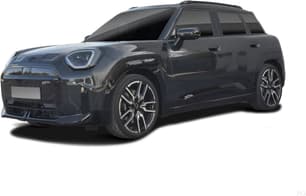
New Minis are all about design, sometimes, in my opinion, to a fault. The Aceman is very 'Mini' with its big googly eyes, little rectangular ‘grille’, blob-like tail-lights and a side profile that resembles a house brick.
That’s how all new Minis look with each model having its own distinguishing characteristics. In the Aceman's case it has more triangular headlights than the Cooper and Countryman but more rounded tail-lights and black plastic cladding around the lower grille, wheel arches and side skirts.
Our test car is painted 'Blazing Blue', with a black roof.
Inside the upholstery is 'Vescin Dark Petrol', a kind of grey blue. The stitched dash is made of recycled polyester and is knitted in 'Dark Petrol' and orange fabric.
I like Mini interiors and I love the multitude of buttons for everything. It's a refreshing change in a world where physical dials and controls are disappearing from car cabins.
The circular OLED screen is pretty and a hat-tip to early Minis with their centre speedo.
Is the Aceman an SUV or hatch? I honestly don’t know and I’ve lived with it for a week. It’s officially classified as an SUV, but it looks like a four-door hatchback with a slightly raised ride height.
If anything the Aceman looks like a cross between the Cooper and the Countryman, not quite a hatch, not quite an SUV, but probably just right for most people.
The Aceman’s dimensions make this car seem small at 4070mm long, 1754mm wide and 1514mm tall, but considering the fairly diminutive exterior the inside is impressively spacious.
The PV5 Cargo’s exterior styling is clean and boxy with a practical appearance that embraces Kia’s signature ‘Tiger Face’ design language, including distinctive LED daytime running lights that extend into the windscreen pillars. Its slippery aerodynamic drag co-efficient of just 0.286 Cd would be impressive for a passenger car and outstanding for a commercial van in optimising energy efficiency (see driving range).
The minimalist cabin design is spacious and practical with a fabric-trimmed pair of bucket seats and a dash that’s free of protrusions to allow drivers ‘walk through’ access to the passenger door, which is appealing for delivery work.
The PV5’s compact 4695mm overall length is not only more than half a metre shorter than the Toyota HiAce but also slightly shorter than a Peugeot Partner LWB small van, so it makes light work of accessing tight parking spaces.
It also rides on a 2995mm wheelbase with a compact 11-metre turning circle to enable easy manoeuvering in confined spaces. And the PV5’s 1899mm height is almost 100mm lower than the HiAce, providing more clearance in height restricted areas like multi-storey car parks which is handy if carrying loads on the roof.
The front motor/front-wheel drive layout also eliminates the need for a driveshaft to the rear wheels, resulting in a conspicuously low floor height of only 419mm for easier loading and generous internal load height (see Practicality).
OK, the moment I typed the word 'spacious’ in that previous section on Design I had a concern. You might think the Aceman is somehow huge on the inside, but it’s not. What it is, however, is cleverly designed so as to maximise the available space and at 188cm tall I’m a good test for this.
Space up front for me in the driver’s seat is excellent, and that goes for head, elbow and legroom. The second row is cramped for me and I can’t sit behind my driving position, but my children were happy back there - one almost a teenager and the other in a child seat.
Storage is good with door pockets, a tray for rear passengers with USB ports, cupholders up front and a wireless charging nook, plus a small box with a lid between the front seats.
The boot has a 300-litre cargo capacity which isn't bad given the car’s size.
Where is the Mini Aceman made? Yes, as I said in the intro the Aceman is made in China as a joint venture between GWM and BMW.
You knew BMW owns Mini right? Of course you did.
But as for being made in China, don’t let that put you off. Some of the best electric cars I've driven all come from China and the worst… not from China.
Its 1910kg kerb weight is relatively light for a full-electric van which when deducted from its 2650kg GVM results in a 740kg payload. It’s also rated to tow up to 750kg of (braked or unbraked) trailer which although small compared to diesel rivals is probably not a high priority for electric van buyers.
The cargo bay’s key dimensions are 2250mm in length and 1565mm in width with its low floor allowing 1520mm of internal load height, which surprisingly is 180mm more than the HiAce and superior to Transit Custom and Staria Load despite the PV5’s lower roof height.
However, its compact dimensions also result in a cargo bay load volume of 4420 litres (VDA) or just over 4.4 cubic metres which is less than major mid-size rivals (typically around low-5.0 to high-6.0 cubic metres) so it may not suit buyers requiring higher load volumes.
Even so, according to our tape measure the PV5 should just fit a standard 1165mm-square Aussie pallet or two 800 x 1200mm Euro pallets with the rear pallet loaded longitudinally, given the relatively narrow 920mm floor width between the rear wheel housings dictated by the low-riding suspension architecture.
High build quality is evident throughout the solid-walled cargo bay which is accessed via sliding doors on each side with 775mm openings (so no side pallet loading) or from the rear through twin-swing doors with 180-degree opening to optimise forklift and loading dock access. No swing-up tailgate option is available.
The walls and doors are lined to mid-height and the load floor is equipped with eight sturdy load anchorage points. There’s also bright LED lighting and a 3.6kW V2L three-pin wall socket behind a neat sliding cover.
Abundant storage is evident throughout the well-designed cabin, including three tiers in each door with the largest central bins providing twin bottle holders.
The dash has a sizeable clamshell-lid compartment ahead of the driver with its own USB-C port, along with a glove box and central fascia offering two more USB-C ports, A 12V socket, wireless phone charging and a large drawer at floor level.
There’s also storage compartments under each seat and lidded underfloor storage in both footwells, plus a sizeable console between the seats containing two cup holders and a large bin. An unusual but welcome inclusion is bins behind each seat, which are ideal for storing items like the portable AC charger/cable bag.
Shortly after the Aceman launched around a year ago Mini dropped the base E grade, leaving the SE and spicy JCW as the only grades left.
The Aceman SE lists for $60,990 before on-road costs. Another five grand will get you into the high-performance Aceman JCW.
Frankly, the SE feels plenty powerful and sporty and the features list is also plentiful.
Standard gear includes 19-inch alloy wheels, proximity unlocking, panoramic glass roof, black roof rails, JCW bucket-style sport seats, a Harman Kardon sound system, 240mm circular OLED central media display, digital radio, head-up display, wireless Apple CarPlay and Android Auto, wireless phone charging, sat nav, ambient lighting, LED headlights and tail-lights.
The interior fabrics and colour styling show in the images are all standard, too.
The value is good considering the Mini Aceman is a prestige car, and you’ll pay a similar amount for entry-grade rivals such as Alfa Romeo's Junior, Volvo’s EX30 and the Zeekr X.
The PV5 Cargo is available only in Clear White paint and S model specification. It comes standard with a single electric motor, single-speed automatic transmission and long range 71.2kWh propulsion battery for a list price of $55,990, before on-road costs.
That pricing is higher than full-electric mid-size rivals from China like the Farizon V7E ($53,990, drive-away) and LDV eDeliver 5 SWB ($52,621, drive-away) but substantially lower than Volkswagen’s ID. Buzz Cargo ($69,990) and Ford’s E-Transit Custom Trend ($77,890).
It’s also in the same ballpark as established diesel rivals including the Ford Transit Custom Trend SWB Auto ($58,990) and Hyundai Staria Load Auto ($49,990) plus Toyota’s HiAce LWB ($53,880) which rules the roost in the mid-size van segment.
The PV5 Cargo comes well prepared for work duties with standard equipment including:
The Mini Aceman is fully electric and while there is talk of a combustion version coming in the future, whether that happens or not is yet to be confirmed. Besides, an electric powertrain is perfect for the Aceman.
In the SE grade the single electric motor drives the front wheels and makes 160kW and 330Nm which is enough to fling the little rectangular beastie from 0-100km/h in 7.1 seconds.
Just as a comparison the five-door Mini Cooper S has a combustion engine that makes 150kW and 300Nm and 0-100km/h comes in 6.8 seconds.
The PV5 Cargo is powered by a front-mounted electric motor that produces up to 120kW of power and 250Nm of torque, which drives the front wheels through a single-speed automatic transmission.
This drivetrain offers three selectable drive modes comprising ‘Normal’, ‘Eco’ and ‘Snow’ plus adjustment of regenerative braking intensity/battery replenishment using the steering wheel-mounted paddles.
These include levels from L1 to L3 topped by the premium ‘i-Pedal’ setting, which allows convenient one-pedal driving that makes the brake pedal largely redundant.
The Aceman has a 49.2kWh battery which sounds small and it is compared with larger cars, but is the same size as similar vehicles such as the Volvo EX30 (49kWh) and Alfa Romeo Junior Elettrica (51kWh).
The DC charge rate of 95kW is disappointingly slow. The EX30 has up to 153kW. The AC charging speed is a standard 11kW.
Charging from 10-80 per cent using a DC charger takes 31 minutes.
Energy consumption is 14.4kWh/100km over combined driving conditions which is neither excessive nor super efficient. My own driving saw 15.4kWh, according to the trip computer.
Range is up to 406km, which also is close to rivals but could be better.
The PV5 Cargo is equipped with a lithium-ion NCM (Nickel Cobalt Manganese) 71.2kWh long-range propulsion battery mounted under the load floor which Kia claims has (WLTP) combined average consumption of 19.1kWh/100km and up to 416km of driving range.
Only the much higher priced VW ID Buzz Cargo has a longer range and not by much (431km). All other full-electric vans have ranges starting with a two or three.
The PV5 uses a Type 2 CCS charge port capable of AC and DC charging. Kia claims charging from 10-100 per cent in around six hours 30 minutes using an 11kW AC wall-box, which is ideal for overnight charging. Alternatively, 10-80 per cent with a 50kW DC fast charger takes around one hour, which drops to only half an hour with a 350kW DC charger.
Our test vehicle had 100 per cent charge at the start of our week-long test, during which we initially drove 197km unladen in busy metro traffic with 44 per cent charge and 199km range remaining. Using the portable AC charger/cable with three-pin domestic plug, we charged at home which provided enough battery top-up to cover the remainder of the test.
Our total test distance was 293km which including more than 50km hauling its maximum payload. Even so, we managed average consumption of 17.4kWh/100km across the week which was lower than Kia’s official figure and no doubt enhanced by consistent use of either (L3) high regen or one-pedal settings.
So, based on our test figures, Kia’s claim of up to 416km from a single charge is credible and impressive efficiency for a full-electric van in real-world use.
There’s not a Mini model I haven’t driven in the past 15 years and the Aceman lives up to the sporty and engaging feel that makes these little cars fun to pilot, even if it’s just down the road to get milk.
Good, instant acceleration, quick steering that’s a little on the heavy side and a comfortable suspension tune that can handle quick corners while keeping the car flat makes the Aceman a liveable and enjoyable car.
A range of noises - Mini calls it a 'Sonic Universe' - provides a soundtrack to your driving and while they’re all a bit embarrassing, only one can be heard outside the vehicle and it’s not too cringeworthy.
The Mini Aceman drives like a small, sporty prestige car, meaning there’s a solid, planted feel with good handling and comfort to go with it.
And its tiny proportions makes it super easy to pilot through tight laneways and park in impossibly small places.
The cabin ergonomics are excellent even for tall people, as they provide a car-like driving position enhanced by numerous comfort features including a fold-down inboard armrest, power adjustable lumbar support, large left footrest and well-placed padded elbow rests on the doors.
There’s also ample headroom and the flat-bottom steering wheel ensures easy boarding with plenty of torso room. Glazed inserts within the windscreen pillars combined with a low beltline and large door windows provide a bright and airy ambience with excellent driver visibility.
Despite being a solid-walled van with no rear vision for its central mirror (it’s only fitted to meet ADRs) all-around vision for the driver is excellent thanks to large door mirrors and numerous active safety systems including multiple parking sensors and camera monitoring.
Kia’s local ride/handling team has done a commendable job in combining load-carrying practicality with a smooth and supple ride, car-like handling and nice steering feel which provides a level of driver enjoyment not usually associated with commercial vans.
We found the i-Pedal mode appealing given its ability to require only one-pedal driving most of the time while optimising battery charge/driving range.
Although the PV5’s 120kW/250Nm outputs are modest on paper, its relatively light kerb weight combined with near instant torque reaction from its electric motor results in energetic response from standing starts, with 0-100km/h acceleration that matches its diesel rivals.
It’s also very quiet thanks to its electric drivetrain combined with the cabin bulkhead which largely insulates the driver from the cargo bay’s rear tyre noise, which is typically the loudest noise path in commercial vans.
To test its GVM rating we used a forklift (fitted with long tynes) to load 650kg into the front of the cargo bay through the rear doors, which with driver equalled a total payload of 740kg that was right on its payload limit. The rear suspension only compressed 33mm under this weight.
Acceleration was slightly subdued as you'd expect but more than adequate for keeping this big payload moving without feeling sluggish. Handling response was barely affected, with the supple rear suspension ensuring no bottoming out over bumps.
Average energy consumption displayed on-screen barely increased under this load which was hauled mostly on metro roads. However, greater increases could occur if carrying similar loads in hilly terrain, strong headwinds, towing etc.
Overall, the PV5 Cargo is hard to fault from a driver’s point of view apart from the cabin’s climate settings being controlled by relatively small central touchscreen prompts, which can be tricky at times for large fingers to operate while driving compared to physical buttons and dials.
The Mini Aceman was awarded the maximum five-star ANCAP rating in 2025. The safety equipment list is vast and includes tech from auto emergency braking (AEB), lane keeping assistance and blind spot warning to rear cross-traffic alert with braking, exit warning and auto parking.
The Aceman has a puncture repair kit in the place of a spare tyre.
For child seats there are two ISOFIX points and three top tether anchor points.
The PV5 Cargo has earned the highest Platinum rating in ANCAP’s Commercial Van Safety Comparison and comes loaded with benchmark passive and active safety features including multiple airbags, autonomous emergency braking (AEB) with car/pedestrian/cyclist/junction turning detection, autonomous blind-spot and rear cross-traffic collision avoidance, lane-keeping, highway driving assist, front/side/rear parking sensors, blind-spot and surround view monitors, reversing camera with dynamic parking guidelines, rain-sensing wipers, full LED lighting including DRLs and more.
Mini covers the Aceman with a five-year/unlimited kilometre warranty and while that's the standard for prestige makers such as BMW and Mercedes-Benz, it falls short of mainstream coverage with some brands now offering seven years or more of coverage.
The Aceman’s battery is covered by an eight-year/100,000km warranty, which is the norm right across the industry.
Mini has conditions-based servicing so rather than a specific schedule, the car's computer will tell you when it is due for a service.
Mini offers owners pre-paid service packages priced from $1575 for four years and $2360 for six years.
Comes standard with a seven years/150,000km warranty plus a separate warranty of the same duration covering the propulsion battery. Roadside assist for up to eight years is also available if serviced at an authorised Kia dealer.
Scheduled servicing is every 24 months/30,000km whichever occurs first, with Kia offering a pre-paid service plan covering the first four scheduled services up to four years/120,000km which totals $2246 or an average of $562 per service. This is one of the strongest warranty/service packages offered for a full-electric van, backed by a national network of more than 150 Kia dealers across all states and territories.