What's the difference?
A number of established small cars are becoming more expensive and less popular. The Toyota Yaris, Mazda2 and Suzuki Swift were once the go-to first car, but now start at around $25,000.
This repositioning was great for MG and its sub-$20,000 MG3, which has spent much of the last few years as Australia's most popular light car. It’s hard to deny a low price will open many wallets.
But now in its new generation, the MG3 is thousands of dollars more expensive than before, starting in the mid-$20K range and headed even further up with a new hybrid drivetrain option. We jump in the base petrol Excite to find out if the value is still there for this British-branded, Chinese-built hatchback.
Up until 2024 when its title was nabbed by the Tesla Model Y, the humble Toyota Corolla has been the world’s best-selling car for quite some time.
A reputation for reliability, affordability, efficiency and in its current guise, being fun to drive, the Corolla has seen off all comers to retain the title of the most popular small car on Earth.
The current twelfth-generation Corolla is now seven years into its life cycle having landed in mid-2018. In that time scores of buyers have moved across into small SUVs, and the Corolla’s competitor set has shrunk dramatically as car brands pull out of the small passenger car segment.
But as we gear up for the next-gen Corolla, is the existing one still worth considering against some newer rivals? And should you look at this instead of a small SUV?
I lived with the mid-range Corolla SX hatchback for a week to find out.
The MG3 still makes a strong argument for a low-cost, low-fuss option just like the models it now beats on price (Yaris, Mazda2, etc) used to.
While it also falls short in some areas like dynamics when pushed, the improvements to interior tech and comfort mean the MG3 should be considered if you're looking for a city runabout.
However, with the MG3’s price jump, rivals from Japanese and Korean brands are closer in cost than they were for the sub-$20K first-gen MG3, and their ability to handle Australia’s conditions outside the city mean they’ll prove a more useful long-term companion for many.
The MG3 nails its brief as a convincing option for first-car buyers or as a second runabout when there’s another option for long trips. It has taken a big step up from the ‘budget-friendly’ vibe of the original.
The final score for this review makes it look as though the Corolla is a middling effort. The scores for each individual section of the review are well considered and fair. The Corolla does lack the practicality of some of its rivals. A lack of an ANCAP rating isn’t great and the powertrain is just okay. But it remains one of the most fun-to-drive hatchbacks on the market today, even seven years into its life, and I would wholeheartedly recommend the Corolla to anyone looking for a small car. If you can forgive some of the quirks, it is a reliable, adorable, fun and efficient small car favourite.
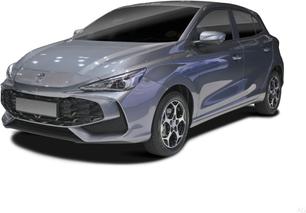
Following the new design language pioneered here by the MG5 sedan and MG4 electric hatch, the MG3 looks like it’s trying for a sportier vibe than its predecessor, and maybe even a hint of European flair.
A grinning front grille and pointed set of headlights are followed around the side by a couple of body creases that give the hatchback a sweeping look, an attempt perhaps to seem longer than it is.
It doesn’t look like any of its rivals, unlike the MG5 which is easily mistaken for a small Mercedes CLA at glance.
Here on our Dover White test car, some angles are unflattering (it's giving 'hire car'), though the model’s available Diamond Red or Brighton Blue are fairly distinctive. Yes, some of the colours reference the brand’s UK heritage, despite being built in China.
Inside, the cabin benefits from a fairly tidy layout, with some genuinely thoughtful attempts at making the otherwise budget-focused model feel a little nice. A cross-hatch design through the dash mirrors, the seat stitching and the steering wheel and its buttons are nicely angular.
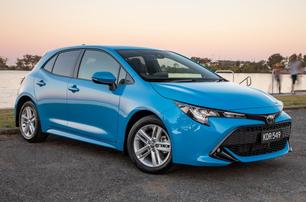
It’s been around for a good seven years, but the current-gen Corolla hatch is still a smart design. It has a squat stance and looks as though it has sporty intentions (it doesn’t), and the head and tail-light treatment doesn’t look like anything else in the segment.
The Corolla has adorable proportions and a pert little behind in a sea of increasingly boring small SUVs.
However, in SX trim and in the ‘Sunstone Orange’ body colour of my test car, the Corolla gives off rental car vibes. Which is hardly surprising given lower grade Corollas are a favourite of rental companies.
Inside that vibe continues. This is where the Corolla is really showing its age.
There are various shades of grey throughout the cabin, with a mix of hard and soft plastics. The cloth seat trim is drab, which is a shame because some other brands have managed to make cloth cool again. Not Toyota.
The touchscreen sticks up out the top of the dash like an old iPad and the dash design is old but functional.
There is nothing inspiring about this interior design. In saying that, of those aforementioned rivals, only the Mazda3 and the new Kia K4 have modern cabins.
That tidy design inside helps when it comes to making use of the space, as well as offering some generous storage spaces.
For starters, while the clean layout means the screen looks like the main point of access for much of the car’s function, there’s an all-important shortcut button for the climate control which means you don't waste time navigating to the vent and temperature controls.
The only issue is that while my phone was connected to the system for Android Auto, I had to navigate away from the mirroring screen back to the MG3’s home screen before being able to shortcut to the climate settings.
Demister and volume control buttons are also present, but the screen itself has an easy-to-navigate menu.
The steering wheel controls are similarly straightforward and clearly labelled, while the driver display is tidy and shows important information clearly.
While the steering wheel isn’t telescopically adjustable, it's easy to find a comfortable seating position thanks to the adjustability of the seats. The material on the seats doesn't feel rough or cheap.
Behind that, there is enough space for my 178cm frame in the second row for the most part, but headroom isn’t incredibly generous.
The rear pew is a single unit, rather than a 60/40 split, so the whole backrest folds down if you need to load anything long through the boot. There’s not even an armrest or little ski hatch for long, thin items.
Its 293-litre boot isn’t small, and there’s a space-saver spare tyre in both petrol variants, but the hybrids are stuck with repair kits.
The Corolla is a small car and that is evident inside. You might bump elbows with your front passenger, but I have no problem with the front leg or headroom.
Those cloth seats might be drab but boy they are comfy, and the fronts have loads of side bolstering.
The steering wheel has typically clear controls and looks and feels nice.
As a more, shall we say seasoned model in the segment, the Corolla still has buttons on the dash for things like air con, but not too many. That bulbous centre stack and the centre console, however, could be better designed for the space.
As it is, the wireless charging pad is hidden under it at the far end of the console. It’s a bit fiddly to get your phone in and out. This is also where one of the USB-C ports lives.
The other one is in the central storage bin which is quite small, but also houses a 12-volt outlet. There are no other places to store things because of the rounded shape of the console, which also features a couple of narrow cupholders.
OurCarsGuide bottle had to be squeezed into the door storage cavity - only narrow, short vessels will fit properly.
That 8.0-inch multimedia screen is very easy to navigate, with logical menus and icons. However, it’s almost too basic, which is not helped by the all-white background. It could be a more engaging set-up but it’s also very hard to fault the functionality. Our Apple CarPlay maintained its connection the whole time with the car, too.
Space is quite tight in the rear, although I have enough headroom for my 184cm frame. Legroom is just okay behind my driving position. There’s more space in the back of a Hyundai i30. It’s also dark because of smallish rear windows and thick C-pillars.
The rear seat backrest is quite upright, but, like the front seats, well cushioned.
Amenities are just average back there - there’s a weird cupholder high on the door, only a passenger side map pocket, no rear air vents and no USB ports, although you could easily use the one housed in the front central bin. There’s a rear fold-down armrest with two cupholders.
The rear seats split and fold 60/40 and they fold flat making for a better loading space.
The good news is the SX (and the base Ascent Sport) come standard with a temporary spare wheel, which is great news for a hybrid model. The bad news is, that reduces boot space to a paltry 217 litres.
That’s off the pace of all of its key hatchback rivals, including the Mazda3 which has its own cargo concerns at 295L, and the Hyundai i30 with 395L.
The Corolla ZR hatch has more space at 333L but you only get a tyre repair kit instead of a temporary spare.
If you’re dead set on a Corolla but need more cargo space, consider the smart looking sedan that has 470 litres.
Even though it’s now more expensive with its $23,990 before on-roads price, it’s hard to deny the petrol-only MG3 Excite is a compelling offering when it comes to inexpensive runabouts.
Not only has the price been bumped up, but so has the apparent interior quality and features list.
A new 13.25-inch multimedia touchscreen is paired with a 7.0-inch driver display and both look pretty slick for the price point and operate well.
Apple CarPlay and Android Auto are both available, but are wired only and can’t be accessed with a Bluetooth connection, while a six-speaker sound system handles entertainment duties.
In terms of seating and material, the Excite gets cloth pews with some contrast stitching.
On the outside, folding mirrors and a set of 16-inch alloy wheels join the new MG3’s design, while this base model Excite is left with halogen headlights like it’s 2015.
The Essence scores a set of LED units and is otherwise distinguishable by its sunroof, though it shares the same wheels as our base car, so it won’t feel like you’re missing out on heaps.
Toyota dropped all exclusively internal combustion engine versions of passenger car models and car-based SUVs last year so the Corolla is now hybrid-only.
The grade we tested is the SX five-door hatchback which is priced from $35,260, before on-road costs. Interestingly, the sedan version, which has a much bigger boot, is $340 cheaper.
The SX sits in the middle of the Corolla range with the Ascent Sport the most affordable (from $32,110) and the ZR the priciest before you get to the fire-breathing GR Corolla hot hatch.
Direct rivals at this approximate price point include the Hyundai i30 N Line ($36,000 BOC), Mazda3 G20 Touring ($37,110), Subaru Impreza 2.0R ($35,490) and the Kia K4 Sport ($35,190), although that is sedan only for now.
You get 16-inch alloy wheels, cloth bucket seats, a synthetic leather steering wheel, auto-dimming rear view mirror, rain-sensing wipers, rear privacy glass, keyless entry and start, dual-zone climate control, USB-C ports, a wireless device charging pad, six-speaker audio, an 8.0-inch colour multimedia display with sat-nav, digital radio, Bluetooth, voice assistant and wireless Apple CarPlay and Android Auto.
The standard features list could be described as adequate without being overly generous for the price. A head-up display (standard in the ZR) would be nice.
On paper, the MG3’s 1.5-litre four-cylinder engine is fairly underwhelming with its 81kW (peaking at 6000rpm) and 142Nm (at 4500rpm).
But these figures, including the engine size and even peak RPMs are not far off the likes of the Mazda2, which is a fairly peppy and fun car despite its lack of grunt.
Keen drivers will, however, be disappointed to hear the MG3 drives the front wheels via a continuously variable transmission (CVT) rather than a traditional torque-converter auto, taking much of the pep out of its power unit.
You can expect to hit 100km/h in a bit over 10 seconds.
Since Toyota dropped the petrol engine from the Corolla range, it’s a hybrid-only affair.
The powerplant is a 1.8-litre naturally aspirated petrol engine paired with Toyota’s fifth-generation hybrid system that incorporates a lithium-ion battery, which is lighter yet more powerful since the 2022 update.
The Corolla drives the front wheels exclusively via a continuously variable transmission (CVT).
It’s not the punchiest engine and could do with more poke, but Toyota does do hybrids well.
MG claims the MG3 uses just 6.0 litres of 91 RON petrol every 100km on the combined fuel cycle, so with its 45-litre tank you can hypothetically bank on a 750km range.
Of course, that might be achievable in lab conditions, but on test we found the trip computer’s estimates looking closer to 500km on a tank for the kind of urban driving it was undertaking with us.
On a dynamic test drive route, the trip computer settled at a displayed consumption figure of 7.7L/100km, but stop-start driving was not great for efficiency, as you'd expect.
According to Toyota the official fuel-use figure for the Corolla hybrid hatch is 4.0-litres per 100 kilometres and CO2 emissions sit at 90g/km.
While the trip computer said 4.8L/100km at the end of our week, my own fuel consumption calculation came to 5.8L.
You will only need 91 RON 'standard' petrol to fill up the Corolla.
The higher quality look and feel of the new MG3 carries through to its day-to-day driving. Some of the car’s Chinese compatriots seem to fall down when it comes to the on-road part, which for some is the most important part of a car.
But for a small city car the MG3 is very user friendly, with light and direct steering, good visibility, and just enough power and torque to not feel like everyone’s getting the green light a couple of seconds earlier than you.
It’s comfortable at urban speeds when it comes to the suspension, and doesn't get rattled too much in the front end by tram tracks or other road imperfections.
In narrow streets, three-point turns aren’t a hassle and the car’s size means it’s easy to reverse parallel park, although the reversing camera takes a second to appear when using phone mirroring.
On the highway, however, and when it comes to high-speed cornering, the MG3 can feel a little uneasy.
The road noise becomes more and more obvious. Driving on well-maintained metro freeways at around 80km/h or above produces unpleasant noise, and a during a particularly breezy week the car felt susceptible to swaying in high wind.
Its power delivery starts to feel lacking out of town, too, and taking corners on fast back roads means plenty of slowing down to avoid the front-end sliding or the feeling of the MG3 leaning unsettlingly around corners.
If you’re considering the MG3 but you need to head out of town regularly, take a proper long test drive before opening your wallet.
But if you just need it as an urban runabout, the MG3 does a fine job.
Most generations of Corollas have been solid, dependable and occasionally, even fun to drive.
My first car was a Holden Nova GS hatchback, which was a rebadged version of the seventh-generation Corolla. I loved that car. It was zippy, fun and super economical.
The same principles generally apply to the current-gen Corolla. Thankfully, Toyota’s former CEO, Akio Toyoda, insisted all models from the Camry to the Kluger needed to be injected with more fun. And he succeeded with the Corolla. So much so that they've spun off a wild GR performance hot hatch version.
The Corolla sits low to the ground and it just feels much more connected to the road than a small SUV can. Even in mid-range SX guise, the Corolla can hug a corner and there is ample grip to ensure a fun drive on your favourite winding road.
Sure, the hybrid powertrain might not set your heart racing, but it is quick enough from a standing start and it lacks the lag of some of its turbocharged contemporaries. There’s also plenty of poke on tap for a small car when overtaking.
Even though it has a sporting edge to how it handles, the Corolla SX has been tuned for comfort first and foremost and this is another area it excels. The damper set-up ensures the Corolla soaks up speed bumps, nasty potholes and whatever else our shoddy roads can throw at it. At no point in my seven days with the Corolla did I complain about a harsh bump or thud.
Steering has a mechanical feel but it is still sharp, adding to the ‘chuckable’ vibe of this hatchback.
The powertrain can be noisy when pushed and combined with a CVT auto it’s the nicest sounding engine out there. Also, the transition from electric to petrol power isn’t particularly smooth. Other carmaker’s hybrid offerings - like Honda for example - are close to seamless.
Some road noise gets into the cabin but it’s no deal breaker.
ANCAP hasn’t tested the MG3 yet, so there’s no crash safety information available. It’s worth noting ANCAP gave the MG5 a zero star score for its lack of active safety equipment, but the MG3 comes with more under its belt than its sedan stablemate.
Six airbags, two front, two side and two curtain, are joined by adaptive cruise control, blind spot detection, rear cross-traffic assist, forward collision warning, lane departure warning, lane keeping assist and speed limit assist.
None of these systems were intrusive on test, though lane-keep assist feels like it could do with some more fine tuning.
The Corolla is currently unrated by crash safety watchdog ANCAP. It did achieve a maximum five-star rating back in 2018 but that expired at the end of last year.
Safety features are largely standard across all grades and the SX comes with auto emergency braking (AEB) with pedestrian and daytime cyclist detection, lane departure alert with steering assist, speed sign recognition, 'Lane Trace Assist', adaptive cruise control, a blind spot monitor with safe exit assist, a rear cross-traffic alert, reversing camera and front and rear parking sensors and a rear occupant alert.
It doesn’t have a driver attention alert, and it’s all the better for it.
The lane keeping aid is well calibrated and subtle in its interventions, but the adaptive cruise let the speed creep several kilometres over the set speed on several occasions.
MG has a 10-year/250,000km warranty which is unmatched in the small-car market.
Servicing is scheduled at every 10,000km or 12-month intervals, with the first seven services averaging out at a fairly hefty $360 - the cheapest being $234 and the priciest $536.
The Corolla is covered by Toyota’s five-year/unlimited kilometre warranty, which, given Kia, MG, GWM, Jaecoo and more have longer terms (not to mention Nissan and Mitsubishi’s conditional 10-year terms) is now officially trailing its competitors.
However, the capped-price servicing plan of up to five years costs just $250 for each service, which is incredibly competitive. The service schedule is every 12 months or 15,000km, whichever occurs first.