What's the difference?
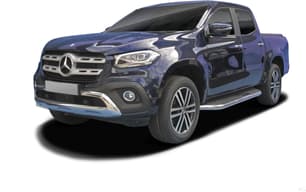
The V6 X-Class is big, bold and bloody expensive – and it has segment-topping safety tech– but its price-tag swiftly climbs above more than $80,000 when you start adding one of the many optional extras and is it really worth that much beyond the cache of the badge? Really?
Sure, the bigger engine is what most potential X-Class buyers were pushing for after the launch of the four-cylinder-powered utes as part of the first-gen X-Class wave, but is there room – or even actual demand – for such a high-priced supposedly luxury ute?
Read on.
I miss my old phone. Sure, my new phone has a bigger screen and it’s smarter and faster, but my previous phone was smaller and easier to use, and now when I go to do a screen shot I accidentally hit the volume button every time.
What I really want in a phone is a new version of the old one – and I have a feeling people may feel the same way about the 2018 Volvo V40.
Some time next year the completely new generation V40 is expected to arrive and there will be some things I’ll miss about the old one. So, this really is your last chance to buy a new ‘old’ Volvo V40.
In a last-hurrah review, I road tested the V40 in the Inscription grade with the T4 petrol engine. What’s so 'missable' about it? Read on to find out.
The V6 X-Class is nice enough to drive on-road and it’s effective enough off-road, but it’s let down by its less-than-impressive interior and those elements combined certainly do not justify such a high price-tag.
Sure, its safety gear is top-notch but the X-Class, even in this V6 guise, feels like a lacklustre attempt at ute greatness, rather than a real effort.
Right now, if you’re in the market for a super-comfortable and capable V6 ute with real class and German precision, check out a top-spec V6 Amarok – and save about $25,000 while you’re at it.
I’m going to miss this V40 like I do my old phone, and for many people this hatch really could really be close to perfect: excellent safety equipment, enjoyable to drive, cool prestige styling and some lo-fi buttons and dials that are far easier to use than swiping a screen. This is your last chance to own an old, new V40.
From the outside, the X-Class looks pretty impressive – it’s chunky and blocky and has a real tough-truck presence.
As mentioned, a fair few of the cool exterior touches are actually paid-for options, and our tester was loaded with these extras and, as a result, looked like a work-or-play ready luxury workhorse.
So, it looks pretty good but, as always, looks can be deceiving and the interior is a very different story.
The V40 has been around forever (well, since 2012) but somehow it still looks great – it’s the Nicole Kidman/Rob Lowe of cars.
The thing is Volvo’s new-generation vehicles now have a different look, which will be worn by the next V40, and that seriously dates the current car.
Sure, in 2016 this V40 was updated and given 'Thor’s Hammer' LED running lights like the new-gen cars, but it’s clear the V40 has the old look.
The question is: are you the type of person who would be annoyed if this time next year somebody in the latest ‘new-look’ V40 pulled up beside you at the lights. If yes, then stop reading now… we’ll just wait a moment for you to leave.
Okay, it’s just us now. We don’t need those shallow people anyway, right? They don’t know what they’re missing out on – like an interior with lots of buttons. I’m serious the centre console actually has a numerical key pad for making phone calls. There are also lots of dials for the climate control and seat warmers and for the auto parking system.
All of these buttons will be replaced by a sexy, large touchscreen in the new V40, which will make the screen in the current one look like the slot in Ned Kelly’s helmet. Wait, don’t leave. See, I’ve road tested the new X60 and I missed just flinging a dial to make the cabin’s temperature cooler, instead I had to go into the screen’s menu, find the climate functions, and then slide my finger down a little digital ladder until I found 21 degrees. It’s a frustrating design and potentially distracting in that it takes your eyes off the road longer than twisting a dial does.
I’ll stop the rant. So, yes, the interior of the new V40 will look so sleek and minimalist, decluttered of its buttons and sporting a large vertical screen, but there are functional advantages to keeping it simple.
That said the current V40’s cabin is still special and elegant. The Inscription grade brings milled aluminium trim to the centre console and that leather steering wheel. Volvo owners would be aware of that solid, well-built feeling with a high-quality fit and finish.
What are the V40’s dimensions? Compared to the Audi A3 Sportback the V40 is 59mm longer at 4369mm end-to-end, 72mm wider at 1857mm across, and 5mm shorter in height at 1420mm.
I’m not a snob about interiors but if I spent almost $90 grand on a ute I’d expect it to have a very high level of fit and finish inside, plenty of storage options and an overall premium feeling inside.
That’s sorely lacking in here.
From the many hard-plastic surfaces, fake leather, brushed-aluminium sections and sort of half-hearted attempts at three-pointed star styling – such as the vents – no part of the interior looks or feels anything like the premium quality you’d expect to find in a Mercedes-Benz.
As for equipment inside, you get the 7.0-inch floating touchscreen and a few other bits and pieces but there are some glaring omissions: you don’t get a reach-adjustable steering wheel, heated seats, or real leather (our tester has the optional black leather seats fitted at a cost of $1750), you don’t get much in the way of storage anywhere, and you don’t get Apple CarPlay or Android Auto – you don’t even get a driver-side grab handle. All of those sort of mod cons, you get in a ute that costs much less than this X-Class.
Room and comfort inside is adequate but a long way from unreal for something so pricey.
Driving position is nice, with plenty of vision all-round, but everyone's seats could do with a bit more cushioning and length in the base.
In the grand tradition of all utes, the rear seat is really the realm of young children and, at a stretch, smaller adults, especially for longer trips in the saddle.
Storage is minimal in the back seat – you don’t even get a drop-down arm-rest with cup-holder.
Umm, next question. Okay, the V40 is not very practical. Those small rear doors don’t open wide, making entry and exit potentially difficult for older or less limber folks.
Legroom in the back is limited – although at 191cm I can just sit behind my driving position and headroom is getting tight, too – but still there’s just enough room for me.
The V40’s cargo capacity is 335 litres and that’s smaller than the A3 Sportback’s boot space (380 litres) and the BMW 1 Series’s luggage capacity (360 litres). The aperture of the boot itself is also small.
There’s even a practicality issue with the driver’s doorway – that windscreen is so slanted that the A-pillars either side of it are hard to dodge for taller people when trying to get in, but especially when climbing out.
The 350d Power ($79,415 plus on-road costs*) is the top-spec variant in a two-variant V6 X-Class range; the other variant is the Progressive, which starts from $73,270 plus on-road costs.
Our tester has a 3.0-litre six-cylinder diesel engine a seven-speed automatic transmission and permanent all-wheel drive system – all from Benz. All of those certainly make a refreshing change from the Navara-based four-cylinder model that preceded this X-Class. (Price as tested is $88,618, including GST plus on-roads.)
Standard gear includes steering-wheel paddle shifters, 19-inch alloy wheels (our tester had the optional 18-inch rim design, part of the $1990 Style Pack), body-coloured exterior parts with chrome accents, fog-lamps, dusk-sensing LED High Performance headlamps, ARTICO/DINAMICA seat upholstery, ARTICO dash and door sill covering with contrast stitching, Electric front seats with lumbar support, front foot-well, vanity and door illumination lamps, dashboard trim in aluminium and black roof liner and more.
Safety gear includes seven airbags, AEB, tyre-pressure-monitoring system, Active Lane Keeping Assist, Hill Start Assist, 360 degree surround-view camera, i-Size child seat anchorages and more.
The roof rails and side steps add to the X-Class’s commanding appearance, but those are part of the optional $1990 Style Pack, they are not standard.
The silver styling bar ($1551) and the tray liner ($899) also look cool– but they’re optional extras.
The Volvo V40 in the mid-range Inscription grade with the T4 engine lists for $43,990. When I road tested it for the first time five years ago (in 2013) it was $45,990, and it’s a better car now than it was then, with more standard features.
The list includes a 7.0-inch touchscreen with reversing camera, sat nav, eight-speaker sound system with CD/DVD player, digital radio, and internet connectivity – but no Apple CarPlay or Android Auto.
Also standard are front and rear parking sensors, an auto parking system, plus power adjustable driver and front passenger seats. There’s also leather upholstery, leather-trimmed steering wheel, dual-zone climate control, 17-inch 'Sarpas' alloy wheels and proximity key entry.
The safety equipment list is impressive, too – you can read all about what’s looking after you in the safety section below.
If you wanted a model comparison, then also look at the BMW 1 Series 18i M-Sport for $43,890 or the Audi A3 Sportback 2.0TFSI for $46,400 or Mercedes-Benz A200 for $44,300.
Also, don’t forget that because the current V40 is due to be replaced, dealers will be keen to move their stock to make way for the new one and that means you should be able to get yourself a bargain.
The V6 350d Power V6 has a Benz-built 3.0-litre diesel engine (190kW at 3400rpm and 550Nm at 1400rpm-3200rpm), matched to a Benz-built seven-speed auto. It’s a mostly smooth combination and any perceived throttle or turbo lag can be swiftly overcome through switching to one of the more sporty of the five driving modes – one of which is actually called Sport – and making judicious use of the steering-wheel-mounted paddle shifters. The other driving modes are Comfort, Eco, Manual and Off Road and all are designed to adjust throttle input, gear changes and shift times to suit the terrain.
This X-Class has Benz’s 4Matic full-time 4WD system with 4MAT (40:60 torque split for daily driving), 4H (the X-Class’s high range, with 30:70 torque split for looser surfaces) and 4L (aka low range with a 50:50 torque split to suit low-speed 4WDing). The driver uses a simple dial – unfortunately tucked away low down, almost hidden, on the centre console – to switch between these modes.
The V40 line-up has three petrol engines to pick from and the T4 sits right in the middle between the most powerful T5 and the least grunty T3. A 2.0-litre four-cylinder turbo-petrol engine the T4 makes 140kW/300Nm and delivers it through a smooth six-speed automatic.
That engine is up there with my favourite things about the V40 Inscription. The power figure isn’t huge but 300Nm of torque provides decent shove. A 0-100km/h time of 6.9 seconds isn’t at all slow.
Fuel consumption is listed as 8.8L/100km (combined).
We recorded 10.9L/100km on test and that included plenty of low-speed 4WDing.
The V6 X-Class has a 80-litre fuel tank.
Volvo says the V40 should use 5.6L/100km of premium unleaded fuel over a combination of open and urban roads.
If you’re only going to stick to urban areas you’ll see higher usage – our trip computer was reporting an average of 14.9L/100km on a regular peak hour commute, but motorways drop the figure to about 8.0L/100km.
Well, this is where the news gets a little bit better.
The V6 is a much better fit for the X-Class than the four-cylinder and it works well with the seven-speed auto, punching the more-than-2190kg ute along – although there is, at times, a substantial delay between foot down and go-time but, as mentioned earlier, that can be overcome by switching to Sport and using the paddle shifters.
It does sit nicely on the road, and ride and handling are generally okay with the X-Class only infrequently revealing some of the skips and jitters you’d expect of an unladen ute.
The coil-spring suspension tends to yield a spongy, comfortable ride rather than the too-firm ride of a ute, especially those of the leaf-spring variety, with nothing onboard.
Steering is pretty sharp and, despite its bulk, the X-Class is reasonably easy to manoeuvre for its size on- and off-road. It has a 12.8m turning circle.
That grunty 2.0-litre engine teamed with that smooth six-speed transmission goes a long way to making the V40 Inscription T4 an enjoyable car to drive.
Good handling and a fairly comfortable ride complete a prestige and easy-to-drive package that’s only really let down by heavy steering and slightly noisy suspension. That heavily sloped windscreen does present some visibility issues, but it’s not a deal breaker.
A big plus in the X-Class’s favour is its class-leading suite of active safety tech including AEB, lane keeping assist, as well as that 360-degree view camera and more.
It has seven airbags, and a five-star ANCAP rating.
First tested in 2012, the V40 the achieved one of the highest-ever scores awarded by EuroNCAP and saw ANCAP give it the maximum five-star rating in Australia. Back then the V40 came standard with advanced safety equipment only making it onto cars these days such as AEB, it also had the world’s first pedestrian airbag, which inflates to protect people from hitting the A-pillars and windscreen.
The 2017 update added blind-spot warning as standard on the Inscription grade. A $1300 option package brings Lane Departure Warning, Lane Keeping Aid, Active High Beam Control, Forward Collision Warning and Road Sign Information. A $3000 package brings adaptive cruise control, collision warning with full auto braking, plus pedestrian and cyclist detection.
ABS, EBD, traction and stability control are of course there to step in should you need it, too. You’ll find three top tether and two ISOFIX points in the second row for child seats. A space-saver spare is under the boot floor.
A three-year/200,00km warranty applies to this ute. Service intervals are up to one year/20,000km.
The V40 Inscription is covered by Volvo’s three-year/unlimited kilometre warranty. Volvo has two capped-price servicing programs – the $1600 Smartcare for three years and the $2950 Smartcare Plus for five years.