What's the difference?
You could argue that no brand is more synonymous with luxury than Mercedes-Benz, but what happens with a standard GLS SUV just isn’t exclusive enough for your tastes?
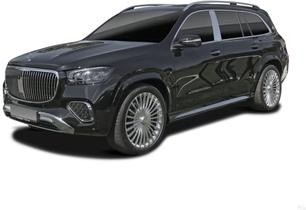
Enter the Mercedes-Maybach GLS 600, which builds on the brand’s large SUV offering with extra helpings of opulence and lavishness.
This thing screams money like Louis Vuitton or Cartier, only it has four wheels and will transport passengers in nearly unrivalled levels of refinement and comfort.
But is it more than just a showpiece? And can it handle the rigours of day-to-day life without losing its shiny, jewel-like lustre? Let’s go for a drive and find out.
The truly great thing about great wealth - I mean like, drop $1 million on a new Rolls-Royce with a casual yawn and a mouse click wealth - would be how great it is not having to do anything for yourself.
Personally, I would hire a chef, so I’d never have to cook again, and a pilot to fly my private jet, so I’d never have to catch pneumonia while flying 34 hours to Ibiza with strangers to do my weird job (oh, and if I was rich I wouldn’t have to work anyway), and in theory I might even hire a chauffeur for those odd times when I didn’t want to drive myself in one of my fleet of beautiful cars.
All right, so I can’t even imagine that last one, but the most interesting fact I gleaned while in Spain, tirelessly testing the new Rolls-Royce Cullinan Series II, is that even the ridiculously rich are falling out of love with not driving these days.
Perhaps, being tech-savvy types, they can see the end of driving and the rise of autonomy coming and they want to make the most of it while they still can. But according to Rolls, the percentage of its buyers who sit in the back rather than in the driver’s seat has flipped entirely over the past 15 years.
Back in the day, 80 per cent of Rolls owners were back-seat passengers, blowing cigar smoke at the back of a chauffeur’s head, while 20 per cent actually drove their expensive motors.
Today, the number who drive themselves has soared to 80 per cent, and apparently that’s not just because it would feel weird being chauffeured around in what is now the most popular Rolls-Royce by far - the Cullinan SUV.
The other big change, apparently, is that the average age of a Rolls-Royce buyer has also dropped, from 56 to the low 40s. And that means more buyers with kids, and gold-plated prams and other associated dross, which means they need bigger Rolls-Royces, family-sized SUV ones, which again helps to explain why the Cullinan now makes up as much as half of all the brand’s sales in some markets.
And why the arrival of this, the facelifted, tweaked and twirled Series II version of a car that was greeted cynically by many in the media when it arrived (“one group was not sceptical, and that was our clients,” as a Rolls spokeswoman delightedly pointed out) is such a big deal.
It’s big, it’s bold and totally baller, but that’s kind of the point.
The Mercedes-Maybach GLS 600 might not win over many fans with its in-your-face design or its sky-high price tag, but there is definitely an appeal here.
Taking luxury to another level is no easy feat, especially in a Mercedes, but the attention to detail, lavish second row and butter-smooth V8 engine combine to turn the already-good GLS into this exquisite Maybach.
Note: CarsGuide attended this event as a guest of the manufacturer, with accommodation and meals provided.
The Cullinan might not be the most beautiful or traditional Rolls-Royce, and it’s a shame modern success means providing an SUV option to everyone, but it’s still a remarkable machine, either to drive or just to sit in. It remains not just a marvel of engineering, but a marvellous of engineering. Hats doffed, old bean.
Note: CarsGuide attended this event as a guest of the manufacturer, with travel, accommodation and meals provided.
If you have wealth, why not flaunt it? I reckon that might be the philosophy of the Maybach designers back at HQ, and it kind of shows!
The styling of the Maybach GLS might be the most controversial thing about it. But honestly, I love it!
The liberal lashings of chrome, the three-pointed star hood ornament, and especially with the optional two-tone paintwork, it’s all just so over the top and in your face that it brings out a smile.
From the front, the Maybach is also distinguished by an imposing grille that gives it serious presence on the road, while the profile is characterised by massive 23-inch multi-spoke wheels – better park well clear of any gutters!
You’ll also notice the Maybach eschews the usual black-plastic cladding around the wheelarches and underbody found on lesser/cheaper SUVs in favour of body-coloured and gloss-black panels.
There is also a little Maybach badge on the D-pillar, which is a nice attention-to-detail touch. From the rear, there’s more chrome, while the dual exhaust outlets hint at the performance on offer. But it’s inside where you really want to be.
Everything in there is just a sea of soft-touch and premium materials, from the dashboard to the seats and even the carpet under your feet.
Though the layout of the interior mirrors the GLS, the extra detailing, like the Maybach-stamped pedals, unique multimedia surround and woodgrain steering wheel, elevates the cabin into something truly special.
And if you opt for the comfort rear seats, well they wouldn’t look out of place on a private jet.
The second-row seats also feature contrast stitching on the headrests, cushions, console and doors for that add a touch of class.
I can see the Maybach GLS might not be to everyone’s tastes, but it certainly stands out from the sea of samey-looking luxury SUVs out there.
It is something of an achievement when a team of designers manage to make a facelifted version of a vehicle less ugly, daunting and disappointing than the original.
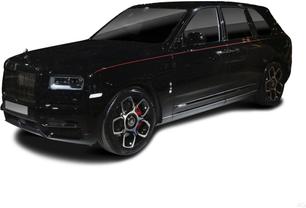
I thought the first Cullinan, launched five years ago, looked like a London black cab that had been mounted and inseminated by a double-decker bus. Big? Sure? Impressive? Yes. Beautiful? Only if you think Boris Johnson is sexy.
There was a lot of chat at the launch about the changes made for Series II, but in summary they tried to make it look more… like a boat, according to Exterior Design Lead Henry Clarke.
“We don’t look for speedy, overcomplicated lines, we take our inspiration from the luxury world, and it’s often from yachts, it’s that same sense of scale and grandeur, that’s the key to the timelessness of a Rolls-Royce,” he explained.
“We’re not focused on the world of automotive design, and if you look at the Cullinan it has that ethos you think of with a yacht, that strong, vital bow and then everything rearwards, the back of a yacht, has an elegance and grace to it.”
Fair enough, but what I appreciated was that they’ve squared the front end off a bit more, by outlining the grille, adding some gills beneath it and putting in some natty DRLs, and then rounded off the rear a little as well, so that it looks less… awful.
Indeed, after a couple of days of staring at it (and particularly admiring how good it looks in your rear-view mirror when behind you), I did come around to its looks. Certainly a lot more than last time.
And strangers driving past seemed to really like it, because they keep smiling and clapping at me.
The Maybach GLS is based on Mercedes’ largest SUV offering to date, which means there is plentiful room for occupants and cargo.
The front row feels positively palatial, with heaps of head-, leg- and shoulder-room for six-foot (183cm) tall adults.
Storage options include generous door pockets with room for large bottles, two cupholders, a smartphone tray that doubles as a wireless charger, and an underarm storage cubby.
But the rear seats are where you want to be, especially with these second-row comfort seats fitted.
It’s rare when there is more room in the rear than the front, but it does makes sense for a car like this, especially when you consider the GLS this car is based on is a three-row vehicle.
The removal of seats six and seven mean there is more room in the second row, especially with the comfort seats fitted, allowing you to recline fairly flat and to get into a comfortable position.
Storage is also plentiful in the second row, with a bespoke centre console in our test car, the aforementioned drinks fridge, backseat storage and a nice door bin.
Open the boot and you will find 520 litres (VDA) of volume, which is plenty for golf clubs and holiday luggage.
However, if you opt for the rear seat refrigerator, the cooler box will eat into boot space.
In terms of being a vehicle you might actually use - and keeping in mind that if you can afford one of these you’ve also got at least a half dozen other choices - every day, the Cullinan is the pick of the Rolls-Royce enclosure.
From the big boot space - 600 litres with the seats up, 1930 litres with them down - and its lovely little Viewing Suite, through the spacious rear relaxing zone to the absurdly comfortable and plush front seats, there’s a sense of grandeur about the whole Cullinan experience.
You can opt for a champagne fridge between those rear seats, if you like, or you can just lie back and stare at the blinking pins of light in your 'Starlight Headliner' and imagine that each one of them represents one of your millions, smiling down at you.
It’s a lovely place to be, in short, and with its super-thick double glazed glass, coated with an acoustic layer on top of that, and carpets thick enough to keep out road noise on their own, it’s also a very pleasantly quiet one.
The best things in life might come free, but the most luxurious things certainly come at a cost.
Wearing a price tag of $378,297, before on-road costs, the Mercedes-Maybach GLS 600 is probably out of the reach for most mere mortals, but there’s no denying Mercedes has thrown in a lot for the spend.
And with it positioned nearly $100,000 north of the Mercedes-AMG GLS 63 ($281,800) – with which it shares its platform, engine and transmission – you’d want to get a bit of bang for your buck.
Standard features include keyless entry, push-button start, Nappa leather interior trim, a head-up display, a sliding glass sunroof, power-closing doors, heated and cooled front and rear seats, and interior ambient lighting.
But, as the epitome of Mercedes’ luxury SUVs, the Maybach also scores 23-inch wheels, a heated woodgrain and leather steering wheel, open-pore wood trim and five-zone climate control – one for each passenger!
Handling multimedia duties is Mercedes’ 'MBUX' 12.3-inch touchscreen display, complete with satellite navigation, Apple CarPlay/Android Auto support, digital radio, a premium sound system and wireless smartphone charger.
Rear seat passengers are also treated to an entertainment system with TV tuner so you can keep up with the Kardashians from the road, as well as a bespoke MBUX tablet with functions for climate, multimedia, satellite navigation input, seat controls, and more.
Sadly, the Samsung-branded tablet glitched out a few times while we were using different functions and required a reset.
No doubt, a software update can fix some connection issues, but it's still something that shouldn’t be happening in a high-dollar, ultra-lux SUV.
Options with the Maybach GLS are surprisingly limited, with buyers able to choose between different exterior colours and interior trims, second-row comfort seats (as fitted on our test car), and a rear champagne chiller box.
Look, nearly $400,000 for an SUV might seem like a lot, but you really are wanting for nothing with the Maybach GLS, and it's comparable in price to other high-end SUVs like the Bentley Bentayga and Range Rover SV Autobiography.
Value? Price? What are these things you speak of, little plebeian person? Such is the disdain for such things at Rolls-Royce that they wouldn’t even tell us what the Series II is going to cost when it lands in Australia later this year.
The people who can afford one don’t much care, of course, but for the rest of us, who like to shake our heads and make low, whistling noises, you can bet the price will rise just a little from where it was with the original Cullinan - and that was $705,000 for the basic car, or closer to $795,000 for the sportier, and blacker, Black Badge variant.
In terms of value, it’s hard to grasp that any car could cost that much, but for a Rolls buyer the equation is very different. They don’t need a Rolls, no-one does, but it makes a nice change from buying art works, gold or small countries.
In terms of features, it has almost too many to mention, but let’s pause on the marvellous massage seats, the bespoke sound system, entirely unique to this case and built by Rolls itself, with incredible levels of detail, the Rolls umbrellas tucked into each door and the very lovely 'Viewing Suite'.
This consists of two pop-up seats in the rear, with a little champagne and canapés table in between, where “you can watch your children play football”.
Try that in Australia, at the rugby league, and you’ll be covered in half-time oranges and abuse spittle in no time. Stick to the polo, perhaps.
Powering the Mercedes-Maybach is a 4.0-litre twin-turbo petrol V8 – the same engine you will find in many AMG products like the C 63 S and GT coupe.
In this application, the engine is tuned to produce 410kW and 730Nm, which is admittedly less than you get in something like the GLS 63, but the Maybach isn’t designed to be an outright powerhouse.
With drive sent to all four wheels via a nine-speed automatic transmission, the Maybach SUV will accelerate from 0-100km/h in just 4.9 seconds – also helped by a 48-volt mild-hybrid 'EQ Boost' system.
Though not designed for outright grunt, the Maybach GLS’s engine is nicely tuned to deliver smooth power and seemless shifting
The Maybach is more than a match for rivals such as the Aston Martin DBX (405kW/700Nm), Bentley Bentayga (404kW/800Nm) and Range Rover P565 SV Autobiography (416kW/700Nm).
Rolls-Royce has committed to being a fully EV brand by 2030, so it’s a safe bet this Series II Cullinan will be the last one offered with its storming, staunch V12 engine.
Indeed, Rolls hinted the only reason it hung around in this version is that this is only a mid-life face-lift for the Cullinan, and the car that replaces it will arrive on an entirely new, all-electric platform.
As good as the EV Roller, the Spectre undeniably is, driving this old-school Cullinan with its 6.75-litre twin-turbocharged V12 making the kind of thumping, torque-thick, nothing-is-too-much-trouble acceleration is a hoot.
It’s not loud, but it’s just loud enough that you can enjoy its deep, brassy tones, and it’s got plenty of power in reserve to hurl even this 2.75-tonne machine past lesser vehicles with ease.
There are two Cullinans to choose from, of course, with the base model providing a very pleasant 420kW and 850Nm or the sportier Black Badge version (Rolls calls it the brand’s “alter ego”) with 441kW and 900Nm.
Official fuel consumption figures for the Mercedes-Maybach GLS 600 are pegged at 12.5 litres per 100km, and it’s recommended to fill up with 98 RON premium unleaded, so be prepared for a big fuel bill.
This is despite the 48-volt mild-hybrid tech that lets the Maybach coast without using fuel in certain conditions, and extends start-stop functionality.
In our brief time in the car, we managed to get 14.8L/100km. Why is the Maybach so thirsty? That’s simple, it’s weight.
All the cool features like Nappa leather interior, woodgrain trim and 23-inch wheels add weight to the overall package, and the Maybach GLS tips the scales at nearly three tonnes. Ouch.
Rolls-Royce claims the Cullinan will provide you with between 16 litres per 100km and 16.8L/100km, but I believe you’d have to drive it quite steadily to achieve even that quite appalling figure.
Twelve cylinders, 2.75 tonnes, you do the math, but it's interesting to note that with a nearly full tank - and we’re talking 100 litres of fuel - my distance to empty was looking like barely more than 500km - that’s an EV-like number.
While you might not find many owners of the Maybach GLS in the driver’s seat, it’s nice to know it can hold its own in the driving dynamics department.
Don’t get me wrong, this won’t give the AMG-blessed GLS 63 a run for its money, but the Maybach SUV is far from dull.
And the engine plays a large part in this. Sure, it’s not as savage as some AMG models, but there is still plenty of grunt to come out of corners with enthusiasm.
The tune of the engine is obviously weighted towards smoothness and comfort, but with 410kW/730Nm on tap there is enough there to make things feel urgent.
The nine-speed automatic transmission also has to be called out, as it is calibrated in such a way that the shifts are imperceptible. There’s none of that mechanical jerkiness and clunkiness involved in swapping cogs, and it just makes the Maybach GLS feel that much more luxurious.
The steering, while straying a towards numb, still offers plenty of feedback so you know what’s happening underneath, but it’s the active body control that works to keep this hefty SUV in check in the bends.
The best bit, though, has to be the air suspension, which floats the Maybach GLS over bumps and uneven roads like a cloud.
The front-facing camera can also read the terrain ahead and set-up the suspension for incoming speed bumps and turns, taking comfort up to a whole new level.
All this is to say, yeah, the Maybach might look like a boat, and cost as much as a boat, but it doesn’t actually feel like a boat behind the wheel.
But really, are you buying this car because you want to be the driver? Or are you buying one because you want to be driven?
In the second row, it’s as close as you’ll get to a first-class flight on the road, and the seats are genuinely plush and cosy.
It’s eerily quiet and supremely comfortable in the second row, leaving you free to carry on with important business like drinking your champagne or uploading to the 'gram.
And while I usually suffer from a bout of motion sickness within minutes of looking at a phone in a car, I didn’t feel such ill effects in the Maybach GLS.
Even after about 20 minutes scrolling through Facebook and emails while being driven around, there was no sign of a headache or queasiness, which is all thanks to how well the suspension is tuned and the active anti-roll technology doing its thing.
The first word that comes to mind when describing the experience of driving a Rolls-Royce the size of a small housing estate is 'intimidating', because it's one of those cars where you take a few deep breaths before setting off (while muttering “please don’t crash it”) and then some sharp intakes of breath the first few times you find cars coming towards you on a narrow road, of which there are many on Ibiza where we were summoned to drive it.
I followed a panicked young man from India who had never driven a Rolls, nor a left-hand-drive car before, and boy, he sure looked intimidated, even if he didn’t ever get above 30km/h.
The incredible thing about the Cullinan, however, is how quickly it relaxes you and how astonishingly light and easy it is to drive. The steering feels almost absurdly light at first, you really can drive it with just one finger, two if you’re feeling cautious, but once you get used to it it just feels very Rolls-Royce.
The whole brand lives on the idea of effortlessness, wafting over the world, and the much-touted 'Magic Carpet Ride', and it really does deliver that sense of ease. You’re almost as relaxed at the wheel as you are in the rear seat (and the massage functions only make you feel more so).
Speed humps do upset the Cullinan, but only a very little, and you’re aware when the car finds broken surfaces, but only distantly so. It feels like someone is dealing with bumps and imperfections in a far-off-place, perhaps the car’s basement, and it shouldn’t worry you too much.
When traffic annoys you, you can just make it disappear by engaging your whumping V12 engine and making the world go briefly blurry.
Attempt to throw the Cullinan through sharp bends at speed, however, and it reacts in much the same way you’d expect the cruise ship it somewhat resembles to.
There’s a bit of body roll, but it’s all quite polite and a sense that if you need to drive like that, perhaps you should go and get one of your other cars.
The Black Badge version does feel just a trifle sportier than the base Cullinan but we’re splitting very grey and expensively coiffed hairs here.
The overall experience is one of grand relaxation, imperiousness and a certain touch of superior glee.
The Mercedes-Maybach GLS 600 has not been tested by ANCAP or Euro NCAP, and therefore doesn’t wear a safety assessment rating.
Despite this, the safety equipment found on the Maybach is comprehensive. As standard, there are nine airbags, a surround-view camera system, autonomous emergency braking (AEB), tyre pressure monitoring, traffic sign recognition, front and rear parking sensors, rear cross-traffic alert, and automatic high beams.
Mercedes’ 'Driving Assistance Package Plus' is also included, bundling adaptive cruise control, lane-keep assist and blind-spot monitoring.
The 'Urban Guard' suite also adds an alarm, tow-away protection, parking damage detection, and an interior motion sensor, which can send notifications to your 'Mercedes Me' app.
The Rolls-Royce Cullinan SUV has not been ANCAP tested, but it feels safe because it’s bigger than a tank. It has eight airbags - driver, front passenger, two curtains, driver side, front passenger side, two rear passenger side), and a full-suite of active-safety tech including Forward Collision Warning and Automatic Emergency Braking.
Like all new Mercedes models sold in 2021, the Maybach GLS 600 comes with a five-year/unlimited kilometre warranty with roadside assist over that period.
This is class-leading in the premium segment, with only Lexus, Genesis and Jaguar able to match the warranty period, while BMW and Audi serve up assurance periods lasting only three years.
Scheduled servicing intervals are every 12 months or 20,000km, whichever occurs first.
While the first three services will cost owners $4000 ($800 for the first, $1200 for the second and $2000 for the third service), buyers can opt to save some money with a pre-paid service plan.
Under the service plan pricing, three years of maintenance will cost $3050, while four- and five-year plans are on offer at $4000 and $4550 respectively.
Questions about service intervals and warranties seem to confuse the people at Rolls, as if none of their customers have ever bothered to ask.
Yes, you would think servicing would be free when you’re pushing a $1 million price tag, and that the warranty would be for life, particularly considering the low mileage on these things, but it is, in fact, just a four-year servicing and warranty offer for Australian customers of this vehicle. So that means an unlimited-mileage warranty, including all services, for the first four years (at which point you obviously buy a new one). "Rolls-Royce Motor Cars will offer a service inclusive package but no pricing available yet and this will not be required until the fifth year of ownership."