What's the difference?
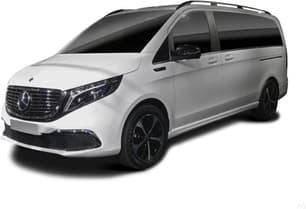
As far as vehicle niches go, this is pretty niche. The Mercedes-Benz EQV is Australia’s first premium electric seven-seat commercial vehicle-based people mover.
The EQV falls under Benz’s electric ‘EQ’ banner and is based on the Vito van platform, but adapted to house an all-electric powertrain.
However, unlike the popular EQA small SUV or recently launched EQB, don’t expect to see too many EQVs on the roads.
It is likely to appeal to airport transfer operators, hotels and other corporate customers that need to ferry multiple people around in comfort.
But given the kilometres those airport limo drivers can clock up in a day, is an EV capable of doing the job? And will these buyers be happy to fork out more than $150,000 for the privilege?
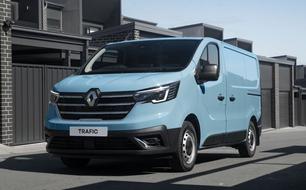
After more than four decades in production and global sales exceeding 2.2 million units, the Trafic has established a loyal following in Australia.
In fact, according to Renault, Australia is the largest market for its popular mid-sized van outside of Europe. Perhaps this is not surprising given our thriving light commercial vehicle market, in which the 2.5-3.5-tonne GVM van segment is one of the most competitive with eight brands vying for buyers.
The current (third) generation Trafic, which was given a facelift and upgraded equipment/safety in 2022, is available in eight configurations. These include a crew van variant plus two wheelbase lengths and three equipment levels comprising Pro, Premium and Lifestyle.
We recently became reacquainted with the Trafic, in base model workhorse guise, to see how it compares to the current crop of rivals from a tradie’s perspective.
The EQV is indeed a curious offering. The driving range is decent, but not outstanding, and depending on what you’re using it for, it could be a savvy investment. Especially if you charge using solar power. You’ll also save on servicing costs. But if you’re a limo operator, it really will depend how many kilometres you’re going to do each day. A V-Class might suffice.
Either way it’s great that Benz is giving buyers electric options in a variety of body styles and segments - an SUV simply won’t suit everyone.
If you can live with that ride quality and have the deep pockets for an EQV, there’s more than enough to like. But I suspect there won’t be many of you.
The Renault Trafic is a practical and capable workhorse, but then so are some other mid-sized van rivals which sell in greater numbers and come standard with five-star safety credentials. Therefore, a potential buyer must be prepared to accept the Trafic’s inferior standard safety menu (or pay extra to enhance it) to exploit its numerous strengths in a working role.
If you’ve seen a Mercedes van or people mover, you’ll have an idea of the EQV.
The difference between it and its V-Class twin is the ‘EQ’ touches, including the front end that has a definite connection to other EQ models like the EQA.
The chrome-rimmed grille is blacked out and has fins, and that’s the key difference between the two MPVs. Otherwise it’s a very large white box on wheels. Nicely designed 18-inch five-spoke alloy wheels, at that.
Inside, the EQV is showing the age of this vehicle's shared underpinnings. Next year will mark 10 years since the current Vito went on sale in Europe, and while it and its derivatives are still somewhat handsome, the interior is getting on.
It’s hard to fault the materials used inside, and elements like the perforated leather steering wheel, and dash stitching are welcome, but it could feel even more premium. It’s no more high-end than a Kia Carnival Platinum that is more than half the price of the EQV.
But the look of the dash is very reminiscent of Benz models from a few years back - certainly nothing like the twin-screen set-up of the current crop. And given the size of the cabin, the 10.25-inch central screen looks small in this vehicle.
Our LWB example rides on a sizeable 3498mm wheelbase with four-wheel disc brakes, rack and pinion steering and MacPherson strut front suspension.
The rear suspension uses torsion bar primary springing, supplemented by a pair of secondary coil springs for carrying heavy loads.
Its 1967mm height ensures access to height-limited areas like multi-storey car parks and underground loading zones, but its lengthy wheelbase and front wheel-drive configuration combine to produce a relatively large 13.8-metre turning circle.
The Pro’s no-frills work focus results in extensive use of unpainted dark grey plastic in external areas where bumps and scrapes usually occur in hard-working vans, including the door mirror shells, wheel hubcaps, front/rear bumpers (including the rear pillars from top to bottom) and along the sides.
As a result, the Trafic has a robust and purposeful appearance, combined with a neat and practical cabin design with seating for three on a tasteful blend of contrasting grey fabrics. Hard surfaces are enhanced with satin chrome highlights.
The minimalist dash design (thankfully) provides physical ‘piano key’ buttons for numerous functions, plus there’s a trio of large manual dials to control fan speed, air-flow and cabin temperature in preference to distracting touchscreen prompts.
If space is what you want, space is what you’ll find in the EQV. People movers like the Kia Carnival are incredibly spacious, but they can’t compete with something that’s spawned from a commercial vehicle platform, like this Benz.
Thanks to the flat floor and 2+2+3 three-row seating layout, you can literally stand up (depending on your height) and walk from the driver’s seat to the third row.
Back up front, the old underpinnings mean no fully digital instrument cluster here, just analogue dials, which is not a bad thing.
That also means the air con controls are separate from the central screen and therefore easy to use.
The MBUX system isn’t as advanced as the version fitted to the latest Benz models, and as a result there are fewer functions and it’s less complicated to use. There’s a touchpad as well as the touchscreen but I only ever used the screen.
Another slightly old school element to the EQV is the fact that it requires a key to start. Which is unusual for an EV. Also, the ignition is on the left side of the steering wheel which is great news for left-handed people but it’s somewhat annoying if you’re right-handed.
Storage wise up front, there is a decent space with a cover under the centre stack, housing cupholders, two USB-C ports and a 12-volt charger, but no wireless charger. There’s ample space for very large bottles in the front doors and it has a medium-sized glove box.
The front leather seats with fold-down armrests on each side are well bolstered and are very comfortable, too. No complaints there.
Given this car is designed to ferry people around, you’d hope for a functional rear cabin and on that Benz has delivered - for the most part.
Unsurprisingly given the EQV’s massive dimensions, there is a huge amount of headroom, legroom, and hip and shoulder room in all rows.
Both sliding side doors are power operated and one (the passenger side) can be opened via the key fob. The very large tailgate is also power operated.
Those two second-row captains chairs are comfy and supportive. There are map pockets on the rear of the front and second-row seats. There are floor and roof-mounted air vents, but just roof vents in the third row.
There’s not a whole lot of storage options in the second row, while the third row has stand-up phone holders, but that’s about it. No USB ports back there.
If you’re folding the second row seats, they’re quite heavy and cumbersome. But tumbling them forward via the lever is much easier. That ensures ample space to get into the third row.
The third row can be folded flat as well but you have to remove the very large and heavy parcel shelf from the cargo area. Like the seats the shelf structure is also on rails and it lifts out if required. That third row can also slide but not as far as the second row.
The shelf can double as a stand-up desk for a computer in the rear if required. It’s actually quite handy.
And it helps hide items in the boot. It comes with plastic folding shopping crates.
Benz says the boot can swallow 1030 litres with all seats in place, but minus the parcel shelf. It also has a 17-inch spare steel wheel under the rear of the vehicle.
With its relatively light 1816kg kerb weight and 3070kg GVM, our test vehicle has a substantial 1254kg payload rating which is almost 200kg higher than Toyota’s HiAce LWB (1055kg).
Its 1630kg braked tow rating is also higher than the HiAce’s 1500kg limit and with its 4700kg GCM (or how much it can legally carry and tow at the same time) the Trafic (like the HiAce) can haul its maximum payload while towing its maximum trailer weight.
Standard cargo bay access is through a single kerbside-sliding door or glazed swing-up tailgate, but a right-side sliding door and glazed symmetrical rear barn-doors with forklift-friendly 180-degree opening (the latter as fitted to our test vehicle) are available as options. The cargo bay walls and doors are lined to mid-height.
The load floor is 2937mm long and 1662mm wide, with 1268mm between the rear-wheel housings. So, it can carry up to two standard 1165mm-square Aussie pallets or up to three 1200 x 800mm Euro pallets, secured by a choice of eight load-anchorage points.
The cargo bay offers a competitive 6.55 cubic metres of load volume. Our example is fitted with a 12mm-ply non-slip floor kit and cube shelving kit provided by local industry supplier Autosafe. According to Renault, this tradie-focused set-up retails for $5254 including freight and installation.
The fixed two-passenger bench seat has a lap-sash belt for the central passenger and even someone my height (186cm) can get reasonably comfortable in the middle of a crew of three, albeit with knees competing for space with the prominent dash protrusion that houses the gearshift. By contrast, the outer passenger has ample knee and foot room.
The cabin is equally generous with headroom and displays optimum use of storage space. This includes a large bin in each door which can fit large bottles, with a smaller bin above.
There’s also small-bottle/cupholders on each side of the dash-pad plus a clamshell-lid compartment ahead of the driver, a large open tray in the centre (with two USB-C ports), small closable bins in the lower dash on either side of the driver and a single glove box.
If you choose the glazed bulkhead option, the centre-seat backrest folds forward to reveal an elaborate three-tier workstation, starting with a clipboard on top that can also be detached to use outside the vehicle or mounted vertically in the workstation to face the driver or passenger.
Beneath the clipboard is a hinged work desk, which when raised reveals a shallow felt-lined compartment that’s ideal for hidden storage of phones, tablets, lap-tops etc.
Folding the bench seat’s front-hinged base cushions forward also reveals a cavernous hidden storage compartment underneath.
It’s fair to say the EQV isn’t cheap. At $155,338 before on-road costs, it’s now the priciest people mover money can buy in Australia.
But, it’s not without expensive electric competitors. Chinese commercial vehicle specialist, LDV, has just launched a new MPV dubbed the Mifa 9, another people-moving EV. The price for that model ranges from $106,000 to $131,000, before on-road costs.
Soon enough Volkswagen will have its funky ID. Buzz people hauler here as well, while Ford’s Transit Custom-based Tourneo MPV now has an electric version in Europe.
Point is, Benz and LDV aren’t going to be on their own for long.
The EQV sits alongside the mechanically related internal combustion V-Class in its line-up and that model ranges from $91,668 and $106,344. So it's quite a leap to electric from there.
The EQV is offered in one grade in Australia and Mercedes has ensured it has a decent amount of standard gear. The EQV comes with a 10.25-inch central screen housing the 'MBUX' multimedia system and operated via touchscreen or touchpad, digital radio, Apple CarPlay and Android Auto, sat-nav, and USB-C ports.
It also gets power side doors, leather trim, a Burmester surround sound system, multifunction leather steering wheel, heated power adjustable front seats, ambient lighting, automatic dual-zone climate control with pre-entry climate, a seat rail system and rear removable parcel shelf.
Lining the specs up next to the LDV reveals that the Mifa 9 Luxe has more gear. It’s not super surprising given that model is very new and LDV has a strong value proposition. Also the underpinnings of the EQV are older.
But at more than $150K and a Benz badge, you think there would be a few more goodies, like heated rear seats or a massage function. Some extra luxuries would be nice, but it’s certainly not without the good stuff.
Our Pro LWB (Long Wheelbase) L2H1 test vehicle, in 'Glacier White' and ‘Pro’ model grade, comes with a 2.0-litre, four-cylinder, turbo-diesel engine and optional six-speed dual-clutch automatic for a list price of $53,000.
In comparison to the major players, that's in the same ballpark as the Toyota HiAce, lower than Ford's Transit Custom and higher than Hyundai's Staria Load and LDV's G10+.
Our example has a couple of extra-cost options including a glazed cabin bulkhead ($400) and glazed rear barn-doors ($400). The cabin is also equipped with a set of carpet mats ($138) from Renault’s genuine accessories range.
Its work-focused standard equipment list includes no-frills 16-inch steel wheels with 205/65R16 tyres and a full-size spare, plus an eight-way-adjustable driver’s bucket seat, 4.2-inch colour driver’s display including digital speedo, two-passenger bench with under-seat storage, rear parking sensors, reversing camera, LED headlights and LED daytime running lights.
Multimedia is provided by an 8.0-inch central touchscreen with wireless Apple and Android smartphone mirroring and Bluetooth audio streaming.
Renault also offers numerous individual options, plus option packs including the 'Comfort Pack', 'Peace of Mind Pack' and 'Trade Pack'.
The EQV is a battery electric vehicle that uses a single motor that sends up to 150kW of power and 365Nm of torque to the front wheels. It is paired with a 90kWh lithium-ion battery pack housed beneath the floor. The kerb weight is a hefty 2846kg.
With a DC charging capacity of up to 110kW, topping the battery up from 10 to 80 per cent can be done using a rapid charging station in about 45 minutes.
If you use an 11kW AC charger, like a Mercedes-Benz Wallbox, it will take approximately 10 hours to recharge from empty to 100 per cent.
The Euro 5-compliant 2.0-litre, four-cylinder, turbo-diesel produces 125kW at 3500rpm and peak torque of 380Nm at 1500rpm.
The six-speed dual-clutch automatic transmission offers the choice of sequential manual-shifting using the shift-lever (no steering wheel paddles) and offers three drive modes comprising 'Normal' (default setting), 'Eco' and 'Performance'.
According to Mercedes-Benz, the EQV has a driving range of 418km on the NEDC cycle, which is about 355km on the WLTP cycle, which is seen as more real world.
I covered 233km in the EQV and by the end of the week the vehicle’s trip computer was sayong I had used 239km of range, which is pretty close.
As an example of how this vehicle would be used, let’s say an airport transfer driver did six trips to and from the Melbourne CBD to the airport in a day (about 46km), that’s about 276km - which is well within the EQV’s range.
However, when you consider the diesel V-CLass has a range of more than 900km, you can see why some buyers might not want to take the risk.
It consumes 26.3kWh of energy, which was the same figure I achieved.
The EQV has a CCS charging port.
Renault claims official combined (urban/extra-urban) average consumption of 6.5L/100km but the Trafic’s dash display was showing 7.9 when we stopped to refuel at the end of our 359km test, of which about one third of that distance was hauling a one-tonne-plus payload.
Our own figure, calculated from actual fuel bowser and tripmeter readings, was higher again at 8.9 which falls comfortably within the usual 2.0-3.0L/100km discrepancy between official and ‘real world’ consumption.
Fact is, any mid-sized van that can produce sub-10L economy in the real world gets a big thumbs-up from us. So, based on our numbers, you could expect an expansive driving range of around 900km from its 80-litre tank.
Driving the EQV feels a bit like driving a bus. That’s because you’re essentially driving a bus.
There’s no getting around the EQV’s size and heft, especially in an urban driving setting. It’s massive and challenging to park, especially in inner city areas with small spaces. It also has a pretty sizable 12.9-metre turning circle.
It does also have excellent visibility thanks to a significant amount of glass around you.
After so many years of complaining about Mercedes’ steering wheel-mounted gear shifter, I think I have finally come around to it. Would I prefer it in the centre console? Yes, but I now think the stalk is actually a logical place for it.
A stalk is a less logical place to house cruise control buttons. They are much better on the steering wheel than a stalk hidden behind the wheel.
From take-off, the EQV doesn’t quite flaw you with its acceleration like some EVs can. It’s more leisurely, but far from slow.
The 0-100km/h dash is done in approximately 12 seconds but around town it is responsive enough. In fact, on a particularly hectic day rushing to and from appointments all over town, I was surprised how lively the EQV felt, despite feeling heavy on the road.
As expected, it’s quiet on the road, for the most part - a nice change from diesel engines found in its siblings. But I did notice some creaking noises when driving on less than perfect tarmac.
The steering is weighted on the heavier side and slow to respond but that’s fine for a vehicle like this. You don’t need point and shoot steering for a 3.0-tonne bus. The brakes are not super responsive and require a bit of weight in the foot.
The biggest issue is with the EQV’s ride. The firmly sprung suspension combined with the vehicle’s mass means that you feel, and hear, every single bump.
I understand it is a commercial vehicle platform but given its positioning, Benz could have done more to soften the ride and make it less crashy, especially over speed bumps, potholes and sections of roadwork.
The EQV bumps along the road after you’ve gone over a speed bump and takes a while to balance itself out. It’s this floaty, bouncy ride characteristic that makes all but the smoothest roads a bit of a chore.
The driver’s seat offers good comfort with its firm bolstering, fold-down inboard arm-rest and adjustable lumbar support. The only thing missing is a left footrest, just like the one residing in the outer passenger footwell which is of course the driver’s footwell in LHD models.
The synthetic leather-rimmed steering wheel feels nice in your hands and has a premium look. Eyelines to all mirrors are good and the large window in the optional cabin bulkhead allows a clear view through the rear barn-doors, but only if you remove the centre seat’s headrest when the middle seat is unoccupied.
Engine response is at its most energetic from 1500rpm where maximum torque is tapped and it continues to pull strongly all the way to maximum power at 3500rpm.
The decisive shifts of the dual-clutch automatic in Normal (default) drive mode feel well calibrated in terms of optimising the engine’s performance in all driving conditions, which is confirmed by only small differences in response when using the Eco and Performance modes.
Its gearing also ensures the Trafic is well-suited to highway work, requiring only 2000rpm to maintain 110km/h. It’s even better with the optional bulkhead/cargo barrier as fitted to our test vehicle given it insulates the driver from most cargo bay noise, which can become intolerable in vans at these speeds without this item fitted.
To test its payload rating we forklifted 975kg into the cargo bay. Combined with the weight of the Autosafe fit-out and driver, it equalled a total payload of 1150kg which was only about 100kg less than its legal limit.
The rear suspension compressed about 50mm under this loading, yet still had ample travel to ensure there was no bottoming-out during our test drive. It hauled this one-tonne-plus payload with commendable ease in city, suburban and highway driving, with negligible effects on handling and braking.
It also impressed on our 13 per cent gradient, 2.0km set-climb at 60km/h, quickly downshifting to third gear to easily haul this load to the top.
Engine-braking on the way down, in a manually-selected second gear, wasn’t as robust, but in our experience typical of small displacement (sub-3.0L) turbo-diesels trying to restrain one-tonne-plus payloads on steep descents. Even so, the four-wheel disc brakes comfortably kept speeds under control without a hint of fade.
At this point, ANCAP has not rated the EQV.
Benz has fitted the EQV with standard safety gear including A-to-D-pillar window airbags, auto emergency braking, driver and front passenger airbags (front, thorax and window), hill-start assist, lane keep assist, blind spot monitor, crosswind assist, reversing camera and sensors, driver attention warning, and a tyre pressure monitor.
It also has Benz’s ‘Active Distance Assist DISTRONIC’ which uses the adaptive cruise control to reduce and increase speed according to the movement of the vehicle it is following.
The Benz’s lane keeping aid is not intrusive. Rather than steering you back into the lane it has a haptic steering wheel vibration and audible alert. The adaptive cruise control is responsive, too.
There’s no ANCAP star rating and the current range (September 2022 onwards) only earned a silver medal in ANCAP’s Commercial Van Safety Comparison, with its score of 45 per cent reflecting the absence of AEB for pedestrians/cyclists and lane-keeping assist.
Even so, its standard safety menu includes front and lateral-curtain airbags for driver and passengers plus driver’s thorax airbag, car-to-car AEB, lane departure warning, rear parking sensors, a reversing camera and more.
However, with a huge blind-spot over the driver’s left shoulder created by the solid cargo bay walls, a Trafic buyer should not have to pay extra to get essentials like blind-spot monitoring and rear cross-traffic alert, given these active safety features are standard on the segment-leading Toyota HiAce.
The EQV is covered by a five-year, unlimited-kilometre warranty for private buyers (that drops to five years/250,000km for commercial buyers), and an eight-year or 160,000km battery warranty.
The servicing schedule is once a year or every 40,000km.
Benz offers the EQV with a choice of three servicing plans, covering three services ($1252), four ($1959), or five services ($2149).
It also comes with a one-year complimentary Chargefox subscription.
The warranty terms are a little better than the LDV Mifa 9 (five years/160,000km), but you get more kilometres (200,000km) for the battery warranty on the LDV.
The Trafic comes with a five year/200,000km warranty, which includes five years 24/7 roadside assist. Scheduled servicing is 12 months/30,000km whichever occurs first. Capped-pricing applies to the first five scheduled services up to five years/150,000km which totals $3555, or an annual average of $711.