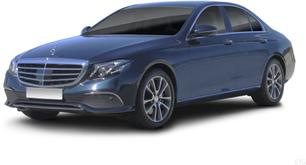
What's the difference?
When is an AMG not really an AMG, but still a fitting homage to the models that built the brand?
The new E 43 is the eighth '43 after the SLC 43, GLC 43, GLC 43 Coupe and four C 43s, all of which arrived last year, and plugs a mighty gap between the mainstream E-Class line-up and the upcoming full-house E 63 S, while forming an almost exact philosophical fit with the E 36 and E 55 that helped put AMG on the map in the 90s.
How? Unlike the angry dinosaur V8 growl, supercar-like performance and generally hardcore demeanour we love about the current top-level models, the E 43 is more of a rapid grand tourer than a four-door supercar. Which is kind of what the AMGs of old were, before they sprouted exhausts from both sides and became more menacing than Mercedes.
The E 43 still boasts a muscular 295kW/520Nm from its twin-turbo V6 and all-wheel drive, but cloaks it all in an air-suspended package that's barely distinguishable from the AMG styling pack available from the base E 200 up.
It's priced $20,000 higher than the E 400 but still around $90,000 less than the E 63 S that arrives in June, and does nothing to dissuade the notion that Mercedes makes a car for almost everyone. And we're glad they do, particularly when the latest addition boasts a 4.6s 0-100km/h claim that would trump most mid-engined supercars of the 90s.
It also promises to be a star-badged alternative to the new BMW 540i, Audi S6 and even the Lexus GS F.
This is the most affordable plug-in hybrid available in Australia – as this review is published – but it’s got a lot more going for it than just that.
The 2026 BYD Sealion 5 is a mid-size SUV wearing a BYD badge that has been thrust into the public’s awareness by the popular BYD Shark 6 – as well as by widespread criticism of brand's less popular aftersales shortcomings through much of 2025.
It’s also a plug-in hybrid that is showing up as the nation faces a fuel crisis, despite many remaining sceptical of going ‘full EV’.
The Sealion 5 has a long list of features, of course, plus a claimed four-figure driving range. Is this BYD too good to be true?
We grabbed the entry-level Essential to find out.
If you want a fast Benz but your other half prefers genuine comfort and doesn't like the sound of NASCAR, this is your solution. It's an opulent luxury saloon by default, but with proper performance and personality just the flick of a switch away.
We know the E 63 S will be sharper and 1.2s quicker to 100km/h, but it will also cost another E 200 more, and feel like a performance car ALL the time. The E 43 doesn't, which is just brilliant.
While the BYD Sealion 5 lacks the polish of some more established plug-in hybrids, it has a seriously compelling price advantage over some competitors. It makes a base-model Mitsubishi Eclipse Cross PHEV feel positively outdated and it’s $13,800 cheaper.
BYD's lack of ANCAP rating for the Sealion 5 and the uncertainty around it still being a new brand are downsides, even if BYD is quickly moving past the latter. But being the most affordable PHEV available while having this much showroom appeal is bound to work in the Sealion 5’s favour, just don’t expect a dynamic masterpiece once you’re out on the road.
Unlike the bulging wheelarches and gaping gob of the new E 63, the E 43 uses discrete flourishes to distinguish it from the regular AMG-pack E-Class.
Most obvious are the more aggressive 20 x 8 and 20 x 9 'RTO' wheels, but if you look closely it also scores subtle black winglets on the outer edges of the front bumper openings, a single bar grille insert, boot lip spoiler and black split exhaust tips.
Hiding within those wheels are upgraded 360mm brakes at all corners, with four piston calipers up front and single at the rear.
On the inside, the E 43 steps up to perforated leather and 'Dynamica' pseudo suede seat trim but the fronts appear to be the same comfortable shape as the regular AMG pack seats. Aside from a smattering of AMG badges, that's about it. Like the outside, it looks a little bit sporty, but luxury is the focus.
The BYD Sealion 5, from the outside, is inoffensive but also uninspiring. That’s likely not such a bad thing for a mid-size SUV – it’s rare you’re hearing someone talk about how beautiful the Mazda CX-5 or Toyota RAV4 is.
Its quartet of colour palette options comes in on the safe side, too. Aurora White is standard, Atlantis Grey, Harbour Grey and Cosmos Black are cost-options.
Our test car is Atlantis Grey, which is interestingly quite blue.
The relatively upright shape is a slight departure from the more ‘aquatic’ silhouettes of BYD’s line-up, but the front grille and light layout are decidedly in step with the brand’s oceanic design language. There’s a bit going on, you could say.
The slimline tail-lights are the rear, especially from a three-quarter angle to the side, look attractive and help break up the rear without looking messy.
The Sealion 5’s design is overall net-good, but it’s inside where the mid-sizer feels like you’re getting plenty for your dollar.
The seats, despite the leather fakery, feel like decent material, and the layout uses buttons and physical controls cleverly without feeling outdated.
Like all E-Class sedans, the E 43 has amble room for four large adults to travel comfortably. Everyday practicality is well considered with dual cup holders front and rear with bottleholders in each door, map pockets and ISOFIX child seat mounts in the outer rear positions. Boot capacity is a useful 540 litres.
Like all AMG performance models, the E 43 forgoes run-flats or a spare tyre in favour of an inflation kit.
To actually interact with the interior is, at times, another story. BYD’s tech interface is generally easy to manage, but could be simpler when it comes to navigating menus for the sake of driver distraction.
While larger text and buttons would be welcome, the multimedia system is easy to use when parked, and the functionality is impressive for the price point.
Winning more points for the Sealion 5, though, are the physical controls – buttons and the traditional gear selector – which make the cockpit much more intuitive while on the move.
Ergonomically, though, the adjustment between the steering wheel and driver’s seat could do with some work, as I found it difficult to find a truly comfortable driving position. This is coming from someone 178cm tall, a very normal height in Australia.
Better adjustability on the steering column would be helpful, as it’s something I’m not sure I’d ever get totally used to.
Visibility and physical space inside the Sealion 5 is impressive, though. The car is 4738mm long, 1869mm wide and 1710mm tall, and the roof and window lines don’t swoop too aggressively towards the rear.
There are low window shoulders even into the rear, so light isn’t at a premium, though under-leg support could be better on the pew.
It’s otherwise un-cramped. The 2712mm wheelbase means decent legroom for second-row folk, plus behind the 60/40 split-fold seats there’s 463 litres of space for luggage. That becomes 1410L with the seats folded.
There’s unfortunately no spare tyre, just a tyre repair kit.
At $159,900 the E 43 sits exactly $20,000 above the E 400. As you'd expect it comes fully loaded with comfort and convenience features, including a choice of black, brown or beige nappa leather, 'Air-Balance' cabin scent and air filtration system, tinted windows, panoramic sunroof, head-up display and a 13-speaker Burmester surround sound audio system.
Like all new E-Classes, the E 43 also comes with the brilliant Drive Pilot suite of active cruise control and lane guidance tech that permit semi-autonomous driving, including the ability to change lanes. More sculpted AMG front seats and a Dynamica pseudo suede-trimmed steering wheel are available as a $3076 option, but it's worth noting that the seat upgrade eliminates the PRE-SAFE impulse side function that moves passengers toward the centre of the car when a side collision is anticipated.
The BYD Sealion 5 Essential kicks off from $33,990 before on-road costs, four big ones less than the Premium ($37,990). We’re focusing on the Essential today, but don’t think that means a shallow list of features.
As you’d expect from BYD if you’ve been paying attention to the Chinese brand in its emergent years, the Sealion 5 comes with more than $34K would normally get you – a 10.1-inch central multimedia touchscreen, an 8.8-inch driver display, synthetic leather upholstery, dual-zone climate, a six-speaker sound system, wireless Android Auto and Apple CarPlay, USB-A and -C ports front and rear, digital radio and keyless entry.
On the outside, LED headlights and tail-lights are the same for both variants.
Both also have 18-inch wheels, not unwelcome for the benefits of on-road comfort.
Consider that the most popular SUV in the country, the Toyota RAV4, costs at least $45,990 without the benefit of a plug-in drivetrain (yet) and comes with, on paper, a more sparse list of features.
The closest PHEV competitors are still more pricey, including the Geely Starray ($37,490) and Chery Tiggo 7 ($39,990), and arguably lack the brand power BYD has come to enjoy.
Rather than simply plonking the 3.0-litre twin-turbo V6 from the other '43s in the E-Class body and fettling the tune to edge it ahead performance-wise over the smaller models, the E 43 uses larger turbos to boost power by 25kW but retains the same 520Nm, which is also 50kW and 40Nm greater than the E 400.
Like all current E-Class variants, the engine is backed by Mercedes' very clever nine-speed torque converter auto and follows the E 400 and other '43s by sending power to all corners via the 4Matic all-wheel drivetrain.
The Sealion 5’s front wheels are driven by a combined maximum of 156kW thanks to a 1.5-litre four-cylinder petrol engine (145kW/300Nm) and a permanent magnet synchronous motor (72kW/122Nm).
BYD claims a 0-100km/h sprint of 7.7 seconds for the Sealion 5 Essential, four tenths faster than the Premium despite only a 61kg difference in kerb weight.
Despite making more power and torque, the E 43 carries the same 8.4L/100km official combined figure as the E 400, but requires more expensive 98RON to achieve it. The E 43 also scores a 14-litre larger 80-litre fuel tank, which should stretch the range between fills by around 167km based on the official figure.
With a charged 12.9kWh lithium iron phosphate (LFP) battery and a full 52-litre (95 RON minimum) fuel tank, BYD reckons the Sealion 5 Essential can cover 1001km under NEDC testing, which is optimistic. It claims 71km can be done on EV power alone.
Not only due to the lenient nature of NEDC testing (WLTP is more common and usually results in lower ranges), but the reality is that once the battery is flat, the engine is doing a lot more work.
Charging is slow, limited to 3.3kW (AC only), which should take between 4 and 5 hours to charge from the lower end of the gauge for the battery size. Given most PHEV owners will do this overnight at home, that’s certainly not the end of the world.
Claimed consumption figures are 1.2L/100km with more than 25 per cent battery charge, or 4.5L/100km when it dips below that.
Realistically you could do sub-50km trips and use no fuel, or never plug your Sealion 5 in and see fuel consumption soar. In any case, anything close to 1001km in a single run is extremely unlikely.
Working our way out of Melbourne via its network of motorways, there's little aside from perforated leather and Dynamica faux suede seats to tell us we're aboard something a bit more special than most E-Classes.
Left in Comfort mode via the console-mounted drive select toggle, the engine delivers a creamy urge with max torque available from 2500rpm, the transmission is silken and the ambience is very E-Class.
On the country roads beyond Melbourne's urban limits, you can tell you're riding on 20-inch wheels with limited sidewalls, but it's all entirely liveable and still very Mercedes.
Flick it over to Sport mode and it's much the same, but confronted with the bitumen rollercoaster that is Chum Creek Rd (look it up, it's worth it), we felt it was time for Sport +. Race mode is reserved for the full-blown AMGs, but Sport + instantly transforms the E 43.
The steering gets heavier, the exhaust gets louder and the transmission drops at least one ratio, but the dampers also become much firmer which makes it feel at least a couple of hundred kilos lighter than the aluminium-abundant W213 E-Class already is.
The stability control also loosens its leash and surprisingly permits some play from the rear end when you're really pushing under throttle. It is all-wheel drive, but the torque bias favours the rear wheels by a factor of 69:31.
The auto manages to shift quickly and the abundance of ratios means it happens very often. You'd have to be pretty bored to bother with the paddle shifters, as everything responds beautifully to your right foot – including the brakes.
It's very easy to drive very fast and you soon forget you're driving a near-5m long sedan.
The V6's growl will never match a V8 symphony, but it helps to stamp the E 43's individual character. If it made no noise it would be disappointing, but it does well to push a classic V6 bark past its turbos.
You might expect a car at this price, regardless of its drivetrain, to be underwhelming from behind the wheel.
That, then, makes it even more pleasantly surprising that the BYD Sealion 5 is actually rather competent. Not massively exciting or dynamic, but certainly not a disappointment.
The Sealion 5 is, save for a couple of arguably minor annoyances, quite easy to get used to and drive.
Firstly, when making proper use of its electric power, the drivetrain provides enough shove for its intended use. It’s not overly powerful, but you won’t have trouble overtaking. It’s the same with most of the inputs, the steering is light but not completely numb – again about right for how the Sealion 5 will be driven.
Perhaps its biggest departure from expectations based on other cars from China is its suspension is on the stiffer side of things, but again it’s not unruly or too rugged. In fact, it does provide a better sense of control than many of its compatriots.
Again, the biggest issue with the Sealion 5 day-to-day is its driving position, the steering column adjustment isn’t up to scratch and there’s not really a perfectly comfortable seating position (I’m a very standard 178cm).
On long trips, you might also find the engine gets quite noisy once the battery power is gone as it works hard to pull the mid-size SUV along under acceleration.
Its driver-assist systems are, you might be pleased to hear, on the calmer side of things – BYD is getting better at calibrating its safety features and I didn’t find myself rushing to switch it all off as quickly as usual.
It can still be a bit too persistent in its lane-keeping, but it’s a big improvement on the way things were.
Like all versions of the W213 E-Class, the E 43 carries the maximum five star ANCAP and EuroNCAP safety ratings. A brilliantly integrated suite of active and passive safety features go well beyond its nine-airbag count, 360-degree parking cameras, rear cross-traffic alerts, and a pedestrian-protecting active bonnet.
There’s no ANCAP rating for the Sealion 5, but the list of safety kit isn’t lacking on paper.
BYD lists seven airbags ,including full-length side-curtain bags and an important centre airbag, plus there’s a whole suite of tech that’s, as noted, better behaved than past driver-assist systems from BYD.
The Essential only misses out on a surround-view parking camera and front parking sensors, both arguably important safety features for parents, but the rest of the list is the same as the Premium including adaptive cruise control, lane-keep and lane departure assist, traffic sign recognition, blind-spot monitoring, rear cross-traffic alert with rear AEB (as well as front AEB, of course) and tyre pressure monitoring.
As with all Mercedes passenger cars, the E 43 is covered by a three-year, unlimited kilometre warranty. Service intervals are either 12 months or 25,000km and the first three services are capped at $668, $1356 and $1356 respectively.
BYD has a six-year/150,000km warranty, which is probably more than you’d need in terms of distance but is behind many competitor brands’ timelines – seven to 10 years is becoming the norm, even if it’s conditional.
An eight-year/160,000km warranty covers the battery, which is about par for the industry.
Servicing for the first five proper services ranges from between $285 and $930, plus there's a free check-up six months into ownership and a total cost over the span of $2355 – an average of $471 per service.
BYD has just over 100 dealerships in Australia, so finding one for servicing shouldn’t be too challenging.