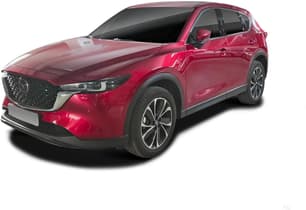
What's the difference?
Australia loves Mazda.
We have all sorts of Mazdas. Big ones, small ones, relatively affordable ones, expensive ones, but one which stands above the rest is the CX-5.
That's because this mid-sizer does a lot of the heavy lifting for the Japanese brand, keeping it in the fight against titans like Toyota in the sales charts.
If you're ready to feel old, this second-generation version of the CX-5 with its eye-catching design is now a whopping seven years old, although it has been tweaked recently in 2022 to bring a few updates, as well as the addition of the variant we're looking at here, the Touring Active.
So, the question we're wrestling with is whether this car's continued massive popularity is still warranted.
Is this still one of the best mid-size SUVs you can buy for your family, or should you be considering more recently arrived alternatives?
Like your favourite TV show from the ‘90s, MG’s high-definition re-boot in the last few years has proven to be full of surprises.
Not only has it earned itself a spot in the top 10 automakers in Australia (the first Chinese-backed brand to ever do so) but the automaker has also proven it has more than one trick up its sleeve.
It found astounding success with its budget MG3 hatch and ZS SUV, and has played an important role in bringing the cost of electrification down in Australia.
The latest offering, and the car we’re looking at for this review, is the now even cheaper plug-in hybrid HS mid-size SUV.
Question is, at a price which can compete with 'self-charging' hybrid tech, should you choose an option you can plug-in? Stay with us to find out.
Despite being far from the most modern option on the market, I'm surprised to see how well the CX-5 is holding up, particularly compared to more recently launched rivals when it comes to driving dynamics and cabin ambiance.
In fact, this car still feels so up to the task it's hard to believe Mazda is already moving its styling upwards and onwards with spiritual successors on the way like the CX-50 and CX-60.
For now, it's hard to go wrong in the CX-5 range, and actually, the Touring Active is the value pick of the bunch if you're willing to do away with certain small luxuries which this design feels like it should have.
MG is quietly establishing itself as a champion of the electric space, with this HS mid-sizer offering a compelling list of specs with a long electric range in an attractive package.
It is still lacking in a few obvious areas, from driving dynamics to charging speed, but it’s doing its part at the asking price to at least make a plug-in hybrid alternative worth considering.
What has always sold the CX-5 is its understated but upmarket-looking design. Even after all these years it oozes cool with its big trend-setting and deeply three-dimensional honeycomb grille, tasteful chrome highlights, and sleek light fittings, which of course are all elements now emulated by other brands.
The recent update brought with it new shapely LED lights front and rear, a tweaked face, new wheel designs and some updated features for the interior.
Meanwhile, this Touring Active grade scores some bright green touches inside and out, as well as additional silver trim pieces and gunmetal wheels.
Inside it's still hard to believe Mazda manages to make a car look and feel this good at the price. It's not hard to imagine someone test driving a Toyota RAV4 and subsequently being blown away by the premium look and feel of the CX-5.
The Lego brick neon green highlights in the interior of the Touring active, which form part of the vent surrounds and work their way into the seat trim, bring an unusually youthful flair to the usually serious Mazda cabin, but they won't be for everyone.
Other highlights include a tasteful smattering of silver trim, a blend of soft-touch materials in the dash and doors, and a more subtle approach to multimedia than many other brands, with low-set screens far from the driver.
MG’s success is not just in being one of the most affordable but making affordability so damn good looking.
Taking cues from Mazda’s successful glitzy design formula, the HS impresses with a chrome-embossed grille, chiselled light clusters, combining with a curvaceous bonnet for an eye-catching face.
Down the side the curvy lines continue, undulating over the wheelarches, to a well resolved rear-end, complete with tidy light clusters and even dual-exhaust pipes.
Look at this car a little too long, though, and you start to find more than a few flaws with its design.
Sure, it’s eye catching, but the 17-inch alloys do a pretty ordinary job of filling those big wheelarches, and there’s something a little off about the ride height.
You can also see the rear suspension control arms sitting well below the base of the rear, a reminder the HS is an SUV based on the MG6 sedan.
Suffice it to say, while it looks great at a few paces, up close it misses out on some of the nuance and poise of its rivals.
Inside follows the same formula of the outside, with attractive curvy lines, a sporty-looking steering wheel and a pair of dazzling screens.
Again, though, look closer and you’ll see this otherwise modern-looking interior is not as impressive beneath the surface.
The seats look plush but feel cheap with vinyl trim, and the same goes for the door cards and centre console. All have soft-touch surfaces which, in reality, are paper thin. It still beats having hard plastic in the doors, though, so context is everything.
The plastic trims throughout are also hit-and-miss, with some looking great, and others hard and nasty.
The +EV versions of the HS ditch the mechanical shifter in the centre console for an electronic one, which combines nicely with the digital dash to make the cabin feel more modern than even some more upmarket rivals.
As one of Australia's most popular mid-size SUVs, you'd hope the CX-5 is up to family duties, and the good news is it mostly aces the brief.
Up front, there's plenty of room for adults, with a good amount of adjustability, and great visibility despite a relatively high belt-line and dash.
The seats in this Touring Active grade are manual adjust only, which may be a downside for some, while the blended seat trim of ‘Maztex' synthetic leather and suede isn't my preference.
I'm more in favour of a basic cloth seat, which will be much easier to clean and will probably wear better, or the lovely real leather seats which appear on higher grades.
Nicely-sized bottle holders appear in the doors and centre console, and the latest update also brings a wireless charger under the climate unit, to match the wireless phone mirroring.
On the topic of phone mirroring, Mazda has taken the commitment to dial-operated systems to a fault.
The multimedia screen, perched atop the dash, is not a touch unit, and is instead operated only with the centre dial.
This dial is fine for operating Mazda's relatively straightforward software, but is downright clumsy when it comes to flicking through menus on Apple CarPlay, in particular.
Still, I appreciate the very straightforward climate panel, which consists of physical buttons and dials for all of its controls. Far preferable to the trendy touch panel, or worse, multimedia-screen interfaces on some rivals.
The rear doors open nice and wide, making it easy to fit child seats, and room back there is more than sufficient for adults in the outer two rear seats, as well.
I had plenty of legroom and headroom behind my own driving position at 182cm tall.
The quality trims continue in the doors, and there's a large bottle holder in each one, alongside a further two in the drop-down armrest.
Interestingly, this part also has a flip-open tray with two USB 2.0 connectors, a tidy way to get power to the rear passengers, but one which can't be used if the middle seat is occupied.
There are no additional outlets on the back of the centre console, although there is a set of air vents back there.
The boot measures in at 438 litres, which is not on the larger end for the mid-size SUV space, and may cause some families to run into issues, particularly if they need to carry a pram on top of regular luggage.
As it is though, it fit our CarsGuide demo luggage set with minimal room to spare. There is a space-saver spare wheel under the floor.
There are some particularly strange things about the HS’s cabin when it comes to practicality.
The seats are perhaps the biggest issue. Not only are they clad in a cheap feeling vinyl, but the seating position is very high, and you hardly sink into the seat base, leaving you with the impression you’re sitting on the car rather than in it. Weird.
Visibility is great out the sides of this car, but with the seating position the way it is, I feel like my head is close to the roof and the windscreen has a narrow letterbox aspect. This is complicated further by the rear vision mirror, which sticks a fair way down into your field of view.
The front of the cabin feels plenty wide enough, though, and there are some other practicality wins, like the multimedia screen which is easily within reach.
Its limited resolution is a benefit here, with the touch elements being big and easy to reach while you’re concentrating on the road, but the stock software is clumsily laid out and slow, taking a full second or two to react to some interactions.
This is especially notable as the entire climate system is operated via the touchscreen.
The cabin offers up decent storage. There are big bottle holders in the doors as part of a larger bin, and there are a further two large bottle holders in the centre console with a removable divider.
The armrest box opens to reveal a small storage area, which also has an internal vent for the air-conditioning.
Under the shortcut buttons up front there’s a flip-open tray with two USB outlets and a 12V port, but this little opening is so tiny it’s no good to store any kind of object. It’s also impossible to close the flip cover if you have something plugged in.
The rear seat is one of the HS’s best attributes. Compared to even the front seats, the rear passenger space is enormous, with ample width, headroom, and legroom.
The seats can recline slightly, and amenities are even impressive with two pockets on the backs of the front seats, large bottle holders in the doors, dual adjustable air vents, and two USB ports for rear passengers.
Of special note is the strangely lavish drop-down centre armrest, which is clad in soft trim and has a flip-open tray and dual bottle holders.
Rear seat space comes at a bit of a cost to boot capacity, though. The HS offers 451 litres, which is a little off-the-pace for the mid-size SUV segment. The rear seats intrude into the space a fair bit, and the floor is quite high.
It fit our three-piece CarsGuide luggage set, but only just, and it required removing the retractable luggage cover. Unlike the top-spec Essence, the Excite does not have a power tailgate.
No spare wheel in +EV versions of the HS, with the underfloor space housing a repair kit and a small cutaway for charging paraphernalia.
Since it arrived Down Under in 2022, the updated CX-5, thanks in large part to its ongoing popularity, is available in a long list of confusingly labelled variants.
To be precise, there are now 11 different versions of this SUV, two basic front-wheel drive variants, and nine all-wheel drive models with three different engine options.
Confused? Me too. To cut to the chase with the Touring Active, though, it's the third cheapest all-wheel drive version, featuring the least powerful of the three engine options.
For roughly the same money you can get into a base model Toyota RAV4 GX all-wheel drive hybrid, or mid-grade all-wheel drive versions of the Hyundai Tucson (Elite) or Kia Sportage (SX+), although I would argue none of those options have quite the visual appeal of our Mazda.
Standard equipment on the Touring Active grade includes 17-inch gunmetal alloy wheels, ‘Maztex' synthetic leather and suede interior trim, a new-for-the-update 10.25-inch multimedia screen with dial control (more on that later), a semi-digital instrument cluster, updated navigation system, and wireless phone charging to match the wireless Apple CarPlay and Android Auto.
There's also dual-zone climate, and re-designed LED light fittings front and rear.
Despite the swish look, there are things missing here. For example, my partner was surprised the seats were manually adjusted in a car which looks this nice inside, and I have to agree.
Plus, you have to spend significantly more to get into a version with the turbocharged engine. There's also no sunroof at this grade, nor is there a powered tailgate.
MG now calls its plug-in hybrid cars +EV. It says this is to help demystify the technology, by showing it’s essentially a combustion vehicle, plus an electric vehicle component.
If you ask me, ‘plus EV’ is actually more confusing, but the point is this new version brings the price down once again.
This is because the plug-in version of the HS originally launched in 2021, only as the top-spec Essence. The Essence is still one of the most affordable plug-in hybrids you can buy in Australia, but the new mid-grade Excite trim we’re looking at for this review brings it down further.
Wearing a drive-away price-tag of $46,990, the strategy here is to offer the more expensive plug-in hybrid technology at the cost of a mid-grade self-charging hybrid RAV4.
Elsewhere the HS Excite competes with higher grades of the currently combustion-only Hyundai Tucson and Kia Sportage, but the big threat for this car will likely emerge in the form of the self-charging hybrid Haval H6 which launces in the coming months.
The HS is immediately impressive in terms of its raw numbers, though, with a massive 16.6kWh battery pack granting it a relatively long 63km purely electric driving range (although this is to the more lenient NEDC standard).
Aside from its electric features, there’s an appealing list of spec items included, with 17-inch alloy wheels, a 10.1-inch multimedia touchscreen with wired Apple CarPlay and Android Auto support, a 12.3-inch digital dash cluster, keyless entry with push-start ignition, six-way power seat adjust for the driver, heated front seats, dual-zone climate control, and a pretty good reversing camera.
What do you miss out on picking the more affordable Excite PHEV over the top-spec Essence? 18-inch alloys, a panoramic sunroof, improved seat trim, and, disappointingly, LED headlights. The Excite only ships with old-school halogen bulbs.
It’s also worth noting the hybrid RAV4s can be all-wheel drive at this price, while the +EV variants of the HS are front-drive only. Still, this mid-size SUV is one of the most affordable PHEVs on the market.
For such a contemporary looking car, things feel a little dated when it comes to engine tech.
Rather than employing a fancy hybrid or downsized turbo unit with a tricky transmission, Mazda relies on a regular 2.5-litre four-cylinder engine, mated to a traditional six-speed torque converter automatic transmission.
The engine produces 140kW/252Nm, hardly on the high end for the segment, and it needs to drive all four wheels.
If this doesn't sound like enough punch for you, there's also a 2.2-litre four-cylinder diesel engine (140kW/450Nm) available on the Touring Active grade, but it carries a roughly $3000 premium.
This is where plug-in hybrids tend to get a bit complicated, so bear with us.
The MG HS +EV pairs a 1.5-litre, four-cylinder, turbo-petrol engine with an electric motor on the front axle. The two drive the front wheels via a new 10-speed traditional torque converter automatic transmission, instead of the dual-clutch which features in the combustion-only versions of this car.
The engine produces 119kW/250Nm on its own, while the electric motor produces 90kW/230Nm. The two combined produce 189kW/370Nm, making the +EV by far the most powerful HS on the market, capable of accelerating from 0-100km/h in 6.9 seconds.
As you'd imagine, a 2.5-litre engine with no electrical or turbocharged assistance can punish you at the fuel pump.
While the hybrid RAV4 has managed to bring fuel efficiency as low as 4.8L/100km to the mid-size SUV space, our Mazda has a comparatively high official combined efficiency of 7.4L/100km.
After 400km of driving in real-world suburban conditions, my test car consumed 9.0L/100km, decidedly higher again.
Thankfully, the CX-5's relatively low-tech engine is capable of consuming entry-level 91 unleaded. It is only compliant with Euro 5 emissions standards, and has a 58-litre fuel tank.
Using the official economy figure, driving range comes in at just over 780km.
The HS +EV backs its electric features with a relatively large 16.6kWh battery pack, allowing it a purely electric driving range rated at 63km.
This is on the more lenient NEDC standard, though, and our car was reporting between 40–45km on a full charge. Still pretty good for a plug-in hybrid mid-size SUV.
As a result of this well-supported system, +EV versions of the HS have an official/combined cycle fuel consumption figure of 1.7L/100km, but as with all plug-in hybrids this will depend on how you use it.
On my week-long test, the car returned a figure of 3.9L/100km, with the caveat I did run it out of charge on more than one occasion. The HS’s turbocharged engine requires mid-grade 95RON unleaded.
Take a moment to appreciate this mid-sizer still used less fuel than a tiny hatchback, but charging is a less impressive story.
MG says the +EV will charge to 100 per cent from the reserve level in five ours on a 7.0kW charging connection, the only problem is the numbers don’t add up.
If you divide 16.6 by five you get 3.3kW, which is the actual charging rate. For a battery this big, that’s too slow. To put it in perspective, it’s only slightly faster than if you were to charge it up from a wall socket, and makes this car best for those who can trickle charge it at home.
Even dragging out your grocery shop to, say, 2.5 hours, will only net you half this car’s battery, making it inconvenient if you need to rely on public charging to get by.
If you've driven any Mazda in the last decade or so, this latest CX-5 won't throw up any surprises. The drive experience adheres to the sporty, firm and purposeful ethos which Mazda has cultivated over a long period of time.
This is defined by nice accurate steering, an overall light and springy feel for the car, and a firm ride.
While the engine has to push harder than some in this class to move along its mid-size bulk and the demands of all-wheel drive, it's still a comparatively fun family SUV to drive.
Especially when compared with the comfortable-but-tame RAV4, and perhaps overly tech-y turbocharged dual-clutch versions of the Tucson and Sportage.
In this way, the Mazda's old-sounding powertrain may be an advantage. In particular, the six-speed automatic transmission is smooth and predictable, great for family buyers and won't throw up any surprises, particularly for those coming out of older vehicles equipped with similar components.
For its most recent CX-5 update, Mazda has tweaked the suspension further, which has thankfully gone a long way to taking the edge off the once too-hard ride.
It's still a firm and reactive SUV, though, amongst the more entertaining to drive in the segment.
Okay, so once you get past the weird seating position we mentioned earlier, it's immediately apparent this hybrid version of the HS is the best to drive in the range.
The powerful electric motor in this car makes it so much smoother and easier to drive than the combustion car. It’s got quiet, smooth acceleration and a nice gentle regen braking, and you never even need to worry about what the transmission is doing.
This 10-speed automatic is so smooth it’s hard to tell what it’s doing at any given time, an out-of-sight improvement over the dual-clutch automatics which appear elsewhere in the range.
Where the HS isn’t as impressive is in the steering. It’s nicely weighted but a bit vague when it comes to feeling. I’m not super confident of what the front wheels are doing, and I feel like it doesn’t handle the additional weight from the big battery pack particularly well.
It feels comparatively top-heavy with a tendency towards mild understeer when you push it, missing some of the confidence its more established rivals have.
The ride is mixed. It’s generally soft, so it’s comfortable over smaller bumps, but when you hit big ones, it is evident the ride lacks a bit of control, because it will bounce around, and feel a little unsettled.
This imbalanced ride and handling is one of MG’s weak spots generally, which is why I’m surprised the electric drivetrain is so sleek, even comparable to Toyota systems.
When it comes to controlling those electric driving functions the HS defaults to a hybrid mode, where it seems to use primarily electric drive at lower speeds, activating the engine automatically at higher speeds, or when the accelerator is more heavily applied.
The only issue I have with this mode is I’m not sure at times how or why it decides to run the engine. With rival systems you’ll get some kind of ‘eco’ indicator which gives you an idea of when the engine will activate, but in this car there’s just a percentage indicator on the dash, which isn’t too helpful.
Your only other drive mode option is to stick it in EV mode, which you can do via a button on the centre console. In this mode it will only use the electric motor, and it’s able to do this at quite high speeds, so even if you’ve got a bit of an expressway or something on your drive it won’t necessarily need combustion support. Meaning you can have genuinely fully electric driving if you’ve got somewhere to charge it up at either end.
There’s no combustion or charge mode like some plug-ins have, and there is also no way to control the regen braking, so it’s not as customisable as we’d like. And the regen tune is relatively mild, so it’s probably not as energy efficient as it could be, either.
Still, the hybrid systems are impressively smooth and as a result the +EV versions of the HS are simply the best in the range to drive by a solid margin.
There are no optional pieces of safety equipment in the CX-5 range, and thankfully the active systems are minimally invasive for the driver, too, letting the drive experience shine further.
Standard equipment includes auto emergency braking (works high speed going forward, and low speed in reverse), lane keep assist with lane departure warning, blind spot monitoring with rear-cross traffic alert, traffic sign recognition, as well as adaptive cruise control and front and rear parking sensors.
As a bonus, there's a nice high-def reversing camera, although you'll have to spend more for the 360-degree version, and a tyre pressure monitoring sensor, too.
The CX-5 has five airbags, dual ISOFIX and three top-tether mounting points across the rear row, and maintains a maximum five-star ANCAP safety rating from when this generation launched back in 2017.
Although the Excite is the more affordable of the two +EV variants, it doesn’t miss out on any of MG’s active ‘Pilot’ safety suite.
This means it scores all the key items, from auto emergency braking (detects pedestrians at up to 64km/h and vehicles at up to 150km/h), plus lane keep assist with lane departure warning, to the rear-facing items including blind-spot monitoring and rear cross-traffic alert.
It also scores adaptive cruise control, which late last year received an update making it a bit less twitchy than in launch form.
Six airbags and the expected array of electronic braking, stability, and traction aids appear, but while combustion-only versions of the HS wear a maximum five-star ANCAP safety rating to the 2019 standards, the +EV versions are excluded from this rating as they arrived later.
Mazda keeps things simple here with five years of warranty, five years of roadside assist, and a five-year capped price service program.
For the latest update, the service intervals have been pushed out from 10,000km to 15,000km and 12 months, and the average cost works out to be $423 per year for the 2.5-litre petrol engine option as tested.
This is not the cheapest servicing in the segment, but it's not unusually expensive, either.
MG has tweaked its ownership promise for its electrified models recently. While the brand generally follows in the footsteps of challenger brands like Kia by offering an ahead-of-the curve seven-year warranty, this has only just been extended to the +EV variants.
Strangely, there’s also a seven-year, unlimited kilometre warranty for the high-voltage battery components, which is a bit different from the industry standard eight-year/160,000km warranty.
Capped price servicing has also been added covering the duration of the warranty. Each visit at 12 monthly or 10,000km intervals costs between $265 and $968, for a yearly average of $403.14.
Not expensive, but also not at the cheap end of the spectrum.