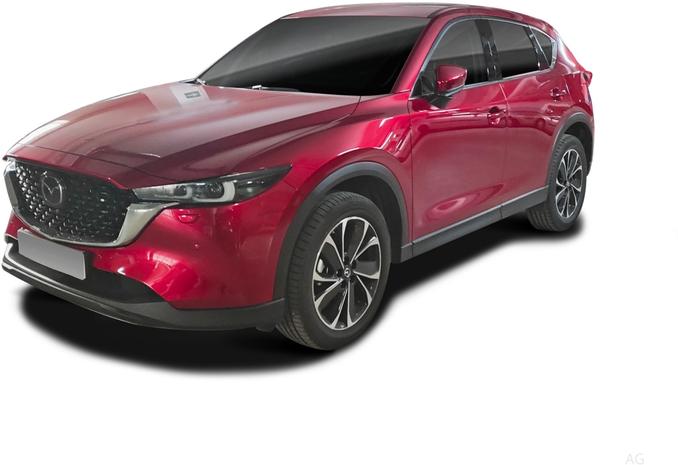
The 2023 Mazda CX-5 range of configurations is currently priced from $21,880.
Our most recent review of the 2023 Mazda CX-5 resulted in a score of 7.5 out of 10 for that particular example.
Carsguide Deputy News Editor Tom White had this to say at the time: Despite being far from the most modern option on the market, I'm surprised to see how well the CX-5 is holding up, particularly compared to more recently launched rivals when it comes to driving dynamics and cabin ambiance.
You can read the full review here.
This is what Tom White liked most about this particular version of the Mazda CX-5: Still looks and feels swish, Nice and sporty to drive, Safety standard
The 2023 Mazda CX-5 carries a braked towing capacity of up to 1800 Kg, but check to ensure this applies to the configuration you're considering.
The Mazda CX-5 2023 prices range from $24,750 for the basic trim level SUV G20 Maxx (Fwd) to $45,980 for the top of the range SUV G35 Akera Turbo (Awd).
There are nine colours in the CX-5 range, including black, white, silver, red, sand, two greys and two blues.
At a minimum, the CX-5 comes standard with 17-inch alloy wheels, a 10.25-inch multimedia screen, a 7.0-inch digital instrument panel, cloth interior trim with manual adjust seats, dual-zone climate control, push-start ignition, and the full safety suite.
The Mazda CX-5 has an upmarket-feeling interior for its price and class, with soft-touch materials throughout. The most recent update in 2022 brought with it a larger multimedia screen, while a digital instrument panel is now standard across the range.
The overheating is far from a mystery: Any time the coolant level in the radiator and cooling system drops below a critical point, there’s simply not enough coolant remaining to effectively cool the engine. So it gets hotter and hotter until it overheats.
The bigger question is why the coolant is leaving the radiator via the coolant recovery tank. In many cases, this is because of pressure from the combustion process finding its way into the cooling system. In turn, that’s very often caused by a failed head gasket which is allowing the combustion pressure into the coolant passages inside the cylinder head and crankcase.
The head gasket not only keeps combustion pressure (the result of the air and fuel being burnt in each cylinder) inside the engine, but also separate from the cooling system. But a failed gasket will often allow the pressure and the coolant to mix, at which point the pressure overcomes the pressure inside the cooling system and the coolant has to go somewhere. Generally, that somewhere will be the recovery tank as this is where the coolant goes in the normal course of its expanding as the engine heats up.
There’s a quick, simple chemical test that a mechanic can carry out to confirm whether the head gasket has failed, and this would probably be your first step. And don’t be tempted to continue driving the car and simply topping up the coolant. This type of leak can get a lot worse very quickly, and overheating can destroy an engine while you watch.
Show more
There’s been no recall for this model regarding oil consumption. And although there have been a handful of recalls for the CX-5, your car is not within the build-date parameters to be one of the affected ones.
It’s important to remember that often, a problem with a car sold in another market, won’t affect the same make and model in another part of the world. This can be because of vastly different operating conditions, different driving and usage habits and even the two apparently identical vehicles being built in different factories with different suppliers producing the parts.
Don’t forget, either, that all engines consume some oil. A turbocharged engine with its higher combustion chamber pressures will often sip a little more, but some oil consumption is part of the normal process of engine operation. That’s particularly true of modern cars which often use low-tension piston rings to reduce internal friction and, therefore, fuel consumption, at the cost of a little more oil consumption.
Show more
This is not as simple as perhaps it should be. Different carmakers use different methods to calculate cargo space, and Mazda uses the VDA method which uses 200mm X 100mm X 50mm blocks to determine the volume. In this case, the CX-5 has a volume of 438 litres with the rear seats up and 1340 litres with the seat folded down.
However, you need to know the dimensions in centimetres, so here’s how it pans out: The CX-5 has a luggage space length of 89.7cm with the rear seat in place, 171.5cm with the seat folded, a luggage space height of 82.7cm and a width of 105cm at its narrowest point.
Perhaps that helps, but the best way by far (if possible) is to visit a Mazda showroom with the wheelchair in question and physically see if it fits.
Show more
The Mazda CX-5 has a 438-litre boot capacity regardless of variant.
There are four variant-dependent engine choices in the CX-5 range, all of which are four cylinders. This includes a base 2.0-litre petrol engine (115kW/200Nm), a mid-grade 2.5-litre petrol engine (140kW/252Nm), a 2.2-litre turbo-diesel option (140kW/450Nm), and a top-spec 2.5-litre turbocharged petrol (170kW/420Nm). All are mated to a six-speed transmission.
Mazda's CX-5 range is five-seat only, with seats clad in either cloth, a combination of synthetic leather and suede, or Nappa leather, depending on grade.
The base G20 Maxx version of the CX-5 can sprint from 0-100km/h in 10.6 seconds, while G25 all-wheel drive versions reduce this to 9.7 seconds. The 2.2-litre diesel versions will complete the sprint in 8.8 seconds, and the fastest CX-5, the G35 2.5-litre turbo can sprint from 0-100km/h in 7.7 seconds. Expect a top speed in the region of 200km/h.
Driving range will depend on variant. Base front-drive 2.0-litre equipped cars will travel an estimated 812km on a single tank of fuel, while mid-spec 2.5-litre AWD versions will travel less far, at an estimated 784km. Diesel versions can travel the furthest, at an estimated 1018km between fills, while the top-spec 2.5-litre turbocharged petrol engine can travel the least distance, at an estimated 707km.