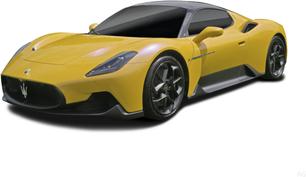
What's the difference?
With Ferrari leaving the Fiat-Chrysler family and becoming an independent entity in 2016, Maserati was left without a technology partner.
Suddenly, the Trident brand had to go it alone and come up with its own engines for the first time in more than 20 years. The MC20 sports-car is the result of that rebirth.
While there’s no doubt the Maserati brand has the currency to pull this off, the MC20 is also a big step outside the company’s usual grand-tourer box.
The new coupe is aimed at McLaren, Porsche and even Ferrari buyers, so can the first true Maserati sports car since the MC12 of 2004 walk the walk? And let’s not forget that the MC12 was Ferrari Enzo-based…
No-compromise cars are often the ones that impose the most compromises, and in that sense, the MC20’s shattering on-paper performance means its greatest attributes can’t be enjoyed on a public road.
That’s why this review was conducted entirely on Philip Island’s 4.4km Grand Prix layout. As a result, we can’t tell you much about parking ease or highway fuel consumption. But as for the things that give a super-sports car its identity, read on.
Back in 2010, Mitsubishi released Australia’s first mainstream electric vehicle (EV) in nearly a century.
That model, the i-MiEV, was a four-seater city-sized Kei car from Japan that cost $48,800, before on-road costs, or from roughly $70,000 in today's money. Little wonder it bombed. That was four times more than petrol-powered equivalents of the time.
Now, in 2026, the new BYD Atto 1 is the first EV sold here since the i-MiEV’s 2013 departure to be considered a four-seater city car.
It’s also the least-expensive EV money can buy, being even cheaper than many internal-combustion engine alternatives like the Mazda 2 and Toyota Yaris hybrid. The fact is, there’s nothing remotely near the Chinese supermini’s base price that’s electric.
But is the Atto 1 any good?
With a 320km/h-plus top speed and the ability to get from rest to 100km/h in under three seconds, there’s no doubting the MC20 meets or exceeds its performance brief. But when you’re paying these prices, there must be more than just the measurable stuff going on.
And there is. The MC20 brings a big dollop of purity to the ranks of current supercars, doing away with all-wheel drive and hybrid tech and relying instead on and old-school approach in terms of handling and overall feel.
Anybody who wants to argue that call has plenty of alternatives to the MC20 from other manufacturers, and for some of us, that less-is-more thing will ring true.
Note: CarsGuide attended this event as a guest of the manufacturer, with meals provided.
The BYD Atto 1 has already earned its place in history as the cheapest new EV ever sold in Australia. And the good news is that, on the strength of bigger-battery Premium version, it rarely puts a foot wrong as a city car, exceeding performance, efficiency, refinement and comfort expectations. The Atto 1 really delivers around town.
But the baby BYD’s price is too close to larger EVs with better range, while extended exposure reveals issues with seat comfort, touchscreen access/distraction, ADAS interference and nervous steering feel at speed. Australian road tuning is required to rectify these.
Still, as a cheap urban EV runabout, the Atto 1 Premium still (just) stands alone. A glimpse into the future, someday, all city cars will likely follow in the bold BYD’s footsteps.