What's the difference?
Replacing the long-standing UX250h, the more powerful Lexus UX300h hybrid sits at the luxury end of the compact SUV segment, and the latest update brings a refined line-up along with tweaks to both design and technology. In this review, I’m looking at the base Luxury grade to see what it's like to live with this hybrid day-today and how it stacks up against its nearest rivals.
Mazda has a tendency to have a lot of similar looking horses in the stable; blink and you'll miss the (very) subtle differences between the CX-8 and the CX-9 but if you're not super keen on the bulk of the CX-9 and you've outgrown the space of the CX-5... this one's for you.
Especially, if you've been considering its competition - the Hyundai Santa Fe Elite CRDi AWD and Toyota Kluger GXL AWD. Both of which have become known for their features and space.
So, how does it compare? The CX-8 GT SP diesel all-wheel drive seats seven, has a decent boot space (albeit, when the third row isn't in use) and handles like a dream.
Perfect combination? Maybe. I've been driving it for the last week with my family to find out for you.
The updated Lexus UX300h Luxury is a solid entry in the premium compact SUV segment. It doesn’t break new ground, and there are areas that could be improved, but it handles well, offers a thoughtful selection of amenities for a base-grade luxury model, and its compact size makes it easy to park almost anywhere. For buyers seeking a stylish, efficient, and practical hybrid with a luxury badge, it’s a dependable choice.
So, what did my family think about the Mazda CX-8 GT SP diesel all-wheel drive? I love how it performs on the road - it's super easy to drive and you don't notice how large it is in a car park.
There are some great family-friendly features scattered throughout and I like how practical this is too with the extra seats and top-tether points. The multimedia system isn’t my favourite and I would have preferred to have seen a few extra airbags and a 360-degree view camera, but overall, it’s a good family car and gets an 8.0/10 from me.
My son loved the sun blinds and the cool colour of the seats. He also gives it an 8.0/10.
The updated Lexus UX is technically a compact SUV, but it feels more like a hatchback that's taken a small dose of steroids. The facelift brings a sharper look with a stylised 3D spindle grille, new air intake vents, fresh 17-inch alloy wheels, updated daytime running lights and a full-width rear light bar. The sculpted bodywork still showcases Lexus’ signature origami-like panelling and, overall, it’s a handsome little thing. That said, the heavy use of black plastic moulding around the lower edges detracts from its premium appeal.
Inside, the cabin takes a more understated approach. Up front it feels premium-enough, with synthetic leather trims, soft-touchpoints and those high-tech dual 12.3-inch displays headlining the dash. Your eye moves smoothly across the layout without lingering too long on any single element, which adds to the sense of elegance.
Not everything feels top-tier, though. Hard plastics are still scattered throughout the cabin, and they’re especially noticeable in the back seat where the doors have very little in the way of a soft surface. Yes, this is the base grade, but in a car wearing a luxury badge, it’s something you notice more than you should.
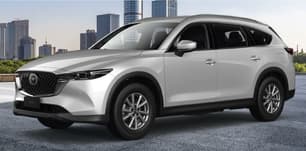
To be honest, I can't really tell the CX-8 and CX-9 apart on the road. They're both large SUVs that sport the classic Mazda bonnet - sharp and long. Up close, the CX-9 has a bulkier shape but otherwise they are remarkably similar.
The CX-8's darkened grille generates some interest with its lattice-work and there are enough shiny chrome accents scattered about the car that it looks pretty.
Yet, the sporty sharpness that Mazda is known for is still hinted at with its shaping and the 19-inch black alloy wheels.
Our model is finished in 'Platinum Quartz Metallic' and it is the highlight for the exterior styling for me. I think because it's such an interesting colour to look at - it varies a lot depending on lighting conditions. Sometimes, it almost has a sheen of pink to it and at others, it looks like pearly sand.
The interior looks polished and refined with its burgundy leather trim and soft-touchpoints. Again, there is a lot of chrome inside to make otherwise dull features, like air vents, pop out.
The UX is a compact SUV, so it's best not to expect a sprawling interior. The front row offers the best space and comfort, with wide door openings and a ground clearance that makes it easy to hop in without any grunts. The seats are comfortable enough on long drives, although some fatigue creeps in on the passenger side due to the lack of lumbar support. Both front seats are power-adjustable and heated, and with the steering wheel also adjusting electrically, it’s easy to dial in a good driving position.
Move to the rear seats, and space becomes noticeably tighter for adults. At 168cm, my knees press against the seat in front, and even my eight-year-old asked me to slide the passenger seat forward this week. That said, he’s been mostly comfortable thanks to the wide door openings, lightweight doors and well-padded seats.
My son did point out that the tall window sills make it hard to see out, which could be a deal breaker for younger passengers. There are three top tether anchor points, but fitting three child seats across is unrealistic.
Storage is on the slim side, but the dual-opening centre console is clever, and there are two cupholders and drink bottle holders up front. The rear row only gets a single map pocket and two cupholders. A few more cubbies for things like sunglasses or keys would be welcome, as the cabin can quickly feel cluttered if you’re not careful.
Technology is neatly integrated. The dual 12.3-inch displays look sharp with clear graphics, and the touchscreen is responsive. The updated operating system isn’t a big leap forward, but it’s easy to use and the wireless Apple CarPlay and Android Auto work seamlessly. There’s also sat nav, a wireless charging pad, four USB-C ports, a single USB-A port and a 12-volt socket for charging.
The boot looks modest at first glance, especially with the floor set in its highest position, but it still swallowed a big grocery shop with no fuss. Officially, capacity is 364 litres, which makes it the smallest compared to its nearest rivals, although the adjustable floor helps with taller items or creates a handy nook for smaller ones.
A bigger drawback is the lack of a spare tyre as you only get a repair kit. For city drivers that might be fine, but for those of us who live regionally or do longer trips, a spare tyre is a must-have. On the plus side, the powered tailgate with kick function is standard here, whereas rivals make you pay extra for it.
The CX-8 is a very practical family hauler because there's ample room in all three rows. Yes, even adults will be able to squeeze into that third row without too many complaints!
All rows enjoy well-cushioned seats and up front they are electrically adjustable, but unfortunately, only the driver's side has lumbar support.
The middle row can slide forward manually or by using the electric button found on the side of the seats... but doing it yourself is way faster.
They do slide far enough forward that you won't embarrass yourself too much when you have to clamber into the third row. Where the seats have a 50/50 split-fold and manual adjustments (accessed via the boot).
In the first two rows there are lots of individual storage options but the front enjoys the most. The middle console is deep enough to be useful and I like the dual opening lid. Each row gets a couple of cupholders and drink bottle holders, too.
The charging options are great, with each row getting two USB-C ports and the front getting a wireless charging pad and 12-volt socket.
All of the controls and dials feel within easy reach and the 10.25-inch touchscreen multimedia system graphics are clear.
You can use it as a touchscreen or opt for the rotary dial but switching between the two was awkward for me. Especially, since the touchscreen function is disabled when you are using the wireless Apple CarPlay. This also has wired Android Auto, for those users.
The amenities are practical throughout with a dark headliner, three-zone climate control and heated outboard seats and retractable sun-blinds in the middle row.
Good news for families because there are five top-tether points across the back rows and ISOFIX child seat mounts on the outboard seats in middle row, in case you need them.
You can fit a 0-4 rearward facing child seat and it shouldn’t impact on front passenger comfort.
My six-year old found it super easy to get in and out of this car because of the 205mm ground clearance and wide door apertures. He enjoyed the high seating position, too, but was disappointed he couldn’t see out of the sunroof!
The boot space is a bit cramped with all three rows are in use at 209L but folding the third row opens up a more respectable 775L - perfect for the average family and its stuff!
The loading space is level, with the temporary spare tyre and clever storage compartments housed underneath. There is a retractable cargo blind and net, luggage anchor points and a 12-volt port, too.
And, as always, I love a powered tailgate, which this has!
The new Lexus UX300h is offered in three grades, and the grade tested here is the entry-level Luxury, priced from $55,370 before on-road costs. That positions it right in the middle of its rivals, with the Audi Q2 35TFSI S starting at $49,400 and the Volvo XC40 kicking off from $56,990.
The Luxury grade brings a solid list of standard equipment. While it won’t blow your socks off, it does offer good value-for-money compared to its premium competitors where a lot of features have to be added for additional cost. Highlights include powered front seats with heat function, synthetic ‘NuLux’ leather upholstery and trims, dual 12.3-inch displays and a upgraded OS for the multimedia system. You’ll also find a 10-speaker sound system and seamless wireless phone mirroring for both Apple CarPlay and Android Auto.
Technology extends further with built-in satellite navigation, Bluetooth, digital radio, reversing camera, two USB-C ports in each row, plus a USB-A port, 12-volt socket and wireless charging pad up front.
Practical features like keyless entry and start, dual-zone climate control, dusk-sensing headlights, updated daytime running lights, rain-sensing wipers, electrically adjustable steering wheel and a powered tailgate with kick function.
A three-year complimentary membership to the Lexus Encore program rounds out the package. Members gain access to the Lexus Connected Services phone app where you can customise your driver profile and have access to a digital key but there are a range of benefits from supporting partners like Westfield and Ampol to enjoy as well.
The GT SP diesel AWD is one of the premium models, sitting third from the top and will cost you $65,560, before on road costs.
However, its price tag positions it as the most expensive compared to its rivals. With the closest rival being the Kluger at $65,310 and the most affordable being the Santa Fe at $60,000.
You do get a stylish-looking package with lots of features for your cash, like heated front seats, heated rear outboard seats, a tilt and slide sunroof, and premium leather interior trim.
There's some great tech scattered throughout, too, like the 10.25-inch touchscreen multimedia system, wireless charging pad, USB-A ports in the third row, Bose Premium sound system with 10 speakers, wireless Apple CarPlay and wired Android Auto.