What's the difference?
It's just about so late to the seven-seat party that all that remains is a tired cleaner sweeping up confetti and cake crumbs, but Lexus has at last launched an SUV with a third row of seats.
Well, technically it hasn’t so much launched a new model as it has extended its existing large SUV, adding a 110mm extension behind the rear wheels to squeeze in two extra seats and form the RX L
Lexus shifted around 2000 units of its five-seat RX last year, and the brand’s local executives reckon 20 per cent of premium SUV shoppers are chasing a seven-seat car. If those numbers stack up, it could mean a 400-strong annual sales boost for the RX range.
A big deal for the Japanese premium brand, then. But what about the rest of us? Is bigger really better for the RX?
There has never been a better time to be shopping for an electric SUV in Australia, with the avalanche of Chinese brands constantly smashing through the price floor as they bid for the title of Australia’s cheapest.
MG led the charge with its S5, which is $40,490, drive-away. Then Leapmotor upped (or downed?) the ante with its B10 with a $38,990, drive-away, price tag. And now BYD has knocked them both out with its Atto 2, officially Australia’s cheapest electric SUV (at least for now), with a MSRP of $31,990, which, in NSW, translates to a drive-away cost of less than $35K.
Cheap is one thing. But cheerful? Let’s find out, shall we?
Lexus has seemingly added two extra seats to its RX range without any design or dynamic drawbacks. If you're a fan of the five-seat car, there's little doubt you'll be a fan of this one, too.
What it will come down to, though, is how often you use the third row of seats, and how big the humans that will be sitting in them in are. If they're for kids or for occasional use, the space will be ample. But if your child has undergone a Tom Hanks in Big-style growth spurt, you will likely find the space back there too tight for everyday use.
The BYD Atto 2 isn't just the cheapest electric SUV in Australia, it's also one that doesn't feel all that cheap, which is a hell of a magic trick. If it's easy, comfortable city motoring you're after, the Atto 2 delivers in spades. But if your blood type is high octane, there are better driving EVs out there.
Note: CarsGuide attended this event as a guest of the manufacturer, with meals provided.
Note: The author, Andrew Chesterton, is a co-owner of Smart As Media, a content agency and media distribution service with a number automotive brands among its clients. When producing content for CarsGuide, he does so in accordance with the CarsGuide Editorial Guidelines and Code of Ethics, and the views and opinions expressed in this article are solely those of the author.
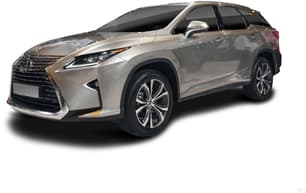
All the action takes place at the back end here (essentially from the rear wheels back), with Lexus adding 110mm in length to form the RX L, which sits on an identical wheelbase to the five-seat car.
They deserve credit for not making this seven-seat version feel like a behemoth, with the extension in keeping with the style of the five-seat car (same 'floating roof' sitting above a kinked pane of glass), with only the more vertical and extended boot line hinting at the third row inside.
Elsewhere, it’s business as usual for the RX L, with the bigger model sharing the sharply angled body styling, narrow headlights and ferocious-looking grille of the standard RX.
Inside, expect a premium-feel interior, with leather seats in the first and second rows (the third gets the man-made stuff), elegant wood finishing and a sleek and simple dash set-up dominated by a floating screen in its centre.
I think it’s a sharp-looking thing, this Atto 2. Kudos to BYD for not making the design look like it’s trying too hard, or like the Atto 2 is something it isn’t. It’s just smooth, sensible small SUV with styling that looks like it will age gracefully.
I like the chunky black moulding which makes it look a bit tougher than it is, plus the LED DRLs and swept back (and spoiler-equipped) roofline add a bit of visual drama.
Inside, BYD has made two pretty good choices. The first is that the cabin feels toned down from the one in the Atto 3 (which is all chunky wheel-style controls and vents).
This one feels far more sedate and conventional in its design, which I think is a win.
The other good decision is to equip the Atto 2 with soft plastics, rather than hard scratchy ones, in places like the door panels. In some cheaper cars, you feel your elbows constantly rubbing against cheap-feeling plastics, but that’s not the case here.
Too much stuff is still controlled through that central screen, and BYD has an awkward way of shortcutting functions. They call it a three-finger swipe, meaning that if you run three fingers across the screen horizontally you can adjust the climate-control’s fan speed, while swiping horizontally adjusts temp, but it feels like a weird movement.
You know how there are some seven-seat SUVs in which, at a pinch, you can squeeze two adults into the third row? Well, the RX L isn't one of them.
For one, climbing over the second row (after pulling a manual handle that Lexus says is quicker than an electric set-up) requires some acrobatics. And once in the seat, my head (I'm 175cm) found itself in an intimate relationship with the roof. My knees were forced into the seat in front, and most worryingly, my presence pushed the second row far enough forward to make that passenger uncomfortable, too.
Still, how often are you really going to squeeze adults back there? There is certainly enough room for younger kids, or - as I suspect is more likely - for the third row to be used as an in-case-of-emergency option. It can house a child seat, too.
There's not a bad ambiance back there, though, with artificial leather seats, two central cupholders and tri-zone climate with vents and temperature controls. Middle-row riders now get an extra 45mm of forward adjustability (to compensate for the third row), and there are two cupholders hidden in the pull-down seat divider and bottle room in each of the rear doors.
Up front, expect two cupholders, along with a pocket in each door, while the large central storage bin is home to two USB connection points and a power source, the latter matching a second power source underneath the air-conditioning controls.
And so, to the boot. All three rows in place, you'll find 176 litres of storage to the seat-tops (211 litres to the roof). Lower the third row, and that number climbs to 433 litres. Drop the second and third row, and you'll find 966 litres of storage.
The Atto 2 measures 4310mm in length, 1830mm in width and 1675mm in height and it rides on a 2620mm wheelbase. It also sits on BYD’s fully-flat EV platform, which helps to maximise space in the back seat.
I’m 175cm tall and could get comfortable behind my own driving position, with enough knee and headroom to ensure I didn’t feel cramped.
There are two ISOFIX attachment points, one in each window seat in the back as well as USB-A and -C connection points.
Boot space is a not cavernous, but also not tiny, 380L with the rear seats in place, growing to 1320L with the rear pews folded flat. Both models also offer a V2L (Vehicle to Load) connection, too, so you can power up household devices.
First, the bad news. There's a price punish for opting for the seven-seat RX. How much, though, depends on which trim level you decide on.
The RX L arrives in 'Luxury' and 'Sport Luxury' trim levels, and with two engines; a petrol-powered V6 or a hybrid option that adds an electric motor. Luxury prices start from $84,700 (a $3280 increase over the five-seat car), while the Sport Luxury models start from $101,500 (a $1630 rise).
Opt for a Luxury car ($84,700 for the 350L, $93,440 for the 450hL) and you'll find leather seats in rows one and two, and artificial leather in the third. You'll also get heated and ventilated front seats, a leather-wrapped steering wheel and tri-zone climate control.
Outside, expect proximity unlocking, 20-inch alloys, LED headlamps and DRLs as well as standard roof rails. Technology is handled by a nav-equipped, 8.0-inch display that pairs with 12 speakers. There is no Apple CarPlay or Android Auto, though, and the entire system is operated via the 'Lexus Remote Touch' mouse pad thingy that I can't get used to no matter how hard I try.
Spring for the Sport Luxury ($101,500 for the 350L, $110,240 for the 450hL) and you'll add a colour head-up display and moon roof, as well as adaptive suspension, heated second-row seats, a nicer interior treatment and LED headlights with adaptive high beam. Your screen is bigger (now 12.3 inches), and it now pairs with a 15-speaker Mark Levinson stereo, too.
This thing really is cheap. The BYD Atto 2 arrives with a two-model range kicking off with the Dynamic, at $31,990, before on-road costs, before stepping up to the Premium at $35,990 BOC. They both get the same motor and battery, by the way, so the extra money comes down to extra kit.
The Dynamic rides on 16-inch alloys wrapped in cheaper Westlake rubber, scores LED headlights and DRLs and gets rain-sensing wipers and heated wing mirrors. Inside, there’s a 10.1-inch central touchscreen, an 8.8-inch driver display, synthetic leather seats with manual adjustment up front and wireless Apple CarPlay and Android Auto linked to a four-speaker stereo.
The Premium rides on 17-inch alloys wearing better Hankook rubber, and there’s a panoramic glass roof with a shade and roof racks. Inside, the central screen grows to 12.8 inches, and there’s an eight-speaker stereo and a wireless charge pad. Your seats are now electronically adjusted and heated and cooled. Plus there’s some extra safety stuff, but we’ll cover that off in a second.
There are two engine options on offer here; the V6 of the 350L or the hybrid powertrain of the 450hL.
The six-cylinder petrol engine is good for 216kW at 6300rpm and 358Nm at 4600rpm, sending that power to all four wheels via an eight-speed automatic transmission.
The hybrid option uses the exact same engine, just with lower outputs of 193kW at 6000rpm and 335Nm at 4600rpm. It's paired with an electric motor that lifts the total output to 230kW. That combination pairs with a CVT auto, sending power to all four wheels.
Lexus claims identical performance figures for both options, with a 0-100km/h sprint of 8.0 seconds and a top speed of 200km/h.
Both Atto 2 models share the same powertrain - a front-mounted electric motor producing 130kW/290Nm which is sent to the front tyres. It feels fairly sedate, even under flat-footed acceleration, though BYD reckons you can knock off the sprint to 100km/h in 7.9 seconds.
The petrol V6 will require a claimed 10.6L per 100km on the combined cycle, with the hybrid predictably performing better, returning 6.0L/100km on the same cycle. Emissions of CO2 are pegged at 234g/km (V6) and 137g/km (hybrid).
The V6-powered RX boasts a 72-litre tank, while the hybrid shaves several of those off, offering 65 litres.
Both models also share the same battery, a 51.1kWh LFP unit, which should unlock a WLTP driving range of 345km. AC charging is pegged at 7.0kW, so a good match for a standard home wallbox, while DC fast charging is 82kW. Using the latter, BYD says you should go from 10 to 80 per cent charged in 38 minutes.
Let’s start with the good news: having admittedly only been behind the wheel for a shortish stretch (and a lot of that was on a freeway) I’ll be damned if I can spot the difference from five- to seven-seater.
Its 110mm longer than the five-seat car, of course, and it's heavier, too. And a more thorough test might well reveal those extra kilograms from behind the wheel. But I suspect you'd have to be truly pushing the RX L around some serious corners to have any chance of noticing.
Keep in mind, this isn't the sportiest option in the segment, and this L version isn’t either. The steering feels a little vague and flat on-centre, and neither engine offers face-peeling acceleration. But the ride is terrific, the cabin is comfortable and polished and both the Luxury and Sport Luxury are ferociously well-equipped.
We'll wait until we get the RX L into the office for a more thorough examination, but after our brief taste test, we reckon there'll be no on-road penalty in opting for the seven-seat option.
Your drive experience in the Atto 2 very much depends on what you ask of it.
Or to put it another way, the first half of my drive route was a breezy run through the city and suburbs, then onto the freeway, before arriving at our destination.
It was probably 60 kays or so, and across it all the Atto 2 felt quiet and comfortable, with enough power at its disposal to easily get up to speed and stay there.
In the second half, though, I hunted down some twisting roads and cracks started to appear. The ride is pretty solid and there isn't huge amounts of body roll during more enthusiastic cornering.
But the steering is vague and there's plenty of slack – you can turn the wheel a fair bit without eliciting much response from the tyres.
Interestingly, turning the wheel with a bit of aggression also produced a weird sound up front, like you could hear the mechanicals shifting the tyres.
The tyres make a difference, too, with the Premium's more expensive Hankook rubber far happier to hang on without squealing than the Dynamic's Westlake tyres.
But context is key here. The Atto 2 is an accessible, affordable city-focused EV, and it performs those duties admirably. But if you're sold on a car-driver connection, there isn't much of that on offer here.
Lexus has a strong reputation on this front, and the RX L is predictably well-sorted from a standard safety viewpoint.
Expect 10 airbags (with the curtain bad extended to the third row), a reversing camera, blind-spot monitoring, rear cross-traffic alert and rear parking sensors. 'Lexus Safety Sense+' also arrives as standard, which adds active cruise control, lane-keep assist, auto high beam and an AEB pre-collision safety system the now includes pedestrian detection for the first time.
The five-seat RX was awarded the maximum five-star ANCAP crash rating when tested in 2015.
The Atto 2 is yet to be assessed by ANCAP but there’s no shortage of stuff. The entry-level car gets six airbags, rear parking sensors and all the usual traction tech. Then there’s active cruise, lane departure warning, blind spot monitoring, cross-traffic alert in both directions - the list goes on. In fact, the only things the Premium adds on top are a 360-degree camera and front parking sensors.
Expect a four-year/100,000km warranty (that's 12 months longer than both Germans), and the RX L will require a trip to the service centre every 12 months or 15,000kms. Your first service is free, and total maintenance costs for the first 60,000km will run you $2031.31.
BYD’s warranty is an okay six years but just 150,000km, which is underwhelming compared to the best in the business. The battery is covered for eight years or 160,000km.
BYD vehicles typically have 12 month, 20,000km service intervals with capped price servicing, but the details are yet to be confirmed for the Atto 2.