What's the difference?
This is a BIG moment for the Lexus RX in Australia. And I'm not just referring to the spindle grille that adorns the front-end of this all-new model (though it too is almost commercially massive).
I'm talking more about the vehicle itself, and its importance to the Lexus brand here. The RX is one of Lexus' best sellers in Australia, and so this new one – which welcomes a new platform, new powertrain options and an all-new F Sport Performance trim level – is a big deal.
So, does it live up to the hype (and to its German competition)? Join me as we figure all that out ahead of the RX's debut here in early 2023.
Despite the similar naming conventions, the new Mazda CX-80 large SUV isn’t a revamped version of the popular CX-8 model even though it technically replaces it.
The CX-80 is actually a seven-seat version of the mid-size CX-60. If you're confused, you're not the only one. The CX-80 joins a loooong list of SUVs that Mazda has brought to our market (including the CX-80 and 90) and while it offers more passenger space than its predecessor, does bigger mean better when it comes to family hauling?
My family of three have spent three weeks with the one-up-from-entry grade Touring G40e to find out for you.
The RX is a big SUV that doesn't always look, or drive, like one, and – in 500h guise especially – can put a smile on a driver's face, too.
Gone are the cabin quirks and the polarising design elements (well, mostly...), and in their place you'll find a solid, premium-feeling family offering without much in the way of drawbacks.
Note: CarsGuide attended this event as a guest of the manufacturer, with travel, accommodation and meals provided.
The Mazda CX-80 Touring G40e will do everything you ask of it and outside of pricey ongoing costs, there’s not much to annoy. It’s too large for my small family of three and if it’s kid stowage that you’re looking for, a people mover might offer better practicality and comfort than what this does. Would it be a model that you jump through hoops to get? Maybe not, but it still has a place as family hauler and is easy to drive.
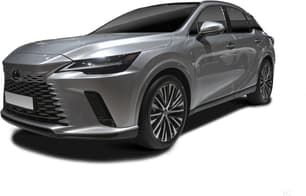
Honestly, the Lexus RX looks far more powerful, and cohesive, in the metal than it does in some photos, and in the right colour (we're fond on the deep black or the copper-rose hues), it looks downright fetching.
That Predator-shaped front-end is massive, but the way the Spindle grille kind of bleeds in the body work at the nose of the vehicle is a neat trick, and the whole design ethos gives the RX a sportier, more modern, and more intimidating, energy from almost every angle.
Perhaps the most clever element though is the wave-like design piece that links the rear window with the boot, somehow managing to shrink almost-five-metre SUV (visually, at least), and leaving the RX looking more sporty than hulking.
The door handles are cool, too. They’re fixed, and you just touch them to open the door, with a similar system used once inside to get out again.
Inside, Lexus has gone for a clean, modern-feeling space, and, thankfully, there isn't a Remote Touch trackpad in sight. Instead, you can choose between two screen sizes – 9.8- or 14.0-inch – which kind of dominate the dash, while the air-con controls are digital and interactive, too.
It must be said, though, some interior treatments feel far more special than others, and while Lexus in Australia isn't spilling on specifics for our market just yet, the top-spec models will almost certainly feel more plush than the cheaper ones.
I've said it before but Mazda SUVs all look like scaled versions of each other to me and the CX-80 looks ridiculously similar to every other larger SUV model in the Mazda stable with the long pronounced nose that features sharp LED lighting and its general robust size.
The rear is where it differs with the proportions becoming a little bulbous but it’s practically shaped and overall is a nice-looking family SUV at the kerb side.
Head inside and the interior is pleasant with its high-quality trims and heavy-handed styling that matches the exterior dimensions with big panelling and air-vents up front to balance out the long width of this dashboard.
However, the whole car tends to lack personality for a model that’s a part of Mazda’s ‘premium SUV’ range. It's nice but doesn't add anything new.
The entire RX range now rides on Lexus' GA-K platform, which is lighter (-40kg), more rigid, and offers a lower centre of gravity (-15mm) than the model it replaces.
The RX is wider (+25mm to 1920mm), lower (-10mm to 1695mm), but no longer (still 4890mm) than the outgoing model. But Lexus has lengthened the wheelbase (+60mm to 2850mm) to earn some extra backseat space for rear riders.
And it must be said, there is lots of room for backseat riders. Sitting behind my own 175cm driving position I had more than enough knee room, and enough head room, and a general feeling of airy spaciousness.
Elsewhere you get the usual practicality perks, with two cupholders up front, two more in the pull-down seat divider that splits the rear seat, and there are two ISOFIX attachment points in the back seat, too.
Charging is handled by a four USB ports, and depending on the trim/spec balance Lexus in Australia shoots for, you should at least find vents with temp controls for backseat riders, too.
Lexus is yet to confirm the luggage space specs for the new RX, but given it’s only being offered with five seats, and that there’s been no change to the vehicle’s length, you can expect a fair bit of room for bags in its auto-opening boot.
Seven-seat SUVs tend to really be a 5+2 combo, where the rear two seats are for kid- or emergency-use only. You'll be pleased to find that all passengers enjoy a decent amount of space in each row in the CX-80. The third row is still a little cosy for an adult but my 6ft2 brother managed to get back there without too many grumbles. However, we all giggled as he sort of fell in due to the lack of handholds (sorry, Mack).
Otherwise, the 170mm ground clearance and wide door apertures make it an easy SUV to get in and out of. The doors are heavy and sometimes miss their 'hold' position if you open them too quickly, making them swing back. My eight-year-old got whacked a few times because of it!
Amenities and storage are best in the first and second rows with front occupants enjoying those heated seats, two USB-C ports, a 12-volt socket and wireless charging pad. You also get dual-zone climate control, and powered seats with adjustable lumbar support. The seats are well-padded but fairly narrow and short in the base, making it easy to fatigue on longer journeys.
Storage includes a large glovebox that can hold a manual and a fair bit more, a shallow but handy middle console because of its dual-opening lid and a total of four drink holders. There's a sunglasses holder but not much else for smaller loose items.
In the second row you get two map pockets, a small storage bin in each door and a total of six drink holders. There's also individual reading lights, two USB-C ports, climate control, directional air vents, a fold-down armrest and retractable sunblinds (always a winning feature in my house).
The third row gets four drink holders, two USB-C ports and two directional air vents.
Feedback from my passengers (kids and adults alike) hasn't been great for the air-conditioning system with all complaining how long it took for the rear two rows to cool down. The low and awkward positioning of the air vents also prevents direct air flow to passengers. The third row is impacted by this as the passenger's legs cover them.
The rest of the technology is solid with the multimedia system offering a rotary dial operation. The system hasn't seen any recent updates, so if you're familiar with the Mazda system, you'll get along just fine.
The built-in satellite navigation is simple enough to use and the wireless Apple CarPlay is easy to connect to. There's also wireless Android Auto. Call connections remained consistent but feedback was that there seemed to be a fair bit of background noise on my end during calls.
Rounding out the interior is the boot space which offers a level loading space, retractable cargo blind and underfloor storage which houses the tyre repair kit. There's also a 12-volt socket and 220-volt/150W AC socket housed on a side panel.
With all three rows up, you get 258L of capacity and that figure jumps up to 566L when the third row is stowed. The CX-8 offered more boot space but the CX-80 is still respectable for the annual family road trip. Plus you get a powered tailgate function in the Touring model, which is always appreciated.
This is an arbitrary seven out of 10, here. Because we don't yet know how many trim levels the new RX will launch in, how much each will cost, or what you'll get for your investment.
What we do know is that the RX will launch with three powertrain options: an all-new turbocharged hybrid, a second, more conventional hybrid, and a turbo-petrol engine. There’s a plug-in hybrid version available overseas, but we ain’t getting it. Or at least, not yet.
In terms of specific trims and equipment levels, you’ll need to wait until closer to the RX’s launch in early 2023 for the full skinny. But you can expect a choice between a 9.8-inch or 14.0-inch central touchscreen with wireless Apple CarPlay and Android Auto, an eLatch door system with fixed handles that unlatch at the push of button inside and out, as well as more high-tech safety kit (thanks to Lexus Safety System 3.0) than you can shake a radar at.
Mazda offers a choice of five CX-80 grades and for almost all of them, you get the option of a new mild hybrid petrol or diesel, or a plug-in hybrid powertrain.
The Touring G40e model on test for this review is second-from-the-bottom and has a petrol mild-hybrid powertrain. It is priced from $61,950 before on-road costs and the Artisan Red Metallic paintwork our test model has adds $995 to the price tag.
The Touring is more affordable than some of its rivals, including the Toyota Kluger GXL at $70,440 MSRP and Hyundai Santa Fe Elite at $62,500 MSRP. However, these two models are full hybrids and the Santa Fe has a slightly longer features list for only a little bit more money which makes it better value overall.
The great thing about Mazda is once you move up from the entry grade, you often benefit from a host of great standard features that would usually come as part of a package or cost extra with other brands. For example the Touring gets leather upholstery, heated and powered front seats and a wireless charging pad, which isn't too bad for a grade that sits towards the start of the range.
There are some solid practical features like the keyless entry and start, rain-sensing wipers, dusk-sensing headlights, powered tailgate, three-zone climate control, retractable sunblinds (second row) and 360-degree view camera system.
Tech feels well-rounded with a 10.25-inch multimedia system, six USB-C ports, two 12-volt sockets, a 220-volt/150W AC socket, satellite navigation and wireless/wired Apple CarPlay and Android Auto.
In terms of value within the CX-80 range, the Touring G40e is the pick of the litter.
Let’s start with what we’re not getting at launch. Internationally, there's a new plug-in hybrid variant that pairs a 227kW hybrid system with a 18.1kWh lithium-ion battery for an EV driving range of more than 65kms, but fight though Lexus in Australia did, it couldn't secure the model for our market at launch. It wants it though, and badly. So watch this space.
Instead we get three options, including the RX 350h, which pairs a 2.5-litre petrol engine with Lexus' existing hybrid system to produce a total 180kW and 316Nm. It's paired with a constantly variable transmission and will be offered in two- or all-wheel drive.
There’s also a turbocharged 2.4-litre petrol engine on offer in the RX 350, good for 205kW and 430Nm, and paired with an eight speed automatic and AWD.
But the powertrain I really, really like lives in the RX 500h F Performance, and pairs a 2.4-litre turbocharged petrol engine with an electric motor up front, and a second at the rear axle, for a total of 273kW and 551Nm.
The all-new hybrid system has been designed with turbocharged engines in mind, and features a single electric motor at the front, and a bigger rear motor, with the latter able to provide real driving power to the rear tyres - and contribute to a sprint to 100km/h of just 5.9secs.
Lexus calls it an 'eAxle' motor, and it can deliver some 76kW to the rear tyres. It pairs with a 'DIRECT4' all-wheel drive system which the brand says improves "handling, controllability, and feel."
Fitting, then, that it features on the RX 500h F Performance, which also introduces a new go-fast tier for the Lexus brand (though one you can expect to see more frequently in the near future), and which sits between the existing F Sport and the top-tier, full-fat F models.
The brand says things like bigger brakes, performance components and the highest power outputs will be reserved for the F Performance models. And so it is with the RX 500h F Performance, which welcomes six-piston front brakes, adaptive variable suspension, dynamic rear steering and 21-inch wheels.
The CX-80 Touring G40e model has an eight-speed auto transmission and all-wheel drive via a 3.3L turbo-petrol in-line six-cylinder engine coupled with a 48-volt mild hybrid system that produces up to 209kW of power and 450Nm of torque.
It’s not ridiculously powerful but pick up is great and there's more than enough to move the CX-80's big body around and support a 2500kg braked towing capacity.
Let’s start with the pure-petrol RX 350, which will sip a claimed 8.8 litres per hundred kilometres on the combined cycle, and will demand premium petrol. The RX 350h is more fuel efficient, demanding 6.4 to 6.7 litres per hundred kilometres on the combined cycle.
But the most impressive is the RX 500h, which Lexus says will need 8.2 to 8.5 litres per hundred kilometres — making it more efficient than the petrol-powered RX 350, despite producing an extra 68 kilowatts of power and 121 newton metres of torque.
The Touring G40e model has a 74-litre fuel tank and an official combined fuel cycle usage of 8.4L/100km, which gives you a theoretical driving range of up to 880km.
The mild-hybrid system works well enough that I didn’t hit double digits for fuel usage despite not being shy on using the power while hauling cargo and people on a mix of open road and urban trips.
My real-world use popped out at 9.3L/100km and while the diesel variant has much more efficient outputs and range, this result is pretty good for such a massive SUV.
Right, let’s cut to the chase here. I like the way the all-new RX family drives, pretty much across the board. If that’s all the information you want or need, feel free to check out here and move on to the next sub-heading.
Still here? Ok, then let’s go a little deeper.
None of the powertrains on offer feel under-powered in the RX range, which is a good start, but they all do their jobs a little differently.
The RX 350 is probably the most familiar, with a traditional automatic and that well-known petrol-powered punch. It’s not the most powerful engine on offer here, but it’s more than enough to get the RX up and moving — but, for mine, it can feel a little thrashy (or like it’s straining a little too hard), when you really start to push it, but such is the price you pay for a four-cylinder engine pushing a large SUV.
Next up is the RX 350h, which Lexus reckons will be the best-selling model in Australia. Lexus and Toyota have been doing hybrid powertrains for some time now, and the system fitted to the new RX is predictably solid-feeling, though it too has its drawbacks – namely that the constantly variable transmission can drone on and on under constant acceleration, and even the commendably insulated cabin can’t block it out completely.
So if this is a Goldilocks’ scenario, then the just right has to be the RX 500h, which blends its powerful powertrain with a traditional-feeling automatic to deliver plenty of performance and a tight, engaging drive experience that makes it feel as though the big SUV is somehow shrinking around you from behind the wheel, courtesy of the best performance kit (brakes, adaptive suspension, etc).
But to be honest, no matter the RX, the thing that really stands out here is its on-road dynamics. The car doesn’t really wobble about, there’s not much in the way of body roll, and it feels tight and confidence inspiring, no matter the model - but especially the rear-wheel-steering equipped 500h.
The RX also does a commendable job of locking the outside world outside of the cabin. Where you want it to be a calm and sedate family hauler, it can be that. But it can also put a smile on your face on the right road, too.
And that, I think, is something to be celebrated. And also not something we’ve come to associate with Lexus over the years. But that’s now beginning to change. Long live F Sport Performance, then.
The Touring G40e model is pleasant, if a little boring, to bum around in. Boring may be too strong a word but there's not much that gets you excited about the driving experience. The Touring performs and has decent power through most situations but it lacks a certain edge. It's not particularly sporty, nor does it sound mean when you put your foot down.
It's nice and does what you expect it to do.
The ride comfort is good with cushioned suspension with enough road feedback but people in the back will jostle a bit over the worst of the bumps.
Road noise can creep in at higher speeds and third rowers will struggle to be a part of the conversation but overall the cabin is refined for longer journeys.
Visibility is mostly good because of the big windows but the wider pillars mean I check my blind spots very carefully, as the side mirrors seem a tad too small for the bulk of the car.
The CX-80 has a small turning circle of 11.6m and most of the time it never feels like it lumbers, but when you’re manoeuvring it in a tight car park the steering can feel heavy and a three-point turn starts to feel clumsy.
A saving grace is the excellent quality of the 360-degree camera system which takes out some of the puff from parking it. The CX-80 fills a space and it’s one you'd be careful to park so you don't get crowded.
The Lexus RX welcomes the brand's Lexus Safety System 3.0 setup, which means more high-tech kit than you can shake a radar at.
What appears where on the Australian lineup remains to be seen, but internationally the RX will offer things like Advanced Park, remote parking from your smart phone, Safe Exit Assist that will actually prevent you opening the doors should the cameras detect pedestrians or cyclists, and Pre-Crash Safety, which scans intersections for bikes, people or cars, and activate alarms and the brakes should it sense a collision.
That, and things like Front Cross-Traffic Alert, active cruise, Lane Departure Warning and Lane Tracing Assist, road-sign recognition and Lane Change Assist, should see Lexus shooting for a five-star ANCAP safety rating.
At the time of this review the new Mazda CX-80 hasn’t been tested with ANCAP and is thus unrated but it has 10 airbags which is great for a big family SUV and includes side-chest airbags for the second row and curtain airbags that extend to the third row.
The Touring G40e model features a robust list of standard safety features including auto emergency braking (AEB), safe exit assist, front and rear cross-traffic alerts, blind-spot monitoring, driver attention alert and monitoring, forward collision warning, lane keeping aid/departure, front and rear parking sensors, a 360-degree camera system, traffic sign recognition, intelligent seatbelt warning and a tyre pressure monitoring system.
The adaptive cruise control is one of the most user-friendly I’ve sampled recently and other than a sensitive lane keeping aid, all systems follow that user-friendly vibe.
There are a total of five top-tether points and two ISOFIX child seat mounts. The width of the middle seat means you should be good to fit three child seats side by side if they're not too large.
The Lexus family is covered by a five-year, unlimited-kilometre warranty, which is about bang-on in the premium-vehicle space.
While servicing details are yet to be confirmed, the previous RX required a trip to the service centre every 12 months or 15,000kms, and it will fall under the brand’s capped-price servicing program, and the Lexus Encore program, which offers all sorts of perks to owners.
The CX-80 is let down a bit by its ongoing costs.
Mazda offers the CX-80 with a five-year/unlimited kilometre warranty which is fairly standard. A number of its rivals are offered with up to seven-year terms these days.
You get a five-year servicing program with services averaging $694, which makes it on the more expensive side, but servicing intervals are reasonable at every 12 months or 15,000km, whichever occurs first.