What's the difference?
So, you’re after an affordable alternative to the increasingly expensive Toyota HiLux and Ford Ranger. You need it to be tough enough for work, but also big and comfortable enough to haul family every now and again.
It’s a common predicament, and one that's increasingly served by Chinese and Korean alternatives.
Today, we’re looking at LDV’s latest effort - the T60 Max Plus. While it looks like just another new variant from the outside, it’s hiding some significant changes underneath, and it takes its place at the top of the T60 range in 2024.
Could it be the right ute to fit your budget? Let’s take a look.
Mercedes-Benz has brought back the entry-grade GLC200 and it's now the most affordable way into the sleek, mid-size luxury SUV.
But ‘entry-level’ doesn’t always mean ‘everyday friendly,’ so we’ve been family-testing it to see if it delivers that signature Benz comfort, quality and class without the premium sting.
The question is, does it offer enough substance and style to take on its high-profile rivals, the Audi Q5 and BMW X3?
The Max Plus brings a lot of welcome upgrades to the T60 range, particularly in its previously non-existent active safety suite, but it’s not all good news. There are still a few areas where this ageing ute could use a lot of polish.
Still, there’s something to be said for how refreshingly straightforward much of it is, and for the most part its specs and features are up to the task of competing with many more expensive alternatives.
The new Mercedes-Benz GLC200 might be the base-grade, but it doesn’t look or feel like it. From the outside, it’s stylish and refined, and inside, it delivers that signature Benz luxury with premium features, impressive tech and a beautiful cabin.
While the engine isn’t wildly powerful, it’s more than capable for everyday driving and long stretches on the highway and the ride quality overall is smooth, quiet and composed. It loses points for being more expensive than its entry-grade rivals and for those steep ongoing servicing costs, which could be a sticking point for some buyers.
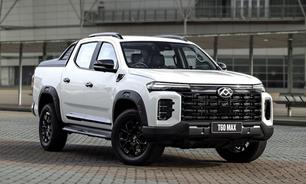
The T60 Max Plus takes the visage of a factory-kitted version of the existing T60 Plus. The most notable difference this time around is the unique gloss black grille design which features a new spot to hide the front radar array for the safety suite, alongside new gloss wheel designs and that huge sports bar fitting atop the tray.
To my eye at least the T60 looks a fair bit more rugged and industrial than most of its rivals, which with every iteration are looking more like passenger vehicles than work-ready utes. Still, there’s an aggressiveness to its contrast black trims and tall ride height which may appeal to some. For others it will be more function-over-form, with less bumper overhang than something like the SsangYong Musso and there’s something to be said for that, too, I suppose.
Inside is where this Max Plus version sets itself apart from the rest of the range with its abundance of screen real-estate, upgraded materials, and an almost EV-like centre console treatment.
It’s certainly more digital-feeling and contemporary than the rest of the T60 range, but it might lose some of the simple but rugged appeal of its interior as a result.
The screens look pretty slick, especially when you’re using phone mirroring to hide the otherwise clumsy stock software suite. It’s one thing to have nice big screens, it’s quite another to have slick, attractive, and customisable software to match.
Sadly, that’s not the case for the Max Plus, which offers one lacklustre look and feel for the dash cluster, paired with an array of confusing menus on the multimedia screen.
The GLC is a handsome SUV with a strong, confident stance. It looks fit and premium, but not overly sporty, especially with the standard 'Avantgarde' exterior styling seen on our test car.
The entry-level grade rolls on 19-inch alloy wheels, features slimline running boards, LED lighting all around and an interior ambient lighting package that even includes logo 'puddle light' projection from the side mirrors.
Inside, the GLC200 doesn’t skimp on style. You get sports seats trimmed in synthetic leather (available in a range of colours), plus a panoramic sunroof, flashy dual displays and a black headliner that adds a cocooned feel.
The ambient lighting is a real standout and reminiscent of sci-fi films like Tron! It adds to the cabin’s upmarket vibe.
Combined with the soft-touch surfaces and neat trim details, the interior feels luxurious. And to be frank, it should at this level. But not every base-grade SUV in this segment gets it right. This one does.
There are some benefits of the new interior design, and there are some disappointments too. These begin with the seating position, which is still miles off the ground in its lowest setting. This might give you a commanding view of the road, which has benefits, but it also makes you feel like you’re sitting on the T60 rather than in it.
The steering wheel is also only pitch adjustable rather than also offering telescopic adjustment, and even then its range of movement is extremely limited. For me, at 182cm tall, this meant the wheel blocked the top of the digital instruments, and I also felt like I was far too close to the roof. It’s an awkward seating position to say the least.
However, the new cabin layout has quite a bit of storage to play with. There are functional bottle holders and pockets in the doors, a decent glove box, and the new centre console offers a huge tray underneath with a removable dual cup holder insert, which also has two little cutaways for storing your keys. This area also hides some USB ports and a 12-volt outlet, for a nice cable-free interior if need be. The armrest console box offers even more space, and the wireless phone charger perched atop the console area is a welcome touch.
Less impressive is the strip of touch-based controls for the climate which sits underneath the multimedia screen. At least it has some controls which don’t require a screen sub-menu to navigate, but it simply doesn’t compare to having actual buttons and dials.
The most puzzling part of this equation is the lack of physical controls of any kind for the headlights, and no way for the passenger to adjust volume without needing to go one or two sub-menus deep. Inconvenient at best, potentially dangerously distracting at worst.
Again, some rivals get an edge here. The Musso’s multimedia suite looks comparatively old, but has heaps of physical buttons, while the GWM Ute Cannon splits the difference, maintaining buttons but gaining confusing menus. Both are better to use than the T60.
The back seat came as a surprise, as it offers pretty decent legroom for a full-sized adult, something quite rare in this ute segment. It also offers pockets on the backs of both front seats, dual adjustable air vents and a USB port on the back of the centre console, two small bottle holders in the doors, and a further two in a centre drop-down armrest. Underneath the seats there’s access points to small storage areas below.
The tray area seems reasonably well appointed with a pre-applied spray-in tub liner and four tie-down points at the extremes of the bed. The tub dimensions come in at 1485mm long, 1131mm wide (between the arches), and 530mm tall for the standard version. The Mega Tub variant extends the length to 1800mm. Payload for the tray is 840kg for the manual, 830kg for the auto, and 800kg for the Mega Tub.
Interestingly, despite its new coil-sprung rear, the T60 Max Plus maintains its 3000kg braked towing capacity, which isn’t the 3500kg industry standard, but is pretty close.
These specs mean the standard tray version is slightly larger than the Ssangyong Musso with a slightly higher payload, although it can tow 500kg less. It has a lower payload and a smaller tray than the GWM Ute, although it can tow about the same amount.
The cabin is spacious in both rows, with decent access thanks to wide door apertures and 195mm of ground clearance. That said, it’s the kind of cockpit you sort of tuck into and I knocked a knee or elbow on the steering wheel getting in (my husband joked this was just a user issue). My eight-year old had no trouble hopping in and out, though.
The front seats are best described as sumptuous, with features like expandable under-thigh and lumbar support. It’s super easy to get comfortable and stay that way, a big plus for anyone who does long drives, like I do.
The rear seats are equally comfy, with generous padding and deep bases. You’ll find three top-tether points in the back row, but realistically, it’s a space better suited to two child seats.
Keeping the cabin tidy is simple thanks to thoughtful storage throughout. There are deep door bins with drink bottle holders, a couple of cupholders in each row, a largish glove box and a dual-lid centre console.
Up front, there’s also a phone cubby, two USB-C ports and a wireless charging pad. In the rear, you get another two USB-C ports and some handy map pockets.
The boot has proven to be a practical space, with 620L of capacity and a level load floor. There’s a reversible mat and underfloor storage, which is also where you’ll find the space-saver spare tyre.
This grade now includes a powered tailgate, a welcome addition, and the second row folds electrically in a 40/20/40 split, giving you more flexibility when you need it.
The updated media display is easy enough to use once you spend a bit of time with it. The touchscreen is responsive, and wireless Apple CarPlay maintained a steady connection throughout our test. I also appreciated how the instrument cluster and head-up display pull through directions from either your phone or the in-built sat nav system.
The T60 Max Plus is the new top-spec version of one of Australia’s most affordable new utes. From the outside it looks very similar to the Max Luxe which sits below it, but hides re-worked suspension, an overhauled interior, and some extra safety kit behind its tweaked grille.
It also continues to be available as a manual at $48,411, an automatic at $50,516 and as an extended ‘Mega Tub’ version at $52,092. LDV deals in drive-away pricing, and you’ll note these prices are roughly equivalent to low-grade versions of the industry leading utes like the Ford Ranger and Toyota HiLux.
The T60 is more likely, however, to compete with other low-cost ute options, like the GWM Ute Cannon also from China (from $52,990 in equivalent XSR form) or the SsangYong Musso from Korea (from $49,500 in equivalent Ultimate form).
Standard equipment is reasonably impressive, with 18-inch gloss black alloys, LED headlights, a sports bar out the rear, spray-in tub liner, a locking tailgate (for the first time), and an abundance of gloss black highlight trims to separate it from lesser models in the range.
On the inside the highlight of the overhauled design is the dual 12.3-inch screens which make up a dash-spanning digital suite. It comes with new-ish software which looks the part at a distance, although I was a little dismayed to discover it had limited functionality, only one ugly theme for the dash cluster, and minimal customisation.
You also score (very) synthetic leather seat trim with power adjust for the driver and front passenger, and an expanded array of soft-touch surfaces throughout. It looks modern and plush from a distance, but feels less impressive once you’re actually inside.
If you want a ute which does a better job of feeling more like a luxurious passenger car, the SsangYong Musso leans into this aspect harder, and if you want something that's bit more accessorised for the rough stuff the GWM Cannon XSR looks more the part. Ultimately it feels as though this new top-spec T60 is left in something of an awkward middle ground between the two.
Of course, the new safety equipment and suspension do add something to the T60 formula, but we’ll talk more about these later in the review.
There are five variants in the GLC range, and for this review we’re testing the new entry-level GLC200, priced from $84,455, before on-road costs.
While it’s definitely more affordable than the next step up, the GLC300, it still wears the highest price tag among its base-grade rivals, with the Audi Q5 35 TDI starting from $73,400 and the BMW X3 xDrive20i from $77,601.
That said, the GLC200’s generous equipment list could easily convince you it sits higher in the range. Standard features include 19-inch alloy wheels, synthetic leather trim as well as electric front seats with memory, heating and Mercedes’ ‘kinetic’ function.
You also get a panoramic sunroof, a slick 12.3-inch digital instrument cluster, a colour head-up display and a vertical 11.9-inch media screen running an upgraded operating system with satellite navigation plus wireless Apple CarPlay and Android Auto.
Practicality hasn't been overlooked, either. There’s a space-saver spare tyre (a welcome change from the run-flat tyre solution often employed by Euro brands), a handsfree powered tailgate, adaptive LED headlights, dual-zone climate control, four USB-C ports, two 12-volt sockets and a wireless charging pad.
Our test car also includes the optional 'Plus Package', which adds $5846 to the price. It bundles in a 15-speaker Burmester sound system, digital matrix LED headlights, heated and noise-insulating glass, augmented reality navigation and a digital key via the Mercedes-Benz app.
You’ll also find a few extra safety additions here, such as a lane centering aid, emergency steering assist, interior monitoring and external surveillance for added occupant protection and theft deterrence.
Overall, a bit more expensive but you get an impressive amount of features.
The T60 Max range lays claim to one of the most powerful 2.0-litre four-cylinder diesel engines - a bi-turbo unit producing 160kW/500Nm with peak torque arriving from 1500rpm.
It is mated to either a six-speed manual, or an eight-speed ZF-sourced torque converter automatic transmission.
It has a 2H, 4H, and 4L selector (alongside an automatic setting for the Plus Max), and is equipped with a rear differential locker (which can only operate below 30km/h).
For those looking to venture well beyond the tarmac the T60 Max Plus has a 27-degree approach angle, a 24-degree departure angle, 220mm of ground clearance, and a 19-degree rampover angle. Wading depth is 550mm, and it has a 12.7-meter kerb-to-kerb turning circle.
The GLC200 is powered by a 2.0-litre, four-cylinder, turbo-petrol engine paired with a 48-volt mild-hybrid system, producing up to 150kW of power and 320Nm of torque. It’s the least powerful engine in the GLC range, but still manages to feel punchy when you need it to.
This all-wheel-drive variant is paired with a nine-speed automatic transmission. While it can feel a little twitchy at lower speeds when the auto start/stop system is active, it’s otherwise a smooth and well-matched combination for everyday driving.
The official combined fuel consumption of the diesel-only Max Plus is 9.3L/100km for the manual or 8.9L/100km for the automatic.
With over 500km of testing with plenty of freeway miles, our automatic example produced an as-tested number of 9.3L/100km.
The GLC200 has an official combined cycle (urban/extra-urban) fuel consumption figure of 7.5L/100km and with its 62-litre fuel tank, you’re looking at a theoretical driving range of up to 826km which are solid figures for a family cruiser.
In real-world testing, I averaged 7.8L/100km, mostly around town with one longer trip thrown in. Overall, I’m pretty happy with its efficiency.
Mercedes-Benz recommends a minimum of 95 RON premium unleaded petrol for this model.
The T60 Max Plus has improved the formula in a few ways, but still feels a bit rudimentary in others.
The awkward seating position does provide quite a commanding view of the road, and makes it easy to gauge where the end of the bonnet is. This is useful parking in a city, but will also have benefits off the road. The 360-degree camera suite also helps with this manoeuvrability.
Interestingly the steering is quite good. This Max Plus is the only variant to score a fully electric power steering rack, as opposed to the lesser power assisted steering rack. It’s initially alarmingly light, but it also makes the T60 a breeze to steer unlike some utes in this class, and I was surprised to find it still had a sufficient amount of feel to give it confidence in the corners.
Yes, this is one of the most powerful 2.0-litre diesels, but it doesn’t feel particularly overwhelming to drive. The transmission, too, despite the brand bragging about its ZF sourcing, feels a bit transparent and rudimentary lumping through the gears with a degree of clumsiness. Still, it’s predictable and does what it says on the tin.
The same goes for the 4H and even ‘automatic’ 4x4 settings, which I found was surprisingly quick to activate if you started slipping on mud or wet tarmac.
Another less than impressive trait is the amount of sound produced. Supposedly this Pro Max version has additional sound deadening over the other variants, and yet the clatter of the diesel engine proved a constant in the cabin at freeway speeds or any time you needed to accelerate hard.
This particular version of the T60 should also feature an improved ride compared to its relations thanks to swapping the leaf sprung rear suspension out for coils, but I was surprised to find it was still quite stiff. No doubt this inherent hardness is down maintaining the same towing capacity. It makes it a bit jiggly when you drive it over the regular sort of road imperfections and corrugations. One wonders what the point of having coil spring suspension is at all if it’s going to feel more or less the same as leaf sprung alternatives.
One area that was particularly pleasing to me was the way the new active safety equipment wasn't overly invasive. There were a few moments where the lane keep tech intervened a bit too hard, but it’s pretty hands off as far as the rest of the systems go.
Overall then it does what it says on the tin, and is surprisingly easy to steer, although it doesn’t really excel at anything, which can be a hard sell in an environment where many utes are more passenger car like than ever.
Despite having the ‘baby’ engine in the range, the GLC200 doesn’t feel underpowered. Power delivery is generally quick, and there’s enough in reserve when you need to get up to speed or overtake. It’s responsive and confident in everyday driving.
That said, the auto start/stop feature is frustrating around town, especially at give way signs or roundabouts where you’re more likely to pause than come to a full stop.
It will cut the engine, and then when you want to accelerate, there’s a delay - sometimes even a little rollback. Not ideal, and definitely something that takes away from the otherwise polished drive.
The suspension hits a lovely balance, it’s forgiving but not floaty. You feel the road just enough to stay connected without it ever feeling harsh, which means the ride stays smooth and composed. It’s also a lovely highway cruiser, easily settling into long stretches with comfort and ease.
Visibility is solid, with minimal blind spots thanks to slim pillars, and the steering is responsive. It corners with confidence, too, with very little body roll, which isn’t always the case in a mid-size SUV.
Parking is straightforward thanks to a clear 360-degree camera system and park assist. The reversing camera turns with the steering wheel, which takes a moment to adjust to, but ultimately makes tight manoeuvres that little bit easier.
Perhaps one of the biggest pieces of new equipment on the T60 Max Plus is the more competitive array of safety equipment than before. It includes auto emergency braking, lane keep assist with lane departure warning, and adaptive cruise control. It also gains a set of front parking sensors to add to its 360-degree parking camera suite.
Technically the LDV T60 range maintains a maximum five-star ANCAP rating, but it dates back to 2017 and is thus about to expire. It has a total of six airbags, consisting of dual front, side, and curtain.
The GLC carries a maximum five-star ANCAP safety rating, based on testing conducted in 2022. It scored an excellent 92 per cent in both adult and child occupant protection, which gives plenty of peace of mind for families.
It’s also well-equipped when it comes to safety tech. There are 10 airbags in total, including a front centre airbag and side chest airbags for both rows; a solid showing in this segment.
Even without the optional Plus Package, the GLC comes loaded with safety features including blind-spot monitoring, side exit assist, lane departure alert, lane keeping aid and traffic sign recognition.
There's also driver attention warning, a 360-degree camera view, front and rear parking sensors, forward collision warning, intelligent seatbelt reminders and rear cross-traffic alert.
With the Plus Package, you add interior and exterior monitoring systems, along with something called 'Pre-Safe Impulse Side'; a clever feature that gently moves front occupants away from the doors if a side impact is imminent.
Autonomous emergency braking is also included, with pedestrian, cyclist, car and backover detection. It operates from 7.0-80km/h (or up to 250km/h for vehicles), which is slightly higher than most systems that usually activate from 5.0km/h.
In the back, there are ISOFIX child seat mounts on the outboard seats and three top-tether anchor points across the row.
LDV continues to have a confusing array of ownership terms across its range. In the case of the T60, it’s seven years and 200,000km, with five years of roadside assist.
It is also one of the only brands on the market not offering any kind of capped-price service program, so it’s a mystery how much it will cost to run. Servicing is required once every 12 months or 15,000km.
The GLC is backed by a five-year/unlimited kilometre warranty, which puts it on par with key rivals in this space. Servicing intervals are generous, too, at every 12 months or 25,000km. Great news if you rack up a lot of kilometres.
But the catch? Servicing costs are steep. Mercedes-Benz offers pre-paid servicing plans in three-, four-or five-year bundles, and the five-year package will set you back $7350. That averages out to almost $1500 per visit. Oof.
For comparison, the Audi Q5’s five-year plan is $3520, and BMW’s five-year 'Basic Service Inclusive' package for the X3 is $2475. So, while the GLC might win on features and finish, it definitely asks more of you when it comes to ongoing costs.