What's the difference?
So, you’re after an affordable alternative to the increasingly expensive Toyota HiLux and Ford Ranger. You need it to be tough enough for work, but also big and comfortable enough to haul family every now and again.
It’s a common predicament, and one that's increasingly served by Chinese and Korean alternatives.
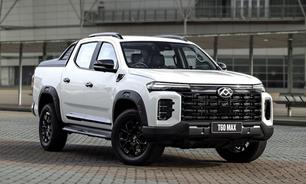
Today, we’re looking at LDV’s latest effort - the T60 Max Plus. While it looks like just another new variant from the outside, it’s hiding some significant changes underneath, and it takes its place at the top of the T60 range in 2024.
Could it be the right ute to fit your budget? Let’s take a look.
Need a dual-cab ute? You’re in luck. Not only does Australia have access to a huge variety of makes and models in the dual-cab space, there is also a huge range of prices and equipment levels.
The sweet spot for Aussie buyers, though, seems to be the dual-cab layout with four-wheel drive and enough convenience and safety gear to make the vehicle a viable family car as well as a work truck when necessary. Which is precisely where the Chinese brands including GWM, BYD and LDV have targeted their current ranges.
There’s been a lot of chat about such vehicles lately, but rather than let the formula stagnate, LDV has ushered in the Terron 9, a dual-cab that, size-wise, falls roughly between the familiar makes and models and the full-sized American-made stuff. This is a crucial point, too, as the Terron 9’s extra size might be a hint on where the dual-cab market is going generally. Certainly, every other class of car and ute is creeping up in size, why not dual-cabs too?
Like the other Chinese brands, of course, the Terron 9’s appeal will largely be based on value for money, so it’s worth picking the car apart to find out how it stands in that regard. But this is 2025, so the Terron 9 is also going to have to produce the goods in terms of driving ability and safety, that modern dual-cab buyers are looking for.
The Max Plus brings a lot of welcome upgrades to the T60 range, particularly in its previously non-existent active safety suite, but it’s not all good news. There are still a few areas where this ageing ute could use a lot of polish.
Still, there’s something to be said for how refreshingly straightforward much of it is, and for the most part its specs and features are up to the task of competing with many more expensive alternatives.
There’s no doubt that the current crop of Chinese utes are better than previous versions. Similarly, there’s little doubt that private buyers are having a big say in which way the market is headed, particularly when it comes to alternatives to the Thai-built legacy players. And that’s precisely where the Terron 9 plays its best game. The value for money is hard to argue with, and the sheer size of the thing gives it an extra dimension if that’s what you think you need in a dual-cab. While we have no quarrel with the driveline of the Terron 9, it will be nice when somebody finally adds an on-bitumen four-wheel-drive mode to one of these in this price range. Until then, the Terron 9 can’t be criticised for this omission. In the meantime, the Terron 9 exhibits quite a bit of refinement in the way both the engine and transmission work together. Our biggest complaint is the way the driver-assistance systems have been calibrated. The driver-distraction warning is almost comical (for the first five minutes, anyway) in its zeal, and the lane-keeping assistance program is bordering on scary in the wrong circumstances. Again, LDV is not alone in this regard, but as a clean-sheet design, sketched up in a driver-assisted world, perhaps we were expecting a little more from this ute.