What's the difference?
Land Rover has launched a 35th Anniversary Edition of the Discovery, a seven-seat model that’s been a familiar sight on Australian roads for decades. Sitting in the large SUV category, it’s up against a fiercely contested field where the Lexus GX and Toyota LandCruiser Prado are household favourites.
The special edition lands squarely in the middle of that pack, a space that demands serious capability and comfort while still delivering a sense of occasion.
So the question is, does it manage to do all three?
This is a review with a difference. For three days, I had a Lexus RX450h and thought it was pretty terrible to drive. Every time I turned the steering wheel, the tyres would squeal as though they weren't inflated with air but instead with tiny, fluffy kittens.
I was bitterly disappointed. How could a car get out the door of the Lexus engineering division with such an aversion to corners. I mean, I know it's not meant to be a corner-carving monster, but normal cornering should have been okay.
After those three days, I'd had enough. The low tyre pressure warning light came on and the penny dropped. I hadn't even thought to check the pressures. They were very, very low. Like only at two-thirds of recommended. So after visiting three separate establishments to find a working pump, I had a whole different car.
The Land Rover Discovery 35th Anniversary Edition drives beautifully, with effortless power and a composed, comfortable ride. It’s elegant and well-equipped for its price, though the technology often frustrates, and it’s not as spacious as some seven-seater rivals. Small quirks in everyday use prevent it from fully standing out in a competitive segment but it does enough to be considered.
The RX is a little frustrating - it's going after Mercedes and BMW and Audi in a hotly-contested space and falls over in a couple of key areas. The media/sat nav system is hopelessly outdated and the drivetrain fails to deliver a significant performance or fuel benefit (although, given its 2.2 tonnes, perhaps it delivers a miracle).
It does come with a rock-solid, scandal-free reputation, a reputation for spectacular customer service, it has a lovely cabin and it's certainly an individual looker. For plenty of people, that's quite enough.
The Discovery remains a handsome SUV. It isn’t as boxy or rugged-looking as some of its rivals, but it still carries a quiet confidence and a hint of adventure in its stance. The 35th Anniversary Edition gets a few subtle touches to help it stand out, including 21-inch black alloy wheels, roman-numeral anniversary badging and slim LED lighting signatures that give it a clean, sophisticated look.
Inside, everything feels solid and thoughtfully put together, with soft-touch materials in all the right places. Some of the trim finishes lean a little synthetic, but the leather upholstery is beautifully done and the dual sunroofs bring in plenty of natural light, which helps elevate the cabin ambience.
The 11.4-inch media display takes pride of place on the dash and looks premium, and there are enough physical buttons and dials to satisfy those who like some tactile-functionality. That said, the cabin doesn’t quite deliver that sense of occasion you might expect at this price. It’s nice, it’s just not especially distinctive.
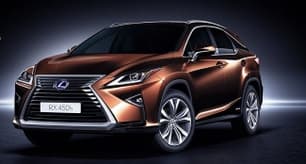
There's a lot of RX and there's a lot going on in that creased, folded and teased sheetmetal. It's a unique design, with a huge 'spindle grille', big lights and the fast glass both front and rear.
It positively screeches Lexus DNA and was a polarising force on our driveway for the week. Most weren't sure, but knew for certain it was a Lexus.
Aggressively flared wheelarches like this aren't common on SUVs (although the squared-off ones are). It's right up on stilts, but the 20s you find it rolling on help to reduce its visual bulk.
That wacky rear quarter glass reminds me of the BMW i3's but it's a Lexus SUV signature. It's quite striking. Do I like it? Not really, but that's completely subjective. You can tell, though, it's built tight as a drum.
Inside is a bit calmer, beautifully laid-out and built to last. The materials are almost all top notch, with lovely switchgear and the real leather is really nice.
There is absolutely nothing avant-garde in there (apart from maybe the pinstripe effect on the centre console), it's all terribly comfortable and easy on the eye. But not exciting, though not all Lexuses are.
This particular car is very US-centric and, if I may, a particularly sunny and humid part, so it can't be too wacky.
The Discovery’s cabin is an interesting mix - at first glance it seems to offer the right balance of space and features, but once you settle in, a few small disconnects between technology and layout become apparent.
Up front is where you want to spend most of your time. The powered seats are well-padded with long bases and excellent lumbar support. There’s plenty of room for tall drivers and passengers and elbow space is generous. The only annoyance is the heated seat function, which is buried behind the menu system and the fiddly climate dials.
The middle row highlights the Discovery’s tall-but-narrow proportions. Adult passengers can feel a little cramped side-to-side, though the flat floor gives decent leg and foot room. The third-row surprises with wider seats and deeper footwells than expected, so knees aren’t pressed against chests. Access, however, is more suited to children than adults.
Storage is abundant and thoughtfully positioned. Up front, there are dual glove boxes (one lockable), a hidden cubby behind the climate panel and underneath the sliding cupholders, a tray housing the wireless charging pad (which, in our test car, didn’t work), and the middle console fridge which is a handy touch for keeping snacks or drinks cool on long trips. The middle row gets map pockets, cupholders and bottle storage, while the third-row benefits from hinged cubbies on each wheel arch.
The boot is the standout, offering a massive 1137L when the third row is folded. Its tall and deep shape makes it practical and features like the powered tailgate, adjustable boot-lip height via air suspension, a full-size spare and a 12 volt socket round out its friendly usability.
Access is a simple step-in and step-out scenario thanks to the Discovery’s 'Auto Comfort Access' mode which, when activated, lowers the vehicle when parked. That said, the doors are heavy and need a firm push to latch properly.
Technology is a bit of a mixed bag. The media system is somewhat intuitive once you spend time with it, but newcomers may find the layout confusing. It includes sat nav, wireless Apple CarPlay, and Android Auto, though in our test car, CarPlay occasionally showed music playing without sound but re-pairing my iPhone 15 Pro Max fixed the issue. The dual-use climate dials, which control temperature, fan speed and seat heating, can feel finicky, and one rear door locked itself for four days despite troubleshooting. The rear seat fold controls also worked inconsistently.
On the plus side, amenities like four-zone climate control, multiple air vents per row, and seven USB ports scattered throughout the cabin are thoughtful touches.
There is plenty of room inside this big unit, which is very welcome. Front seat passengers have lots of storage, such as a deep central bin under the armrest, dual cupholders and big door pockets with bottle holders.
Step into the rear and there is a ton of leg and headroom although the transmission tunnel intrudes slightly for the middle passenger. Chuck them out, drop the armrest and you have two more cupholders and each door has pockets and bottle holders.
The boot is pretty big considering the angle of the rear glass. You start with 453 litres (but an expanse of flat floor), which rises to 924 litres with the split-fold seats down. That seems conservative given just how much space you appear to have.
Since the launch of the 35th Anniversary Edition, the Discovery line-up has shifted, now trimmed to five diesel-powered grades. Originally based on the Dynamic SE, this special edition is based on the Gemini variant which is second from the top of the range.
Pricing starts from $132,090 MSRP, placing it above key rivals like the Lexus GX 550 Luxury ($112,607) and Toyota LandCruiser Prado VX ($87,400). In other words, it’s priced right in the middle of the family-luxury SUV battlefield.
Inside, you get heated and powered chairs up front with four-way lumbar, plus heated outboard second-row seats. There’s no heated steering wheel or front seat ventilation, which feels like a miss at this price point, but the equipment list remains generous. Standard highlights include an 11.4-inch media screen, satellite navigation, dual sunroofs (one fixed), wireless Apple CarPlay and Android Auto and a premium Meridian sound system.
Family practicality is well-covered with a hands-free powered tailgate, adjustable load height, full-size spare wheel, 360-degree camera system, five USB-C ports, two USB-A ports, two 12-volt sockets and directional vents in every row. You also get seating flexibility and family-friendly safety points: four ISOFIX mounts and five top-tether anchors across the back rows.
The Anniversary Edition builds further with rear privacy glass, a Wi-Fi-enabled media system (with data plan), colour head-up display, power-tilt/fold second-row seating, tow pack (including hitch receiver and tow assist), anniversary badging, black roof rails, centre console 'fridge' and four-zone climate control.
Our test vehicle also features the 'Capability Plus Pack' ($4910), which adds meaningful off-road hardware like a rear differential lock, twin-speed transfer case (high/low range), multi-terrain modes (including 'Grass', 'Gravel', 'Snow', 'Mud-ruts' and 'Rock Crawl') and a wading sensor. Land Rover’s 'All-Terrain Progress Control' (essentially a low-speed, off-road cruise control) is also included.
It offers a well-rounded feature set that keeps it competitive, though a handful of additional premium touches would elevate it to a more commanding position in the segment.
The RX450h F Sport lightens your bank account of $102,460 before on-road costs, the only hybrid SUV within cooee of this price.
That nets you 20-inch alloys, a 15-speaker stereo, dual-zone climate control, heated and cooled electric front seats, reversing camera, that ever rare CD player, keyless entry and start, a solid safety package, reversing sensors, active cruise control, sat nav, a massive sunroof, auto LED headlights, head-up display, partial leather interior, power tailgate, auto wipers and a space-saver spare.
The Lexus media system is run from the gigantic dash-mounted screen that is shamed only by those massive Tesla units.
Sadly, the joystick-style control remains as does the very confusing software system that is less than delightful to use. It's such a shame that a tech-laden machine is let down by the world's most baffling entertainment system.
Once you get it working and understand it, it's okay, I guess, but several years into this job I still can't easily fathom how it works. And that naff analogue clock...
F Sport cars also pick up adaptive suspension and a several driving modes to liven things up.
The 35th Anniversary Edition runs a hefty 3.0-litre, six-cylinder, twin-turbo diesel paired with a 48V mild-hybrid system. Together, they produce 257kW and 700Nm. It’s brisk, too, with a 0-100km/h sprint time of 6.3-seconds, which is impressive for such a large 4WD.
Towing is rated at 3.5 tonnes and wading depth sits at 900mm, reinforcing its credentials as a proper adventure vehicle. Our test vehicle also features the 'Capability Plus Pack', which brings low-range gearing, rear differential lock and multiple terrain modes.
Not too bad for something that looks more like a school-run luxury SUV than some of its rivals.
You can choose three different powertrains in the RX - a 3.5-litre V6, a 2.0-litre turbo four-cylinder, or this one, the 3.5-litre V6 with hybrid.
As a series hybrid it can run for short distances on electric only before firing up the V6 to supply charging and motivation.
The 3.5 produces 193kW/335Nm along with the electric motor. That torque figure seems low and it probably is, but that's a function of the weird way of measuring torque from a hybrid unit. The combined power figure, however, is 230kW.
The hybrid system is hooked up to Lexus' CVT auto and sends power to all four wheels. Lexus says the 450h will complete the sprint from 0-100km/h in 7.7 seconds, which isn't bad for a 2210kg SUV.
The 35th Anniversary Edition has a claimed combined fuel figure of 7.8L/100km, and with its 89-litre tank you’re looking at a theoretical driving range of around 1141km. In the real world, I saw 9.0L/100km - that’s with one longer highway run mixed into a week of school runs and suburban errands.
It’s a touch thirstier than I’d hoped given I wasn’t towing or carrying heavy gear, but it still sits comfortably within expectations for this segment and size of vehicle.
The official combined cycle figure is listed as 5.7L/100km. And, uh, yeah, we didn't get that. I did manage 8.9L/100km over the week, which included a long motorway run from Sydney up to the Blue Mountains (a roughly 160km round trip).
Power delivery in the Discovery feels effortless, with none of the laggy, heavy character you can get from some big diesels. It responds quickly when you need it to, whether you're merging into traffic or overtaking and always feels like it has plenty left in reserve.
Ride comfort is excellent. The adaptive suspension absorbs bumps and settles the body confidently through corners without feeling floaty or wallowy. Steering has a reassuring weight to it - not too light, not too heavy - which helps the Discovery feel sure-footed and composed on the road.
The cabin is impressively quiet, making it easy to chat with passengers across all three rows and reducing fatigue on longer drives. Visibility is generally strong and the high seating position gives a good command of the road. The only drawback is the middle-row headrest, which blocks the rear view. A digital rear-view mirror would be a helpful addition, especially when the car’s full.
Despite its size, the Discovery is surprisingly easy to manoeuvre, with a fairly forgiving 12.7-metre turning circle. Parking is straightforward thanks to a clear 360-degree camera system, although the display itself could be larger. Even in tight shopping centre car parks it never feels unwieldy.
Right. So this is a salutary lesson about tyre pressures. The first few days the tyres were only pumped up to 200kpa (29psi). That's an easy 100kpa (14psi) short of the required 300 (43psi).
Every time I, or my wife, went around a corner, the big Dunlop Sport Maxx SPs would squeal and squirm and it was most unsatisfactory.
So check your tyres, because the extra 100kpa makes all the difference. Also, the number of service stations it took to find a working pump was unacceptable. Pull your socks up, Sydney.
Anyway.
Correct tyre pressures enacted, the big Lexus turned into a comfortable, competent cruiser. Its motorway performance is super-impressive, purring along the M4 and it's ridiculously poor surface like it was born to it. Which it sort of was.
The hybrid drivetrain allied to the CVT is mostly whisper quiet. It's not the most responsive combination, the initial step-off of the electric motor's torque soon giving way to the rubber band effect of the transmission.
It doesn't feel as swift as the claimed 7.7 seconds and it would be nice if the drive select dial made a genuine difference to the throttle and transmission's response.
In the city, it's a proper wafter, moving about the broken down city streets of Sydney without fuss and a plush ride that's a bit of a surprise given the huge wheels and substantial weight of RX.
It's all very easy and pleasant but the wild looks do not match the experience. Which is not a criticism, just an observation.
The new Discovery hasn’t been tested by ANCAP yet and is unrated but it does come with a large suite of safety features and eight airbags which is good to see on a large 4WD.
Standard equipment includes autonomous emergency braking, blind-spot monitor, driver attention monitor, lane keeping aid, rear collision alert, rear cross-traffic alert, traffic sign recognition, speed limit warning, intelligent seatbelt warning, powered child locks, front/rear parking sensors and a 360-degree view camera system.
The adaptive cruise control is well-calibrated as it slows smoothly behind traffic and confidently builds speed again once the lane clears, without the hesitation some systems have. The only safety feature which is intrusive is the speed limit warning and unfortunately you have to slough though some menus to mute it.
There are four ISOFIX and five top-tether anchor points spread across the rear rows, which should delight families.
The RX ships with eight airbags (including knee airbags for both front seats), ABS, stability and traction controls, blind spot sensor, reversing camera, forward collision warning, forward AEB and reverse cross traffic alert.
There are three top tether restraints and two ISOFIX points.
The RX scored a maximum five ANCAP stars in January 2016.
The Discovery 35th Anniversary Edition is covered by a five-year/unlimited-kilometre warranty, which is fairly standard for vehicles in the luxury SUV segment. However, it's worth noting the Nissan Patrol is offered with a 10-year (conditional) warranty.
Land Rover offers a pre-paid, five-year service plan for around $3500, which is cheaper than paying for each service individually. Service intervals are well spaced at every 12 months or 20,400 km, whichever comes first. There are approximately 71 authorised Land Rover centres across Australia, so even if you live regionally, you should be able to service your Discovery fairly easily.
Lexus offers a fence-sitting four year/100,000km warranty with roadside assist thrown into the bargain for the same period.
Service intervals arrive at 12 month/15,000km and there is, sadly, no capped-price servicing.
Lexus will, however, promise you a car for the day or come and get your car from you and drop it back when the service is done. And it will be washed and vacuumed. The website makes a big deal about that.