What's the difference?
Australia is experiencing a mass extinction event.
Like the dinosaurs before them, and hopefully not the bees in the near future, the sub-$20,000 car is nearing the bitter end.
An evolutionary dead-end, as higher emissions and safety regulations relegate older models (read Mitsubishi Mirage) to the great scrap-heap in the sky and prevent newer ones (read Honda Jazz) from leaving their local markets.
For you, this means there are quite literally a handful of brand-new vehicles left in Australia which wear before-on-road price-tags under the magic $20,000 number.
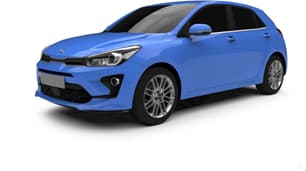
One of them is the car we’re looking at for this review: The Kia Rio S, with the catch being you’ll have to be happy changing gears yourself.
So, is this most basic Rio worth your while, or is it best left as a puzzling fossil for future generations to study? Let’s have a look.
Up until 2024 when its title was nabbed by the Tesla Model Y, the humble Toyota Corolla has been the world’s best-selling car for quite some time.
A reputation for reliability, affordability, efficiency and in its current guise, being fun to drive, the Corolla has seen off all comers to retain the title of the most popular small car on Earth.
The current twelfth-generation Corolla is now seven years into its life cycle having landed in mid-2018. In that time scores of buyers have moved across into small SUVs, and the Corolla’s competitor set has shrunk dramatically as car brands pull out of the small passenger car segment.
But as we gear up for the next-gen Corolla, is the existing one still worth considering against some newer rivals? And should you look at this instead of a small SUV?
I lived with the mid-range Corolla SX hatchback for a week to find out.
The Rio S Manual is a fun-to-drive little car with a big practicality and multimedia offering in a segment rapidly heading towards extinction.
While some elements of the drive experience are reminiscent of budget cars from 10-20 years ago, Kia makes up for it by wrapping the Rio in a contemporary looking and feeling package, ready for the buyer who needs no frills and demands no nonsense. Until the manual transmission goes the way of the dodo, there is almost no better option.
The final score for this review makes it look as though the Corolla is a middling effort. The scores for each individual section of the review are well considered and fair. The Corolla does lack the practicality of some of its rivals. A lack of an ANCAP rating isn’t great and the powertrain is just okay. But it remains one of the most fun-to-drive hatchbacks on the market today, even seven years into its life, and I would wholeheartedly recommend the Corolla to anyone looking for a small car. If you can forgive some of the quirks, it is a reliable, adorable, fun and efficient small car favourite.
While notable equipment is missing, the Rio reclaims lost ground with the way it looks, and to a degree, the way it feels.
Ever since this new generation hatch launched, I’ve thought it brings a slick modern design to the city-car space, and even in its most rudimentary form as-tested (our car even came in the most basic ‘Clear White’ paint) it’s a great looking little hatch.
Sure, it doesn’t have the romance factor of the Fiat 500, nor the more delicate curvature of the much more expensive new-generation Toyota Yaris, but it certainly has a more refined visage than, say, the MG3 whilst feeling a bit more grown-up than the Suzuki Swift.
Solid, squared-off lines give this car a sporty pose, and its frowny-face and blocky rear round out a stout city-car persona, and I especially like the way even this most basic trim is adorned with contrast pieces, a spoiler above the boot lid, and body-coloured door handles and mirrors.
Sure, the 15-inch steelies dress it down a bit, but on the Rio these leave the impression of financial prudence rather than cost-cutting.
Inside is basic but tidy. The overall look maintains a hint of sportiness, with an appealing symmetrical finish to the dash.
There’s no question the Rio is a budget model when it comes to the touch though, with everything either a soft polyurethane or a nasty hard plastic, so while it all might look neat it’s far from the most comfortable place to be for long periods of time.
The basic dot-matrix multifunction display, chunky plastic air-conditioning controls, and polyurethane items from the wheel to the handbrake and shifter are reminders of a bygone era, but the overall aesthetic of the driver’s space is pleasing.
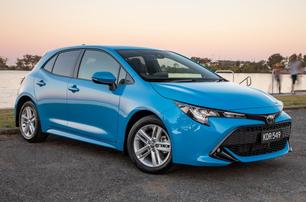
It’s been around for a good seven years, but the current-gen Corolla hatch is still a smart design. It has a squat stance and looks as though it has sporty intentions (it doesn’t), and the head and tail-light treatment doesn’t look like anything else in the segment.
The Corolla has adorable proportions and a pert little behind in a sea of increasingly boring small SUVs.
However, in SX trim and in the ‘Sunstone Orange’ body colour of my test car, the Corolla gives off rental car vibes. Which is hardly surprising given lower grade Corollas are a favourite of rental companies.
Inside that vibe continues. This is where the Corolla is really showing its age.
There are various shades of grey throughout the cabin, with a mix of hard and soft plastics. The cloth seat trim is drab, which is a shame because some other brands have managed to make cloth cool again. Not Toyota.
The touchscreen sticks up out the top of the dash like an old iPad and the dash design is old but functional.
There is nothing inspiring about this interior design. In saying that, of those aforementioned rivals, only the Mazda3 and the new Kia K4 have modern cabins.
I'd argue the key reason to buy the Rio at this end of the market is that it has the most space and largest cabin relative to its rivals, bar maybe the Suzuki Baleno.
All-round practicality is great, with front passengers scoring a low, sporty seating position with a high roof, and so much width in the cabin it almost feels like the Rio belongs in the next segment up.
Storage options up front include a large bottle holder and bin in each of the doors, dual cupholders next to the handbrake up front, and a large storage tray underneath the climate unit. Unlike the Yaris or Mazda2, the Rio features a small armrest console box, which gives a small lift to the ambiance of the cabin.
Back seat passengers are treated to great space for this segment, which feels nice and open courtesy of the large rear windows. At 182cm tall, I have airspace for my knees behind my own driving position, as well as relatively healthy headroom and ample width, which is again more like a car in the next segment up.
Rear passengers don’t get adjustable air vents, but there is a single USB port, a single pocket on the back of the passenger seat, and small bottle holders in each of the doors.
Perhaps the Rio’s biggest drawcard is its boot capacity, which at 325 litres is one of the largest in the city car class. Unlike the Yaris, Mazda2, or Suzuki Swift, the Rio will actually accept the CarsGuide three-piece luggage set with the rear seats up, although the rear view was obscured by the medium case.
Thanks to the boxy roofline, the Rio offers a cavernous 980L with the rear seats folded down, and despite its abundance of room, maintains a space saver spare wheel under the floor.
The Corolla is a small car and that is evident inside. You might bump elbows with your front passenger, but I have no problem with the front leg or headroom.
Those cloth seats might be drab but boy they are comfy, and the fronts have loads of side bolstering.
The steering wheel has typically clear controls and looks and feels nice.
As a more, shall we say seasoned model in the segment, the Corolla still has buttons on the dash for things like air con, but not too many. That bulbous centre stack and the centre console, however, could be better designed for the space.
As it is, the wireless charging pad is hidden under it at the far end of the console. It’s a bit fiddly to get your phone in and out. This is also where one of the USB-C ports lives.
The other one is in the central storage bin which is quite small, but also houses a 12-volt outlet. There are no other places to store things because of the rounded shape of the console, which also features a couple of narrow cupholders.
OurCarsGuide bottle had to be squeezed into the door storage cavity - only narrow, short vessels will fit properly.
That 8.0-inch multimedia screen is very easy to navigate, with logical menus and icons. However, it’s almost too basic, which is not helped by the all-white background. It could be a more engaging set-up but it’s also very hard to fault the functionality. Our Apple CarPlay maintained its connection the whole time with the car, too.
Space is quite tight in the rear, although I have enough headroom for my 184cm frame. Legroom is just okay behind my driving position. There’s more space in the back of a Hyundai i30. It’s also dark because of smallish rear windows and thick C-pillars.
The rear seat backrest is quite upright, but, like the front seats, well cushioned.
Amenities are just average back there - there’s a weird cupholder high on the door, only a passenger side map pocket, no rear air vents and no USB ports, although you could easily use the one housed in the front central bin. There’s a rear fold-down armrest with two cupholders.
The rear seats split and fold 60/40 and they fold flat making for a better loading space.
The good news is the SX (and the base Ascent Sport) come standard with a temporary spare wheel, which is great news for a hybrid model. The bad news is, that reduces boot space to a paltry 217 litres.
That’s off the pace of all of its key hatchback rivals, including the Mazda3 which has its own cargo concerns at 295L, and the Hyundai i30 with 395L.
The Corolla ZR hatch has more space at 333L but you only get a tyre repair kit instead of a temporary spare.
If you’re dead set on a Corolla but need more cargo space, consider the smart looking sedan that has 470 litres.
Value seems less important here when you’re contending with a limited list of potential options at this end of the market.
The Rio S manual currently wears an MSRP of $19,690, and if you’re able to shuffle cogs yourself, it counts its rivals as the Suzuki Baleno GL ($18,490), Suzuki Ignis GL ($19,490), or Fiat 500 Lounge ($19,550).
There’s also the option of the MG3 (from $18,990) or Kia’s own much smaller Picanto (from $15,990).
I’m pleased to report the Rio S is one of the best among these options, though. Not only is this car much more modern in terms of its platform and design than pretty much anything on that list, it packs great standard equipment, too.
The major wow-factor item is the Rio’s best-in-class multimedia system, consisting of an 8.0-inch touchscreen with wireless Apple CarPlay and Android Auto connectivity, just one of the areas where this car will grab eyes over rivals.
Elsewhere is a predictably honest list of standard equipment, including basic halogen headlights, 15-inch steel wheels, manual air conditioning, cloth seat trim with a polyurethane steering wheel, a small multifunction display in the dash, two USB ports, a six-speaker audio system, and surprisingly, steering-wheel mounted controls.
There’s no keyless entry or push-start ignition, and this level of equipment makes you feel lucky to have automatic headlights. Sadly, the S manual also misses out on the basic luxury of cruise control.
It’s cheap, missing a lot of gear, and feels it with an abundance of plastic trims, but somehow this car gets by with almost everything you really, truly need. Sure, it’s a bit of a hark back to the equipment lists of the early 2000s, but if you’re just looking for a basic car to get the job done, you could do far worse than this Kia with its impressive multimedia offering.
Toyota dropped all exclusively internal combustion engine versions of passenger car models and car-based SUVs last year so the Corolla is now hybrid-only.
The grade we tested is the SX five-door hatchback which is priced from $35,260, before on-road costs. Interestingly, the sedan version, which has a much bigger boot, is $340 cheaper.
The SX sits in the middle of the Corolla range with the Ascent Sport the most affordable (from $32,110) and the ZR the priciest before you get to the fire-breathing GR Corolla hot hatch.
Direct rivals at this approximate price point include the Hyundai i30 N Line ($36,000 BOC), Mazda3 G20 Touring ($37,110), Subaru Impreza 2.0R ($35,490) and the Kia K4 Sport ($35,190), although that is sedan only for now.
You get 16-inch alloy wheels, cloth bucket seats, a synthetic leather steering wheel, auto-dimming rear view mirror, rain-sensing wipers, rear privacy glass, keyless entry and start, dual-zone climate control, USB-C ports, a wireless device charging pad, six-speaker audio, an 8.0-inch colour multimedia display with sat-nav, digital radio, Bluetooth, voice assistant and wireless Apple CarPlay and Android Auto.
The standard features list could be described as adequate without being overly generous for the price. A head-up display (standard in the ZR) would be nice.
The Rio is beginning to fall behind here with an antiquated 1.4-litre four-cylinder non-turbo petrol engine. Peak outputs aren’t far off where they should be for this segment, with 74kW of power and 133Nm of torque, although they arrive at the most distant end of the rpm range (6000rpm and 4000rpm respectively) so you need to rev it.
It can be clumsy to extract this power, too, with the engine paired in this circumstance to a six-speed manual which leaves a lot to be desired in terms of action and clutch feel.
While the abundance of ratios can be beneficial for fuel consumption, it’s clear this car was designed to be paired with the more modern three-cylinder turbocharged engine only available on the top GT-Line trim.
Since Toyota dropped the petrol engine from the Corolla range, it’s a hybrid-only affair.
The powerplant is a 1.8-litre naturally aspirated petrol engine paired with Toyota’s fifth-generation hybrid system that incorporates a lithium-ion battery, which is lighter yet more powerful since the 2022 update.
The Corolla drives the front wheels exclusively via a continuously variable transmission (CVT).
It’s not the punchiest engine and could do with more poke, but Toyota does do hybrids well.
The Rio S manual has an official combined cycle fuel consumption rating of 5.6L/100km, which is about right for a light car with a small engine.
On test, covering largely urban kilometres, I saw a higher but not unreasonable 7.4L/100km. Still, this number isn’t too far off what some larger cars with 2.0-litre engines are capable of.
Rios with this engine accept entry-level 91RON unleaded fuel, and have 45-litre fuel tanks. They are only compliant with Euro 5 emissions regulations.
According to Toyota the official fuel-use figure for the Corolla hybrid hatch is 4.0-litres per 100 kilometres and CO2 emissions sit at 90g/km.
While the trip computer said 4.8L/100km at the end of our week, my own fuel consumption calculation came to 5.8L.
You will only need 91 RON 'standard' petrol to fill up the Corolla.
A six-speed manual with a tiny non-turbo engine is an absolute oddity in today’s new car market, but as a result of its rudimentary approach, there’s something refreshingly honest about the Rio S.
The engine requires a wringing to extract the desired result, and a lot of action on the gears, as six speeds proves to be quite a few to work your way through before you achieve cruising speed.
As so much interaction is required with the transmission, I wish it was tighter when it comes to the clutch which feels a bit doughy at the best of times.
The Rio is very organic, though, with next to no electrical assistance for any of its interaction points offering the driver a high level of control.
The steering is direct, but as a result of a cheaper rack (with less teeth compared to this car’s Stonic relation), it feels simple and brittle when it comes to feedback.
The same criticism can be levelled at the suspension, which errs on the side of firm. This attribute combines with the low seating position to make even this most basic Rio an absolute hoot in the corners.
But it can be a little crashy over every-day potholes and corrugations, despite the abundant amount of rubber cladding the 15-inch steel wheels.
Visibility is superb out of this little car’s big windows, making you feel in control of your surroundings (necessary in the multi-lane confines and tight parking conditions of a city), and ergonomics in the cabin are absolutely on-point with the large touchscreen elements easy to reach and the instruments taking a basic no-nonsense form.
While noise levels are okay at urban speeds, they pick up above 80km/h, making the Rio more unpleasant to drive over long distances than, say, the more upmarket-feeling Yaris.
The Rio does find its place in this price bracket as a fun-to-drive, but predictably rudimentary experience, for the niche audience of drivers seeking an entry-level car who are still able to shift gears themselves.
Most generations of Corollas have been solid, dependable and occasionally, even fun to drive.
My first car was a Holden Nova GS hatchback, which was a rebadged version of the seventh-generation Corolla. I loved that car. It was zippy, fun and super economical.
The same principles generally apply to the current-gen Corolla. Thankfully, Toyota’s former CEO, Akio Toyoda, insisted all models from the Camry to the Kluger needed to be injected with more fun. And he succeeded with the Corolla. So much so that they've spun off a wild GR performance hot hatch version.
The Corolla sits low to the ground and it just feels much more connected to the road than a small SUV can. Even in mid-range SX guise, the Corolla can hug a corner and there is ample grip to ensure a fun drive on your favourite winding road.
Sure, the hybrid powertrain might not set your heart racing, but it is quick enough from a standing start and it lacks the lag of some of its turbocharged contemporaries. There’s also plenty of poke on tap for a small car when overtaking.
Even though it has a sporting edge to how it handles, the Corolla SX has been tuned for comfort first and foremost and this is another area it excels. The damper set-up ensures the Corolla soaks up speed bumps, nasty potholes and whatever else our shoddy roads can throw at it. At no point in my seven days with the Corolla did I complain about a harsh bump or thud.
Steering has a mechanical feel but it is still sharp, adding to the ‘chuckable’ vibe of this hatchback.
The powertrain can be noisy when pushed and combined with a CVT auto it’s the nicest sounding engine out there. Also, the transition from electric to petrol power isn’t particularly smooth. Other carmaker’s hybrid offerings - like Honda for example - are close to seamless.
Some road noise gets into the cabin but it’s no deal breaker.
Sadly, the Rio S misses out on any advanced active safety items. This is one area where city-sized cars are struggling to keep up, as expensive active safety systems tend to push them well into the mid-$20,000 region.
Unlike the mid-range Rio Sport, the S has no auto emergency braking, lane keep assist, or driver attention alert.
It makes do with the more basic array of brake, stability and traction controls, with the addition of a great reversing camera, three top-tether and two ISOFIX child seat mounting points, and six airbags.
The Rio carries a valid five-star ANCAP safety rating, to an earlier 2017 standard before its missing modern active safety items were mandated.
The Corolla is currently unrated by crash safety watchdog ANCAP. It did achieve a maximum five-star rating back in 2018 but that expired at the end of last year.
Safety features are largely standard across all grades and the SX comes with auto emergency braking (AEB) with pedestrian and daytime cyclist detection, lane departure alert with steering assist, speed sign recognition, 'Lane Trace Assist', adaptive cruise control, a blind spot monitor with safe exit assist, a rear cross-traffic alert, reversing camera and front and rear parking sensors and a rear occupant alert.
It doesn’t have a driver attention alert, and it’s all the better for it.
The lane keeping aid is well calibrated and subtle in its interventions, but the adaptive cruise let the speed creep several kilometres over the set speed on several occasions.
The Rio again gets the edge on its budget competition with a lengthy seven-year, unlimited kilometre warranty. In this space it only butts heads with the MG3, which offers a matching promise.
Roadside assist is included for up to eight years if you continue to service with Kia, and there's also a capped price service program for the duration of the warranty, covering up to 105,000km.
The Rio needs to be serviced once every 12 months or 15,000km, and prices range from $269 and $608 per visit, for an annual average of $409.40.
Not the cheapest servicing schedule we’ve seen, particularly when compared with the likes of Toyota.
The Corolla is covered by Toyota’s five-year/unlimited kilometre warranty, which, given Kia, MG, GWM, Jaecoo and more have longer terms (not to mention Nissan and Mitsubishi’s conditional 10-year terms) is now officially trailing its competitors.
However, the capped-price servicing plan of up to five years costs just $250 for each service, which is incredibly competitive. The service schedule is every 12 months or 15,000km, whichever occurs first.