What's the difference?
Kia has released the newly updated Niro, which is the smaller and less sporty sibling to Kia’s popular, EV6. As far as EVs go, it has a decent driving range and specs that should entice first-time electric vehicle owners to dip their toes into the EV pool.
However, the updated model does come with a price hike… which might not excite a budget-conscious buyer, especially with such affordable competitors like the MG ZS EV and Hyundai Kona Electric also available.
I’ve been hanging in it for a week with my family of three to see how it handles!
I’m family testing the updated Genesis G70 this week, which has seen some tweaks to its technology and safety systems.
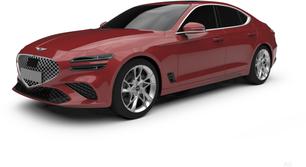
The G70’s release also sees the line-up trimmed to one highly-specified Sport Luxury grade, available as a four-cylinder Shooting Brake wagon or the V6 sedan on test here.
It competes with other mid-size sedans like the Audi A4, BMW 3 Series and Mercedes-Benz C-Class. So, how does the G70 handle life with a small family of three? Keep reading to find out!
The Kia Niro S Electric is a solid little SUV that has decent space inside and some nice specs, but it's more expensive than its nearest rivals. The EV powertrain can take a little getting used to and I would have liked a smoother ride, but the 460km driving range is good.
For first-time EV owners, this wouldn’t be a bad option if you wanted to dip your toes in the water but it will suit urban dwellers and smaller families, like mine, best. This gets a 7.5/10 from me.
My son wasn’t in love with this one. Not enough buttons for him to press and he did comment on how bumpy the ride was in the back. He gives it a 6.0/10.
The updated Genesis G70 3.3T Sport Luxury is beautiful to look at and drive. It features premium features, trims and great power but the cabin is tight on space. Which makes it a little awkward to use, so this will suit a small family best or families where this may not be the primary mover. That said, I love the after-care program and it suited my small family of three, so it gets an 8.0/10 from us.
It’s a compact SUV with a footprint that's 4420mm long, 1825mm wide and 1570mm tall. But while small, I wouldn’t call it cute. It’s boxier than its sibling and without any of the swoopy design elements that make the EV6 look cool.
I do like the way the two-tone body panelling, which is seen most prominently on the C-pillar, breaks up the ‘blocky-ness’ and creates areas of interest. As do the high-mounted rear LED lights.
Speaking of lights, the base model makes do with halogen headlights, which unfortunately stand out against the LED daytime-running lights. You’ll notice the dimmer light at night, too.
The 17-inch alloy wheels are thick for better aerodynamics but the clever two-tone colouring stops them from looking unfashionable.
The interior has a lot style cred with the curvature of the door panelling blending in almost seamlessly with the dashboard.
The gently sloping panelling that houses the multimedia systems and switchable touchscreen interface for the controls creates a very pleasing cabin space.
There are some harder plastics mixed in here but enough soft touchpoints that you won’t be bothered by them.
The G70 sedan is absolutely gorgeous to look at and the our test vehicle's 'Kawah Blue' paintwork makes the crisp pleating across the body stand out.
The G70 has a muscular stance, much like its BMW rival, but the rear is softer in its shaping.
The front looks sophisticated with the wide-set LED lights and black air-intake vents. The sporty 19-inch alloy wheels and red calipers behind them hint at what the powerful V6 engine can do.
The interior looks high-end with our test vehicle’s white quilted Nappa leather upholstery and a soft-touch black headliner. The dashboard looks solid and robust but the slick looking 10.25-inch touchscreen multimedia system and digital climate control panel elevate the overall design.
The only thing I didn’t like about the design was the ambient lighting. It’s limited to two panels on the roof and is a little distracting when you drive at night. I think if it was scattered more throughout the cabin, it would be less intrusive.
It’s surprisingly roomy inside and all passengers will enjoy decent leg and headroom, but taller passengers will find the backseat cosier than the front.
As such, two child seats will fit best but you do have ISOFIX child seat mounts on the outboard positions and three top-tether points, if you need them.
The synthetic leather/cloth seat trim cleans well and is nice to touch. The seats themselves, front and rear, are well-padded and super comfortable.
The backs of the front seats can double as coat hangers and have hardened kickplates, which are always practical for little feet.
The front row gets the most amenities and tech. The 8.0-inch touchscreen multimedia system has clear graphics but is different to other Kia’s I’ve sampled recently. It seems to have been simplified but you’ll get used to it quickly.
There are plenty of charging options available, too, with a USB-A and C port, plus a 12-volt socket. Not needing a cable for the wireless Apple CarPlay is a bonus, too!
The front row also has the most storage space with two retractable cupholders, dedicated phone tray, glove box, middle console and skinny drink bottle holders in each door.
Back seat passengers enjoy two USB-C ports, reading lights, drink bottle holders in each door plus an armrest with two cupholders. As well as, a standard three-pin socket in case you need to run electrical gear or charge anything up on the go.
The windows are wide and offer good visibility but I really like the 150mm ground clearance. It was super easy for my six-year old to climb in and out, plus he got a good view this week!
The boot is good for this size SUV with 475L of capacity available. It does look more like a hatchback, because while you can readjust the floor to sit lower, the back still slopes up.
However, it was fine for my weekly grocery and school run. The 'frunk' storage is small at 20L, which is just big enough for a charging cable.
You don’t get a spare wheel but you do get a puncture repair kit. And being the base model, it’s not a powered tailgate but it’s not heavy to close.
The practicality is hurt a little by the space available for passengers. The front row benefits the most when it comes to head- and legroom but if you’re ferrying passengers in the back seat, you’ll have to scoot your seat forward to accommodate them.
Especially if they’re tall because my knees brush the back of the driver’s seat when it’s in my driving position and I’m only 168cm tall!
The individual storage options throughout the car are okay for the class with the front enjoying a small middle console and glove box, two cupholders and two small drink bottle holders in each door.
The rear gets map pockets, two cupholders in a fold down armrest and two very small storage bins in the doors.
The other amenities are great in both rows and a high-level of comfort will be found for adults with the heat and ventilation functions on the front seats and the heat function on the rear outboard seats.
However, the width of the rear seat and the tall transmission tunnel means the middle seat should be strictly reserved for a kid. Think of the G70 as more of a four-seater if you have adults to carry.
The boot has a 330-litre capacity and it’s not too hard to reach to the very back if items roll that way. The back seat has a 60/40 split and there is a temporary spare tyre underneath the floor.
In terms of technology, you get a USB-A and USB-C port up front, as well as, a 12-volt socket and wireless charging pad to choose from. Rear passengers get two USB-C ports and the boot features another 12-volt outlet.
The 10.25-inch multimedia system looks great and is easy to use with a responsive touchscreen. It also has built-in satellite navigation, wired Apple CarPlay and Android Auto and the system now features over-the-air updates and Genesis Connected Services functionality.
The digital climate panel is responsive and very simple to operate, which is handy when on the go. The 12.3-inch digital instrument cluster is semi-customisable and it’s handy that the 8.0-inch coloured head-up display pulls through satellite navigation directions and traffic sign information.
There are two variants for the Niro, our base model, the S, and the range-topper GT-Line.
Despite being the base model, the Niro S will still set you back $65,300, before on-road costs. Which makes it about $5K dearer than the equivalent Kona Electric, and $20K more expensive than the ZS EV.
There is a hybrid Niro (also available in two grades), if you’re not quite ready to commit to a full EV life. The price isn’t as eye-watering, either, being just $44,380, before on-road costs.
The Niro is well-specified, though, and the driver will enjoy an electric seat with adjustable lumbar support while the passenger side remains manual.
The regenerative braking is customisable (levels 0-3), there’s an 'iPedal' function, a dual-zone climate system, reversing camera and the backs of the front seats even double as coat hangers.
The tech is also good, with an 8.0-inch touchscreen multimedia system, 10.25-inch digital instrument panel plus wireless Apple CarPlay and wired Android Auto all coming as standard equipment. More on the tech below.
The G70 3.3T Sport Luxury sedan on test here is priced at $88,000, before on-road costs, which is $7000 more expensive than the 2.0T Shooting Brake version. That positions it right in the middle of its nearest competitors and you get some fab features included.
The premium items include electric front seats with heat and ventilation functions, heated rear outboard seats, Nappa leather upholstery and other leather trims, a sunroof, a heated leather-wrapped steering wheel and a premium 17-speaker Lexicon by Harman sound system.
The update sees the G70 now have an intelligent speed limit assist feature, the 'Genesis Connected Services' app and over the air updates to its software.
Other standard features include keyless entry, keyless start, remote start from the key fob, a powered tailgate, 19-inch alloy wheels, a temporary spare wheel, dual-zone climate control and extendable sun visors.
The Niro is a full EV and has a front-wheel drive drivetrain with a maximum output of 150kW/255Nm. It’s not as powerful as its stablemate and only has the single-motor which is powered by a 64.8kWh lithium-ion battery but going from 0-100km/h can still be achieved in 7.8 seconds. With specs like those, this is most suited for an urban setting.
The G70 3.3T Sport Luxury sedan has a 3.3-litre V6 turbo-petrol engine with a maximum power output of 274kW and 510Nm of torque. The G70 sedan is a rear-wheel drive and features an eight-speed auto transmission.
The V6 engine responds eagerly, being able to do a 0-100km/h sprint time in just 4.7-seconds. Suffice it to say it’s fun to drive.
Such is the EV life but you can’t escape the charging.
The onboard DC charger has up to 85kW of capacity and that means on a 50kW fast charger station, you can get from 10 to 80 per cent in 65 minutes.
However, if plugged into a 350kW ultra-fast charger, you’ll only save 22 minutes because it can’t accept that faster speed.
On a 7.5kW system, you’ll go from 10 to 80 per cent in approximately nine hours, 25 minutes. On an 11kW, you’ll see that figure drop to six hours, 20 minutes.
The charging port is a Type 2 (CCS Combo2) and the car comes with an emergency charging cable that can plug into a standard three-pin domestic socket, if needed.
However, it’s slow going and you’re looking at a wait time of up to 27 hours, 30 minutes to get to a full charge. All other cables cost extra.
The official kWh/100km consumption is 16.2kWh and my average on-test figure was 14.3kWh after a mix of urban and open-road driving.
However, I did see figures getting closer to 20kWh on longer trips. Still, I would consider my average to be efficient.
The Niro S has a driving range of up to 460km (WLTP).
The compromise for getting all of the power is that she’s a thirsty gal and the official combined cycle fuel consumption figure is 10.4L/100km and my real-world usage came to 10.6L/100km.
However, that’s after mostly doing open-roading – expect the fuel usage to be higher in an urban setting.
Based on the combined cycle and the 60L fuel tank, expect a driving range of around 577km on average. Which means you’ll be filling up more on a longer journey than more efficient sedans.
This is a pretty simple car to drive but it doesn’t feel as fun as some other EVs I’ve driven. It can even feel sluggish when you accelerate from a full stop and that makes it feel laggy in stop/start traffic.
Once you’re on your way, the acceleration is fairly responsive. You feel confident overtaking on the open road, too.
The car feels connected to the road with minimal shuddering through the steering wheel. The car responds in a timely manner when you have to make sudden moves, which I like.
Sometimes, the lane keeping aids make it feel jerky and I turned it off in some situations.
The regen braking delivers a big physical presence like the EV6 but isn’t as refined and can feel almost ‘bunny hoppy’ at times.
You can customise it up to four levels, zero being low regen and four being the iPedal. I’m not overly fond of the iPedal, so didn’t use it that much this week and kept it at level 3.
You do have to change up how you drive an EV, so this wasn’t that surprising and something I’m sure you’d get used to.
The ride comfort is pretty mixed. Around town, it’s good but there’s quite a bit of passenger movement in this. You kinda feel like you’re bobbing along sometimes, which is jolting.
You also feel the road but the seats are so comfortable, they stop it from feeling too rough.
Surprisingly, the cabin gets very loud with wind and road noise. You can still chat but you won’t forget that it’s there, which is a shame.
I didn’t notice much difference between the drive modes, so it was kept on 'Normal', too.
This is very easy to park! It’s a good size for even a tight car park with a 10.6m turning circle and the reversing camera is super clear, which is great.
However, I would have liked to have seen front parking sensors, as well as the rear sensors. You can get them on the GT-line though.
The G70 sedan is a lovely car to drive with graceful handling and a good well of power to dip into.
That oomph is there when you need it and it’s as easy to drive in the city as it is on the open-road.
The responsive steering makes the G70 sedan feel nimble and well-balanced in turns, even when you accelerate out of a hair-pin corner.
The suspension is on the firm side and that can lead to a few grunts when you hit bigger bumps but the ride is not unpleasant, even for back-seaters.
The cabin is generally quiet but you can get road/wind noise at higher speeds. It’s not enough to intrude on chatting but you don’t forget it’s there, either.
The G70 sedan is easy to park because it has an outstanding 11m turning circle. The 360-degree camera system is clear and the front and rear parking sensors make light work of a tight car park.
The Niro EV S has a good list of safety features, with the following being standard: LED daytime running lights, lane departure alert, lane keeping aid, blind-spot monitoring, rear cross-traffic alert, a reversing camera (with dynamic guidelines), rear parking sensors, driver fatigue alert, check rear occupant alert and adaptive cruise control (with stop/go function).
It has auto emergency braking with car, pedestrian and cyclist detection as well as junction turning assist, which is operational from 5.0-85km/h.
The Niro was recently awarded a maximum five-star ANCAP safety rating in 2022. It has eight airbags and that does include the newer front centre airbag.
There are ISOFIX child seat mounts on the rear outboard seats and three top tethers, but two seats will fit best. And while there will be room for a 0-4 rearward facing child seat, it will encroach on front passenger comfort.
The Genesis G70 has a great suite of safety features and it’s almost a case of what doesn’t it have.
But a real highlight is the blind-spot view monitor which pops a video feed of your blind spot onto your instrument cluster. Very handy to have in a city setting!
The G70 has a maximum five-star ANCAP safety rating from testing done in 2018, with the update now featuring 10 airbags, which is fantastic for the class.
Other standard safety features include blind-spot monitoring, blind-spot collision avoidance assist, driver attention warning, forward collision warning, lane keeping aid, lane departure alert, rear cross-traffic alert, rear occupant alert, adaptive cruise control with stop and go function and a tyre pressure monitoring system.
A clear 360-degree camera system as well as front and rear parking sensors also come standard.
The G70 has AEB (operational from 10–180km/h) with pedestrian and cyclist detection.
There are ISOFIX child seat mounts on the rear outboard seats and three top tether anchor points but only two child seats will fit. Front passenger comfort may be compromised for front occupants when a 0-4 rearward facing child seat is installed.
The ongoing costs are great on the Niro. It comes with Kia’s ‘better-than-average-for-the-market’ seven-year/150,000km warranty, which also covers the battery.
You get a seven-year capped-price servicing plan and services average $250 per year, which is good.
Servicing intervals are more in line with a petrol car at every 12 months or 15,000km. It’s usual to see those intervals doubled on an EV but it’s still reasonable.
The Genesis after-purchase program is hard to beat and such a treat because you get five years or up to 50,000km complimentary servicing with the G70. How good is that?
The G70 also comes with a five-year/unlimited km warranty and the servicing intervals are every at 12-months or 10,000km, whichever occurs first. The interval could be annoying if you travel a lot but any annoyance will be softened by the fact that the services are free.