What's the difference?
For off-road adventurers, having the flexibility to be able to tow your camper-trailer off the beaten track, out bush and along a beach, opens up a whole new realm of fun and possibility – and that's why Jayco's Outback versions of the company's mainstream camper range have a growing legion of fans.
But the question for camper buyers is: should they upsize? Bigger is often better, but does that hold true in the camper-trailer world? Is a big camper actually worth the extra cash? And is it more difficult to tow?
We take the Jayco Swan Outback (from $30,490), the biggest camper in the Outback range, on a trip into the bush to answer these questions and plenty more.
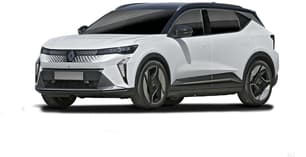
What’s 15 years between friends? Well, in this instance quite a lot because this is the all-new, pure-electric Renault Scenic E-Tech small-medium SUV.
The Renault Scenic we knew here until the late noughties was a petrol-powered, five-seat family car or an upright, seven-seat people mover.
But this is an altogether sleeker proposition, priced and specified to compete with other electric SUVs like the BYD Sealion 7, Hyundai Elexio, Kia EV5, Skoda Elroq and Zeekr 7X.
So, could this fresh Euro contender have what it takes to steer you away from such an impressive set of pure-electric competitors?
We attended its local launch to find out.
The Jayco Swan Outback is a nice solid camper, packed with features and suited for most trips away.
Sure, it's not the roomiest or flashiest camper around and – you've been warned – it is definitely not up to hard-core 4WDing, but it does come from a company responsible for sharply priced units with plenty of flexibility regarding optional add-ons so that counts for a lot.
The Renault Scenic E-Tech is lining up against some heavy-hitting competitors, but Renault Australia admits it has one top of mind - the Kia EV5. The Kia’s a quality package and if you’re in the market for a mid-size electric SUV, you’ll no doubt have it on your shopping list. And you should have a look at this slightly smaller car, as well. It has the refinement, practicality and safety to stand up confidently in a rapidly expanding segment.
Note: CarsGuide attended this event as a guest of the manufacturer, with travel, accommodation and meals provided.
Correct me if you reckon I'm wrong, but no camper-trailer from any company will ever be in the running for a 'Gorgeous Temporary Home' award. But that's part of this camper's appeal; it's highly practical and functional, not pretty and useless.
The forward bed is to the left as you step inside; the rear bed is to the right. Its kitchen is in front and to the right of the door as you enter the camper.
Interior height is a standard 2070mm and inside is spacious, but tempers will likely fray if all four adults and two kids are standing or sitting around inside at the same time. Hope for no rain.
The interior includes a four-burner stove, Dometic 95-litre fridge (Touring models get the 90-litre fridge), stainless-steel sink, dinette seat, table, club lounge, and the two beds plus the dinette-convertible bed.
If you can't find some places in which to stow away your gear in this Outback, then you're not looking hard enough.
The 'Ezi glide' pull-out drawers include room enough for your large pots, cutlery, kitchen gear and numerous other bits and pieces.
Interior lighting includes overhead LEDs for the dining/entertainment area and reading lights for the beds. There’s a fan for the beds.
In terms of how it all works in practice, at just under 4.5m long, close to 1.9m wide and less than 1.6m tall with a 2785mm wheelbase, the Scenic is more compact than the larger BYD Sealion 7 or Zeekr 7X, for example.
But there’s plenty of breathing room up front, with the centre screen angled towards the driver enhancing the cockpit feel for the one doing the steering.
There are large carpeted bins in the doors with room for bottles and a lidded storage box between the seats doubles as a centre armrest. That lid slides forward by 70mm to cover a small storage cubby under the front of it, which is a handy trick.
Locating the gear selector on the right-hand side of the steering column liberates extra space for a centre cupholder and large console storage bin. There’s a generous glove box and a wireless smartphone charger under the centre screen includes a rubberised base and two lugs to stop devices sliding around. Power and connectivity runs to two USB-C ports and a 12-volt socket.
Moving to the second row, sitting behind my 183cm driving position, while toe room is a little tight (with the driver’s seat set low down), there’s heaps of leg and headroom as well as enough shoulder room (and foot room thanks to a flat floor) for three adults on short to mid-length trips. A pair of adjustable centre air vents is also a welcome inclusion.
Storage includes door bins (again with room for bottles), large and device-sized pockets on the front seat backs and the pièce de résistance is the evocatively named ‘Ingenious armrest’, which includes a storage area and two cupholders at the base of articulated horizontal arms that allow passengers to mount a phone or tablet at various angles in rubberised slots for joint or solo viewing.
It is, indeed, ingenious and four USB-C plugs (two in the armrest, two near the air vents) mean back-seaters won’t be short of power options.
Boot volume with the rear seats upright is useful at close to 545 litres (VDA), expanding to around 1670L with the 40/20/40 split-fold second row lowered. A power tailgate is standard across the range.
There are bag hooks, tie-down anchors, lighting and a 12-volt socket back there, although for V2L (vehicle to load) functionality you’ll need an accessory adapter to plug into the charge port.
Maximum braked trailer towing capacity is a handy 1100kg, but there’s no spare tyre, only a repair/inflator kit, which isn’t good enough.
Jayco campers are easy to tow and the Swan Outback is no different. It towed steady and stable – no worries – behind our long-termer 2019 2.0-litre four-cylinder bi-turbo Ford Everest 4WD (157kW/500Nm).
We did decent stretches of highway, country back-road and gravel track, deeply rutted in places, with no strife.
The extra length (305mm) over its top-tier stablemates – Hawk and Eagle – was hardly noticeable and only took a little adjustment and increased vigilance when turning in between trees on pinched bush tracks.
With a 130kg towball weight, it feels marginally livelier than Hawk (145kg) and Eagle (150kg), but nothing drastic – again, as long as the driver pays attention there's no issue.
Visibility back along both sides and over the top is good without need for towing mirrors.
The single-axle Swan Outback has a hot dip galvanised 'Endurance' chassis on Jayco’s 'JTech' coil-spring suspension with a little extra ground clearance over road-focussed Touring models. (Note: Jayco’s Outback models are made for dirt tracks and gravel roads, not 4WD-only tracks. They are not built for hard-core off-roading.)
Renault says the entry-grade Scenic Techno will accelerate from 0-100km/h in 8.6 seconds with the more powerful Techno Long Range and Esprit Alpine lowering that number to 7.9sec. So, it’s quick without being scary fast.
It’s certainly nippy in traffic and at the risk of stating the bleeding obvious, quiet. Even in the context of premium EVs the Scenic is quiet and refined.
Suspension is strut front, multi-link rear and the car feels super planted. The launch drive took in some reasonably rapid twisting corners and there’s no hint of lateral movement in the car. Body roll is minimal, too.
Tyres are energy-efficient Michelin e.Primacy (Techno - 205/55x19 / Esprit Alpine - 235/45x20) and the steering is quick with a relatively low number of turns lock-to-lock. It’s never jerky or too sharp. Rather, it means the car starts to turn into a corner the instant you apply steering lock.
That said, the feel between your hands on the wheel and the front tyres on the road is less than intimate.
There are four drive modes - ‘Comfort, ‘Eco’, ‘Sport’ and ‘Custom’. None of them adjust the suspension tune, it’s more about accelerator response and we found Comfort delivers the best blend of right-foot urgency and overall composure.
Most of the braking you’re going to do will be courtesy of the regenerative system and there are five levels, adjustable via steering wheel paddles, including the most aggressive single-pedal mode.
The one-pedal setting pulls the car up nice and progressively and if you do need to use the physical brakes, they’re ventilated discs all around. Some bite on initial application, but even on downhill corner sections, leaning on them quite hard, they perform well without drama.
Under the heading of miscellaneous observations, you can sense the ADAS (Advanced Driver Assistance Systems) including functions like lane-keeping assist doing their thing occasionally, but it’s all quite subtle, which is a good thing.
The Esprit Alpine’s sports front seats remained grippy and comfortable after a couple of hours behind the wheel. And it’s worth noting the Scenic’s relatively compact 10.9-metre turning circle helps in slow-speed manoeuvring.
Speaking of which, some of the modes in the audio system and external warning sounds for pedestrian safety have been designed by French composer and performer Jean-Michel Jarre, noted for his electronic, ambient-style music. Hats off to Renault for commissioning him.