What's the difference?
If a Jaguar owner fell through a wormhole from 2003, the company they bought their car from would be almost unrecognisable. Back then, it was a bewildering mess making an odd assortment of cars, yet to emerge into the light after Ford's confused and debilitating period of ownership.
Why 2003? Fifteen years is a nice round number and pre-dates the arrival of the brand-saving XF.
Today, Jaguar has three SUVs, and the gorgeous F-Type, the XE, its second-generation XF and the big XJ. It has three SUVs (the F-Pace, E-Pace and I-Pace) because without them Jaguar would be a niche manufacturer before long, because big sedans, formerly the brand's trademark, are continuing their gentle decline. Oddly enough, one of the market segments contracting even faster than sedans is wagons.
So what better time to launch into a draining pool from the three-metre board than now? Jaguar has bravely taken that risk and brought us the puzzlingly named XF Sportbrake.
It is hard to immediately think of a country more suited to the convertible life than Australia. Even our coldest states (you know who you are…) are blessed with more warming sun than almost anywhere else on the civilised parts of the planet, so you’d think we’d be swanning about in dropped-top bliss almost year round.
But it’s actually in the UK (despite being cold, grey and almost always underwater) that convertibles really fly out of dealerships, with sun-starved Brits buying more than anyone else in the world. Weird, right?
Still, here they remain something of an oddity, sold in small numbers to drop-top diehards. At least partly because the convertibles of old were almost always slightly worse than their hardtop equivalents.
But Mercedes - which makes more convertibles than most - claims to have mastered the soft-top formula with the E400 4Matic, a car it says offers all the perks of open-air motoring without any of the dynamic or practical downsides.
With that iron fist wrapped in a velvet glove wrapped in bubble wrap engine, excellent ride and gorgeous looks, the XF Sportbrake ticks all the boxes. Apart from the entry price and options prices, there are few objective reasons not to buy the car. It's just as good as any of its German competition and arguably the prettiest of the lot.
Should Jaguar have taken the dive? Given the XF Sportbrake is a luxury wagon done right, yes.
A convertible that doesn't feel like one when the roof is in place is no easy task to build, but it's one Merc's engineers have pulled off with the E400 4Matic Cabriolet. Effortless power, a tonne of technology and a comfy, leather-wrapped cabin all make Merc's drop-top E-Class a strong proposition.
The second-generation XF is a very pretty car. A few carmakers have a had a crack at that four-door coupe idea, but Jaguar's Ian Callum got it right first go. You might expect the wagon to be a bit dumpy but it's far from it. That's not to say wagons can't be good looking - many are better-looking than the car they're based on (the weirdly proportioned Golf wagon being the exception to the rule). The XF sedan just looks right.
Anyway, the Sportbrake is basically the same until behind the B-pillar, with the roof continuing on to steeply raked tailgate glass. Obviously the lights are different back there but it's a nicely integrated job, it doesn't look like a dodgy extension. Rolling on the optional 20-inch wheels it looks amazing - low, long and well-proportioned. Unfortunately, it's more than vaguely hearse-like in black (the only First Edition colour).
Inside is standard XF, with the obvious exception of the rear seats and the big open load area. With this First Edition's glass roof the cabin seems infinite. Either way it's big and comfortable, although fit and finish could be a bit tighter.
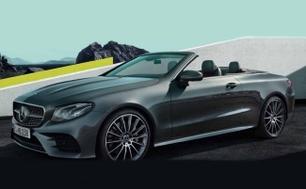
Elegance. That's the word that springs to mind when you first clamp eyes on the E400 Cabriolet. While the Coupe version has a crouched-over sportiness about its exterior design, the convertible is all about big and boat-like proportions, especially with the fabric roof opened.
Like nearly all drop-tops, the E400 looks best with the cabin open to the elements, and the side profile especially paints a picture of well-heeled wafting, with only the AMG alloys and body styling hinting at the performance on offer under the bonnet.
Inside, expect perfectly executed modern luxury, with soft leather seats, touchpoints that melt under the fingers and a sprinkling of woodgrain trim. All of which feel like old-world luxury, nicely juxtaposed by the huge twin-screen display that dominates the dash.
Front and rear passengers enjoy plenty of space. Storage includes a not-quite-big-enough-for-a-phone tray ahead of the rotary dial gear selector and a pair of cupholders. Those in the rear have plenty of space, except for the middle seat occupant who must straddle a stout transmission tunnel. The rear armrest holds a pair of cupholders and the doors have slim pockets.
The boot holds 565 litres with the seats in place and "up to" 1700 litres with the seats down - that latter figure does not feel like a VDA number.
It's a two-door, four-seat convertible, so practicality isn't at the very top of its list of strengths.
That said, life is peachy for upfront riders, both of whom will travel in spacious luxury. There are two cupholders hidden beneath a woodgrain cover underneath the climate controls - also home to a power outlet - as well as a clever double-hinged central storage bin that can be opened by either the passenger or driver, and which opens to reveal two USB points.
There's room in the doors for bottles, too, and the entertainment system can be controlled via a touchpad controller mounted above the traditional click wheel - although, to be honest, using it is harder and more time consuming than simply pretending it doesn't exist.
Climbing into the back (and we mean climb - there are no rear doors) is made easier by the fact you can fold and slide the front seats automatically by pulling a lever mounted near the headrest. Once there, though, you'll find space is a little tighter, and you feel weirdly cocooned, owing to the huge raised tunnel that runs through the middle of the cabin, and the low roof line.
There are two cupholders that live in the space where the middle seat would normally go, and there's a little bottle-holder cubby to the left of both backseat riders. There are air vents back there, too, but no temperature controls.
The front doors are huge and really very heavy, requiring considerable heft to open them.
The boot space is predictably a little limited, with 385 litres on offer. There's also a little flip-down separator, which shows you how much room the roof will need to come down, reducing boot space to 310 litres. Speaking of which, the soft-top can be lowered in just 20 seconds, and at speeds up to 50km/h.
One practicality quirk, though. The front (and only) doors are huge and really very heavy, requiring considerable heft to open them, especially if you're parked on a slight angle. Honestly, I was reduced to kind of pushing them open with my foot at times.
Over the years the XF has edged its way upmarket and is now playing with the Germans in the big luxury segment. And as is now customary for Jaguar, the Sportbrake is available in First Edition guise. First Editions are available for a model's first year of production and are usually based on the top-spec (in the Sportbrake's case, that's the 30d S) with a few extra bits and pieces to make things interesting.
While the 30d S retails for $123,450, the FE weighs in at $137,300. For that you'll waft out of the showroom with 19-inch alloys, dual-zone climate control, a huge panoramic glass roof with gesture-activated roof blind, around-view camera, front and rear parking sensors, 11-speaker Meridian-branded stereo with DAB, sat nav, head-up display, electric gesture-activated tailgate, keyless entry and start, rear air suspension, auto LED headlights, auto wipers, leather trim and a space-saver spare.
Jaguar Land Rover's 'InControl' media system is presented on a whopping 12.3-inch screen and, as ever, is steadily improving but goes without Apple CarPlay and Android Auto. The sound is, as you might expect, pretty good.
Our car had a few options fitted. 'Active Safety Pack' (see below), carbon-fibre trim ($3470), driver and passenger memory pack ($3210, including perforated leather trim), 20-inch wheels upgrade ($2790), cold-climate pack ($2540), illuminated metal treadplates ($2110), privacy glass ($950), 'InControl Protect' ($630), configurable interior lighting ($540), nets and rails ($390 and $320 respectively), extra power socket ($240) and 'InControl Apps' ($100). Most of it is cosmetic and/or unnecessary and took us to $158,950.
And there is still a plethora of boxes to tick.
At $157,400, the Cabriolet is the most expensive model in the E400 family, and is roughly $20k more than the sedan and $10k more than the coupe variants.
That money buys you a comprehensively kitted-out ride - as it really should - with the E400 Cabriolet arriving with 20-inch AMG alloys, LED headlights (made up of 84 LEDs) with high-beam assist, proximity unlocking with push-button start, air suspension and Merc's AIRCAP - a lip above the windscreen that's designed to push air up and over the cabin when the roof is down.
Inside, you'll find leather seats, dual-zone climate control and the clever 'AirScarf' system, which pumps hot air onto your neck when the roof is down (and it's cold out). You'll also nab heated front seats, power windows front and back and an automatic belt feeder, which saves you reaching over your shoulder to get to your seatbelt. So exhausting.
On the tech front, expect a killer 590W, 13-speaker Burmester stereo, controlled by the seriously impressive widescreen cockpit; two 12.3-inch screens that spill from about the centre of the dash all the way to the driver's binnacle, and control everything from navigation to Apple CarPlay and Android Auto.
There's a whole bunch of safety stuff, including semi-autonomous technology, but we'll drill down on that under the Safety sub-heading.
The First Edition ships with Jaguar's 3.0-litre twin-turbo diesel V6. Good for 221kW and a prodigious 700Nm, power heads to the rear wheels via an eight-speed ZF automatic.
With all that power and torque, the XF Sportbrake cracks 100km/h from rest in 6.6 seconds.
The air suspension means you can tow up to 2000kg with a braked trailer.
It's a fabulous engine, this twin-turbocharged V6 - even if it doesn't feel quite so lively in Cabriolet form as it does in the hardtop equivalents.
The 3.0-litre unit produces 245kW/480Nm, sending it to all four wheels via a nine-speed automatic transmission, linked to the standard 4Matic all-wheel drive system.
Jaguar claims a combined-cycle figure of 5.9L/100km. Our time with it was mostly shuttling around the suburbs with a couple of highway runs and we managed a respectable 8.3L/100km.
Mercedes claims 7.4L/100km on the combined cycle (but you can expect to be pushing nine litres in real-world conditions), with emissions pegged at 170g per kilometre of CO2.
The 66-litre tank will only accepts 95RON fuel.
There's no getting away from the size and heft of the Sportbrake. Where a four-cylinder sedan comes in under 1600kg - not bad for an almost five-metre-long car - up here at the top it's well over 1800kg. With big wheels and a long wheelbase it's not going to win any wards for manoeuvrability, with a big turning circle and a length that's challenging to shopping centre car parks.
The 3.0 V6 twin-turbo is a fantastic unit. It can be a bit noisy when cold but it's super smooth and with all that torque it crushes overtaking with little need for advanced planning. The Sportbrake wafts along, lazily turning over in traffic and keeping the vibe calm.
Despite those big wheels, the ride is excellent. Even when in Sport mode, it's a rare bump or surface that will cause drama. It's very comfortable and very quiet, almost to the level of the XJ limo.
If you do fancy a bit of amusement, the V6 and well-sorted chassis are ready to play. In reality, Sport mode is where both myself and my wife left the car the whole time we had it. Both of us found the steering a little too light and preferred the more lively throttle response. The XF features torque vectoring using the brakes and coupled with a well-judged stability and traction control system, it delivers a good impression of a sporty sedan.
But the XF is best when you keep it relaxed. Both in town and in the cruise, it's a lovely, quiet place to be and a relaxing, undemanding drive.
Only a couple of things were annoying - the light steering we've already covered. The heated windscreen was more reflection-prone so the head-up display could be hard to see in some lighting conditions. And sometimes it beeped for no apparent reason, which I eventually traced to the blind-spot warning.
Sure, the E400 Cabriolet can drive itself, but we’re equally pleased to note that it’s still a lot more fun handling the steering duties yourself.
And that is mostly due to that fabulous engine; quiet and effortless at city speeds, rorty and enthusiastic at pace, and genuinely angry with the drive setting switched to their most hardcore Sport+ mode.
We’ve already spent time in the sedan version, and while this Cabriolet is heavier (1935kg vs 1820kg) and slightly slower to 100km/h (5.5sec vs 5.2sec) it doesn’t immediately feel it behind the wheel, with a similar and satisfying lurch into the future when you plant your foot.
But hard charging is not what this car is about, and the E 400 is at its peachy best when rolling about the city or the ‘burbs with the top down, and the warm summer air washing through the cabin.
In its normal drive settings, the steering is light but engaged, and the ride on offer from the standard air suspension is outstanding, cosseting the cabin from all but the very worst road imperfections, while the torque from the V6 serves up effortless, unobtrusive acceleration.
With the roof up, Merc’s designers have done a stellar job of hiding the fact this thing is a convertible at all. It’s a solid-feeling cabin with the fabric roof fastened, and the cabin is quiet and free from wind noise.
The XF comes with six airbags, ABS, stability and traction controls, forward AEB, reversing camera, lane-departure warning, and tyre-pressure monitoring.
For child seats you've a choice of three top-tether anchors or two ISOFIX points.
Our car had the $4360 Active Safety Pack, which adds blind-spot monitoring, reverse cross traffic alert, lane-keep assist, adaptive cruise and driver-attention detection. If you were to ask me, this little lot should be standard at this level.
Despite that, the XF scored a maximum five ANCAP stars following assessment in 2015.
There are few cars on the road as overloaded with safety technology as the E400 Cabriolet.
The standard stuff is all there, of course. There's a 360-degree parking camera, as well as nine airbags (dual front, dual pelvic/thorax for front-seat passengers, dual sidebags for rear passengers, dual head bags in the doors and a knee airbag for the driver), rollover protection and tyre-pressure monitoring, as well as braking and traction aids.
But the E400 adds some really clever technology, including Merc's Driving Assistance Package Plus, which adds active lane keeping, blind-spot assist, cross-traffic alert and evasive steering assist.
It's this suite of systems that allows the E400 to navigate freeways autonomously, including changing lanes on demand. At the moment, the system will warn you to keep your hands on the wheel every so often, but you can sense a time when that will no longer be required. And that time is soon.
The E-Class range scored the maximum five-star ANCAP safety rating when crash tested in 2016.
Jaguars are offered with a three-year/100,000km warranty with a matching roadside-assist package. You can purchase a five-year/130,000km service plan for an oddly reasonable $2200. Even more reasonable are the service intervals - 12 months or 26,000km (!).
Expect the usual three-year, unlimited-kilometre warranty, with service intervals pegged at 12 months or 25,000km. Mercedes' capped-price servicing scheme limits maintenance costs to $2280 for the first three years of ownership.