What's the difference?
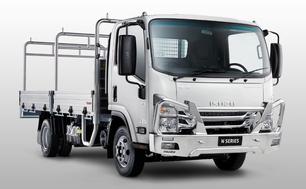
Isuzu’s N-Series of light trucks is really doing the business in Australia. In fact, the whole Isuzu Trucks brand is dominating the market here, with almost one in every two rigid trucks sold here bearing the Isuzu badge, cementing the brand’s 33-year run of holding top spot on the sales ladder.
The N-Series has been a large part of that, and now, with an upgrade to include new safety features, the N-Series is closer than ever to being a real alternative to other light commercials including dual-cab utes and vans.
We’ve looked at the range of N-Series trucks here that are able to be driven on a normal car license. That means a Gross Vehicle Mass (GVM) of up to 4500kg (although the N-Series includes vehicles up to 8700kg GVM) and includes layouts including narrow and wide cabin, crew-cab and 4x2 and 4x4 variants.
There are currently 14 rivals competing for customers in the Light Duty or LD (3501-8000kg GVM) segment of Australia’s heavy commercial vehicle market. Business buyers and fleet operators are thick on the ground here and competition for their business is fierce.
Chinese brand LDV, a division of the huge SAIC Motor conglomerate which is now the seventh largest automotive company in the world, recently joined this battle with its new Deliver 9 van range that’s priced to entice. We spent a week aboard one to see how LDV’s claim of superior value stacks up when there’s work to be done.
Driving a truck of this size has never been easier than it is with these new Isuzus. Once you’ve worked out how to judge gaps in traffic and have acclimatised to the bulk of a light truck, it’s all pretty straight-forward.
The greater levels of connectivity and safety in this generation of trucks is a big leap on the OH and S front, and there’s no trade-off in terms of the traditional practicalities trucks like these offer.
Our advice would be to option up the suspension driver’s seat and, where possible, look into the independent front suspension, too, as this gives the vehicle a more car-like feel in terms of both steering and ride quality.
Meantime, the option of the ready-to-work packages makes the whole idea of getting into a light truck all the more simple, fuss-free and financially attractive. Which are all things fleet managers around the world can agree on.
Note: CarsGuide attended this event as a guest of the manufacturer, with meals provided.
It has its flaws, like any vehicle, but it’s not as far away from segment leaders in terms of refinement and performance that its bargain-basement pricing might suggest. Whichever way you look at it, this is a lot of van for not a lot of money.
While it’s generally agreed that trucks trail cars and utes in terms of safety and connectivity, the latest N-Series trucks are aimed at reversing that trend. Lots of active safety gear has been added to the N-Series in the most recent upgrade and that’s led to a much safer vehicle.
The ability to connect Apple CarPlay and Android devices is also a major bonus this time around.
The other element unique to Isuzu is the ability for customers to order a fully-finished truck, rather than order the basic package from the truck manufacturer and then finding a third-party supplier for the body they need.
Isuzu calls it its ready-to-work option and it spans various types of bodies including a service body, conventional drop-side tray, enclosed van and even a tipper body. As an off-the-shelf alternative to the traditional way of ordering and specifying a truck, it’s a surprise nobody else has done it, although Isuzu’s volumes definitely play a part.
If imitation is the greatest form of flattery then Ford should be blushing, because the Deliver 9 appears to draw a lot of exterior design inspiration from the Transit van. It’s a substantial vehicle, as they tend to be in this weight division, with a 3750mm wheelbase and 14.2 metre turning circle, length of almost 6.0 metres (5940mm) and width of 2466mm. Its 2535mm height excludes it from underground and shopping centre carparks with typical height limits of 2.2 metres.
The rear-wheel drive chassis construction is simple and robust, with MacPherson strut front suspension, multi-leaf live axle rear suspension with supplementary rubber cones to boost support of heavy loads, rack and pinion steering and four-wheel disc brakes. There’s also ample use of hard-wearing black plastic on lower body sections where most scrapes and dents appear.
The cargo bay is accessed by one kerbside sliding door and dual rear-barn doors with 180-degree opening. The walls are lined to mid-height and there’s no roof lining. Bright LEDs provide ample lighting and even though our test vehicle was not the high-roof model, there was enough headroom for tall adults to stand without stooping.
The cabin has a spacious and airy feel, even with a crew of three aboard, thanks largely to a banana-shaped dashboard with ends that curve towards the windscreen providing wide entry access and passenger legroom which is unusually generous for a commercial van.
The cabin has higher-grade look than you would expect at this price, with a tasteful two-tone blend of light/dark grey plastics and faux carbon fibre inserts on the dash along with comfortable, supportive seats with quality-feel fabrics.
However, there is room for improvement, as there’s no cargo protection for driver and passengers, no driver’s left footrest, crackly AM radio reception (too bad if you like talkback) and a poor-quality image projected by the reversing camera.
Because they’re made to work first and foremost, the cabins of these 4.5-tonne trucks are roomy and offer plenty of storage space for clipboards, receipt books, Eskies and more.
As a workspace rather than simple transport, plenty of thought has gone into how they function for an eight-hour shift, too, and options like suspension driver’s seats will make a difference.
They’re a bit of a climb up, though, so getting in and out requires at least some measure of dexterity. But once you are in, the view through that huge, panoramic windscreen is fabulous and if you like the seat-height advantage of an SUV, you’ll love an N-Series truck.
Beyond that, the quality of the interior plastics still trails the car and ute world by a margin, and the hard plastic surfaces aren’t great to look at or engage with. By trucks standards, though, they’re on the money.
Its 2358kg kerb weight and 4000kg GVM leaves a competitive maximum payload of 1642kg. It’s also rated to tow up to 2800kg of braked trailer but given the GCM figure (or how much you can legally carry and tow at the same time) is not published, we can’t tell you how much payload it can legally carry while towing that weight.
We struck a similar problem testing a G10 LDV van as far back as 2017, when LDV could not provide the GCM despite a direct approach to the factory in China. Why such a fundamental figure must remain secret is a mystery to us and could be a deal-breaker if you need to tow and carry.
The cargo bay offers a competitive 10.97 cubic metres of load volume. Its load floor’s 3413mm length, 1800mm width and 1366mm between wheel housings means it can easily carry two 1165mm-square Aussie pallets or up to four 1200 x 800mm Euro pallets, held in place by a choice of eight sturdy load anchorage points. There’s also a small cave above the cabin which is ideal for carrying straps, ropes, load padding, tarps etc.
There’s more than ample cabin storage too, with large-bottle holders and two levels of storage in each front door, numerous nooks of different shapes and sizes across the dashboard including a driver’s cup holder, plus a single glove-box and large overhead storage shelf with central sunglasses holder.
Pivoting the two passenger seat base cushions forward reveals another big storage area beneath them. The centre seat backrest also folds down to reveal a handy work desk on the back if it, which includes two cup holders. Overall, there’s smart use of space here.
Trucks don’t necessarily represent huge value in technology terms, but when it comes to actual metal for the money, they claw back a bit of ground.
Isuzu’s 4.5-tonne GVM N-Series units start at $63,193 for the NSR 45-150 in ready-to-work Traypack form and fitted with the automatic transmission option. You can spend less by buying a bare cab-chassis version of the same truck which starts at $55,676 with the manual transmission.
At the other end of the 4.5-tonne GVM range sits the NPR 45-150 Servicepack which gets you the comprehensive service body, automatic transmission and bigger, 5.2-litre engine for a total of $103,691. In between those two extremes lie the rest of the range including every ready-to-work body, and transmission and engine options.
The big news this time around has been the addition of the active safety features detailed elsewhere in this review.
But for the end user, the bigger news will perhaps be the move to make Isuzu’s CoPilot touchscreen standard across all N-Series trucks.
With smart-phone mirroring, the 10.1-inch screen offers the chance to use Apple and Android apps as well as providing 32Gb of storage space, digital radio and interfacing with the reversing camera, sensors and four analogue cameras around the vehicle. Wireless phone charging is another new-to-N-Series feature.
Our test vehicle is the long wheelbase mid-roof, which is part of a three-model Deliver 9 range offering mixed wheelbase and roof height combinations. According to local distributor Ateco, the van’s unusual name has no real significance beyond the fact that in China it’s sold as the V90, so given Volvo’s existing V90 nomenclature, LDV changed the name to Deliver 9 in export markets.
Available only with a 2.0 litre turbo-diesel engine, the standard transmission is a six-speed manual or there’s the optional six-speed automatic like our test vehicle, which has an RRP of $44,726. Needless to say, that’s a massive saving compared to top-selling van rivals like the Ford Transit 350L LWB RWD auto at $54,090 and Mercedes-Benz Sprinter 314 CDI LWB RWD auto at $66,240.
Colour choice is limited to Blanc White or Pacific Blue. It comes equipped with 16-inch steel wheels and 235/65R16C tyres with a full-size spare, plus checker-plate-pattern rubber flooring throughout, LED cargo bay lighting, big truck-style power adjustable and heated side mirrors with indicators, seating for three including an eight-way adjustable driver’s seat with fold-down inboard armrest and an multimedia system with big 10.1-inch touchscreen, two USB ports and Apple CarPlay (but no Android Auto) to name a few. There’s even a rare and endangered cigarette lighter and ashtray.
LDV also offers a $1500 options pack which adds 236-degree rear door opening (except mid-wheelbase model), blind-spot monitoring, lane-change assist and remote keyless entry with push button start.
The base engine for the N-Series trucks is a 3.0-litre turbo-diesel with 110kW of power and 375Nm of torque. Available across the short and mid-wheelbase N-Series models, the 3.0-litre engine is more or less the same engine as seen in the Isuzu D-Max ute range.
As such, it has a good reputation for durability and although there are some turbocharger and tuning changes compared with the D-Max, the basic engine is very similar.
There’s also a much more heavy-duty, truck-like engine option. That is also a four-cylinder unit, but with a massive 5.2 litres of capacity, it’s a real statement of intent. Although power is only marginally more than the 3.0-litre engine, at 114kW, torque is the big winner with 419Nm at just 1600rpm.
Typically fitted to N-Series models with the wider cabin, the 5.2-litre engine also shifts the GCM up a gear to 9000kg from 8000kg. The braked towing limit of the bigger-engined truck also jumps to 4500kg (from 4000kg).
The 3.0L trucks are fitted with either a conventional five-speed manual gearbox or a robotised six-speed manual (which operates like an automatic and is driven with just two pedals). The bigger engined versions have a choice of six-speed manual or six-speed robotised manual.
LDV’s Euro 5-compliant 2.0-litre four-cylinder turbo-diesel produces 110kW at 3500rpm and 375Nm between 1500-2400rpm, which is adequate but not class-leading. It also offers a choice of Eco and Power driving modes and auto stop/start.
The six-speed torque converter automatic is smooth-shifting and easy to use. It also has the option of sequential manual-shifting which can be handy at times when hauling heavy loads, particularly in hilly terrain to save the transmission from continually hunting for gears.
The first thing to know is that vehicles in this weight class – unlike passenger cars and dual-cab utes - don’t have to undergo an official government test for fuel economy. So there’s no simple comparison to be made here.
Also, there are simply too many variables in truck fuel economy to make definitive statements. Unlike cars which are usually loaded to within a few hundred kilograms trip-to-trip, a truck’s mass can vary enormously from empty to fully loaded (and with what) and those circumstances will vary nearly every day.
Then there’s the issue of what body is fitted to the chassis. Obviously, a high van body will contribute a lot more drag at highway speeds than a low-line tray body.
With all that in mind, it’s impossible to generalise although you can expect fuel economy to increase the more you put on board or hitch to the tow-bar.
It’s also worth mentioning that Isuzu’s N-Series engines meet Euro 5 emissions standard for diesel engines. N-Series trucks have fuel tanks ranging from 75 to 100 litres.
The dash display was showing an average combined figure of 11.0L/100km at the end of our 290km test, with the auto start/stop function disabled and about a third of that distance hauling maximum payload. Our figure crunched from fuel bowser and tripmeter came in at 12L/100km, so you could expect a real-world driving range of around 660km from its 80-litre tank.
Although the sheer size of the Isuzu can be a bit daunting at first, once you’re in with the excellent side mirrors adjusted, it’s vastly less confronting.
The view to the front and sides is brilliant thanks to the deep glass and the high-and-mighty seating position is terrific for finding the corners of the vehicle, too.
You still need to understand that the length of the truck imposes some unconventional lines through corners, and leaving plenty of space between yourself and the insides of corners soon becomes second nature.
The seating position itself offers up a classic truck-like set-up with an upright seat-back and an almost flat steering wheel. It sounds terrible to car drivers but it’s not. It’s actually very comfortable for long stints at the helm.
Ride quality is compromised to an extent by the N-Series’ role as a hauler (and spring rates to suit that role) but the optional independent front suspension makes it a lot more comfy.
And even with the more traditional front suspension fitted, the fast steering makes the truck a lot more manoeuvrable than you might have imagined.
The biggest gripe for us was the transmission, specifically, the optional robotised manual six-speed. This unit really does hark back to the very early days of the technology (before the dual-clutch layout arrived) and the shifts are slow and stilted with a distinct lurch as the transmission swaps gears and engages the clutch.
You can improve things by lifting off the accelerator to initiate each shift, but fundamentally, modern dual-clutch transmissions do a much better job.
The other issue will be for drivers who like to left-foot brake in any vehicle with two pedals.
Unfortunately for them, the Isuzu places both pedals to the right of the big, almost vertical steering column with neatly cleaves the driver’s footwell in two, making left-foot braking impossible.
It’s pleasantly civilised to drive unladen, even on bumpy roads. With rock-hard tyre pressures (front 51psi, rear 71psi) recommended for load-carrying, the unladen ride remained disciplined and relatively smooth, so LDV has done a good job with the suspension tuning.
We were also pleasantly surprised by the low internal noise levels, not only in city and suburban driving but also at highway speeds. We can only assume that the load floor’s thick rubber flooring, which also covers the rear wheel housings, is effective in reducing the higher noise levels typically experienced in vans without cabin bulkheads like this one.
There are clear eye-lines to the door mirrors and the view through the rear doors using the central mirror is also uncluttered. There’s evenly-balanced elbow support for the driver between the fold-down inboard armrest and door moulding. However, we did miss having a left footrest.
With maximum torque available across a broad band between 1600-2400rpm, the engine displays good flexibility in city and suburban driving, even though it lacks the instant punch of rivals like the Transit’s stellar 2.0 litre EcoBoost engine when operating in its peak torque zone. The engine only needs 2000rpm at 100km/h and 2250rpm at 110km/h, but the degree of push required on the accelerator pedal to maintain it feels like it’s punching above its weight a little in either drive mode.
Our only major gripe is the adaptive cruise control. Usually these systems will automatically resume their pre-set speed, after being given clear road ahead following a lane change from behind a slower vehicle. However, our test vehicle required tapping the accelerator each time a lane change was made to resume the set speed. It also required this reset technique after downhill braking, so some refinement here would be welcome.
It’s generally agreed that trucks have, traditionally, been one or two generations behind passenger cars when it comes to safety equipment and technology.
That kind of changes now, and the N-Series (and other Isuzu models) features a whole raft of active and passive safety features that brings the light truck up to the standard of many road cars.
The newest tech is Isuzu’s ADAS (Advanced Driver Assistance Systems) which incorporates tech such as autonomous emergency braking, lane-departure warning, traffic movement warning, distance warning and stability control. A stereo camera system combined with a radar unit is at the heart of the technology.
Other safety tech includes traction control, ABS brakes, speed limiter, hill-start assist, automatic lighting, driver and front passenger airbags and seat belt pretensioners.
What’s missing? Mainly side airbags and curtain air-bags for rear-seat passengers in the crew-cab models. Overall, though, the N-Series is setting new benchmarks for light-truck safety, acknowledging OH and S concerns across the industry.
There’s no ANCAP required in the 3501-800kg GVM class but it comes well equipped for the money with AEB, lane-departure warning, reverse parking sensors and wide-view reversing camera, hill-hold assist, adaptive cruise control and stability control. There’s also driver and passenger front, side and curtain airbags. No cross-traffic alert but blind-spot monitoring and lane-change assist are available as part of the previously mentioned options pack.
Because trucks are designed to be used day in, day out, the warranty reflects that. In this case, it’s six years and 250,000km of factory cover for any two-wheel drive N-Series.
The four-wheel-drive variants are, due to the tasks they’re usually put to, covered for three years or 150,000km.
Isuzu also provides six years of roadside assistance. There’s also capped-price servicing on a pay-up-front basis although the cost varies between models.
LDV’s national network of 82 dealers inspires more confidence than the three years/160,000km warranty, which is less than the major players – but then its purchase price is much lower too. Scheduled servicing is six months/5000km then 12 months/35,000km whichever occurs first and 12 months/30,000km after that. Capped-price servicing program of $1895 covers the first three years or 95,000km whichever occurs first.