What's the difference?
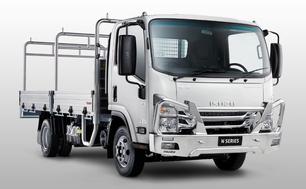
Isuzu’s N-Series of light trucks is really doing the business in Australia. In fact, the whole Isuzu Trucks brand is dominating the market here, with almost one in every two rigid trucks sold here bearing the Isuzu badge, cementing the brand’s 33-year run of holding top spot on the sales ladder.
The N-Series has been a large part of that, and now, with an upgrade to include new safety features, the N-Series is closer than ever to being a real alternative to other light commercials including dual-cab utes and vans.
We’ve looked at the range of N-Series trucks here that are able to be driven on a normal car license. That means a Gross Vehicle Mass (GVM) of up to 4500kg (although the N-Series includes vehicles up to 8700kg GVM) and includes layouts including narrow and wide cabin, crew-cab and 4x2 and 4x4 variants.
If you believe there should be a ute version of everything, Jeep has long been there for you with a tray-backed Gladiator version of its iconic Wrangler off-roader.
But the Gladiator has hardly attracted the same love as its mainstream ute rivals, preferring a more lifestyle-oriented vibe, which it leans into extra hard for this 2026 update.
While it might look pretty much identical from the outside, Jeep has made some pretty significant changes underneath to make it a better overall offering, with a nice reduction in price, too.
So is it now worth your consideration? Read on to find out.
Driving a truck of this size has never been easier than it is with these new Isuzus. Once you’ve worked out how to judge gaps in traffic and have acclimatised to the bulk of a light truck, it’s all pretty straight-forward.
The greater levels of connectivity and safety in this generation of trucks is a big leap on the OH and S front, and there’s no trade-off in terms of the traditional practicalities trucks like these offer.
Our advice would be to option up the suspension driver’s seat and, where possible, look into the independent front suspension, too, as this gives the vehicle a more car-like feel in terms of both steering and ride quality.
Meantime, the option of the ready-to-work packages makes the whole idea of getting into a light truck all the more simple, fuss-free and financially attractive. Which are all things fleet managers around the world can agree on.
Note: CarsGuide attended this event as a guest of the manufacturer, with meals provided.
The Gladiator is far from the most practical, versatile, or sensible dual-cab on the market. Not going to lie, though. This is the most fun I’ve had in a ute in a long time.
While it’s generally agreed that trucks trail cars and utes in terms of safety and connectivity, the latest N-Series trucks are aimed at reversing that trend. Lots of active safety gear has been added to the N-Series in the most recent upgrade and that’s led to a much safer vehicle.
The ability to connect Apple CarPlay and Android devices is also a major bonus this time around.
The other element unique to Isuzu is the ability for customers to order a fully-finished truck, rather than order the basic package from the truck manufacturer and then finding a third-party supplier for the body they need.
Isuzu calls it its ready-to-work option and it spans various types of bodies including a service body, conventional drop-side tray, enclosed van and even a tipper body. As an off-the-shelf alternative to the traditional way of ordering and specifying a truck, it’s a surprise nobody else has done it, although Isuzu’s volumes definitely play a part.
Despite a legion of trendy retro-styled off-road pretenders, from the Ineos Grenadier to the GWM Tank 300, there’s nothing quite like the original Jeep style which the Gladiator shares with its Wrangler sibling. Unless you’re Mahindra which has technically been producing Willys Jeep successors for longer, but that’s another story for another time).
The new Rubicon looks a bit more swish in 2026, with the body coloured wheel arches and a tweaked grille which is now wider and shorter. The two-tone roof which was previously optional is now standard.
It looks rugged, tough, and undeniably classic, with the mud terrain tyres sealing the deal.
Of course, you can’t forget the many so-called ‘Easter eggs’ Jeep hides about the place. In the case of the Gladiator, these include a silhouette of a Willys Jeep climbing up the driver’s side windscreen, a gorilla imprint on the opposite side signifying the windscreen is now constructed from the same stuff designed to make your phone scratch-free. The tray features imprints of dirtbike tyres where you might want to strap two in and even the recirculate button on the climate unit is in the shape of a Wrangler. Nice touch.
On the inside generally, it feels like a purpose-built vehicle in much the same way as an old Defender. It leaves you with a sense of how genuine it all is, with loads of physical switchgear and an overall shape meant to replicate the no-nonsense appeal of Jeeps dating back to the Willys.
Because they’re made to work first and foremost, the cabins of these 4.5-tonne trucks are roomy and offer plenty of storage space for clipboards, receipt books, Eskies and more.
As a workspace rather than simple transport, plenty of thought has gone into how they function for an eight-hour shift, too, and options like suspension driver’s seats will make a difference.
They’re a bit of a climb up, though, so getting in and out requires at least some measure of dexterity. But once you are in, the view through that huge, panoramic windscreen is fabulous and if you like the seat-height advantage of an SUV, you’ll love an N-Series truck.
Beyond that, the quality of the interior plastics still trails the car and ute world by a margin, and the hard plastic surfaces aren’t great to look at or engage with. By trucks standards, though, they’re on the money.
However, also like an old Defender, the Gladiator’s interior is full of compromises to maintain its iconic design.
The seating position is awkwardly high, which is fine when off-roading, but can be limiting when you’re just driving around a city, and the footwell is half taken up by a transmission tunnel so there’s nowhere to rest your foot.
The door cards are pretty basic because the doors are removable (although Jeep stresses this is only legal on private property), but elsewhere there’s much-appreciated levels of functionality in an era of touch-based controls.
The centre control panel, for example, features physical dials for high-use functions and toggles or buttons for everything else. It’s mercifully easy to use and old-school motorists will also love the physical shifters for gear selection and the transfer case alongside. And an analogue handbrake is an increasingly rare sight.
There are even buttons we didn’t ask for, like the four pre-wired auxiliary switches, and while the dash trades away a fully digital panel for a digital supervision screen with analogue dials either side, it suits the character of the car.
It’s not the most comfortable space to be in, however. Not only is the seat base super high off the ground, but despite the Gladiator’s imposing dimensions the front seat somehow feels narrow.
Storage is okay, but not on the same level as many rival utes. The basic doors score nettings on each side, with two deep and useful bottle holders in the centre console. The armrest box is two-tiered which is handy, and there’s a small glove box. Outside of this, there’s not a lot of storage up front.
The rear seat is decent when it comes to space for the ute segment, although it is also very high off the ground and hard to clamber into thanks to the way the rear door is shaped. Once you’re in there, be sure not to smack your head on the frame, which seems like it could be an easy thing to do.
Again, nets feature in the doors, with two more nets on the backs of the front seats, which also feature luggage hooks. There are dual adjustable air vents back there and two bottle holders moulded out of the centre console. They're nicely-sized, but will eat into the legroom of any adult you want to put in the centre rear position, making it extra cramped if you have three across.
The back seat features some things I’ve never seen before, though. There’s a huge storage area underneath the seats with its own lid, and some limited storage space behind the seat backs which features a removable Bluetooth speaker which also automatically re-charges when it’s docked back there. Cool.
The rear window features an opening port, which is also rare, while all the main storage compartments are lockable for when you want to leave the car with the roof and/or doors off.
Capacities and payloads have never been a strong point for the Gladiator. The tray measures 1531mm long, 1443mm wide and 1137mm between the arches, making it unable to fit a standard-sized Australian pallet. The payload is also limited at just 693kg, far short of the close-to-one-tonne many work-focused dual-cabs can hit.
However the tray isn’t for show only, featuring an array of useful tie-down points and a built-in rail system to help secure all sorts of objects. There are even steps built into the rear bumper design for easier access and a full-size spare wheel underneath.
The braked trailer towing capacity is limited to just 2721kg which is also short of the industry benchmark 3500kg, all of which may limit its use as a work vehicle, or even its appeal as a touring vehicle. I could see how these capacities are easily exceeded with a rooftop tent, recovery gear, a fridge, supplies and at least one passenger.
Trucks don’t necessarily represent huge value in technology terms, but when it comes to actual metal for the money, they claw back a bit of ground.
Isuzu’s 4.5-tonne GVM N-Series units start at $63,193 for the NSR 45-150 in ready-to-work Traypack form and fitted with the automatic transmission option. You can spend less by buying a bare cab-chassis version of the same truck which starts at $55,676 with the manual transmission.
At the other end of the 4.5-tonne GVM range sits the NPR 45-150 Servicepack which gets you the comprehensive service body, automatic transmission and bigger, 5.2-litre engine for a total of $103,691. In between those two extremes lie the rest of the range including every ready-to-work body, and transmission and engine options.
The big news this time around has been the addition of the active safety features detailed elsewhere in this review.
But for the end user, the bigger news will perhaps be the move to make Isuzu’s CoPilot touchscreen standard across all N-Series trucks.
With smart-phone mirroring, the 10.1-inch screen offers the chance to use Apple and Android apps as well as providing 32Gb of storage space, digital radio and interfacing with the reversing camera, sensors and four analogue cameras around the vehicle. Wireless phone charging is another new-to-N-Series feature.
For this update, the Gladiator has been trimmed down to just one variant, the fully-loaded, top-spec Rubicon.
While the lesser Night Eagle grade has been discontinued, the good news is the Rubicon is now more affordable, starting at $82,990, before on-road costs. Although this still pitches it against only the most expensive mainstream dual cabs.
At this price, for example, you could pick a Ford Ranger in luxury Platinum or sporty Wildtrak form, or even as a plug-in hybrid. However, this car’s classic vibe and purpose-built feel, with a big six-cylinder petrol engine, is more reminiscent of the Ineos Grenadier Quartermaster, which wears a price tag well in excess of $100,000.
While it might be a pricey ute, the Gladiator Rubicon comes with all the gear plus extra stuff for this update, including new 17-inch two-tone wheel designs clad in pricey BF Goodrich mud terrain tyres, Nappa leather seats and a more powerful standard alternator with pre-wired auxiliary switches.
There are also body-coloured fender flares replacing the previous black plastic ones, 12-way power adjust and heating for the front seats, extended soft-touch materials throughout the cabin, a much larger and better-specified 12.3-inch multimedia touchscreen (with built-in nav) as well as wireless Apple CarPlay and Android Auto connectivity. In addition, the LED headlights have picked up an auto high-beam function and the spray-in bedliner for the tray is now standard.
Standard overlanding kit includes the brand’s signature 'Roc-Trac' on-demand 4x4 system, which includes front and rear differential locks, an electronic sway bar disconnect (pretty rare), manually selectable low-range gearing (with a 4:1 ratio), as well as additional underbody protection and rock-slider side steps.
Not enough? This is the only ute on sale in Australia where you can remove the roof and pop the windscreen flat for a full-on Barbie (or maybe Ken) Power Wheels vibe.
The base engine for the N-Series trucks is a 3.0-litre turbo-diesel with 110kW of power and 375Nm of torque. Available across the short and mid-wheelbase N-Series models, the 3.0-litre engine is more or less the same engine as seen in the Isuzu D-Max ute range.
As such, it has a good reputation for durability and although there are some turbocharger and tuning changes compared with the D-Max, the basic engine is very similar.
There’s also a much more heavy-duty, truck-like engine option. That is also a four-cylinder unit, but with a massive 5.2 litres of capacity, it’s a real statement of intent. Although power is only marginally more than the 3.0-litre engine, at 114kW, torque is the big winner with 419Nm at just 1600rpm.
Typically fitted to N-Series models with the wider cabin, the 5.2-litre engine also shifts the GCM up a gear to 9000kg from 8000kg. The braked towing limit of the bigger-engined truck also jumps to 4500kg (from 4000kg).
The 3.0L trucks are fitted with either a conventional five-speed manual gearbox or a robotised six-speed manual (which operates like an automatic and is driven with just two pedals). The bigger engined versions have a choice of six-speed manual or six-speed robotised manual.
There’s a relatively massive 3.6-litre non-turbo, non-hybrid ‘Pentastar’ petrol V6 engine under the bonnet, producing 209kW/347Nm.
Sounds old-school because it is, and it remains the only option for this machine in Australia despite emissions regulations closing in and a 2.0-litre four-cylinder turbocharged engine available in the current Wrangler and overseas versions of the Gladiator.
The V6 is mated to a predictable ZF-sourced eight-speed (torque converter) automatic transmission and drives either the rear- or all four wheels depending on the mode selected.
The first thing to know is that vehicles in this weight class – unlike passenger cars and dual-cab utes - don’t have to undergo an official government test for fuel economy. So there’s no simple comparison to be made here.
Also, there are simply too many variables in truck fuel economy to make definitive statements. Unlike cars which are usually loaded to within a few hundred kilograms trip-to-trip, a truck’s mass can vary enormously from empty to fully loaded (and with what) and those circumstances will vary nearly every day.
Then there’s the issue of what body is fitted to the chassis. Obviously, a high van body will contribute a lot more drag at highway speeds than a low-line tray body.
With all that in mind, it’s impossible to generalise although you can expect fuel economy to increase the more you put on board or hitch to the tow-bar.
It’s also worth mentioning that Isuzu’s N-Series engines meet Euro 5 emissions standard for diesel engines. N-Series trucks have fuel tanks ranging from 75 to 100 litres.
As you might imagine, the large naturally aspirated petrol engine combines with the over 2.0-tonne Gladiator to make for a relatively steep fuel bill.
Consumption is a hardly-impressive 12.4L/100km on the official combined (urban/extra-urban) cycle, with our car consuming even more - 12.9L/100km - on our three day test covering nearly 500km and with no shortage of freeway time either.
Brim the 83-litre tank and theoretical range is around 670km, dropping to just over 640km using our on-test figure.
Although the sheer size of the Isuzu can be a bit daunting at first, once you’re in with the excellent side mirrors adjusted, it’s vastly less confronting.
The view to the front and sides is brilliant thanks to the deep glass and the high-and-mighty seating position is terrific for finding the corners of the vehicle, too.
You still need to understand that the length of the truck imposes some unconventional lines through corners, and leaving plenty of space between yourself and the insides of corners soon becomes second nature.
The seating position itself offers up a classic truck-like set-up with an upright seat-back and an almost flat steering wheel. It sounds terrible to car drivers but it’s not. It’s actually very comfortable for long stints at the helm.
Ride quality is compromised to an extent by the N-Series’ role as a hauler (and spring rates to suit that role) but the optional independent front suspension makes it a lot more comfy.
And even with the more traditional front suspension fitted, the fast steering makes the truck a lot more manoeuvrable than you might have imagined.
The biggest gripe for us was the transmission, specifically, the optional robotised manual six-speed. This unit really does hark back to the very early days of the technology (before the dual-clutch layout arrived) and the shifts are slow and stilted with a distinct lurch as the transmission swaps gears and engages the clutch.
You can improve things by lifting off the accelerator to initiate each shift, but fundamentally, modern dual-clutch transmissions do a much better job.
The other issue will be for drivers who like to left-foot brake in any vehicle with two pedals.
Unfortunately for them, the Isuzu places both pedals to the right of the big, almost vertical steering column with neatly cleaves the driver’s footwell in two, making left-foot braking impossible.
The Gladiator is interesting to drive for many reasons. Mainly, because as a purpose-built off-roader it's a little compromised when it comes to on-road manners.
For example, the high seating position and tapered bonnet shape might be great for visibility off-road, but the boxy design of the chunky A-pillars (designed to keep the car in one piece when the doors roof and windscreen are removed) make it a little difficult to see properly around corners at T-junctions or roundabouts in the confines of a city.
Even proximity of my head to the roof presented a problem when trying to see whether traffic was coming at an intersection with the vehicle angled downhill.
The next alarming trait is how vague the steering is while on the tarmac. It’s an unfortunate characteristic of the Gladiator’s rugged live front axle, making this ute a bit of a handful to steer at low speeds. And it tracks all over the place on the freeway, requiring constant vigilance and steering input from the driver at higher speeds.
It’s also noisy, despite this 2026 version featuring extended sound deadening in the cabin. It needed it. The knobbly mud terrain tyres make their presence felt through a resonant droning entering the cabin at all speeds.
Then, at freeway pace, the wind noise from the Gladiator’s blocky shape picks up. You can feel the sound waves leaking in through the removable doors and plasticky removable roof. There are even silly things like being able to feel reverberations of the sound system through the accelerator pedal.
So, I should hate the Gladiator, right?
Wrong.
This thing is ridiculous amounts of old-fashioned fun. The V6 engine is keen to rev and the transmission lets you ride the gears out, creating a throaty roar and lurching acceleration reminiscent of old Commodores.
While the mud terrain rubber is noisy and offers questionable levels of grip on tarmac or in the wet, the thick sidewall combines with coil springs and chunky Tenneco shock absorbers all-around to make for a pretty decent ride for a ladder-frame vehicle.
In addition, we took the Gladiator for a quick off-highway jaunt as its design intends and it performed as-expected. It has great approach and departure angles, with good visibility for peering over moguls and into ruts or dips.
The mechanical hardware feels up to the task, and while it might slip once or twice as the less sophisticated traction systems (compared to, say, a modern Defender) find their bearings, the Gladiator ate up the moderately challenging trails we found for it.
The chunky tyres come into their own, with the sidewall offering confidence, and the car clambers about with relative ease. Obviously, the enormous 3488mm wheelbase and resulting 18.4-degree breakover angle are the Gladiator’s Achilles heel, making me think twice about cresting certain hills or objects, and making this ute particularly prone to cringe-inducing underbody scraping.
Still, despite its comparatively unsophisticated approach and lack of environmental responsibility the Gladiator is a huge amount of fun to drive.
It’s generally agreed that trucks have, traditionally, been one or two generations behind passenger cars when it comes to safety equipment and technology.
That kind of changes now, and the N-Series (and other Isuzu models) features a whole raft of active and passive safety features that brings the light truck up to the standard of many road cars.
The newest tech is Isuzu’s ADAS (Advanced Driver Assistance Systems) which incorporates tech such as autonomous emergency braking, lane-departure warning, traffic movement warning, distance warning and stability control. A stereo camera system combined with a radar unit is at the heart of the technology.
Other safety tech includes traction control, ABS brakes, speed limiter, hill-start assist, automatic lighting, driver and front passenger airbags and seat belt pretensioners.
What’s missing? Mainly side airbags and curtain air-bags for rear-seat passengers in the crew-cab models. Overall, though, the N-Series is setting new benchmarks for light-truck safety, acknowledging OH and S concerns across the industry.
The previous Gladiator was awarded just a three- out of five-star ANCAP safety rating in 2019, although this updated version gets a few notable upgrades including side curtain airbags, seat reminder alerts and auto high beams.
On the modern active safety equipment front, the new Gladiator scores auto emergency braking, blind spot monitoring with rear cross-traffic alert, adaptive cruise control, roll mitigation as well as front and rear parking sensors and a halfway decent reversing camera.
Not present is lane departure warning or lane keep assist, and given how long the Gladiator is, it would be nice to have a front parking camera, too.
It’s disappointing to see the Gladiator miss key kit like lane keep assist, but unlike a lot of modern vehicles, the Gladiator isn’t annoying to drive and I didn’t find myself needing to turn any equipment off to make it work off-road, either.
Because trucks are designed to be used day in, day out, the warranty reflects that. In this case, it’s six years and 250,000km of factory cover for any two-wheel drive N-Series.
The four-wheel-drive variants are, due to the tasks they’re usually put to, covered for three years or 150,000km.
Isuzu also provides six years of roadside assistance. There’s also capped-price servicing on a pay-up-front basis although the cost varies between models.
It’s no secret ownership has long been an awkward topic for Jeep, with models like the Grand Cherokee previously causing all kinds of dramas for owners. A quick scan of forums suggests the Wrangler and Gladiator are less prone to issues compared to their more mainstream siblings in the Jeep line-up. So, food for thought.
Regardless, the Gladiator is offered with a five-year warranty which is distance-limited to just 100,000km, which is well off the pace, although a five-year capped price servicing pack is priced at a reasonable $399 per annual or 12,000km workshop visit.
The brand also offers lifetime roadside assist so long as you continue to service your Jeep in its authorised dealer network.