What's the difference?
Anybody who doubts that Hyundai is gunning for the number one in the world has rocks in their head. Big heavy ones. Korean companies do not settle for anything less than number one. The second-generation Genesis (our first taste here in the Antipodes as the gen-one had its steering wheel on the wrong side) is proof.
What's different about Hyundai's unstoppable rise is the way they're going about it. They've always done their own thing in Korea, reinventing themselves time and again when they strayed off the beaten path.
The Genesis is a gamble for a Korean company in foreign markets whose default setting for luxury is marked, Britain or Germany. If Hyundai gets the Genesis wrong there will be howls of derision, or at best patronising pats on the back - "Nice try, you'll get there one day". But if they get it right...
Citroen is a brand in a state of flux as it, once again, finds itself fighting to find a distinct identity from its Peugeot sister brand under its new Stellantis parent company.
It’s also had a shocker of a year in Australia, racking up just over 100 sales in 2021, but the brand is promising new beginnings, and a new crossover-y identity as it heads into 2022.
Leading the charge is the new-generation C4, which has morphed from a funky hatchback to a funkier SUV-like shape that it hopes will set it apart from related cars like the Peugeot 2008.
Other Citroens are set to follow in its footsteps in the immediate future, so is the Gallic marque onto something? We took the new C4 for a week to find out.
The Genesis is not quite a match for cars twice its price but it makes you think what's possible. It doesn't have the dynamic brilliance of a BMW or the self-assured faultless execution of a Mercedes. Lexus ought to be worried, though - why would you have an LS when you could have this? The only answer is 'badge'.
The Genesis is an epoch-making car for the Korean manufacturer. As the company has got better, there are fewer excuses for overlooking it. While the Genesis is pitched into a shrinking market, it's not really meant for the average i30 buyer to buy, but to see.
It's bristling with tech and is not only a halo car but a shot across the bows of both Lexus and the Germans. Attached to that shot is a note: "We're coming for you." In other words, Hyundai got it right.
It’s weird, wonderful and fun, in more ways that one. I think every segment could use an oddball alternative like the C4. Citroen has successfully transformed it from a hatch to a small SUV with a difference. It’s not going to be for everyone – few Citroens are – but those who are willing to take a chance will be rewarded with a surprisingly competitive little package that stands apart from the crowd.
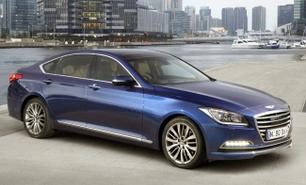
The Genesis is like no other Hyundai. For a start, it's gigantic - it looks easily as big as a BMW 7 Series (it isn't) with the road presence to match. There's a lot of BMW from most directions, but with a sharper approach to the creasing and character of the sheet metal.
Towards the rear it's more BMW 6 Series Gran Coupe and is all the better for it. The style is understated and technocratic.
Inside is also very Germanic, but with a bit more of a Lexus feel
The big wheels from the Ultimate pack help make it look lower and sleeker, too.
Inside is also very Germanic, but with a bit more of a Lexus feel. Our car had the lighter leather which meant that the wood and the metal materials didn't necessarily work well together.
The interior is expertly put together and feels like it will last forever.
The only jarring moment is the gear selector is shared with our long-term Hyundai i30 - it looked a bit cheap in what is otherwise a beautifully executed cabin - it needs more heft.
On Australian-delivered cars there is just one Hyundai badge, sitting proudly on the boot - you get the feeling this was debated long and hard and when the decision was made to go for it, a big one was chosen.
However, the winged Genesis branding takes pride of place everywhere else. When you approach the car at night and the puddle lamps come on, the Genesis logo is projected on to the ground, crisp and clear.
It’s really hard to stand out in Australia’s busy marketplace, especially in this small SUV space, where there doesn’t really seem to be as much of a design rulebook as there is in other segments.
Rooflines are wildly different, as are beltines and light profiles. While some may decry the fall of the hatchback to these more high-riding options, at least some of them are bringing fresh design ideas to the car world.
Our C4 is a great example. An SUV perhaps in profile only, it sports a slinky descending roofline, tall, contoured bonnet, a frowny-face LED profile, and characterful plastic claddings, which are a continuation of Citroen’s ‘Airbump’ elements, which gave cars like the previous-generation C4 Cactus such a unique look.
The rear is this car’s most confronting angle, with a post-modern approach to the light profile, and in reference to C4s past, a spoiler integrated into the rear tailgate.
It looks cool, contemporary, and I think is successful in its aim to blend the sporty elements from the hatch world with the sought-after high-riding elements of an SUV.
It certainly caught a few eyeballs in my time with it, and if nothing else, a bit of attention is something the Citroen brand desperately needs.
In the past you could rely on this brand to give you a funky interior, but one that sadly also came with its fair share of sub-par plastics and strange ergonomic. So I’m pleased to report that the new C4 dips into the better looking and feeling Stellantis parts catalogue for a still interesting yet more coherent experience this time around.
The modern look and feel of this car continues with interesting seat designs, a high-riding dash with a higher degree of digitization than before, and improved ergonomic features (even over some notable Peugeots). We’ll talk more about those in the practicality section, but the C4 feels as weird and different from behind the wheel as you’d hope , with an odd dash profile, a fun and minimalist steering yoke, and attention-to-detail elements, like a detail strip that runs through the door trims and across the seats.
These elements are welcome and help separate this Citroen from its Peugeot siblings. It will need this going forward, as it also now shares much of its switchgear and screens with its sister brand.
This is largely a good thing, with the 10-inch screen looking and feeling good and slotting into this car’s design nicely.
The only way to describe the Genesis' pricing is aggressive - kicking off at $60,000, it's the most expensive Hyundai money can buy, but with a spec list like this, you won't feel at all short-changed.
Your sixty large buys you a huge cabin with a seventeen speaker stereo, auto headlights and wipers, LED ambient lighting inside and out, dual-zone climate control, keyless entry and start, powered front seats which are heated and cooled, satnav, front and rear parking sensors, and plenty of other bits and pieces.
Our car had the $22,000 Ultimate package, adding 19-inch alloys, blind spot sensor, front and side cameras, around-view display, real leather, more adjustments for the driver's seat, ventilated seats in the front, heated rear seats, panoramic glass sunroof, acoustic glass, heads-up display, powered bootlid and LED foglamps.
The Genesis is like no other Hyundai
You can have a lot of the more useful features in the $11,000 Sensory Pack. It's a good middle ground that, for example, features the excellent heads-up display.
The 9.2-inch screen splits the asymmetric air-conditioning vents. The software is unique to the Genesis and a huge leap forward over the rest of the Hyundai range - classy, smooth graphics, a good responsive screen.
You control the seventeen speaker stereo from here, which kicks out a rich sound and an impressive Bluetooth performance - rear seat passengers can also run the stereo from their armrest. The satnav is detailed and chatty, while the excellent heads-up display shows a configurable information set in strong, clear graphics.
In recent memory, Citroen’s offerings (the smaller C3 hatch in particular) have decidedly missed the mark on value. It’s not enough to be a niche player in Australia anymore – we have too many brands for that - so Citroen has had to have a re-think of its pricing strategy.
The resulting C4 that launches in Australia comes in a single, highly specified trim level, at a price that is remarkably competitive for its segment.
Wearing an MSRP of $37,990, the C4 Shine is positioned to compete with rivals like the Subaru XV (2.0i-S $37,290), Toyota C-HR (Koba hybrid - $37,665), and equally funky Mazda MX-30 (G20e Touring - $36,490).
For the asking price you also get the full list of available equipment, including 18-inch alloys, full LED exterior lighting, a 10-inch multimedia touchscreen with wired Apple CarPlay and Android Auto connectivity, built-in navigation, a 5.5-inch digital dash cluster, a head-up display, dual-zone climate, full synthetic leather interior trim, and a top-down parking camera. This leaves only a sunroof ($1490) and metallic paint options (everything but white - $690) as available extras.
The Citroen also packs some unusual items that represent surprising value – the front seats have a massage function and are stuffed with a very nice memory foam material, while the suspension system packs a set of hydraulic dampers to iron out the ride.
While the C4 faces tough competition in the small SUV segment, I think it represents pretty solid value at the price, so long as you’re chasing a virtue like comfort over hybridisation. More on that later.
The Genesis is powered by Hyundai's own 3.8-litre V6 developing 232kW and 397Nm, mated to Hyundai's eight-speed automatic transmission.
Despite weighing just under two tonnes, the Genesis completes the dash to 100km/h in 6.5 seconds.
It has a claimed 11.2L/100km on the combined cycle. In what must be a first, we got below that, averaging 10.8L/100km over two weeks. And that's without stop-start fuel-saving to blunt the effect of lot of city driving.
The Genesis is not going to tempt you into a track day, even with rear wheel drive
We'd still like to try the V8 - only available in left-hand drive markets - though.
The C4’s single trim level has a single engine, and it’s a good one; a peppy 1.2-litre three-cylinder turbo.
It appears elsewhere in the Stellantis catalogue and has been refreshed for the 2022 model year with a new turbo and other small refinements. In the C4 it produces 114kW/240Nm and drives the front wheels via an Aisin-sourced eight-speed torque converter automatic transmission.
No dual-clutches or CVTs to be found here. This sounds good to me, but is it good to drive? You’ll have to read on to find out.
At five metres long, with a ride firmly pitched in the luxury camp, the Genesis is not going to tempt you into a track day, even with rear wheel drive.
Blindfold your passengers and swap them between a Lexus, a BMW and a Genesis and the overwhelming impression they'll get is one of incredible smoothness.
If you're wanting sudden movements, this isn't the car for you
Sitting in the back of the Genesis, it's easily as good as the German and luxury Japanese competition. The seats are hugely comfortable, there's ample head, leg and shoulder room and it feels lot nicer than anything within a bull's roar of its price.
No matter where you sit, it's an incredibly quiet car. The engine is a distant whoosh, the tyre noise muted and there's almost no wind or ambient noise. It's supremely comfortable and the excellent stereo will wash away what little noise does invade.
It certainly feels its weight from the driver's seat, with a competent, soft turn-in, but if you're wanting sudden movements, this isn't the car for you.
The Genesis is an epoch-making car for the Korean manufacturer
On fast flowing roads you can have some fun, but things will get floaty and that will quickly kill that fun. The ride and isolation from the rest of the world is completely worth it.
Driving the C4 is an interesting experience because it approaches the road a little differently from most of its rivals.
It really leans into Citroen’s newfound comfort-focused niche with the seating and suspension. This results in an overall experience that is a bit unique in the market, and quite pleasant, too.
The ride really is quite good. It’s not a fully hydraulic system but has dual-stage dampers that essentially smooth out corrugations and much of the nasty stuff that comes into contact with the tyres.
It’s odd because you can hear the big alloys crashing about on the road, but ultimately you feel little of it in the cabin. What’s more impressive is Citroen has managed to imbue the C4 with this floating-on-the-road feeling, while maintaining enough of a ‘real’ driving position to make it feel like you’re sitting in the car and not on it.
The overall result is impressive. The comfort extends to the seats, as mentioned, which really do still feel floaty and supportive even after hours on the road. It also extends to the steering, which has a very light tune. This is a bit unsettling at first, as it feels like it has a large dead-zone in the centre, but it is also speed dependent, so once you’re cruising it regains a significant amount of feel. You can also manually bring back a bit of firmness by setting this car to its Sport drive mode, which is unusually good.
This means you can have an ease of operation in tight quarters while maintaining enough feel to make it fun to drive when you need to ask more of it. Clever.
Speaking of fun, the revised 1.2-litre three-pot is a hoot. It has a distant but entertaining gruff tone under pressure, and surges forward with just enough urgency to not leave you really wanting for power.
It’s not what I would call quick, but it has a raucous attitude paired with a well-behaved torque converter auto to make it truly entertaining. When you push it, there’s a moment of turbo lag followed by a lump of torque, which the transmission lets you ride out before decisively snapping into the next gear. I like it.
Again, it's not quick, but it punches just enough above its weight to leave you with a smile when you stick your boot in. To have that in a car otherwise so focused on comfort is an unexpected pleasure.
The dash cluster could use some work, as could visibility out of the cabin. The small aperture out the rear and tall dash line could leave some drivers feeling a bit claustrophobic. While the engine is fun to engage with, the turbo lag could potentially be a source for annoyance at times, too.
Brief negatives aside, I think the C4's drive experience really brings something unique, fun, and comfortable to the small SUV space.
Nine airbags, traction and stability control, lane departure warning, forward collision control, ABS, brake force assist and distribution and traction and stability control bring the ANCAP count to five stars.
The Sensory and Ultimate packs add blind spot sensors and around view cameras.
There's not such a good story to tell here. While the C4 comes with today’s expected suite of active-safety items, it just fell short of a five-star ANCAP rating, scoring just four stars upon its launch.
Active items on the C4 Shine include auto emergency braking, lane-keep assist with lane-departure warning, blind-spot monitoring, adaptive cruise control, and driver-attention alert.
Some active items are notably missing, like rear cross traffic alert, rear auto braking, and more cutting-edge items like junction alert for the AEB system.
What cost this car its five-star rating? ANCAP says the lack of a centre airbag contributed, but the C4 also fell short on protection for vulnerable road users in the event of a collision, and its AEB system also had marginal night-time performance.