What's the difference?
Honda's Jazz is like the little engine that could.
It occupies a shrinking part of the market but has seen off a bevy of once-were competitors (most notably the Hyundai i20) and continues to battle gamely with the Mazda2.
Honda gave the range a little tweak in late 2017 to hand us the MY18 Honda Jazz. Some features were lost, and a few gained in an effort to keep up with Mazda's finest.
By God, but hasn't Lexus come an awfully long way from what was undeniably a drab and dull past? The Japanese premium brand now routinely pumps out cars that are not just fun to drive, but are even *gasp* fun to look at, too.
And should you trace the genesis of all this new-found excitement, you'll find it was the Lexus RC that started it all. That car, unveiled at the Tokyo Auto Show in 2013, was an early sign that Lexus was going to start pushing the envelope with its passenger cars.
The two-door, four-seat RC has just been updated for 2018, with added technology, safety kit and even a particularly un-Lexus launch-control system in the most powerful models.
High time we took a closer look then, no?
The Honda Jazz is an extremely capable small car, with an ace card of virtually unbeatable interior space. While it's hardly an excitement machine, or the best looking or equipped in its class (it is missing out on some useful safety gear), the Jazz deserves its status as a well-loved hatchback.
The best in the range is probably the VTi. There isn't anything compelling further up the variants unless you're keen on bigger wheels or leather trim. Its entry-level offering is a good-value, sturdy car that is packed with its best qualities, no matter which one you buy.
Still a rock-solid option in the (admittedly not massive) premium-coupe space, the Lexus RC looks and feels like a quality product. The 2018 update has addressed any safety shortcomings, even if the interior technology still feels a touch behind the times.
But an out-and-out performance car this ain't. Even in cars fitted with the big V8 engine, the RC behaves more like an effortless grand tourer than it does a performance coupe. But if we're being really honest with each other, that only serves to make it much easier to live with.
The Jazz's exterior design is instantly recognisable. The shape has been roughly the same since the car's 2002 debut, with the mildest evolution over the years. The 2018 Jazz leads with the chin a bit, with a pronounced underbite and when fitted with a chrome grille, it looks a bit like the giant Jaws from James Bond after whacking his head.
Apart from that, the slimmed headlights and one-box body shape are almost entirely inoffensive, save for the chunky, stacked rear lights.
When you head inside it's a simple, basic interior. Well put together, it's easy to find your way around and, because there isn't much happening in here, it's unlikely you'll need the owner's manual, unless you want to identify and use every single deployment of the excellent Magic Seats in the back.
As you climb the range, you'll start to see body-kit additions like a rear spoiler and side skirts, but nothing particularly racy.
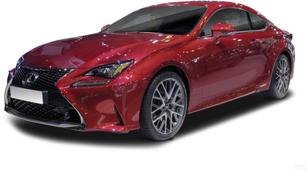
Yes, yes - eye of the beholder and all that business. But for mine, the RC looks terrific. We cycled through two models, the RC350 and the performance-focused F Sport, and both cut a fine and athletic figure on the road.
Front on, the pincered grille dominates the view, sweeping back into bonnet, and stretching to the lowest corners of the front end, while a flared-lip body kit runs the length of the body. Special mention also goes to the cat-claw swipes that live behind the rear wheels.
The regular RC models make do with twin exhaust tips, while the F Sport range scores quad pipes, separated by a slinky rear diffuser, and the rear spoiler is an integrated lip that forms part of the boot. Cooler still, the Carbon Edition adds lightweight elements, like a carbon-fibre roof panel and an active rear wing - with about 6.6kg shaved off the kerb weight.
Climb inside, and you'll find a quality - if slightly dated interior - with soft leather seats, carbon-effect trim elements and a new, 10.3-inch screen in the centre of the dash.
As you can see from our interior photos, though, some elements do now feel a little behind the times. The door panels feel harder than I'd like, almost as if a thin-piece of leather has been stretched over hard plastic, and the control unit in the middle of the cabin is awash with hard black plastic, and the knobs mounted on it feel a touch cheap and non-premium, too.
The interior is full of cleverness packed into a small space. The centre console has two cup holders, a space for your phone and a compartmentalised open tray reachable by both front and rear-seat passengers. A third cupholder folds out of the dash on the driver's side. The back seat doesn't have any cupholders, unfortunately, and nor is there a centre armrest.
Rear legroom is impressive for such a small car - it's no wonder the HR-V compact SUV was spun off the Jazz platform. Added to that are the excellent 'Magic Seats', which fold in a variety of ways to increase the boot space dimensions from 354 litres to 1314 litres.
Luggage capacity is not bad for such a small car and with the flexible interior, the boot size goes up by four times in volume. This is one area in which it really does outdo the Mazda2. The removable cargo cover means you can get a decent chest of drawers in, however there's a bit of a drop once you get things over the loading lip.
You can also fold the seat bases up and out of the way to provide space for shrubbery, or a dog, or an awkward flat pack.
The basic VTi misses out on a bit of storage, namely the centre console storage box and driver's side seatback pocket, but the rest of the range has them both.
Now look, if you see a future filled with trips to Bunnings or ferrying the troops to soccer training, the RC is not for you. It's a two-door, four-seat coupe - and those two rear seats couldn't be less helpful for adult-sized humans if they'd been painted on.
Its dimensions measure 4695mm in length, 1840mm in width and 1395mm in height, but most of that space is focused on the front-seat riders, where your surrounds feel sporty-snug, but not claustrophobic.
Up front, that cursed mousepad control system is still in full flight, but the screen it controls is now bigger. There are two cupholders to be shared between front-seat folks, as well as the usual compliment of USB and 'aux' connections. And even a CD player, for that matter.
Climb into the back, which is no easy task in and of itself, and you'll find the space cramped for anyone but kids. But while it's tiny, it's clever. Deep cut-outs in the rear of the front seats mean more room for your legs. Headroom, however, is a problem, and my (I'm 176cm) head was touching the roof.
There are two cupholders, at least, but - surprisingly - little in the way of entertainment connections. You will find an ISOFIX attachment point in both of the rear seats.
The boot opens to reveal a fixed 423 litres of space, which is handy enough for weekends away. Predictably, though, extra practical accessories are fairly limited - you can forget optional roof racks.
The Jazz range is made up of three models. As with any car, how much you get is dependent on how far up the price list you go. Honda occasionaly offers drive-away deals, but we're using RRP as a guide. We've done an exhaustive model comparison as well as snapshots to help you decide between the three trim levels - VTi, VTi-S and VTi-L.
Our American cousins score a Sport edition, but sadly we miss out on that one.
The VTi opens the price range at $14,990 for the five-speed manual, rising to $16,990 for the CVT auto. Standard features include a four-speaker stereo, air-conditioning, reverse camera, remote central locking, projector style halogen headlights, 15-inch steel wheels, cruise control power windows and mirrors, black cloth trim, trip computer and hill-start assist.
The inclusion of the reversing camera is good but the lack of rear parking sensors is mystifying, a problem shared with the VTi-S, although they are optional on both specifications.
While the spare tyre is a space-saver, it's better than a tyre-repair kit, should trouble strike. A small tool kit is also supplied for just such an occasion.
Even with the 2018 update, there is no Apple CarPlay or Android Auto, although you can plug in your iPhone or Android device via the USB port. Irritatingly, the USB port is under a cover next to the 7.0-inch touchscreen itself, so you have a cable poking out of the dashboard. You might prefer Bluetooth in that case.
Step up to the CVT-only VTi-S ($19,990) and you pick up foglights, 16-inch alloy wheels, LED headlights, 'premium' cloth trim, leather-wrapped steering wheel, a centre console with storage box and GPS sat nav.
There is no improvement to the multimedia system.
The VTi-L ($22,990) adds LED daytime running lights, climate control, navigation system (hooray!), smart key keyless entry, push-button start, leather seats, paddle shift for the CVT gearbox, an alarm, bi-LED headlights, LED daytime running lights, heated front seats and two extra speakers,
Missing from the accessories list are a CD changer, DVD player, DAB or MP3, panoramic sunroof, sport pack, black pack, city pack, subwoofer, improved sound system, HID headlights, tonneau cover, roof rack, different rims and even floor mats.
You're stuck with the same infotainment head unit right across the range - its not even a radio/CD player arrangement, just radio and your phone. At least the VTi-L has more speakers for its sound system.
Dealers will no doubt sell you darker tinted windows and an extended warranty.
The Jazz is available in seven colours, with Rally Red the only freebie. For $495 you can have one of six shades of mettallic paint - Crystal Black, Brilliant Sporty Blue, Modern steel (gunmetal grey), Phoenix Orange, Lunar Silver and White Orchid. If you're after pink or yellow, you're out of luck. Not very Jazzy.
As it is with most of the Lexus range, the RC model comparison is pretty straightforward. You need to pick your engine (300 or 350) and then choose your trim level (how much you want to pay), be it Luxury, F Sport or Sports Luxury. Only the RC F model line differs, because here you can choose from the base RC F trim, or the more expensive RC F Carbon.
Engine and kit aside, the RC family is the same basic set-up; four seats, two doors and coupe styling. The rest, then, depends on your intended price range.
Entry-level Luxury cars - $65,400 for the 300, $68,400 for the 350 - arrive with 18-inch alloy wheels, LED headlights and fog lights, leather trim, standard navigation, heated and ventilated front seats, dual-zone climate and keyless entry with push-button start.
Step up to the F Sport Trim - $74,700 for the 300, $77,700 for the 350 - and you'll get bigger 19-inch alloys, a better Mark Levinson stereo and rain-sensing wipers.
Finally, the Sports Luxury models - $84,900 for the 300, $87,900 for the 350 - get better seats, some fancier cabin furniture and a moonroof. All the RC models get a new 10.3-inch screen (but no Apple Car Play/Android Auto).
Step up to the the V8-powered RC F models - $138,100 for the base model, $152,300 for the RC F Carbon - and you'll add adaptive variable suspension and an improved safety package that we'll come back to under the Safety sub-heading. The Carbon variant - predictably - gets a carbon-fibre roof panel, active rear wing and some carbon-fibre interior trim elements.
On the colour palette, the regular RC range is available in 'Sonic Quartz' (white), 'Mercury Grey', 'Premium Silver', 'Sonic Titanium' (another silver), 'Onyx' (black), 'Graphite Black' and 'Infrared' (red). The performance-flavoured RC F cars nab some extra choices, including 'Cobalt Mica' (blue), 'Lava Mica' (orange) and the brand's new hero colour, 'Zinnia Yellow'.
A moonroof (or sunroof) is standard fit on the RC F models, as well as the Sports Luxury trim, while it's a cost option on the cheaper cars. Speaking of which, you'll find all sorts of goodies in the accessories catalogue, including unique floor mats.
Each price listed is the RRP, of course, so you'll be paying more in on-road expenses. But you knew that already, right?
All Jazzes are powered by Honda's 1.5-litre single-cam four-cylinder. The engine specs don't make for inspiring reading, with just 88kW and 145Nm. That's not a lot of horsepower, but when you consider the weight of the car, the figures don't look so weedy.
Power goes to the front wheels, so the Jazz is definitely not an off-road proposition.
Only the base model VTi has a choice of manual vs automatic, with a five-speed manual transmission and a CVT auto to choose from.
As to the question of timing belt or chain, the Jazz has the latter, so you don't have to worry about a belt change. The oil type is 5W-30
There is no diesel option, so there'll be no diesel vs petrol argument. Nor is there an EV or plug-in hybrid - with a battery, it's unlikely you'd have much boot space left. There isn't an LPG, 4x4, or AWD version either.
If you can be bothered fitting a towbar, the manual's towing capacity is 1000kg braked while the CVT's load capacity drops to 850kg. Both transmissions will haul 450kg unbraked.
The more you spend, the more you get. Spring for the 300, and you'll find a 2.0-litre turbo engine nestled under the bonnet, good for 180kW at 5800rpm and 350Nm at 1650rpm. It pairs with an eight-speed automatic, and shuffles power to the rear wheels.
Step up to the 350-badged cars and your engine specs improve accordingly. You'll now find a 3.5-litre V6 motor providing the horsepower, good for 232kW at 6400rpm and 380Nm at 4800rpm. The gearbox (eight-speed auto) remains the same, and the power is still sent to the rear axle.
The pick of the power bunch, though, is the 5.0-litre V8 engine nestled in the RC F cars. It'll fire 351kW at 7100rpm and 530Nm at 4800rpm toward the rear wheels - more than enough to shift the 1820kg (tare) weight. It's paired with an eight-speed automatic, or what the Lexus spec sheet refers to as a "Sports Automatic".
There is no AWD or manual transmission option anywhere in the range, and for specific oil type etc, consult your owner's manual.
Fuel figures are slightly different, depending on the gearbox you've chosen. Honda claims you'll get 6.5L/100km on the combined cycle in a manual while the CVT uses a bit less, coming in at 5.9L/100km. So fuel consumption km/L works out at about 15km/L for the five speed and 17.km/L in the CVT.
Real-world consumption is a little different, however. Our most recent test with the manual yielded 8.0L/100km while the CVT chugged down 8.2L/100km. Having said that, you'll see better fuel economy figures in the manual if, as I admitted in my VTi review, you don't drive it enthusiastically. The CVT was a bit disappointing because I was a lot more sedate in that one and it didn't deliver better mileage than the manual.
Fuel-tank capacity is 40 litres.
Let's start from the top, shall we? There is a price to pay for power, and the V8-powered Lexus arrives with its claimed 10.9L/100km on the combined cycle. That's quite a lot, and it's a number that will surely only worsen if you drive the RC F the way that you really should drive it.
Things improve with the 3.5-litre capacity engine, recording 9.1L/100km on the same cycle, while the 2.0-litre engine will return 7.3L/100km.
There is no diesel engine anywhere in the range, and the fuel-tank capacity across the board is 66 litres, with 95RON fuel required.
The Jazz has always been a comfortable, easygoing car with performance figures to match. Its 0-100km/h acceleration is best described as leisurely, so if it's speed your after, this car isn't for you.
That said, the manual VTi is terrific fun to drive. Switch to the CVT, however, and the Jazz's reputation is restored. A good ride for front-seat passengers comes from McPherson struts up front while the rear suspension is by torsion beams, meaning rear-seat occupants can get a few shocks over bumps.
Road noise is a little higher than you might expect, but that's probably a combination of tyres and a commitment to lightness.
Obviously, being such a small car, manouverability is a key advantage. The turning radius is 5.2m, which is good but not super tight and the light, electric power steering makes dodging about easy. It certainly doesn't feel like it's on rails, but that's hardly what a car with a such a small engine size is about.
Ground clearance is 137mm, which is reasonable but jumping gutters is not advised.
In the base manual, you have a five-speed with a light clutch and an easy shift. For a motor missing out on a second cam, let alone a turbo, progress is swift rather than exciting, the engine droning away with a relaxed air. The CVT has an eco mode, which further blunts performance, but a ring of light around speedo glows green if you're behaving yourself.
Having now spent a fair chunk of time behind the wheel of the V6 and V8-powered cars, we're ready to make a pretty bold claim: the six-cylinder engine is - and there's no other way to put it - simply more fun.
Shocking, I know, but there it is. There's effortless power on offer in the RC F models, of course, but it's the way that power is delivered that makes it feel like more of a loping grand tourer than a fire-breathing performance coupe.
For one, both the power and exhaust notes arrive in stages. So if you're gentle with the throttle - like you almost always are in the CBD or suburbs - it wafts around in near silence, the engine feeling anaesthetised, and like it's only using a tiny proportion of its available oomph.
The V6 engine just feels sportier. It's still not super emotional, but I think it reacts to inputs quicker.
Leave your foot buried, however, and the character transforms, the exhaust booming into life and that big V8 finally unlocking its prodigious power. With the adaptive dampers (no air suspension) set to the sportiest setting, it sits flat in corners, with nary a roll through the body. And while there isn't an intimate connection with the road below, nor masses of feedback through the steering, it does acquit itself well on the bends.
But... the V6 engine just feels sportier. It's still not super emotional, but I think it reacts to inputs quicker, and comes alive a little lower in the rev range than the big V8. It doesn't really matter if you're in Normal, Sport or Sport+, it just feels more vibrant. Hell, you can even get the traction light flashing if you're particularly silly with the accelerator.
And as such, it's our pick of the bunch. Sure, it can't match the outright performance of the V8, nor the speed of its 0-100km/h acceleration time, but it puts a bigger smile on your face in normal, day-to-day driving. And let's face it, that'll be 90 per cent of the time you spend behind the wheel.
The safety specifications include six airbags, ABS, stability and traction controls, brake assist and brake-force distribution. The Jazz was awarded a five-star ANCAP safety rating in January 2015.
Baby car seat security is offered with either three top-tether anchors but there are no ISOFIX points.
Missing is the more comprehensive safety equipment of its key rival, the Mazda2, which has forward AEB as standard, and its mid-range adds reverse AEB and at the top of the range scores reverse cross traffic alert and blind -spot monitoring. The airbag count is competitive, however.
Standard safety across the RC includes dual front and front-side airbags, as well as front airbags for the second row. You'll also find a knee airbag for both driver and front-seat passenger. Forward-collision warning with AEB (and pedestrian protection) is standard fit, too, and so are front and rear parking sensors and a parking camera.
F Sport and Sports Luxury-badged cars add blind-spot monitoring and rear cross-traffic alert, along with lane-departure warning and lane-keep assist. The RC F and RC F Carbon both get radar cruise control and an active lane-departure system included in the standard offering.
The Lexus RC range is yet to be crash-tested by ANCAP, and so is yet to receive an Australian safety rating.
Honda's standard five year/unlimited kilometre warranty also comes with capped-price servicing for the first five years or 10 services, whichever comes first. Service intervals are every 10,000km or six months.
Up to 30,000km you won't have any extras but once you hit 40,000km you'll have to do the brake fluid, which is a reaonable $144 extra. Your service cost structure is otherwise simple - $259 for odd numbers and $297 for even.
Many people ask where the Honda Jazz is built, and the answer to that is "not Japan", or in Honda's Thailand plant.
Second-hand values appear strong, with around 60 percent of value retained after three years. Resale value is something of a Honda strength, which is probably to do with a lack of high-profile reliability issues.
A dip into the usual internet forums yields little in the way of common faults, problems, complaints or issues for the Jazz. Some look for automatic transmission problems, others for manual gearbox problems, but the current Jazz seems quite clear of defects in Australian-delivered cars.
The RC range is covered by a four-year/100,000km warranty, with service intervals pegged at 12 months/15000km. There is no capped-price servicing program on offer, but Lexus will guarantee you a loan car every time your vehicle is in the shop, and will even come to your house or workplace to collect - and drop-off - your car.
For any owner-reported reliability problems, keep and eye on our Lexus ownership page.