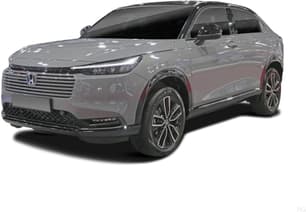
What's the difference?
Like many car brands, Honda is storming the hybrid field. The new HR-V brings with it a hybrid powertrain and external facelift but is it enough to keep it competitive in the small SUV segment?
As with any cosmetic surgery you may wonder whether the facelift has been successful.
No tricks – I’ll tell you straight up the new external design might be what you’re looking for if you’re on the hunt for a small SUV that doesn’t look like it moonlights as an Uber for Mr Big Ears (a Noddy reference for any youngsters out there).
We're testing out the top hybrid model, the L, to see what else this urban dweller gets right and what it sometimes gets wrong.
The Subaru WRX – do we even need to introduce this iconic beastie at all? With its rally winning roots to being a legend in its own suburb, the ‘Rex’ is a sports car that’s affordable and fun – although the one we’re testing here is one of the pricier versions: the WRX tS Spec B.
So what is a tS Spec B? Well, the old king of the WRX world – the STI – was retired at the end of the previous generation. Now this new grade – the tS Spec B – is the new WRX monarch.
So does this mean the tS Spec B has more superpower than the rest of the line-up? Does it have a bigger engine? How much more does it cost? Does it have a manual gearbox? So many questions – the answers are below.
The Honda HR-V e:HEV L offers a respectable driving experience in the city but compared to its rivals, it’s features list and safety don’t always stack up. It sort of straddles the fence between basic and lux at times, which is an odd place for a top-model to be but its sharper styling will win hearts and the cabin is still practical.
Possibly one of the most perfect performance cars you can drive daily for the price. Dynamic and fun to drive, but also easy to live with thanks to the drive modes for extra comfort, the high ground clearance and the practicality that comes with four doors, lots of storage and a big boot.
The tS Spec B is the priciest WRX in the range, but compared to rivals it's also great value. A car I would buy with my own money for sure.
The small SUV segment can often be littered with odd-looking cars that highlight pillowy or severely angular body-shapes (lookin' at you C-HR) but the HR-V offers something stylish and modern instead.
The 2025 HR-V has a sharper design that accentuates the coupe styling, slim LED headlights and crisp-looking grille. A feature highlight is the eye-catching full-length tail-light treatment which makes the design pop at the back.
The interior is gorgeous with a streamlined dashboard that features just the right number of buttons and dials for those who want more tactility in a world where screens rule.
While the technology screens are on the smaller end, they look great against the synthetic leather trims and soft touchpoints that are liberally splashed throughout the cabin.
The cockpit is driver-orientated with everything within reach and easy to use while on the go. The steering wheel looks sporty and feels wonderful.
Everything looks well-built and feels solid; it's a cabin you’ll be pleased to spend time in.
The WRX tS Spec B stands out from its siblings with 19-inch matte-grey alloy wheels with gold Brembo brakes and if you don’t notice any of that, then surely you won’t miss the gigantic rear wing planted on the boot lid.
The air scoop jutting out of the bonnet like a pizza oven is standard across the WRX range and it looks tough. There’s the rear diffuser which also looks beefy but also a bit plasticky, and the quad exhaust, that’s nice, and so is the note which wafts out of them at idle.
The tS Spec B’s Recaro sports seats are also in other tS grades – they do look and feel good, and offer outstanding comfort and support.
The rest of the cabin is much the same as other WRX grades with a large portrait-style screen, physical buttons for climate control, and yes, that is a traditional, mechanical handbrake you can see in images.
This is a sporty-looking although slightly outdated cabin compared with more modern rivals.
For a small SUV, the cabin is large. Both seating rows feature excellent access with the 195mm ground clearance not eliciting one grunt from my occupants (even the oldies).
Head- and legroom is decent in both rows but taller passengers might brush the ceiling on bumps when seated in the back.
The only area that lacks this feeling of space is the boot, as it only has 304L of capacity available when all seats are in use and that's on the tiny side compared to its rivals. The Kia Niro has 425L which rivals some sedans!
Seat comfort is best in the front where thick padding and a longer cushion offer more comfort on a longer journey, despite lacking lumbar support.
The rear seats are harder and shorter and you should expect some big stretches from adults after a road trip. However, the directional air vents and other amenities keep it from feeling too basic on comfort.
There are lots of storage options with a glove box that's large enough to fit a manual with room to spare, a small middle console, two large 'stacked' shelves in front of the gearshift, four cupholders, four drink-bottle holders and two map pockets that also feature a device holder large enough to fit my iPhone 15 Pro Max.
The HR-V has 'Magic' seats in the rear which means the base can fold up or the backs can be folded flat. It’s a cool feature that opens up extra storage options.
The technology is simple to use and responsive. The touchscreen multimedia system has built-in satellite navigation, the Honda Connect app, wireless Apple CarPlay and wired Android Auto. The CarPlay is easy to set up and maintains a steady connection.
Charging options are good with a single USB-A and three USB-C ports, as well as, a 12-volt socket but you miss out on a wireless charging pad despite the L being the top grade.
What’s so appealing about the WRX is that despite it being a performance car, it’s based on a regular 'small' sedan and with that comes all the practicality of a four-door, five-seater with a big 411-litre boot.
Space inside is excellent with plenty of room up front, while rear legroom is ample enough for me, at 189cm tall, to sit behind my driving position with plenty of headroom, too.
That all said the Recaro seats up front are on the snug side and I know they’re supposed to be, but I’m just saying they might not suit everybody – and by that I mean everybody.
Those with long legs might also find they have to adjust their driving position when letting out the clutch.
Big door pockets throughout, four cupholders, and hidey-holes for items throughout make for good cabin storage.
There are four USB ports and one 12V outlet, but no wireless phone charging to be found.
There are three HR-V variants available, starting with the petrol base-model Vi X, moving to the mid-spec e:HEV X and on to the top-grade e:HEV L; which is the model on test here.
The L is priced from $42,900, drive-away (2000, NSW postcode), which positions it as the most affordable compared to its similarly graded rivals. The Kia Niro HEV GT-Line is $55,487, drive-away, and the Toyota C-HR Koba is $55,180, drive-away.
Despite having a much higher price tag, the rivals sport a few extra features including electric front seats, ventilated front seats, larger media screens, wireless Android Auto, a wireless charging pad and upgraded sound systems... just to name a few.
Oh, and the HR-V is only a four-seater, so the rivals also boast a fifth seating position.
That being said, the L isn't a total lump in the features department and the standard equipment is still pretty good (just not full-bodied like it's rivals).
The L comes with synthetic leather and cloth mixed upholstery and trims, heated front seats, a heated steering wheel and 18-inch alloy wheels.
Technology includes a 9.0-inch touchscreen multimedia system with satellite navigation, wireless Apple CarPlay, wired Android Auto, six-speaker sound, the 'Honda Connect' app, a 7.0-inch digital instrument cluster, one USB-A port, three USB-C ports, a 12-volt socket and Bluetooth connectivity as well as AM/FM and digital radio.
Practicality feels well-rounded with keyless entry and start, rain-sensing windscreen wipers, dusk-sensing headlights, dual-zone climate control and a powered tailgate.
The WRX tS Spec B sits at the top of its range and lists for $61,490 plus on-road costs, making it expensive for the model compared to say the entry-grade WRX which is only $48,190 and pairs the same engine with the same gearbox.
Still, it comes with some unique features which makes this grade stand out from the other lower rungs in the WRX hierarchy.
The tS Spec B comes standard with 19-inch alloy wheels, six-piston front and two-piston rear high-performance Brembo brakes with ventilated and drilled discs, an enormous rear spoiler, STI Performance Mufflers at no extra cost, Recaro sports bucket seats in the front, a leather STI steering wheel and a 12.3-inch instrument cluster.
Also unique to the grade are drive modes which allow the suspension, engine, and steering to be customised for comfort or performance.
Standard on the ts Spec B, too, is equipment you'll find on lower grades in the WRX range, including LED headlights and daytime running lights, privacy glass, dual-zone climate control, an 11.6-inch touchscreen, a 10-speaker Harman Kardon sound system, wireless Apple CarPlay and Android Auto, proximity locking and push-button start.
Rivals to the WRX tS Spec B include the Hyundai i30 N Sedan that's $10K cheaper, and the Honda Civic Type R and Volkswagen Golf R which are both at least $10K more. The value for money in the tS Spec B is great compared to competitors, but there’s even better value to be found in the lower-grade WRXs.
The L is a hybrid which combines a 1.5L four-cylinder petrol engine with an electric motor and together they produce up to 96kW of power and 253Nm of torque.
Which is plenty to make the L feel like a zippy city car but on the open road, the engine has a tendency to over-rev and can get whiny going up a hill, which may be a by-product of the continuously variable auto transmission.
Who doesn’t love the sound of a boxer engine? Well, probably your neighbours if you own a WRX. And while the tS Spec B doesn’t have any more power than any of the other WRXs – with it sharing the same 2.4-litre turbo-petrol four-cylinder boxer engine as the rest of the line-up – the 202kW and 350Nm feel like the perfect amount of power and torque for this package.
It’s probably been about six months since I last drove a car with a manual gearbox, and that shows how rare they’re becoming when you’re testing a new car nearly every week.
The six-speed manual in the tS Spec B has satisfying clunky shifts and a heavy-feeling clutch pedal, but it all plays along perfectly with this engine, sending the drive to all four wheels.
If you’re looking for a version of the tS Spec B with an automatic transmission you’ll be searching forever because this grade only comes with a manual gearbox. There are WRXs with autos – well, a CVT – the entry grade, the RS and the tS.
The HR-V L has a low combined (urban/extra-urban) fuel cycle figure of just 4.3L/100km which is not far off the 4.0L/100km claims of its rivals. Combined with the 40L fuel tank, you have a theoretical driving range of up to 930km, which is pretty darn good!
After doing a lot of urban driving, with a couple of longer trips thrown in, my real-world usage came out at 5.1L, which is isn't too far off the claimed figure, is still a good result overall and computes to a range in excess of 780km.
The WRX tS Spec B manual really likes its fuel – it’s a hungry beastie and everybody who’s about to get into the WRX life should be aware that, like most petrol performance cars, it’s not super fuel efficient.
Subaru is beautifully honest with its fuel consumption figures, which have the the WRX tS Spec B using 10.4L/100km in combined driving and 14.2L/100km in urban environment, which is so close to what we recorded - ours was 14.1/100km after mainly urban driving. You'll also have to feed it 95 RON.
The fuel tank is a healthy 63 litres in volume and that should give you a range of 606km – in theory. Do not test this theoretical range somewhere remote, okay?
The HR-V L is an SUV perfectly suited to city life. Its power delivery is responsive around town, allowing for quick bursts when needed and the well of power feels deep until you get onto the open road. And as mentioned, that’s when it’s let down a bit.
The HR-V has a tendency towards mild understeer in quicker sweeping bends but is otherwise surefooted on the road. The suspension is firm, and you’ll notice the bumps here and there, but ride comfort still manages to be okay most of the time. Also road noise isn’t too high around town.
The visibility is great until you’re trying to look out of the back window and have a passenger to your left or a car seat installed. A digital rearview mirror would have been quite welcome in these scenarios.
Like most small SUVs the HR-V is easy to park and it’s small enough to be your best friend in a tiny car park. However, the reversing camera doesn’t reflect the grade level as the quality of the feed isn’t the best.
This may sound strange, but a few months ago I was squished into the tiny cockpit of a 2025 Chevrolet Corvette Z06 sitting at the traffic lights wishing I was in the 2020 Subaru WRX STI beside me. And having driven so many supercars and muscle cars in the past, many costing hundreds of thousands of dollars, I still see the WRX as being such a perfect daily driver performance car.
Sure, it doesn't have Porsche 911 dynamics or the straight-line acceleration of many electric cars, but it's the way the way this boxer engine interacts so beautifully the six-speed manual gearbox, combined with sticky all-wheel drive, a wonderful balance and such direct steering that make the WRX ts Spec B feel exactly right.
The tS Spec B is very much at home in the suburbs dotted with roundabouts and obstacles like speed bumps, but they all become part of the fun of driving this car in the same way that when you let it loose and open road it performs happily and so well, too.
The suspension does feel firm, but part of the big news of this tS Spec B is that it now has a drive mode function and this allow you to adjust the suspension, the steering and the throttle response to either sporty or comfort settings. This just makes this car an even more agreeable thing to live with daily.
The HR-V has a four- out of a possible five-star ANCAP safety rating from testing done in 2022. It only features six airbags and its individual assessment scores aren’t as high as its rivals.
In fact, both the rivals I’ve mentioned performed much better and have additional safety features to boot, including safe exit assist, 360-degree view camera systems and rear occupant alert. Which the HR-V misses out on.
The top model HR-V benefits the most in safety compared to the lower grades and includes blind-spot monitoring, front fog lights, forward collision warning, rear cross-traffic alert, lane keeping aid and departure warning, traffic sign recognition, intelligent seatbelt warning, adaptive cruise control and a reversing camera as well as front and rear parking sensors.
Some notes, though. The lane departure and keeping aids seem to 'activate' whenever they feel like it. I had them come on more on unmarked roads than marked.
The adaptive cruise control can be too sensitive at times and having the car slam on brakes when you're passing a parked car on the highway going 100km/h is a scary experience to say the least.
The HR-V has AEB with car, pedestrian, and cyclist detection which is operational from 5.0 to 100km/h (170km/h for car).
Being a four-seater, you only get two ISOFIX child seat mounts and two top-tether anchor points and while it is easy to fit a child seat in, the top of it wipes out your rearview vision.
The safety is pretty disappointing as it lets down an otherwise solid SUV.
The WRX hasn’t been given an ANCAP rating and up until only last year manual versions weren’t equipped with safety tech such as autonomous emergency braking.
The WRX tS Spec B manual has AEB, blind-spot warning, rear cross-traffic alert, adaptive cruise control, lane departure warning and high-beam assist.
It’s interesting but not particularly good that manual versions of the WRX don’t have parking sensors. I don't need to tell you that parking sensors on cars in the city are so helpful for squeezing into tight spots without nudging the vehicle or railing behind you.
A space-saver spare wheel instead of a full-sized spare isn’t ideal either in Australia where dirt and gravel roads beckon the WRX.
For child seats there are three top-tether anchor points and two ISOFIX mounts across the second row.
Honda offers the HR-V with a five-year/unlimited km warranty and an eight-year battery warranty which is on the lower end considering it's rivals can get up to seven-years unlimited km warranty now.
The five years capped-priced servicing program offers excellent value, however, as services are a flat $199, which is great for the class.
Servicing intervals are at every 12 months or 10,000km, whichever occurs first and that should be fine for the average city dweller. But it could get annoying if you put higher than average kays on your car every year.
The WRX tS Spec B is covered by Subaru’s five-year/unlimited-kilometre warranty, which while the standard for the mainstream segment, is behind the seven-plus terms we're now seeing from a lot of Chinese and Japanese car brands.
Servicing is recommended every 15,000km/12 months and can be expensive compared to other brands, with the five years of capped price servicing coming to $2692.