What's the difference?
I’m just going to cut to the chase here. This Honda Civic hybrid is a good car. A great one, even.
But for some reason, nobody is really buying it. And it’s not just because it’s not an SUV – it has been outsold in its segment this year by the the BMW 1 Series, the Mercedes A-Class, the MG4 EV, and the VW Golf. Premium and non-premium alike, they’ve all got the little Honda licked.
So, what’s going on? A CarsGuide investigation is required. Stick around and we’ll try to figure this out together.
It’s fair to say Mercedes-AMG GLS63 buyers really want it all; good looks, cutting-edge technology, seven-seat practicality, leading safety and V8 performance to name a few key desirables. And, lucky for them, the new model is finally here.
Yep, the latest GLS63 is yet another exercise in excess, leaving very little to be desired by its buyers. Indeed, it ticks almost every box when it comes to a utility vehicle that well and truly puts the sports in Sports Utility Vehicle.
But, of course, this raises questions over whether or not the GLS63 is trying to do too much. And given this model does a whole lot more than its predecessor, these questions need to be answered again. Read on.
Talk about your new-car unsung heroes – I can't believe Honda's not selling more of these. So, if you can get over the price, and you worry it might be too small for you, I encourage you to check the Civic out. The back seat and boot are both bigger than you might expect, and the drive experience leaves most SUVs in the rear view mirror.
The GLS63 is an intimidating beast from afar, but it rewards its occupants in almost every way. Yep, there really isn’t a box it doesn’t tick without serious compromise, such is its breadth of capability.
If there was ever a Swiss Army Knife of cars, the GLS63 is definitely a contender for the title, one that makes it very hard to wipe the smile off your face. Just make sure you can fit it in your garage first…
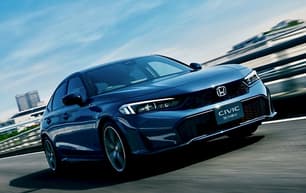
Beauty. Eye. Beholder. All that. But I reckon this Civic looks fantastic. Low-slung and sporty. The perfect antidote to all those bland, beige SUVs currently doing the rounds.
New as part of the most recent refresh is the front-end treatment, a new front bumper, more body-coloured flourishes and new designs for the 18-inch alloys.
I think it looks sleek, premium and purposeful, and not at all boring.
Inside, though, it’s a little less adventurous, though I do adore some of the little design touches, like the perforated metal effect that spans the dash.
The central screen is pretty small by modern standards, and you don't want to push too hard on some of the touch points, like the gloss-black highlights on the doors, which feel flimsy, flexible and pretty cheap.
Now, the screen. Does UX design count in the overall design section? Let's say that it does. I haven’t really experienced less intuitive and user friendly cabin tech lately.
For example, I couldn't figure out (though I must admit I didn't resort to owner's manual) how to get Apple CarPlay to load automatically, if you can.
Instead I had to select my phone, cycle through several screens of approval, and then select my phone again, every single time I got in the car. I had a similar issue using Google maps, which simply wouldn't connect at all for me.
Good tech is easy and intuitive. This wasn't.
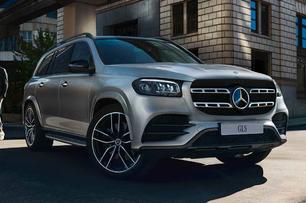
If the GLS63 was a Marvel superhero, it would undoubtedly be the Hulk. Simply put, it has road presence like few others. In fact, it’s frankly menacing.
Of course, the GLS is already pretty intimidating due to its sheer size and blocky design, but the GLS63’s full-fat AMG treatment takes it to another level.
Naturally, the GLS63 gets an aggressive body kit, with its purposeful bumpers, side skirts and rear spoiler serving as instant reminders of what you’re dealing with, but it’s AMG’s signature Panamericana grille insert that really hammers home the point.
Around the side, the GLS63’s 22-inch alloy wheels with staggered tyres (front: 275/50, rear: 315/45) make their presence known, positioned below the wheelarch extensions.
That said, some fun’s also had at the rear end, where the GLS63’s diffuser element integrates the foreboding sports exhaust system with quad tailpipes very neatly.
The focused Multibeam LED headlights also look the part, while the opposing LED tail-lights tie everything together outside quite nicely.
Inside, the GLS63 stands out from the GLS crowd with its sports steering wheel with Dinamica microfibre accents, and multi-contour front seats, which are covered in Nappa leather alongside the armrests, dashboard and door shoulders and inserts.
Of note, the doors bins are unfortunately of the hard plastic variety, which is very disappointing in a vehicle that costs this much. You would expect that cow hide would also been applied to them, but alas it isn’t.
The GLS63’s black headliner serves as an obligatory reminder of its sporting intent, and while it makes for a dark cabin, metallic accents are prominent throughout, while the optional trim (our test vehicle had carbon-fibre) mixes things up, alongside the ambient lighting.
And let’s not forget the GLS63 is still loaded with plenty of cutting-edge technology, including a pair of 12.3-inch displays, with one the central touchscreen and the other the digital instrument cluster.
Both are powered by Mercedes’ class-leading MBUX multimedia system and feature Apple CarPlay and Android Auto support. This set-up arguably remains the best there is today thanks to its speed and breadth of functionality and input methods.
The Honda Civic measures 4569mm in length, 1802mm in width and 1415mm in height, and as you've no doubt already noticed, it's not an SUV, rather a liftback-style sedan.
But if you feel like you need an SUV to move a family, I beg to differ. While the middle seat in the second row is too tight for adults (owing largely to the intrusive raised tunnel that runs through the middle of the cabin), the two window seats can absolutely fit adult humans. I'm 175cm, and had absolutely no issue sitting behind my own driving position.
But the biggest surprise is the boot, which opens to reveal a flat and wide storage space that can swallow 409 litres (VDA) of luggage. In real terms, that's more than enough for our pram and the assorted knick-knacks that go with it on a baby day out.
Unfortunately, though, there’s no spare. Instead you’ll find yourself wrestling with a hateful repair kit should you get a puncture, and you don't want to wait for roadside assist.
There's also twin USB ports in the back, as well as air vents, along with twin cupholders in the pulldown divider.
Measuring 5243mm, 2030mm wide and 1782mm tall with a 3135mm wheelbase, the GLS63 is an upper-large SUV in every sense of the term, which means it’s also very practical.
For example, cargo capacity below the load cover is decent, at 355L, but stow the 50/50 power-split-folding third row via the boot and it’s very good, at 890L, or drop the 40/20/40 power-split-folding middle bench, too, and it becomes a cavernous 2400L.
Better yet, the boot’s aperture is almost square, and its floor’s flat, while there’s no load lip to contend with, making loading bulkier items even easier. Up to four tie-down points are also on hand (depending on seating configuration) to secure loose cargo.
Under the false floor is the space-saver spare, which is to be expected, but what isn’t expected necessarily is the fact there’s also enough room there for the cargo cover when it’s not in use, which would be the case if six or more passengers are regularly onboard.
Moving into the power-sliding second row, the GLS63’s practicality is once again brought to the fore, with up to six-plus inches of legroom available behind my 184cm driving position.
There’s also two inches of headroom with the panoramic sunroof in situ, not to mention just enough toe-room. The GLS63’s small transmission tunnel and sheer width also mean three adults can be seated on the middle bench with few complaints.
Amenities-wise, the second row has map pockets on the front-seat backrest and a small fold-down cubby below the rear climate controls, with it containing two slots for smartphones and a pair of strategically placed USB-C ports.
The rear door bins can take one large bottle each, while a fold-down central armrest is also on hand, featuring a shallow tray and retractable (and flimsy) cupholders.
Alternatively, the $2800 Rear Seat Comfort Package fitted to our test vehicle subs in a tablet that can control the multimedia system, a wireless smartphone charger and a small cubby into the former, as well as a heated/cooled cupholder atop the rear of the centre console.
In the third row, it’s not quite as roomy if you’re an adult. With the middle bench in its most accommodating position, my knees still brush up against its backrest, which is to be expected given it’s primarily designed for children. I also have an inch of headroom there.
Nonetheless, getting in and out of the third row is relatively easy as the power-operated middle bench tumbles forward and provides just enough space to make entry and exit somewhat graceful.
When seated, rear occupants are treated to two USB-C ports and one small cupholder each, so they’re arguably taken better care of than those in the middle.
Child seats are well and truly accommodated, with four ISOFIX and five top-tether anchorage points fitted across the second and third rows, although the latter will inevitably prove to be a much tighter fit.
The driver and front passenger are still taken care of, with a front cubby taken up by two heated/cooled cupholders, a wireless smartphone charger, two USB-C ports and a 12V power outlet, while their door bins take one large and one small bottle each.
In-cabin storage options include the large central storage bin, which hides another USB-C port, while the glovebox is on the smaller side, with about a third of it taken up by the fragrance, which is pumped into the cabin to ensure the interior always smells its best.
Ah, so we may have hit the first Honda hurdle. Ours is the entry-level e:HEV L, and it’s a cool $49,900, drive-away. The top-spec LX is $55,900, on the road.
To put that into perspective, Toyota's two Corolla sedan hybrid grades are about $36K and $39K, drive-away, at the moment. The admittedly non-hybrid Golf starts at $39,990, on the road.
The German premium brands are still more expensive, but I think that might be at least part of the Honda’s problem. It now occupies a space between mainstream and premium, which might also be something of a no-man’s land.
Still, the entry-level L is decently equipped, with 18-inch alloy wheels wrapped in quality Michelin Pilot Sport rubber, all-LED lighting all around and key-less entry.
Inside, there’s synthetic leather and fabric seats, dual-zone climate, a 9.0-inch central touchscreen with Apple CarPlay and Android Auto, but also with Google built-in that provides mapping and updates and a 12-speaker Bose stereo.
Both Civic variants also arrive with a three-year subscription to 'Honda Connect', which gives you remote access to your car to lock or unlock it, pre-heat or cool the cabin, or set a geofence alert if your teenagers are borrowing it, that sort of stuff.
But… there are no full-leather seats, there's no sunroof, no wireless charging and you have to open the boot yourself.
The lack of all that doesn’t feel overly premium.
Priced from $255,700 plus on-road costs, the GLS63 commands a $34,329 premium over its predecessor, although buyers are arguably getting more bang for their buck than before, even if it does sit well clear of the two other GLS variants: the $147,100 GLS450 and $153,900 GLS400d.
Standard equipment not already mentioned in the GLS63 includes regular metallic paintwork (our test vehicle was finished in Selenite Grey), dusk-sensing lights, rain-sensing wipers, power-folding side mirrors with heating, soft-close doors, roof rails, rear privacy glass and a power-operated tailgate.
Inside, keyless entry and start, augmented reality (AR) satellite navigation with live traffic, digital radio, a 590W Burmester surround-sound system with 13 speakers, a head-up display, a panoramic sunroof, heated seats (including middle outboard) and armrests, cooled front seats with massaging functionality, power-adjustable seats, a power-adjustable steering column, temperature-controlled front cupholders, five-zone climate control, stainless-steel pedals and an auto-dimming rearview mirror feature.
With BMW not offering an X7 M (although the slightly smaller $209,900 X5 M Competition is available) and the $208,500 Audi RS Q8 really from the segment below, the GLS63 does not have a direct rival in the Upper-large SUV segment.
In fact, the $334,700 Bentley Bentayga V8 is actually the model that comes closest to the GLS63 when looking for a seven-seater with a similar level of bent-eight performance.
The Civic range is an all-hybrid affair, which in this case is what Honda calls its 'two-motor hybrid', which pairs a 2.0-litre petrol engine with two electric motors, one being an electric generator, and the other being the actual propulsion motor which sends power to the wheels. Expect a total 135kW and 315Nm, which is sent to the front wheels via a CVT auto.
The GLS63 is powered by a familiar 4.0-litre twin-turbo V8 petrol engine, with its version producing a thumping 450kW of power at 5750rpm and 850Nm of torque from 2250-5000rpm.
This unit is mated to a nine-speed torque-converter automatic transmission and AMG’s fully variable 4Matic+ all-wheel-drive system with torque vectoring and a rear limited-slip differential.
This set-up also features Mercedes’ EQ Boost 48V mild-hybrid system, which actually gives a 16kW/250Nm electric boost in short bursts, such as when accelerating off the line.
Speaking of which, the GLS63 sprints from a standstill to 100km/h in just 4.2 seconds, while its top speed is electronically limited to 250km/h.
Honda says you can expect 4.2L/100km on the combined (urban/extra-urban) cycle, but we found the fuel use was a still impressive 5.5L or so, admittedly mostly in the city.
The 40-litre tank drinks 91 RON 'standard' fuel, meaning its cheapish to fill up, and — using Honda’s numbers at least — should deliver a 950km driving range.
Yesterday, 91 RON was about $1.80 per litre meaning you can theoretically get from Melbourne to Sydney for around $75.
The GLS63’s fuel consumption on the combined-cycle test (ADR 81/02) is 13.0L per 100km, while its carbon dioxide emissions are 296 grams per km. All things considered, both claims are unsurprisingly high.
In our real-world testing, we averaged a fearsome 18.5L/100km over 65km of driving, split between highways and country roads, so not your usual mix. A very heavy right foot definitely influenced that result, but don’t expect to do too much better in a normal run.
For reference, the GLS63’s 90L fuel tank can be filled up with 98RON petrol at a minimum.
First things first – I really, really like the way this Honda drives. There's a finesse, a confidence, in the drive experience that's sometimes missing from the new brands when they first arrive in Australia.
In short, it feels like it was engineered by people who really know what they're doing. That's the easiest way to describe it.
If you're used to driving older-fashioned hybrid systems you might be used to a bit of shuddering harshness when the engine kicks in, but that's simply not the case here.
Instead, the transition is seamless, with the Honda Civic making the choice for you and largely leaving you out of the process entirely.
Where the powertrain does let itself be more known is under heavier acceleration, with engine thrum seriously invading the cabin, without much in the way of flat-footed performance to accompany it.
But the magic of the Civic drive experience is in its balance. It's not a performance car, but there's real driver engagement to be found in the way it rides and handles. Equally, though, it's never uncomfortable, striking the balance between road-holding confidence and comfort really well.
Happy in the city, happy on a twisting road - this is not one of those smaller cars that leaves the drive experience as a secondary factor. It feels like it really has the driver at heart.
Frankly, the GLS63 has absolutely no right being as capable as it is. It’s a really big bus that’s legitimately convinced it’s a sports car half its size.
Being a GLS variant, the GLS63 has independent suspension consisting of four-link front and multi-link rear axles with air springs and adaptive dampers, but its party trick is the addition of active anti-roll bars.
In what feels like magic, the GLS63 is simply not intimidated by corners, despite having massive dimensions and a considerable 2555kg (kerb weight) to deal with.
The active anti-roll bars make the GLS63 so much easier to drive fast through the twisty stuff, almost eliminating body roll, taking one key variable out of the equation for the driver. Active engine mounts are also fitted, helping to settle things even further.
The electric power steering on hand is also good. It is speed-sensitive and has a variable ratio, which basically makes the set-up more direct when it needs to be. It’s typically light in hand, too, until one of the sportier drive modes is engaged and extra heft is added.
So, handling is scarcely believable, which means the ride must be compromised, right? Yes and no. With the adaptive dampers in their softest setting, the GLS63 is very compliant. In fact, we’d say it feels luxurious when compared to other high-performance SUVs.
That said, our test vehicle was fitted with the optional 23-inch alloy wheels ($3900), which look the part but expose sharp edges and other road imperfections, not to mention generate noise easily heard inside. Naturally, feedback is exacerbated in the sportier drive modes.
Anyway, there’s more performance, and the GLS63 has the rest in spades. Its engine is a powerhouse in every sense of the word. It’s so powerful, in fact, that it hilariously hunkers down off the line or when suddenly accelerating at low speed.
Thanks to the mild-hybrid system, wads of torque is available from the get-go, making for a highly responsive driving experience, even in those rare moments when the engine isn’t on song.
While not as characterful as some of the other members in the 63 series, the GLS63 still makes some thoroughly entertaining noises, with its sports exhaust system popping like mad while on the overrun.
All of this ability is very well and good, but you need to be able to pull up quickly, and the high-performance braking package (400mm front and 370mm rear discs with six-piston fixed callipers and single-pot floating stoppers respectively) mercifully does exactly that.
The big safety news surrounding the Civic is that its eight airbags are joined by 'Honda Sensing', which packages up every safety system you can possibly imagine — forward collision warning, lane keeping, adaptive cruise, AEB – and delivers them as standard across the range.
But the bigger news is that, refreshingly, none of it is overly intrusive. Even the speed limit warning, which – as in most cars – always gets the speed wrong, just flashes gently on the driver display, rather than binging and bonging through the cabin.
The Civic Hybrid scored a full five-star ANCAP safety rating, with the score based on crash testing in Europe through Euro NCAP.
Neither ANCAP nor its European counterpart, Euro NCAP, have awarded the GLS range a safety rating, but it’s fair to assume it would perform well in testing.
Advanced driver-assist systems in the GLS63 extend to autonomous emergency braking with pedestrian and cyclist detection, lane-keep and steering assist (including emergency), adaptive cruise control, active blind-spot monitoring, rear cross-traffic alert, traffic sign recognition, driver attention alert, high-beam assist, tyre pressure monitoring, hill-descent control, hill-start assist, park assist, surround-view cameras and front and rear parking sensors.
Other standard safety equipment includes nine airbags (dual front, front-side, curtain and rear-side plus driver’s knee), anti-skid brakes (ABS), electronic brake-force distribution (EBD) and the usual electronic stability and traction control systems. Yep, it doesn’t leave much to be desired on the safety front.
The Honda is covered by a five-year/unlimited-kilometre warranty, and servicing is every 12 months or 10,000km.
There is a capped-price servicing program, called 'Low Price Servicing', which means your first five services are $199, but don't cover things like brake pads and tyres.
As with all Mercedes-AMG models, the GLS63 comes with a five-year/unlimited-kilometre warranty, which currently sets the standard for the premium market. It also comes with five years of roadside assistance.
The GLS63’s service intervals are relatively long, at every 12 months or 20,000km (whichever comes first). Better yet, it’s available with a five-year/100,000km capped-price servicing plan, but it costs $4450.