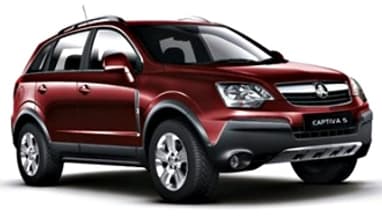
Are you having problems with your 2010 Holden Captiva? Let our team of motoring experts keep you up to date with all of the latest 2010 Holden Captiva issues & faults. We have gathered all of the most frequently asked questions and problems relating to the 2010 Holden Captiva in one spot to help you decide if it's a smart buy.
It's got nothing to do with the fuel you're using; the Captiva is fine to run on regular unleaded. You need to have a mechanic experienced in diagnosing problems with modern engines check it out for you. Clearly the dealer's mechanics are not up to the task.
It appears Holden is unable to fix the problem, so owners experiencing rapid tyre wear/the vehicle pulling to the left should think about consulting a suspension/steering specialist who seem to be able to do what Holden can't.
Holden claims the fuel consumption of the petrol Captiva is 16.4 L/ 100 km in urban, or city, driving conditions, but that drops to 8.9 L/100 km in extra urban, or country type driving. On average, the company claims, the Captiva would average 11.6 L/100 km. You say yours does 6.2 km/litre, which equates to 16.1 L/100 km, and that's in line with Holden's claims for urban driving. When you look at the labels on the windscreen you need to take in all of the information, not just the combined, or average, figures. The main thing they are there for is to allow you to compare one vehicle with another rather than give you an outright number that you will get from the vehicle yourself. Before complaining to the dealer I would do what has been suggested, that is to run it for the 15,000 km. You should see a reduced in the consumption as the vehicle beds in.
I feel you are right, and there are lots of other Captiva owners out there who feel the same way. The tyre wear is a camber problem and there isn't enough adjustment on the front-end to correct it. You can go to a company like Pedders and they can fit camber pins to the front-end and do an alignment, which will fix the problem. The cost will be in the order of $250. The pulling problem is a different one and related to caster. Right now there is no fix available for it, but a number of suspension specialist companies are developing eccentric bushes that can be fitted to allow the caster to be adjusted to rid it of its tendency to pull left. You could also follow Holden's advice and have the car wheel aligned to the specification you have been given, and see how it goes.
25,000 km is not too shabby for a big, heavy car like the Captiva. I wouldn't expect to get more than 35,000-40,000 km at best. If it hasn't been wheel aligned it's probably worth doing to make sure the wheel alignment is correct. If it is and you want to have a suspension specialist check it there are many around who could do it, Pedders being one.
Yours is the first complaint we've received on this issue. Contact Holden's Customer Assistance service on 1800 033 349 or fax (03) 9647 1237. If you want to write to the company, perhaps to the Managing Director, the address is PO Box 1714, Melbourne, 3001. There isn't an e-mail address you can use.
Holden is recalling almost 3000 of its Captiva family SUVs because the car could lurch forward by itself if the keys are left in the ignition of certain models.The car maker is attempting to contact 2951 owners of Captiva 5 and Captiva 7 vehicles made between 22 February 2007 and 25 November 2010.The engine may crank over and the car may move forward half a metre or soThe recall affects only models with manual transmission, the bulletin says."If the key is left in the ignition and the car is still in gear … there is a chance the engine can crank and cause the car to lurch forward," said Holden spokeswoman Kate Lonsdale."The car won't drive off but the engine may crank over and the car may move forward half a metre or so."Holden says it has had seven reported incidents in Australia but no accidents and injuries occurred as a result of the fault.The recall is similar to one on the Holden Barina and Trax models late last year where a faulty ignition led to the same fault.However, the Captiva was not recalled at the same time because the faulty part was made by a different supplier.Holden says the latest ignition recall issue in Australia is unrelated to recalls in the US last year for ignition faults that affected more than 2.6 million vehicles and was linked to 84 deaths.Holden has had three recalls so far this year, the same number as Jeep.Last year both Holden and Jeep set a new record with 14 recalls each in a calendar year.
Holden Captiva is a medium-large SUV that has a lot of Australian input in its design and engineering teams. It is available in two slightly different body styles, with the MaXX having a sporty look and five seats, while the other body type can be purchased as a five- or seven-seater.The third row seats are larger than those in many of Captiva’s seven-seat competitors and, while still better suited to children than adults, can carry the grownups in reasonable comfort.Storage space when all seven seats are in place is severely restricted, hardly unusual in this size of vehicle. The seats can the folded down in a variety of ways and, when all are flat, you have up to 1565 litres of luggage space.There are a number of smaller stowage compartments including a large wet/dry area beneath the load compartment floor. Interior storage is excellent, with seatback pockets; a glovebox cooler; front and rear centre console storage; door bins; drink holders; and an overhead sunglasses holderWhen introduced in 2007 the only Captiva powerplant was a 3.2-litre V6 petrol built by Holden. The engine was shipped to the South Korean factory to be installed in Captivas used on many global markets. A 2.0-litre diesel engine was added to the range in March 2007.Initially all Holden Captiva models used the same part-time 4WD system, with drive normally being to the front wheels and the rear wheels being engaged when extra traction was demanded.The 4WD system is well engineered and the Holden Captiva can tackle some quite tough off-road areas as it has good approach and departure angles. It’s not a heavy-duty 4WD but can go surprisingly far in the hands of an experienced operator.A 2WD version, through the front wheels, was introduced in December 2009. Called the Captiva 5 and using the MaXX style body it’s a five-seater powered by a 2.4-litre four-cylinder petrol engine.A five-speed automatic with tiptronic-style manual override was the only transmission option until the arrival of the Captiva 5, which is offered with a six-speed manual as well as an automatic transmission. The automatics were upgraded to six forward ratios with the introduction of an upgraded Captiva in February 2011.All Captiva models come with electronic stability control, ABS brakes with brake assist, traction control, active rollover protection and descent control. There are dual front airbags in all models with side curtain airbags optional in the lower cost models and standard on the others.Holden is very well represented in most areas of Australia and dealers in all regions are likely to carry the more common spare parts for the Captiva. Other components can usually be shipped in within a couple of working days. Prices are lower than average for an imported vehicle in this class.Parts and servicing costs are reasonable and the relatively simple layout of the Captiva means the good amateur mechanic can do a fair bit of their own work. Safety related items should only be worked on by professionals.Insurance costs are pretty reasonable and we haven’t seen a big variation between companies. However, it’s always smart to shop around for the best deal making sure that you’re comparing apples with apples when doing so.Check for rust in the lower area of the body and in a Captiva that may have been used on the beach. Look over the interior for signs of dirt having been ground into carpets. Similarly, check for damage and/or stains on the seats.Look for off-road damage to the bumper corners, the door sills and for light scratches in the paintwork on the doors and the front guards. If the load area has been used to cart heavy gear and/or has been damaged by poor loading and/or fastening there could be severe damage to the carpets. Again, signs of sand may be bad news.Engines that are slow to start or blow smoke when worked hard may be due for major repairs. Automatic transmissions that don’t go into Drive quickly when moved from Neutral or Reverse may need servicing.So few SUVs ever get taken off-road that it’s probably worth passing up one that has been used as an SUV. Silly, isn’t it?
The Korean-built SUV with family-friendly seating wasn't a serious off-roader. New Holden was slow to pick up on the shift to SUVs. When it hit the market it did so with an imported model instead of going the local route as rival Ford had done. The Captiva was one of many Korean-built models as Holden moved away from
Holden’s answer to the SUV wave seemed to fit the bill — initially New Holden was caught with its corporate pants down when SUV sales surged at the dawn of the new century. Quite simply, the brand didn’t have one. Ford was in a similar predicament and responded by building the Territory. Holden dithered,
Disclaimer: You acknowledge and agree that all answers are provided as a general guide only and should not be
relied upon as bespoke advice. Carsguide is not liable for the accuracy of any information provided in the
answers.









.jpg)