What's the difference?
Ford has introduced what is being touted as an adventure-type van to its Transit Custom line-up and it’s called the Trail.
The Trail is based on the long-wheelbase Transit Custom Trend and it’s equipped with a suspension lift, on-demand all-wheel drive, 'Trail' drive mode, LED headlights and daytime running lights, a variant-specific grille, black wheel arch moulding and side strip, yellow exterior decals and 16-inch matt black twin-spoke alloy wheels.
With all that in mind, maybe a van is your next adventure vehicle?
Read on.
Long before a hash-tag was anything more than a confusing symbol on a typewriter, vanlife was already a thing.
And you can largely thank Volkswagen for that because its Kombi models from the 1950s, '60s and '70s help cement the idea of roaming around the planet in a self-contained car-cum-house as a counter-culture favourite. More than that, the affordable, rugged Kombi made it actually possible.
Back then, there were a couple of paths to tread. You could take a second-hand butcher’s or florist’s Kombi van (windows optional) and trick it out with a bed, a table and whatever gear you needed to survive on the road.
Or, if the cash was around in sufficient quantities, you could buy a Kombi brand-new and have it converted to camper spec. And of all those brand-new conversion options, Volkswagen’s own, in-house conversion supplier, Westfalia was (and is) regarded as the pick of the crop.
So, when VW announces a 21st Century take on the concept of a factory campervan, those who like the idea of a lap of Australia but don’t like caravans or towing, are suddenly all ears.
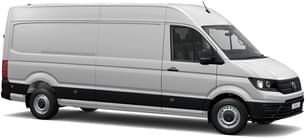
Like most things, the latter-day VW camper has grown a size or two over the last six or seven decades. Which is why the factory Kampervan TD1410 4 Motion (to give it its full name) is based on the long-wheelbase, high-roof version of the Crafter van rather than the original Transporter layout. (There’s still the VW Multivan-based California if the Kampervan is too big.)
But just as commercial vehicles have become bigger and more sophisticated, and glamping has grown out of actual camping, does the modern take on a hippy legend make the grade in 2024? And does the Volkswagen offering retain any of the charm of the original campervan?
Oh, and forget about Westfalia. This conversion is the work of none other than Aussie caravan specialist Jayco.
The deal between Jayco and VW locally, means this variant of the Crafter Kampervan is an Australia-only deal.
The Ford Transit Custom Trail has plenty of appeal as a work van or a camper fit-out candidate. It’s a well-packaged, comfortable and contemporary van that’s nice to drive and as a bonus, with all-wheel drive it’s given the scope of capability to be able to tackle mild off-roading situations with confidence.
It’s built for work and play and though it’s limited to two-up for travels, the Trail offers so much potential as a camper conversion for adventure seekers its few niggles are easily forgotten when you’re busy making memories.
This is not the vehicle for somebody looking for the odd weekend away. That’s mainly because it will take up a lot of real estate when you’re not using it (it may not even fit in a lot of car-ports or garages) and it’s far from a daily driver for the school run or shopping trips.
If you’re looking for a getaway machine that will also work at home for the other 48 weeks of the year, a conventional caravan and four-wheel-drive is likely to be a better bet, purely because the tow-vehicle can be your day-to-day transport
But if your plans include longer getaways and you have the storage space to keep the Kampervan stashed away safely, it starts to emerge as a functional alternative.
Talk to long-term travellers, and even the best camper trailer needs to be set up each night and folded away next morning, and as for tents, don’t even start us…
But like a full-sized caravan, the VW simply pulls up to where ever it is you want to stay for the night and is ready to feed, entertain and rest its occupants within seconds of stopping.
But unlike a big, heavy caravan, the Volkswagen imposes far fewer driving caveats (including fuel consumption) and is a vastly more enjoyable and simple thing to drive in pretty much any circumstance.
It's not for everybody, but for those whose lifestyle it matches, the VW Kampervan is an alternative to a caravan that deserves short-listing. Let’s face it, 50 million hippies can’t be wrong.
Note: CarsGuide attended this event as a guest of the manufacturer, with accommodation and meals provided.
It looks like a van but with some striking yet low-key flourishes that all kind of work as a whole. Those include a Trail grille and the matt black alloy wheels. The yellow sticker-pack is a neat touch.
The Trail has more presence than a regular Trend with its 30mm-taller raised suspension and overall adventure-ready look with strong front end and chunky wheel arches.
The striking but low-key theme continues inside with a neatly laid-out yet spartan cabin. The two synthetic leather seats are topped with Trail embossing and lined with yellow stitching.
The cabin is separated from the rear cargo area by a bulkhead, which incorporates a small wired window.
Given that the design of the camper conversion was partly the work of Jayco, there’s every reason to suspect that the end result should work for recreational users. That is, of course, provided Jayco’s caravan-building experience translates to a campervan layout.
That’s because this is not as simple as plonking a wheel-less caravan onto a Crafter cab-chassis; integration in the key here.
The various zones – driving, entertaining, sleeping, bathroom and cooking – need to work with each other with as many components having more than one job.
The off-grid capability is also a highlight and, in the case of the All-Terrain model with its off-road tyres, bash plates and 30mm higher ground clearance, makes getting farther off the beaten track more of a reality.
A lot of people will wonder why VW didn’t simply import a batch of the campervan conversions it already builds in Europe.
The fact is, however, that the left-hand drive layout means the sliding side door would be on the wrong side for Australia, and the integrated gas system would not have met ADR standards. So was born the idea of a local conversions which is where Jayco came in.
It’s a van so there are two distinct sections to the Trail, the cabin and the load space.
Firstly, the cabin. More a work-friendly than family-friendly interior, this Trail is a two-seater with plenty of durable plastic everywhere – ready for work and life – as well as charging (with USB-A and -C ports) and storage (including a van-favourite dash-top slot for logbooks etc, outboard moulded cupholders and a nifty pop-out cupholder), all amenities enough to cope with most daily van-related duties.
The seats are comfortable, supportive and have a fold-down lock-in-place armrest.
Now for the load space. There are no seats back there and as such it has plenty of potential as a work van or touring vehicle.
Access to the rear load space is via a barn door at the back and this Trail has a sliding door on both sides.
The cargo area is substantial – 3002mm long (to the bulkhead; 3450mm long if load-through hatch is used), 1392mm wide (between wheel arches) and 1425mm high (floor to roof). Easily big enough for work equipment or recreational gear. It can cope with four Euro pallets (each measuring 1200mm x 800mm) and it has a listed maximum load volume (with the bulkhead) of 6.8 cubic metres.
Load height through the rear barn doors is 531-585mm, depending on how much weight is already onboard.
The load space has the aforementioned metal bulkhead (with window and load-through hatch), load area protection kit (full height walls and moulded floor), LED lights and eight tie-down loops.
Otherwise, this is a load area ripe for customisation. Maybe a plethora of shelves for a tradie, or some bedding and extra storage for an adventurous person or couple.
The Crafter’s phone mirroring system seems to work pretty well, although it’s menu-driven layout can be a bit frustrating (it’s hardly alone there) and Android phones sometimes didn’t want to connect as simply as they should have (potential user-error here, folks).
But the rest of the interior is typically Crafter-smart including lots and lots of cupholders, USB ports and cubby-holes dotted around the front seat area.
Doubtless, a few months on the road will show up design issues according to the individual, but for now, our main comment would be the proximity of the bathroom to the food preparation area (although, to be fair, most owners will cook outside the vehicle).
The mattress is a split queen unit (rather than a single mattress) and it occupies the full width of the rearmost part of the vehicle, so making the bed might be a bit more difficult.
The location and width of the bathroom (although it feels pretty tiny once you’re in there and operates as a wet-room) also means there’s just half the rear view that the vehicle might otherwise have.
The thick pillar between the two rear barn-doors also adds to that blind spot. At least the mirrors are good; nice and wide and very clear.
It’s when the Kampervan is not being used to survey this wide, brown land that its practicality starts to come into question. Unlike a conventional four-wheel drive and caravan rig, the accommodation section of the Crafter can’t simply be unhooked and parked in the driveway.
Which means it’s not really suburb or city-friendly. Underground car-parks will soon detach the air-conditioning unit in a pretty violent way, and the almost-seven-metre length will have you looking for adjacent empty parking spaces (or the car-and-trailer section at Bunnings).
Put simply, this is the touring solution for those who want to tackle the Big Trip in one go, staying on the road for weeks or perhaps even months. Obviously, that’s an observation rather than a criticism, but it remains something to think about.
The 2025.75Y Ford Transit Custom Trail has a MSRP of $61,990 (excluding on-road costs).
Standard features onboard include a 13-inch multimedia touchscreen (with wireless Apple CarPlay and Android Auto), a 12-inch digital instrument display and synthetic leather upholstery with Trail logos on the seats.
Other gear includes an eight-way manually adjustable driver’s seat, keyless entry and start, front and rear parking sensors, climate-control air and automatic LED headlights.
It also has all-wheel drive, LED headlights and daytime running lights, a variant-specific grille, black wheel arch moulding and side strip, yellow exterior decals and 16-inch matt black Trail twin-spoke alloy wheels.
The standard no-cost exterior paint is 'Frozen White'. Anything else – 'Agate Black Metallic', 'Grey Matter', 'Magnetic' or 'Moondust Silver' – will cost you $700.
Based on the top-shelf Crafter van, the Kampervan then goes on a mission to be both a car and a holiday house.
So, pull up a comfy chair, because there’s a fair bit to discuss here. This isn’t just a tent on wheels, it’s a fully functional tiny home that just happens to be relocatable on a daily basis. As such, the vehicle needs to be able to manage energy, water, gas and waste.
VW’s aim was to elevate the quality standards of the caravan industry to that of the car-making world, as well as address its customers’ main agendas, including storage, the ability to go off-grid and the management of light and ventilation for sleeping.
That utility starts with the walk-through layout where the front seats swivel to form the other half of the dining table seating. From there, the layout runs to a full bathroom, a kitchen and then back again to a fixed queen-size bed.
The bathroom combines a shower and a lavatory with a cassette system for black-water storage and disposal.
The kitchen features a 90-litre fridge with a freezer drawer that is accessible form both inside and outside the vehicle. There’s a dual gas-hob and a 9.0kg gas bottle stored in the rear compartment (under the bed, but accessed from outside) that also includes a huge slide-out drawer for an extra fridge or whatever else needs to be carted around.
There’s also a sink with a mixer tap and the vehicle carries 120 litres of fresh water, not to mention gas-powered on-demand hot water.
A wind-out awning runs the full length of the van, extending the living space and forming a space for the VW-branded camping table and chairs.
The bedroom includes a pair of swivelling fans for cross-ventilation, USB and 240-volt ports, a swivelling TV and blinds and screens on all windows. The standard air-conditioning system will also run for about seven hours before the vehicle runs out of power.
Speaking of power, the electrical system is a force of nature. Aside from the standard Crafter battery (which remains the start battery and can’t be depleted by the equipment on board) the standard smart-alternator function has been disabled so the engine can help charge the batteries whenever possible.
That power storage array incorporates a 400Ah lithium-ion battery with a 3000-watt inverter to run the 240-volt system even when off-grid. There’s a 60A DC-to-DC charging system and, all up, VW reckons the vehicle can stay off grid for about three days straight based on normal power consumption. A multi-screen control panel tracks power usage and issues alerts when required.
So, what’s missing from the Kampervan? Climate-control air-conditioning for the cabin, mainly (the Crafter starts life as a commercial van, after all). Oh, and beds for the third and fourth passenger. Cue hippy-free-love jokes.
The Kampervan starts at $157,990 for the on-road biased Style model and $165,490 for the All-Terrain version.
As the more off-road capable variant, the All-Terrain gets 16-inch steel wheels with all-terrain tyres, bash plates, a higher ride height and a snorkel.
In either case, the accommodation fittings and fixtures are identical, that sounds pretty steep, but go out and price a full-sized four-wheel drive and a full-sized caravan with a bathroom and then see how it all stacks up.
The Ford Transit Custom Trail has a 2.0-litre four-cylinder turbo-diesel engine producing 125kW at 3500rpm and 390Nm at 1750-2500rpm.
The Trail has a clever eight-speed automatic transmission and an on-demand all-wheel drive system.
It all works rather well, but it’s a van afterall and as such it is less dynamic and more dependably driveable than perhaps a cross-shopped SUV wagon. However, as an AWD van the Trail can be trusted to keep its grip on wet bitumen, soggy grass and loosely-gravelled tracks and that’s a strong part of its appeal over a 2WD van.
The Crafter is powered by VW’s now-familiar 2.0-litre turbo-diesel four-cylinder engine which produces 130kW of power and 410Nm of torque thanks to a pair of turbochargers.
Driving through an eight-speed automatic transmission, the torque is then sent to all four wheels via VW’s '4Motion' permanent all-wheel-drive system.
It’s worth mentioning the automatic transmission is a conventional torque-converter unit, rather that the dual-clutch layout VW has championed for years now.
The Crafter also uses ventilated disc brakes front and rear and the however you look at it, the modern driveline of the Kampervan makes an old air-cooled Kombi look even more antiquated (which is saying something).
And while the Crafter in commercial-vehicle trim has the option of an electronic locking rear differential, the Kampervan adds this as standard.
The Ford Transit Custom Trail has an official combined cycle (urban/extra-urban) fuel consumption figure of 8.5L/100km. On this test I recorded 8.8L/100km.
The Trail has a 70-litre fuel tank so going by my on-test fuel figure you could reasonably expect a driving range of about 795km from a full tank of diesel. However, as with any vehicle, once you’ve loaded the Trail with real-world burdens (e.g kids, dogs, camping gear, etc) you’ll soon see that fuel consumption increase.
Although the Crafter’s driveline boasts energy recuperation, it’s not a hybrid system. Instead, the vehicle’s alternator is able to generate electricity during braking and store that in the vehicle’s batteries for later use, rather than storing that power in a dedicated hybrid battery.
This also helps ensure the main battery is always fully charged to power the stop-start system that is also standard on the Crafter.
Because it’s a commercial vehicle, there’s no compulsion to offer an official fuel consumption figure and, indeed, Volkswagen doesn’t.
But our real world drive including some winding roads and a bit of freeway thrown in, gave us an average figure of between nine and 10 litres per 100km. This is likely to be a bit lower on a purely highway run, but is a good indicator of general use consumption.
The 75 litre fuel tank should, then, give an easy 700km of range, but don’t forget the Crafter’s engine uses AdBlue, so that extra cost needs to be factored into running costs.
It’s easy to get in and out of the Trail’s driver seat with a wide-opening door and a big step to help you inside.
The seats are comfortable and it’s simple enough to dial-in your driving position via the tilt-and-reach adjustable steering wheel and manually-adjustable seat.
Word of warning: the auto transmission is operated via a stalk mounted on the right-hand side of the steering wheel column, which takes some getting used to.
Once underway, the Trail is punchy enough around town and in the suburbs with its 2.0L 'EcoBlue' turbo-diesel engine offering a more-than-adequate amount of power and torque (125kW and 390Nm) and its clever auto helping out with nifty moves through traffic (for a van, anyway).
Visibility is impressive from the cabin and you’re afforded a convenient vantage point with the Trail standing a bit taller than its regular Transit Custom stablemates as it’s on lifted suspension, but feeling composed on most surfaces.
The Trail has a listed kerb weight of 2046kg and a turning circle of 12.1m, pretty standard for a long wheelbase van, so this is not an insubstantial vehicle and it’s a bit tricky to 'flip a u-ee' if the situation demands it.
It has six drive modes – 'Normal', 'Eco', 'Slippery', 'Tow/Haul', 'Sport', 'Trail' – which each adjust engine torque, throttle response and traction control, among other things, to suit the road surface and conditions.
But we’re all here to see how it goes off-road, aren’t we?
Well, obviously this is no rock-crawling machine and it’s not intended to be. It’s best thought of as having an all-wheel drive system that gives this van mild off-road capabilities, as in it can tackle wet bitumen, soggy grass, lightly corrugated bush tracks and very shallow mud puddles with more confidence than the Transit Custom Trend it's based on.
In a nutshell, the AWD Trail will be able to handle most low-level traction-compromised scenarios. But it does not have enough ground clearance, wheel articulation, grip or underbody protection to tackle any terrain beyond modest off-roading.
Speaking of grip, the Trail as standard rides on Bridgestone Duravis R660 (215/65 R16) rubber, a van/light truck commercial tyre and they are not so well suited to dirt tracks and the like. Grippier all-terrain tyres would help this van perform slightly better off-road than on its showroom rubber.
In its favour, the Trail has a front skid plate and underbody protection in case it cops some knock from the ground during its adventures.
Not in its favour, however, especially as a potential touring vehicle, is the fact it has a space-saver spare wheel and tyre.
If you’re thinking of using your Trail as a tourer, it’s worth knowing payload is listed as 1179kg, maximum braked trailer towing capacity is 2500kg, Gross Vehicle Mass (GVM) is 3225kg and GCM is 5725kg.
You can see the appeal of a high driving position the moment you step into (or climb into, really) the Kampervan. The view out is fabulous and even though the vehicle is just shy of seven metres long, you soon develop a bit of a sixth sense for where the back wheels are, based on what the front wheels have just done.
The glass area is huge with the exception of the view to the rear thanks to that bathroom placement.
The front seats are big and comfy, although the two rear seats are pretty flat and place the occupants quite close together. There’s enough adjustability in the seat and steering column to make anybody feel at home and the exterior mirrors are big and clear.
There’s enough performance, to be sure, but the sheer mass of the Kampervan and the fact that it’s moving a lot of air means you’ll be giving the rather long-travel accelerator a decent workout.
Taking off into traffic is the only time the VW will feel a bit sluggish, but once the engine has a few revs on board it all gets going fairly smartly.
Unlike a lot of modern cars that can feel as though they're travelling a lot slower than they really are, the Kampervan is the opposite. Not that it’s spooky to drive, but there will be times you’ll be in a 100km/h zone, look down and discover you’re doing 90.
In the context of a leisure vehicle, this shouldn’t bother anybody apart from a highway patrol officer down on his or her monthly quota.
The engine is smooth and the transmission is refined and possesses enough smarts to make a better job of shifting itself than the driver ever will.
It’s not exactly silent inside, though, with a smattering of clicks and clatters from some of the less-automotive furniture, but it’s a fair bet even a brand-new house would likewise rattle a bit if you hurled it down a bumpy road at 100km/h.
The biggest source of noise pollution, though, is in the All-Terrain model and consists of a chorus of sucking, sobbing, choking and burping noises from the snorkel which is placed right near the driver’s right ear. Obviously, it’s worse with the window open.
Ride quality is very good. Clearly, having a bit of weight on board doesn’t hurt, but even so, the Kampervan refuses to pitch or wallow despite that ride compliance. In fact, it’s very composed for such a big unit that was originally designed to carry parcels and pallets.
The Ford Transit Custom was tested as part of ANCAP’s Commercial Van Safety Comparison in 2024 and received a Platinum score “achieving a near-perfect score in safety assessments”, according to ANCAP.
The Trail has all of the Custom’s driver-assist tech and safety features, including six airbags (driver, front passenger, front side curtain and front side seat), as well as AEB, adaptive cruise control (with stop and go), traffic sign recognition and lane centering, blind-spot monitoring and assist, rear cross-traffic alert, forward collision warning, hill launch assist, side wind stabilisation, front and rear parking sensors, a rear view camera (with 180-degree split view) and on-board tyre pressure monitoring.
The Crafter, on which the Kampervan is based, is typical of the emerging breed of commercial vehicles that try not to give anything away to passenger cars in safety terms.
Well, in the front seats anyway, because the two seats in the rear are formed by a bench seat that doubles as a kitchen-table seat, so lacks the contouring of most car seats.
More importantly, the rear seats miss out on side-curtain airbags. This is understandable given the vehicle’s origins. Both rear seats do, however, feature top-tethers for child restraints.
Up front, meantime, the two front passengers get both front and side-curtain airbags with a full array of driver aids to help with safety.
They start with stability control, anti-lock brakes, brake-assist, traction-control, multi-collision braking and hill-holding function.
There’s also autonomous emergency braking that works at speeds up to 60km/h, driver-fatigue detection, a rear view camera, adaptive cruise-control, rear cross-traffic alert, blind-spot monitoring and lane-keeping assistance.
What’s missing? Apart from the side airbags for all passengers, we’d like to see tyre-pressure monitoring on such a large, heavy vehicle and AEB that works beyond 60km/h.
The Kampervan has not been ANCAP tested.
Ford’s five-year/unlimited kilometre warranty applies to the Trail.
Servicing is set down for every 12 months or 30,000km and capped-price servicing is offered. Four scheduled services will set you back $2000 (including a brake fluid change at year three) which isn't over the top for a vehicle of this type.
Ford Australia has about 195 independent Ford dealers in Australia, with many located in metropolitan or suburban areas.
The Kampervan carries Volkswagen Australia’s full five-year/unlimited-kilometre warranty. That extends to not just the base vehicle, but the whole conversion including all of Jayco’s additions and other aftermarket fittings.
VW offers a version of capped price servicing called its 'Service Care Plan' that covers scheduled maintenance for the first five years and can be purchased at the time the vehicle is ordered.
No price for this was available as we went to press, but for reference, the same five-year service plan for the Amarok dual-cab ute costs $1900.
Standard service intervals are every 12 months or 20,000km, whichever comes first.