What's the difference?
Ford has introduced what is being touted as an adventure-type van to its Transit Custom line-up and it’s called the Trail.
The Trail is based on the long-wheelbase Transit Custom Trend and it’s equipped with a suspension lift, on-demand all-wheel drive, 'Trail' drive mode, LED headlights and daytime running lights, a variant-specific grille, black wheel arch moulding and side strip, yellow exterior decals and 16-inch matt black twin-spoke alloy wheels.
With all that in mind, maybe a van is your next adventure vehicle?
Read on.
Up until 2024 when its title was nabbed by the Tesla Model Y, the humble Toyota Corolla has been the world’s best-selling car for quite some time.
A reputation for reliability, affordability, efficiency and in its current guise, being fun to drive, the Corolla has seen off all comers to retain the title of the most popular small car on Earth.
The current twelfth-generation Corolla is now seven years into its life cycle having landed in mid-2018. In that time scores of buyers have moved across into small SUVs, and the Corolla’s competitor set has shrunk dramatically as car brands pull out of the small passenger car segment.
But as we gear up for the next-gen Corolla, is the existing one still worth considering against some newer rivals? And should you look at this instead of a small SUV?
I lived with the mid-range Corolla SX hatchback for a week to find out.
The Ford Transit Custom Trail has plenty of appeal as a work van or a camper fit-out candidate. It’s a well-packaged, comfortable and contemporary van that’s nice to drive and as a bonus, with all-wheel drive it’s given the scope of capability to be able to tackle mild off-roading situations with confidence.
It’s built for work and play and though it’s limited to two-up for travels, the Trail offers so much potential as a camper conversion for adventure seekers its few niggles are easily forgotten when you’re busy making memories.
The final score for this review makes it look as though the Corolla is a middling effort. The scores for each individual section of the review are well considered and fair. The Corolla does lack the practicality of some of its rivals. A lack of an ANCAP rating isn’t great and the powertrain is just okay. But it remains one of the most fun-to-drive hatchbacks on the market today, even seven years into its life, and I would wholeheartedly recommend the Corolla to anyone looking for a small car. If you can forgive some of the quirks, it is a reliable, adorable, fun and efficient small car favourite.
It looks like a van but with some striking yet low-key flourishes that all kind of work as a whole. Those include a Trail grille and the matt black alloy wheels. The yellow sticker-pack is a neat touch.
The Trail has more presence than a regular Trend with its 30mm-taller raised suspension and overall adventure-ready look with strong front end and chunky wheel arches.
The striking but low-key theme continues inside with a neatly laid-out yet spartan cabin. The two synthetic leather seats are topped with Trail embossing and lined with yellow stitching.
The cabin is separated from the rear cargo area by a bulkhead, which incorporates a small wired window.
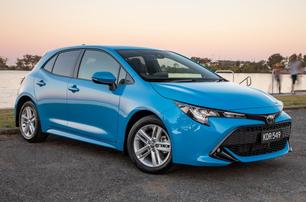
It’s been around for a good seven years, but the current-gen Corolla hatch is still a smart design. It has a squat stance and looks as though it has sporty intentions (it doesn’t), and the head and tail-light treatment doesn’t look like anything else in the segment.
The Corolla has adorable proportions and a pert little behind in a sea of increasingly boring small SUVs.
However, in SX trim and in the ‘Sunstone Orange’ body colour of my test car, the Corolla gives off rental car vibes. Which is hardly surprising given lower grade Corollas are a favourite of rental companies.
Inside that vibe continues. This is where the Corolla is really showing its age.
There are various shades of grey throughout the cabin, with a mix of hard and soft plastics. The cloth seat trim is drab, which is a shame because some other brands have managed to make cloth cool again. Not Toyota.
The touchscreen sticks up out the top of the dash like an old iPad and the dash design is old but functional.
There is nothing inspiring about this interior design. In saying that, of those aforementioned rivals, only the Mazda3 and the new Kia K4 have modern cabins.
It’s a van so there are two distinct sections to the Trail, the cabin and the load space.
Firstly, the cabin. More a work-friendly than family-friendly interior, this Trail is a two-seater with plenty of durable plastic everywhere – ready for work and life – as well as charging (with USB-A and -C ports) and storage (including a van-favourite dash-top slot for logbooks etc, outboard moulded cupholders and a nifty pop-out cupholder), all amenities enough to cope with most daily van-related duties.
The seats are comfortable, supportive and have a fold-down lock-in-place armrest.
Now for the load space. There are no seats back there and as such it has plenty of potential as a work van or touring vehicle.
Access to the rear load space is via a barn door at the back and this Trail has a sliding door on both sides.
The cargo area is substantial – 3002mm long (to the bulkhead; 3450mm long if load-through hatch is used), 1392mm wide (between wheel arches) and 1425mm high (floor to roof). Easily big enough for work equipment or recreational gear. It can cope with four Euro pallets (each measuring 1200mm x 800mm) and it has a listed maximum load volume (with the bulkhead) of 6.8 cubic metres.
Load height through the rear barn doors is 531-585mm, depending on how much weight is already onboard.
The load space has the aforementioned metal bulkhead (with window and load-through hatch), load area protection kit (full height walls and moulded floor), LED lights and eight tie-down loops.
Otherwise, this is a load area ripe for customisation. Maybe a plethora of shelves for a tradie, or some bedding and extra storage for an adventurous person or couple.
The Corolla is a small car and that is evident inside. You might bump elbows with your front passenger, but I have no problem with the front leg or headroom.
Those cloth seats might be drab but boy they are comfy, and the fronts have loads of side bolstering.
The steering wheel has typically clear controls and looks and feels nice.
As a more, shall we say seasoned model in the segment, the Corolla still has buttons on the dash for things like air con, but not too many. That bulbous centre stack and the centre console, however, could be better designed for the space.
As it is, the wireless charging pad is hidden under it at the far end of the console. It’s a bit fiddly to get your phone in and out. This is also where one of the USB-C ports lives.
The other one is in the central storage bin which is quite small, but also houses a 12-volt outlet. There are no other places to store things because of the rounded shape of the console, which also features a couple of narrow cupholders.
OurCarsGuide bottle had to be squeezed into the door storage cavity - only narrow, short vessels will fit properly.
That 8.0-inch multimedia screen is very easy to navigate, with logical menus and icons. However, it’s almost too basic, which is not helped by the all-white background. It could be a more engaging set-up but it’s also very hard to fault the functionality. Our Apple CarPlay maintained its connection the whole time with the car, too.
Space is quite tight in the rear, although I have enough headroom for my 184cm frame. Legroom is just okay behind my driving position. There’s more space in the back of a Hyundai i30. It’s also dark because of smallish rear windows and thick C-pillars.
The rear seat backrest is quite upright, but, like the front seats, well cushioned.
Amenities are just average back there - there’s a weird cupholder high on the door, only a passenger side map pocket, no rear air vents and no USB ports, although you could easily use the one housed in the front central bin. There’s a rear fold-down armrest with two cupholders.
The rear seats split and fold 60/40 and they fold flat making for a better loading space.
The good news is the SX (and the base Ascent Sport) come standard with a temporary spare wheel, which is great news for a hybrid model. The bad news is, that reduces boot space to a paltry 217 litres.
That’s off the pace of all of its key hatchback rivals, including the Mazda3 which has its own cargo concerns at 295L, and the Hyundai i30 with 395L.
The Corolla ZR hatch has more space at 333L but you only get a tyre repair kit instead of a temporary spare.
If you’re dead set on a Corolla but need more cargo space, consider the smart looking sedan that has 470 litres.
The 2025.75Y Ford Transit Custom Trail has a MSRP of $61,990 (excluding on-road costs).
Standard features onboard include a 13-inch multimedia touchscreen (with wireless Apple CarPlay and Android Auto), a 12-inch digital instrument display and synthetic leather upholstery with Trail logos on the seats.
Other gear includes an eight-way manually adjustable driver’s seat, keyless entry and start, front and rear parking sensors, climate-control air and automatic LED headlights.
It also has all-wheel drive, LED headlights and daytime running lights, a variant-specific grille, black wheel arch moulding and side strip, yellow exterior decals and 16-inch matt black Trail twin-spoke alloy wheels.
The standard no-cost exterior paint is 'Frozen White'. Anything else – 'Agate Black Metallic', 'Grey Matter', 'Magnetic' or 'Moondust Silver' – will cost you $700.
Toyota dropped all exclusively internal combustion engine versions of passenger car models and car-based SUVs last year so the Corolla is now hybrid-only.
The grade we tested is the SX five-door hatchback which is priced from $35,260, before on-road costs. Interestingly, the sedan version, which has a much bigger boot, is $340 cheaper.
The SX sits in the middle of the Corolla range with the Ascent Sport the most affordable (from $32,110) and the ZR the priciest before you get to the fire-breathing GR Corolla hot hatch.
Direct rivals at this approximate price point include the Hyundai i30 N Line ($36,000 BOC), Mazda3 G20 Touring ($37,110), Subaru Impreza 2.0R ($35,490) and the Kia K4 Sport ($35,190), although that is sedan only for now.
You get 16-inch alloy wheels, cloth bucket seats, a synthetic leather steering wheel, auto-dimming rear view mirror, rain-sensing wipers, rear privacy glass, keyless entry and start, dual-zone climate control, USB-C ports, a wireless device charging pad, six-speaker audio, an 8.0-inch colour multimedia display with sat-nav, digital radio, Bluetooth, voice assistant and wireless Apple CarPlay and Android Auto.
The standard features list could be described as adequate without being overly generous for the price. A head-up display (standard in the ZR) would be nice.
The Ford Transit Custom Trail has a 2.0-litre four-cylinder turbo-diesel engine producing 125kW at 3500rpm and 390Nm at 1750-2500rpm.
The Trail has a clever eight-speed automatic transmission and an on-demand all-wheel drive system.
It all works rather well, but it’s a van afterall and as such it is less dynamic and more dependably driveable than perhaps a cross-shopped SUV wagon. However, as an AWD van the Trail can be trusted to keep its grip on wet bitumen, soggy grass and loosely-gravelled tracks and that’s a strong part of its appeal over a 2WD van.
Since Toyota dropped the petrol engine from the Corolla range, it’s a hybrid-only affair.
The powerplant is a 1.8-litre naturally aspirated petrol engine paired with Toyota’s fifth-generation hybrid system that incorporates a lithium-ion battery, which is lighter yet more powerful since the 2022 update.
The Corolla drives the front wheels exclusively via a continuously variable transmission (CVT).
It’s not the punchiest engine and could do with more poke, but Toyota does do hybrids well.
The Ford Transit Custom Trail has an official combined cycle (urban/extra-urban) fuel consumption figure of 8.5L/100km. On this test I recorded 8.8L/100km.
The Trail has a 70-litre fuel tank so going by my on-test fuel figure you could reasonably expect a driving range of about 795km from a full tank of diesel. However, as with any vehicle, once you’ve loaded the Trail with real-world burdens (e.g kids, dogs, camping gear, etc) you’ll soon see that fuel consumption increase.
According to Toyota the official fuel-use figure for the Corolla hybrid hatch is 4.0-litres per 100 kilometres and CO2 emissions sit at 90g/km.
While the trip computer said 4.8L/100km at the end of our week, my own fuel consumption calculation came to 5.8L.
You will only need 91 RON 'standard' petrol to fill up the Corolla.
It’s easy to get in and out of the Trail’s driver seat with a wide-opening door and a big step to help you inside.
The seats are comfortable and it’s simple enough to dial-in your driving position via the tilt-and-reach adjustable steering wheel and manually-adjustable seat.
Word of warning: the auto transmission is operated via a stalk mounted on the right-hand side of the steering wheel column, which takes some getting used to.
Once underway, the Trail is punchy enough around town and in the suburbs with its 2.0L 'EcoBlue' turbo-diesel engine offering a more-than-adequate amount of power and torque (125kW and 390Nm) and its clever auto helping out with nifty moves through traffic (for a van, anyway).
Visibility is impressive from the cabin and you’re afforded a convenient vantage point with the Trail standing a bit taller than its regular Transit Custom stablemates as it’s on lifted suspension, but feeling composed on most surfaces.
The Trail has a listed kerb weight of 2046kg and a turning circle of 12.1m, pretty standard for a long wheelbase van, so this is not an insubstantial vehicle and it’s a bit tricky to 'flip a u-ee' if the situation demands it.
It has six drive modes – 'Normal', 'Eco', 'Slippery', 'Tow/Haul', 'Sport', 'Trail' – which each adjust engine torque, throttle response and traction control, among other things, to suit the road surface and conditions.
But we’re all here to see how it goes off-road, aren’t we?
Well, obviously this is no rock-crawling machine and it’s not intended to be. It’s best thought of as having an all-wheel drive system that gives this van mild off-road capabilities, as in it can tackle wet bitumen, soggy grass, lightly corrugated bush tracks and very shallow mud puddles with more confidence than the Transit Custom Trend it's based on.
In a nutshell, the AWD Trail will be able to handle most low-level traction-compromised scenarios. But it does not have enough ground clearance, wheel articulation, grip or underbody protection to tackle any terrain beyond modest off-roading.
Speaking of grip, the Trail as standard rides on Bridgestone Duravis R660 (215/65 R16) rubber, a van/light truck commercial tyre and they are not so well suited to dirt tracks and the like. Grippier all-terrain tyres would help this van perform slightly better off-road than on its showroom rubber.
In its favour, the Trail has a front skid plate and underbody protection in case it cops some knock from the ground during its adventures.
Not in its favour, however, especially as a potential touring vehicle, is the fact it has a space-saver spare wheel and tyre.
If you’re thinking of using your Trail as a tourer, it’s worth knowing payload is listed as 1179kg, maximum braked trailer towing capacity is 2500kg, Gross Vehicle Mass (GVM) is 3225kg and GCM is 5725kg.
Most generations of Corollas have been solid, dependable and occasionally, even fun to drive.
My first car was a Holden Nova GS hatchback, which was a rebadged version of the seventh-generation Corolla. I loved that car. It was zippy, fun and super economical.
The same principles generally apply to the current-gen Corolla. Thankfully, Toyota’s former CEO, Akio Toyoda, insisted all models from the Camry to the Kluger needed to be injected with more fun. And he succeeded with the Corolla. So much so that they've spun off a wild GR performance hot hatch version.
The Corolla sits low to the ground and it just feels much more connected to the road than a small SUV can. Even in mid-range SX guise, the Corolla can hug a corner and there is ample grip to ensure a fun drive on your favourite winding road.
Sure, the hybrid powertrain might not set your heart racing, but it is quick enough from a standing start and it lacks the lag of some of its turbocharged contemporaries. There’s also plenty of poke on tap for a small car when overtaking.
Even though it has a sporting edge to how it handles, the Corolla SX has been tuned for comfort first and foremost and this is another area it excels. The damper set-up ensures the Corolla soaks up speed bumps, nasty potholes and whatever else our shoddy roads can throw at it. At no point in my seven days with the Corolla did I complain about a harsh bump or thud.
Steering has a mechanical feel but it is still sharp, adding to the ‘chuckable’ vibe of this hatchback.
The powertrain can be noisy when pushed and combined with a CVT auto it’s the nicest sounding engine out there. Also, the transition from electric to petrol power isn’t particularly smooth. Other carmaker’s hybrid offerings - like Honda for example - are close to seamless.
Some road noise gets into the cabin but it’s no deal breaker.
The Ford Transit Custom was tested as part of ANCAP’s Commercial Van Safety Comparison in 2024 and received a Platinum score “achieving a near-perfect score in safety assessments”, according to ANCAP.
The Trail has all of the Custom’s driver-assist tech and safety features, including six airbags (driver, front passenger, front side curtain and front side seat), as well as AEB, adaptive cruise control (with stop and go), traffic sign recognition and lane centering, blind-spot monitoring and assist, rear cross-traffic alert, forward collision warning, hill launch assist, side wind stabilisation, front and rear parking sensors, a rear view camera (with 180-degree split view) and on-board tyre pressure monitoring.
The Corolla is currently unrated by crash safety watchdog ANCAP. It did achieve a maximum five-star rating back in 2018 but that expired at the end of last year.
Safety features are largely standard across all grades and the SX comes with auto emergency braking (AEB) with pedestrian and daytime cyclist detection, lane departure alert with steering assist, speed sign recognition, 'Lane Trace Assist', adaptive cruise control, a blind spot monitor with safe exit assist, a rear cross-traffic alert, reversing camera and front and rear parking sensors and a rear occupant alert.
It doesn’t have a driver attention alert, and it’s all the better for it.
The lane keeping aid is well calibrated and subtle in its interventions, but the adaptive cruise let the speed creep several kilometres over the set speed on several occasions.
Ford’s five-year/unlimited kilometre warranty applies to the Trail.
Servicing is set down for every 12 months or 30,000km and capped-price servicing is offered. Four scheduled services will set you back $2000 (including a brake fluid change at year three) which isn't over the top for a vehicle of this type.
Ford Australia has about 195 independent Ford dealers in Australia, with many located in metropolitan or suburban areas.
The Corolla is covered by Toyota’s five-year/unlimited kilometre warranty, which, given Kia, MG, GWM, Jaecoo and more have longer terms (not to mention Nissan and Mitsubishi’s conditional 10-year terms) is now officially trailing its competitors.
However, the capped-price servicing plan of up to five years costs just $250 for each service, which is incredibly competitive. The service schedule is every 12 months or 15,000km, whichever occurs first.