What's the difference?
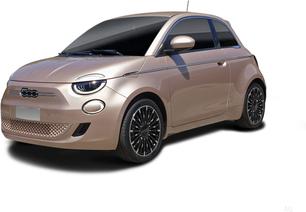
You wouldn’t know it to look at it, but this is a brand-new — as in really and truly all-new — Fiat 500.
That has got to be a big deal for fans of Fiat’s pint-sized city car, with a genuinely all-new 500 about rare as spotting Halley’s Comet soaring over Turin. The last time was way back in 2007, by the way, and that car will remain on sale alongside this new one for the foreseeable.
But that’s not the only surprise. This 500 is also entirely electric, properly modern inside, and it has actual technology in its cabin and on its safety list.
Fiat reckons this is a big reset for the 500. And that there will never be another all-new petrol model again.
So, how does this new 500e stack up against the recent flood of small EVs, predominantly from China?
Let’s go find out.
Kia admits that, even a handful of years ago, a car like the EV4 likely wouldn't exist in Australia. With a forecast of 70 sales a month, or 840 a year, it won't come close to the brand's biggest all-electric sellers, and senior executives and product planners alike would have been wondering if it was worth the effort.
But times have changed, and so have regulations, and Kia is happy to roll the dice on as many EVs as it can get its hands on to lower its fleet emissions in the wake of the New Vehicle Efficiency Standard (NVES).
If you'll forgive the long and rambling intro, I'll now get to the point. Long live the NVES, because the EV4 is a good (if a little bizarre-looking) thing. It's quite lovely to drive, will cross vast distances in its long-range guise, and will undoubtedly make our roads a more visually interesting place.
But would you have one over the Tesla Model 3 or BYD Seal? Read on.
A fun, funky EV which will no doubt appeal to lovers of Italian style, but also one which struggles a little on the range and price front.
Still, there’s no doubt that electrification has improved the Fiat 500 formula.
An electric sedan is really shrinking the buyer pool, which is why Kia has such gentle expectations for the EV4 in Australia. But it's a lovely driving EV with plenty of perks, and the design alone will brighten up Australia's roadways. For my money, I'd either be going for the cheapest one that's sharp value with plenty of kit, or the flagship GT-Line that gets the big battery and the works in terms of equipment. The Earth for me sits in no-man's land.
Note: CarsGuide attended this event as a guest of the manufacturer, with travel, accommodation and meals provided.
Note: The author, Andrew Chesterton, is a co-owner of Smart As Media, a content agency and media distribution service with a number of automotive brands among its clients. When producing content for CarsGuide, he does so in accordance with the CarsGuide Editorial Guidelines and Code of Ethics, and the views and opinions expressed in this article are solely those of the author.
It looks, well, it looks like a Fiat 500.
It’s actually bigger in every dimension than an ICE cinquecento, but it doesn’t really look like it, which is a good thing.
The 17-inch wheels look great, and big against the very small Fiat, and I like the hidden doorhandles, which make the already smooth-looking 500’s flanks look a little smoother still. But I can take or leave the little DRLs up front that are meant to act as little illuminated eyebrows for the headlights, which come over a bit too cutesy.
But I think the highest compliment I can pay it is that it looks like a regular Fiat 500 — one of the most successful reincarnations of a timeless design ever — and not some modern, eco-friendly version that would have killed the look.
In the cabin, however, it’s definitely a more modern affair, with the big screen, the horizontal push-button gear selector, and the nifty push-button door openers.
Still, it’s all pretty familiar Fiat 500, only a little nicer, even if some of the plastics are far too hard and scratchy for a vehicle this expensive.
There are five colours available: Ice white, Onyx black, Rose gold, Ocean green and Celestial blue.
The slippery-looking unit that adorns this page is the EV4 sedan. There’s also a hatch, but it comes out of Europe, while this one comes out of Korea, and that would likely make the hatch far more expensive than this bad boy. It's under study, apparently, but yet to be confirmed.
Anyway, to steal a hackneyed football analogy, for mine this is a game of two halves. I actually really like the front end. It looks sleek and slippery and there’s a real presence from the swollen arches.
I am, however, a little less sold on this rear end, which looks sharp and blocky and almost like it has been bolted on. Also annoying is the fact that it looks like it should be a liftback, with the boot hinged up above the rear windscreen. But nope, it's hinged below it, so you still get a dinky little opening to squeeze your stuff through.
Kia's international designers are pushing the boat out at the moment, and they deserve credit for making things different. Whether it sinks or swims with the general public, though, will be the real test.
Inside, it's all pretty traditional Kia, with all three models sharing the twin 12.3-inch digital displays, along with the little climate panel in the middle. Kudos to Kia for keeping some physical buttons, too. I'm less sold on the use of some cheap, hard plastics, even in the top-spec cars.
The 500e is 29mm taller, 61mm longer and 56mm wider than the current ICE Fiat 500 (now 1529mm, 3631mm and 1683mm respectively), and it rides on a longer wheelbase, too .
That means more front-seat room and head room, but there’s still not oodles of space in the four-seat cabin, and especially in the back, where things are pretty tight.
I’m 175cm tall, and my head touches the ceiling in the back, and if I had another full-size human in the back with me, I’d want it to be someone I know well, because we’d be well and truly aquatinted by the time we got to our destination.
The front seats are more accomodating, but there is a strange tightness to the pedal area for the driver. It’s so tight, in fact, that when you rest your left foot, you have to be careful not to accidentally clip the brake pedal when driving.
The boot is a small 185 litres, too. But you’re not buying this for practicality perks, are you?
At 4730mm long, 1860mm wide and 1480mm tall, the EV4 sits between the Model 3 and the Seal in terms of its outright dimensions. Kia says the EV4's wheelbase and interior packaging has been designed to maximise backseat space, which I must admit, there is plenty of.
Sitting behind my own 175cm driving position, I had miles and miles of leg room, and enough head room, though there is some kind of optical illusion that occurs in the backseat of the EV4 – even though you definitely have enough space, the dark materials of the GT-Line still leaving me feeling a little claustrophobic somehow.
Something else not to be sneezed at is the inclusion of the household-style power plug in the back. My laptop died while I was taking notes on my test, and I plugged it straight in and powered it up. Super handy.
At the back, there is 490 litres of boot space, which is about middle ground. The Seal is more like 400 litres, but the Model 3 offers more.
Sadly the EV4 is yet another EV that does not have a spare wheel of any kind. Instead you have to make do with a tyre repair kit.
The 500e is not cheap by modern small EV standards — we’re looking at you, China — but it does arrive in one well-equipped trim level, called La Prima, with paint the only available option.
It's also, quite shockingly for anyone who has driven an ICE Fiat 500 lately, stacked with some truly high-tech kit.
There’s heated seats for the first time ever, for example, and there’s 10.25-inch central screen with Apple CarPlay and Android Auto, and wireless charging.
There’s a digital driver display, too, plus there’s faux-leather on the seats and dash, a panoramic glass sunroof and fancy push-button front doors (though with a mechanical back-up lever hidden in the door pockets should something go pear shaped).
Outside, you’ll find 17-inch alloys, as well as LED lightning all around, including the DRLs, and there’s keyless entry and push-button start, too.
But, and it’s a significant but, the 500e lists at $52,500 before on-roads , which — when you consider its size, battery and range — really edges it into the premium EV space.
A similar-sized EV from China can be had for under $40k, which means you are going to have to really love the 500e to drop that extra $15k or so.
In modern Kia EV style, the EV4 arrives in three trim levels — the Air, Earth and GT-Line — and then in Standard Range or Long Range battery sizes.
The range opens with the Air, which is a pretty sharp-feeling $49,990 before all of your on-road costs. Kia says drive-away pricing is coming, but how much it will be is still to be figured out.
That money buys you the Standard Range battery, which we will come back to in a moment, along with 17-inch alloys, flush-finishing door handles, LED lighting, rain-sensing wipers and heated wing mirrors.
Inside, there are two-tone cloth seats, an artificial-leather steering wheel and dual-zone climate with rear vents, while tech is handled by Kia’s loveable dual 12.3-inch screens (one for your entertainment, and another for your diving info), with a smaller 5.0-inch screen between them that handles climate settings. There’s wireless Apple CarPlay and Android Auto, a six-speaker stereo and four USB-C connections, too.
All EV4 model grades get two vehicle-to-load (V2L) connections (so you can plug things in with a normal household plug), with one in the backseat and the other as part of the exterior charger – though the latter is an accessory on the Air. All also get access to the Kia Connect app and over-the-air updates, too.
Stepping up to the Earth ups the spend to $59,190, which is a gigantic financial leap, but you’re mostly paying for the bigger battery and longer driving range, as well as 19-inch alloys, cloth-and-synthetic-leather seats, a powered seat for the driver, and Kia’s very cool and comfortable mesh headrests.
Finally, the GT-Line tops the range, and is yours for $64,690. It gets a more polished look, courtesy of the exterior plastics being swapped out for gloss-black detailing, and it rides on its own 19-inch alloy design. It also gets a sunroof, a powered boot, dynamic welcome lights and projection headlights.
Inside, there’s a heated steering wheel, full synthetic-leather seats, relaxation seats to get comfy when charging, and ambient interior lighting. You also get ventilated front seats, a better eight-speaker Harman Kardon stereo and wireless device charging.
That is a big, broad pricing spectrum, and something tells me Kia has worked very, very hard to get that entry-level model below $50k, where it can compete with the likes of the BYD Seal ($46,990) and Tesla Model 3 ($54,900).
A single front-mounted electric motor delivers the power here, with 87kW and 220Nm on offer. Enough, Fiat says, to knock off 100km/h in 9.0 seconds. But it does feel quicker than that in real life, thanks to the way electric vehicles deliver their power.
There’s the usual EV single-speed gearbox, too, with power sent to the front wheels.
All EV4 models are front-wheel drive, with a single front-mounted motor producing 150kW and 283Nm, fed through a single-speed gearbox. That’s enough, Kia says, to knock off the sprint to 100km/h in around 7.5 seconds. The Air is the fastest, at 7.4s, while the heavier Earth and GT-Line claim 7.8s. Top speed is a claimed 170km/h.
The Fiat 500e’s 42kWh battery provides a smallish 311km driving range on paper, but when we got in it was more like 290km at 96per cent charged. A city car, then, rather than a long-distance hauler.
When it does come time to charge, you’re set up for 85kW DC fast charging which should take you from zero to 80 percent in 35 minutes.
Let’s talk about range for a moment, because it's bloody impressive. Not quite the best out there, but the furthest any electric Kia has ever travelled between charges.
There are two battery options, a 58.3kWh NCM battery in the Standard Range, and a 81.4kWh unit in Long Range models. The Standard will deliver 456kms in driving range, but the Long Range ups that to 612kms, both on the WLTP cycle.
The EV4’s 400-volt architecture does slow down charging a little, though, with DC fast charging capped at 128kW. That means going from 10 to 80 per cent in around 30 mins when using the fastest chargers. If you’re using a 50kW charger, it’s up to almost an hour and 20 minutes for the bigger battery, which is a long coffee stop.
Plugged in at home, provided you have an 11kW wallbox, it’ll take just under five and a half hours, or just over seven hours, to go from 10 per cent to fully charged, so an overnight charge no matter the battery size.
This is the probably the best-driving example of the Fiat 500 I’ve ever climbed into. Sure, it’s not quite as engaging as self-shifting a perky little manual, but it’s smoother, easier and more comfortable, and a whole lot better than ICE vehicles fitted with Fiat's odd dual-logic automatic gearbox.
The EV transition genuinely suits the little Fiat, admittedly sapping a little character, but also thoroughly modernising the drive experience, with smooth, constant acceleration, sharp-enough steering and a ride that’s mostly settled, only really becoming crashy over the bigger road imperfections.
The small dimensions here also help the EV reincarnation. Yes, it’s heavier than you might expect, weighing in at 1290kg (tare), with the batteries adding several hundred kilograms to the equation, but the 500e still doesn’t feel overly heavy, with the little Fiat remaining pretty light on its feet.
There are three drive modes on board, including the catchy Sherpa mode (because it will help get you where you’re going), which, when you’re running low on battery, kills the climate control and anything else it needs to preserve range and get you home.
But you can’t shake the feeling that the 500e is a little expensive for such a specialist tool. It’s unashamedly a city car, but one that will cost you more than $50k, and which doesn’t feel quite premium enough in the cabin to justify that asking price.
I learned something new and exciting (well, to me, at least. You might be very bored) from Kia's ride and handling guru on this launch. And that is that the tuning frequency for common city road imperfections, like bridge expanders, is actually the same as for the bigger, bouncier undulations you get on country roads. And so you can tune to prioritise one or the other, not both.
In real terms, it means a car that feels custom-built for the city, gliding over urban roads with mega comfort (which is exactly what the EV4 does), feels slightly less at home out of town, where there is more obvious movement in the cabin.
Bored yet? Ok, the point is that, while never uncomfortable, the EV4 feels right at home in the city, which is where it's expected to spend most of its time, but weirdly firmer on longer adventures.
This really is easy, city EV motoring, done well. There's no alienating floatiness to the ride, no lifeless lightness to the steering, it's comfortable, quiet and – despite no headline-grabbing power figures – more than potent enough to get you up and moving.
There's nice weight to the steering, and though the front tyres gave up their grip a couple of times when pushed with some steering lock on, there isn't much in the way of aggressive body roll, and it all feels pretty confidence inspiring.
The power is most effective from around 10km/h to 80km/h, before the urgency starts to fall away – it's slower to respond at freeway speeds – but that too just leans into its city credentials.
There's really not much to complain about here. It feels well sorted, and quite fun to drive. There is nothing that really stands out as spectacular about the drive experience, but nor is there anything to complain about. It's just really solid motoring, which isn't always guaranteed these days.
There’s a heap of active safety stuff on board (again, unusual for a 500), with active cruise control, traffic sign recognition, front, rear and side parking sensors, blind-spot monitoring, AEB with pedestrian and cyclist detection, and more.
Still, the 500e only secured a four-star ANCAP safety rating, scoring just below the five-star cut off in Adult Occupant Protection, Child Occupant Protection and Safety Assist, with a lack of a centre airbag not helping.
There’s no ANCAP rating on the EV4 yet, but the brand says it's confident it will adopt the five-star scores issued in Europe. All models get seven airbags, like active cruise control, AEB autonomous emergency braking (meaning it will anchor up if it senses an accident), front and rear parking sensors, an active blind spot monitor that will take evasive action if it senses a collision, and lots, lots more.
Only the GT-Line switches up the standard safety kit offered on the other two grades, adding a surround-view monitor, a camera that shows what’s happening in your blind spot, powered child locks and a reverse parking aid that will brake for you if it thinks you're going to hit something.
The fly in Fiat’s ointment is its ownership proposition, with a three-year, 150,000km warranty now way below par in Australia these days, even if the battery is covered for the standard eight years.
Servicing is every 12 months or 15,000kms, and will cost $250 a pop for the first eight years, which is commendably cheap.
Kia ownership proposition is simple, and pretty strong. You get a seven-year warranty no matter how far you travel, an eight-year warranty for the high-voltage systems, again no matter how far you travel, and capped-price servicing. Pre-paying your service costs will set you back $688 for three years, just over $1300 for five years, or just under $2000 for seven years.