What's the difference?
Cub Campers is Australia’s oldest camper-trailer manufacturer and one of the oldest businesses in the caravan and camping industry, having just celebrated 50 years of operation in 2018.
The company can lay claim to inventing the soft-floor camper trailer, pioneering the rear-fold and championing off-road campers when everyone else was concerned with the on-road market. Amongst all that, though, it was late to the game when it comes to forward-fold campers, not releasing the Frontier until early in 2016, well after the flood of Chinese manufactured versions became immensely popular. So why did Cub wait so long and was it worth it?
The small van segment (Under 2.5-tonne GVM) is one of the smallest in Australia’s light commercial vehicle market, as it currently caters for only three contenders, the Volkswagen Caddy Cargo, Peugeot Partner and Renault Kangoo.
Although total sales in this category are a fraction of those achieved in the mid-size (2.5-3.5-tonne GVM) van division, these compact commercials are ideal for buyers not requiring the big one-tonne payload ratings and cavernous load volumes of their larger siblings.
Petrol and diesel-powered models are typically equipped with small displacement engines offering excellent fuel efficiency, combined with cabin ergonomics and driving dynamics which are the most car-like of any LCV offering.
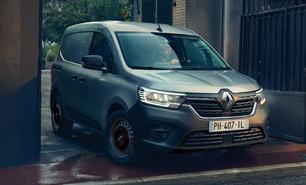
French manufacturer Renault released its third generation Kangoo range in Australia in 2024, comprising a mix of petrol and full-electric variants. We were recently handed the keys to one of the petrol models to see if it has what it takes to win costumers in this three-way fight.
All in all, the Frontier is the best forward-fold camper on the market, although it is also the most expensive. If you were making a buying decision purely based on features, you’d probably look elsewhere, but if you are prepared to pay a little more because this camper-trailer is Australian made, you get a very functional camper that’s easy to set up, reliable, strong and light.
The latest petrol-powered Kangoo has the pricing, practicality and performance to win friends in Australia’s small commercial van class. If you can afford an option pack or two, like those fitted to our test vehicle, it's even better.
The real appeal of a forward-fold camper-trailer is the internal configuration. Because the bed folds out over the front of the camper, the trailer body is configured with a wrap-around lounge and dinette area, that also converts into a bed. It brings a certain level of caravan comfort to a camper-trailer-sized package. Cub’s execution is quite good. The lounge is comfortable and the dinette table is highly adjustable up and down or around and around. It converts into a bed more simply than any other on the market I’ve seen.
The downside of the forward-fold concept is the quantity and access of storage. Very little of the internal storage is easy to get to, and in truth there’s very little of it. That’s what happens when you put a couch in a trailer, sorry. There are hatches under the seats, but even they are limited by the slide-out kitchen and battery box across the back, plus, they’re not as easy to get to as a drawer. It’s the same in every manufacturers version, though. However, the Frontier has one unique features that makes it stand out – a series of pigeon holes under the foot of the bed which provide the only easy-to-access internal storage in any forward-fold I’ve come across so far.
Our test vehicle’s 1447kg kerb weight and 2010kg GVM results in a useful 563kg payload rating.
It’s also rated to tow up to 1500kg of braked trailer and with its 3510kg GCM (or how much it can legally carry and tow at the same time) it can carry its maximum payload while towing its maximum trailer weight for optimum versatility.
Cargo bay access is through asymmetric rear barn-doors which can be opened to 180 degrees for forklift and loading dock access, or sliding doors on each side with (according to our tape measure) 625mm openings. The walls and doors are lined to mid-height and there’s internal lighting.
The cargo bay’s load volume is a competitive 3.3 cubic metres and with more than 1.8 metres in length, almost 1.6 metres in width and more than 1.2 metres between the rear-wheel housings, it can easily swallow one standard Aussie pallet or two Euro pallets.
The load floor, which does not include a protective liner as standard equipment, offers a choice of six load-anchorage points.
The solid bulkhead doubles as a sturdy cargo barrier and insulates the cabin from cargo bay noise, most of which comes from the tyres emanating through the rear-wheel housings.
Given its compact dimensions, the cabin is surprisingly spacious and accommodating even for someone my height (186cm), thanks to front doors that open to a full 90 degrees, generous leg and elbow room plus a high roof relative to the seating position that adds to the airy feel.
Storage includes a large-bottle holder and bin in the base of each door, single glove box, full-width overhead shelf, large open tray in the centre of the dash-pad and (in standard form at least) a centre console with two cupholders and trays for small items.
However, given our test vehicle is equipped with the optional Business Pack, the standard console is replaced with a more elaborate version, which in addition to a pair of cupholders has a wireless phone-charging dock up front and a box with hinged lid at the back.
There’s also a sizeable clamshell-lid compartment set into the dash-pad ahead of the driver, which includes a smartphone holder on a stalk that can be easily moved to either side of the compartment depending on driver preference.
Our only criticism is the lid on the optional console box. Although it’s been thoughtfully angled downwards at the front to provide the driver with comfortable elbow support, there’s no mechanism on the hinge to hold it in the open position.
This makes it awkward to access the box, as the angled lid naturally wants to keep closing on your hand, so a detent in the hinge would be useful.
And, in a similar context, we’d also like to see hinge detents (or struts) to firmly hold the rear barn-doors open in their 180-degree positions, given their propensity to slam shut if hit by wind gusts during loading/unloading.
This can potentially injure the operator, so these devices should be standard issue, not only for Kangoos but all barn-door vans.
The Frontier is quite good under tow. Cub designed and manufactures its own coil-spring independent suspension and has paid quite close attention to the balance and dynamics of the trailer.
As it’s not overly heavy, it’s not a handful, even on the beach, and behind the Mitsubishi Triton I tested it with, it was barely a struggle. On the road, the camper is well behaved, easy to see over and around and because it’s not very long, it’s not very daunting.
Apart from the huge and unavoidable solid-walled blind-spot over the driver’s left shoulder, the Kangoo feels more like a nippy small car than a commercial van.
The driver’s seat has no adjustments for lumbar support or base-cushion rake and the backrest angle is restricted by the bulkhead close behind it, but there’s still enough room even for tall people to find a comfortable driving position.
Its leather-rimmed wheel feels nice in your hands and the unladen ride quality is excellent, with nicely weighted and responsive steering feel, reassuringly strong braking and suspension settings that combine good handling response with supple bump absorption.
The turbocharged 1.3-litre four is a refined and willing performer, albeit with softer response below its peak torque band which is tapped at 1600rpm.
From there it happily spins its way to maximum power at 5000rpm, with the dual-clutch auto getting the best out of this engine in all drive modes, when either unladen or hauling a heavy load.
Its diminutive size and agility are well suited to zipping through heavy city traffic, squeezing into tight loading zones or negotiating narrow and crowded city lanes for delivery work.
Manual sequential-shifting allows more direct control if preferred when hauling heavy loads, or for those simply wanting a more engaging drive experience (particularly in Performance mode).
It's impressively quiet up to 80km/h in city and suburban use, but at highway speeds tyre noise becomes more intrusive (particularly on coarse bitumen surfaces) and some wind noise is evident.
The engine requires only 2000rpm to maintain 110km/h cruising speeds and the (optional) adaptive cruise control is resolute in maintaining its speed settings, even on long and steep descents.
To test its GVM rating, we forklifted 415kg into the cargo bay which with driver equalled a payload of just over half a tonne, or about 50kg under its legal limit.
The rear suspension compressed 55mm, which engaged the long cone-shaped jounce rubbers positioned inside the rear coil springs to provide a second stage of load support.
The Kangoo coped commendably with this payload, floating smoothly over bumps and with minimal effect on handling, braking and engine performance.
It also made light work of our 13 per cent gradient, 2.0km-long set climb at 60km/h, quickly self-shifting down to fourth gear to easily reach the summit.
Engine-braking on the way down was not as robust, as you’d expect from such a small engine with more than half a tonne on its back, but still within expectations for small vans.
Our only gripes are the absence of a full-width driver’s left footrest and that the thick panel separating the bulkhead windows almost completely blocks the central mirror’s view through the LHS barn-door. You can option a smart digital mirror with rear-facing camera to resolve this issue, but that’s another $800.