What's the difference?
The Chevrolet Silverado enjoys enduring popularity in Australia’s unique new vehicle market for locally remanufactured right-hand drive versions of full-size US pick-up trucks.
Armed with unique V8 power, the range offered by General Motors Speciality Vehicles (GMSV) comprises the entry-level 1500 LTZ Premium and top-shelf 1500 ZR2, while the colossal 2500 HD offers the ultimate in heavy towing capabilities.
Their combined sales represent a leading market share of more than 40 per cent, in a specialised segment where purchase prices extend well into six figures.
The latest MY26 Silverado range is backed by a new five-year/unlimited km warranty paired with five years of roadside assist, which provides greater peace-of-mind for buyers than the previous three-year/100,000km and three years' roadside assist. The ZR2 also gets upgraded driver assistance plus additional exterior colours.
We recently spent a week aboard one of the latest 1500s to find out why the Silverado is such a popular choice for Aussie buyers and if it’s well suited to tradie duties.
BYD has achieved much success in recent years in Australia and it's now branching out with a new, more premium brand.
Denza is like the Lexus to Toyota and it’s launching in Australia with two large body-on-frame plug-in hybrid (PHEV) SUVs – the B5 and B8.
The former is on test here and its rivals include mainstream models like the GWM Tank 300 PHEV, however it also pitches itself against more premium offerings like the Land Rover Defender.
We’ve already driven the B5 over in China and this is the first time we’re getting to test it out on Australian roads, so let’s see how it fares.
With its unique V8 soundtrack, all-terrain capabilities and sumptuous comfort, the ZR2 is a quintessential American muscle truck that's as capable of carting crews and accessing rugged worksites during the week as it is towing boats, horse-floats and caravans or getting muddy on weekends. For either work or play, there's a lot to like here.
Denza has made a huge statement with the B5 and for the most part the hype is deserved. It packs an incredible amount of luxury and tech inside and out which is even more surprising given the impressive asking price.
There are only a few flaws like the busy ride, over-the-top body roll and the occasional infotainment quirk. Hopefully these can be fixed with future over-the-air software updates.
Note: CarsGuide attended this event as a guest of the manufacturer, with travel, accommodation and meals provided.
The Silverado’s extensive remanufacturing to RHD, performed on a purpose-built production line in Melbourne, meets OEM standards of fit and finish.
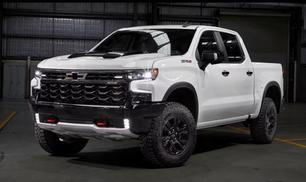
As the off-road focused 1500 model, the ZR2 has hardware and detailing consistent with its rugged bush-bashing persona, highlighted by aggressively treaded mud-terrain tyres and unique raised suspension with high performance dampers.
Other ZR2 features include a raised bonnet with ZR2 applique, ‘off-road cut’ front bumper, bash plates, black grille with ‘Flow Tie’ (flow-through) bow-tie motif, ‘Performance Red’ chassis-mounted front recovery hooks, concealed dual-outlet exhaust, black fender flares/door handles/bumpers/window surrounds and chrome ZR2 badges.
It has a tough and purposeful look with bluff-fronted styling and an imposing stance.
An expansive length of almost 6.0 metres (5931mm) and a 14.4-metre turning circle highlight formidable (and at times impractical) dimensions for urban life.
The cabin is spacious and airy with a tasteful blend of contrasting tones and textures combined with many soft-touch surfaces, yellow stitching along seams and splashes of chrome and satin chrome creating a plush look and feel.
It’s worth calling out straight away that the Denza B5 is essentially an SUV version of the BYD Shark 6 as the two share underpinnings, but it’s much more luxurious and blingy.
Externally it has a big, boxy and bluff design that helps it stand out on the road. It looks even tougher when the suspension is in its lifted mode.
I particularly like the front fascia with the big headlights and the prominent Denza badge on the grille, but there are some strange body creases around the side.
While the boxy looks make the B5 stand out, it’s not necessarily unique. There are elements that are reminiscent of the Land Rover Defender, plus many angles look similar to the GWM Tank 300.
Inside is where the luxe is dialled to the max. There are so many soft touches around the cabin that it makes a lovely place to spend time.
Additionally there is a lot of high-quality physical switchgear which is surprising given how prominent the large 15.6-inch central touchscreen is.
Lastly, I like how substantial many of the finishes are. There are large grab handles on either side of the dashboard which you do need to use to hoist yourself into the cabin, plus chunky interior door handle pulls that are satisfying to use.
The ZR2’s hefty 2587kg kerb weight and 3300kg GVM results in a 713kg payload, which is modest given a seated crew of five big tradies could use up about two-thirds of that payload capacity before loading any of their gear.
It can also legally tow up to 3500kg of braked trailer on a 50mm ball and up to 4200kg on a 70mm ball. The latter figure is 300kg less than the LTZ due to the specialised off-road suspension.
However, given the ZR2’s 6851kg GCM rating (or how much it can legally carry and tow at the same time), you would be left with a mere 64kg of vehicle payload if you wanted to tow the maximum 4200kg.
That’s barely enough for a driver - and a light one at that. Fact is, few if any owners in real-world use would need to tow 4200kg, but it’s important to be across these legal limits if you’re planning to.
The load tub is protected internally by a spray-on liner and offers almost 1.8 cubic metres of load volume. Its load floor is 1776mm long, 1813mm wide and sits 569mm deep, with 1286mm between the rear-wheel housings. More than wide enough for hauling Aussie or Euro pallets.
There are also 12 load-anchorage points, power assistance for lowering the tailgate and a tub camera to keep an eye on loads when driving. The rear bumper provides surefooted tub access using either the centre step or concave side-steps.
All occupants enjoy luxurious space, particularly rear passengers thanks to easy entry created by the wide-opening doors, a flat floor with no transmission hump for the centre passenger to straddle and palatial head and legroom even for tall people. Combined with ample shoulder room, a full crew can travel in enviable comfort.
Cabin storage for the driver and front passenger includes two bottle holders and a bin in each door. There’s also a large glove box and the centre console has an open tray and two USB ports up front, two bottle holders in the centre and a big box at the back topped by a padded lid that provides comfy elbow support.
Rear passengers get a bottle holder and bin in each door, plus more USB ports and two more pairs of bottle holders in the rear of the centre console and in the bench seat’s fold-down centre armrest.
There’s also storage pockets on both front seat backrests and handy compartments for small items are cleverly concealed within the rear seat’s upper-backrest cushions. Its 60/40-split base cushions can also swing up and be stored vertically if more internal load space is required, or to access ample under-seat storage.
Many Chinese cars have lots of bling but lack actual substance when it comes to comfort and usability. This is where the Denza differs.
Take the driver’s seat, for example. In a number of Chinese cars they look plush and comfy, but in reality they are firm after longer drives and lack adjustability.
The B5’s driver’s seat, however, is very comfortable, offering almost limitless adjustment, plus heating, ventilation and even a massage function as standard. The latter is great for longer road trips.
Ahead of the driver the steering wheel has plenty of adjustment, allowing people of different heights and statures to get comfortable behind the wheel. There are also lots of physical buttons and switches that have a satisfying click when pressed.
The digital instrument cluster is high-resolution and clear, and there's a number of different informative pages that you can cycle through. It’s nice to have this level of customisation.
Moving across, the aforementioned 15.6-inch touchscreen multimedia system dominates the dashboard. If you’re familiar with the user interface in other BYD vehicles, it’s virtually identical in the B5.
It’s very easy to navigate around and if you do get lost there are a number of shortcut buttons at the bottom of the screen that can either take you back home or to other key functions.
One of my favourite features about the screen is the swipe-down control centre menu. You can customise it to have key shortcut functions. It’s much better than having to dig through countless submenus.
It’s clear Denza still has a few kinks to iron out with the translations from Chinese to English as some don’t make sense. Denza will likely sort this with future software updates.
As standard there is wireless Apple CarPlay and Android Auto and it takes up the full screen when connected. It’s a stunning set-up, though reaching the far left-hand side of the screen from the driver’s seat can be a little tricky on the move.
As I touched on earlier, there is a lot of physical switchgear around the cabin which is helpful as you don’t need to solely rely on the touchscreen for key functions. The piano key buttons for the drive and EV/HEV modes are particularly handy, plus the rising gear shift lever is premium-feeling.
In terms of storage up front, there are up to two 50W wireless chargers (depending on the variant you opt for) with ventilation, two cupholders with adjustable depths, some shallow storage under the centre console, plus a fridge/hotbox under the centre armrest.
Moving to the second row there is plenty of space for at least two adults to sit comfortably. Pushing it to three may be a little tight with shoulder room, plus the centre seat is raised compared to the outboard ones. It’s worth noting though that there is a flat floor so you don’t need to fight for foot space.
Second-row amenities include chunky grab handles for easy ingress and egress, air vents on the back of the centre console, as well as heated and ventilated outboard seats in the top-spec Leopard trim. It’s properly luxe.
At the back the tailgate is side-hinged which can be problematic if you reverse into a carpark as you need to allow for space for it to open up. It has a soft-close function which is handy as you don’t need to slam it shut.
There’s 470L of boot space with the rear seats upright, expanding to around 1000L when folded. It’s a decent amount of space and is square with a very minimal load lip.
Amenities include a 12V socket, a wide array of hooks and nets, as well as a small storage space under the boot floor for the charging cables.
Lastly the B5 comes with a full-size spare wheel mounted on the tailgate. This is becoming increasingly rare in electrified vehicles and is very handy if you have a puncture.
Our 1500 ZR2 test vehicle, like its LTZ Premium sibling, comes standard with GM’s thumping 6.2-litre petrol V8 paired with a 10-speed automatic and multi-mode 4WD transmission for a list price of $144,900.
Our example is also fitted with several items from the GMSV genuine accessory range including the tri-fold tonneau cover, side rocker protectors (aka rock rails) and matching removable side-steps. It’s also finished in 'Riptide Blue Metallic', which like the accessories is available at extra cost.
The ZR2’s standard equipment includes 18-inch gloss black alloy wheels with chunky 275/75 R18 Goodyear Wrangler Mud-Terrain tyres and a full-size alloy spare, LED headlights/DRLs/tail-lights, load tub camera, spray-on tub-liner with ZR2 logo, power tailgate, 4500kg towing kit including towbar, 12-pin harness and electric trailer-brake controller, 360-degree camera with up to 14 views and lots more (see Design).
Climb aboard the sumptuous interior with its keyless opening/start and you’re treated to a heated leather-wrapped steering wheel with power tilt/reach adjustment and multiple remote controls, leather-appointed and heated/cooled driver and front passenger seats with 10-way power adjustment and memory settings, heated rear seats, power sliding rear window, dual-zone climate control, front and rear USB ports and lots more.
The high-feature dash includes a colour 12.3-inch configurable driver’s instrument display and 13.4-inch multimedia touchscreen that controls, among other things, the Bose premium sound and wireless Apple CarPlay/Android Auto connectivity. The driver also has a choice of adaptive and non-adaptive cruise control plus there's a head-up display, switchable rear-view mirror camera function, tyre pressure monitoring and lots more, including the recent addition of standard front parking sensors on the ZR2.
Owners who need to tow will appreciate the reversing camera with hitch guidance and view, in-vehicle trailering app with different trailer profiles, trailer theft alert, automated trailer lighting test and a GCM alert.
The 2026 Denza B5 is offered in two trim levels – entry-level and the top-spec Leopard. Pricing for the former is $74,990 before on-road costs, while the latter is $79,990 before on-road costs.
This is very competitive and it undercuts many top-selling rivals like the diesel-powered Toyota Prado and Ford Everest by a significant margin if you want similar levels of specification.
It’s worth noting however, the GWM Tank 300 PHEV, which is the B5’s closest rival in terms of powertrains, is even cheaper at $59,990 drive-away.
As a base, the B5 is loaded with standard equipment. You get 18-inch alloy wheels, adaptive LED headlights, a glass panoramic sunroof, 12.3-inch digital instrument cluster, 15.6-inch touchscreen multimedia system, 16-speaker Devialet sound system, leather upholstery, heated and ventilated front seats with a massage function, plus heated outboard rear seats.
If this isn’t enough, the B5 Leopard gets larger 20-inch alloy wheels, adaptive hydraulic suspension, a digital rear-view mirror, a second wireless phone charger, Nappa leather upholstery and ventilated outboard rear seats.
This amount of standard equipment is wild, especially because the asking price is firmly below $100K.
Like the LTZ, the ZR2 is powered by a 6.2-litre petrol V8 producing 313kW of power at 5600rpm and 624Nm of torque at 4100rpm. It features cylinder deactivation to optimise fuel economy when full power isn't required.
This is paired with a refined 10-speed torque converter automatic, armed with an auxiliary external oil cooler ideal for heavy towing duties and off-road slogging. It also offers sequential manual shifting using steering wheel-mounted paddles and there are numerous selectable drive modes.
Its dual-range transfer case with push-button control offers the choice of '2WD High', '4WD High', '4WD Low' and '4WD Auto', with the latter being a full-time torque-on-demand system. It’s also equipped with driver-selectable front and rear locking differentials for optimum traction in the rough stuff.
Power comes from plug-in hybrid set-up combining dual electric motors (one on each axle) and a 1.5-litre turbocharged four-cylinder petrol engine.
It’s a similar set-up to the BYD Shark 6, but the B5 has more power. Total system outputs are a meaty 400kW and 760Nm, which is good for a claimed 0-100km/h sprint in just 4.8 seconds.
Power is sent to all four wheels and for added peace of mind off-road there are front and rear mechanical diff locks as standard, plus a wide range of drive and terrain modes, including a low-range mode.
Backing this up is a 3000kg braked towing capacity and up to 600kg of payload.
GMSV claims official combined cycle (urban/extra-urban) fuel consumption of 12.7L/100km and the dash display was showing 15.3 when we stopped to refuel at the completion of our 397km test, which included our usual mix of suburban, city and highway driving of which about half was hauling a variety of payloads.
This compares to our own figure, calculated from fuel bowser and tripmeter readings, which was higher again at 16.8L/100km. That exceeds the usual 2.0-3.0L/100km discrepancy between official and real-world consumption but is still acceptable for a 2.5-tonne pick-up powered by a big petrol V8 in urban use.
So, based on our real-world consumption figure, you could expect a driving range of around 540km from its relatively small 91-litre tank.
Feeding the electric motors is a 31.8kWh lithium iron phosphate (LFP) Blade battery which Denza claims to allow the B5 to travel up to 100km on electric power alone, according to NEDC testing.
There’s also vehicle-to-load (V2L) capability with 6.6kW output through the charging port using an adapter. This allows you to use the battery charge to power appliances. It’s handy if you go camping, for example.
The battery can be AC charged at rates up to 11kW or DC fast-charged at rates up to 100kW.
There’s also an 83L fuel tank. Denza claims the B5 has a total range of 975km, according to NEDC testing.
Fuel consumption depends on whether or not you charge up the battery. Denza claims you’ll use 1.9L/100km from 100 to 25 per cent battery charge and 9.5L/100km under 25 per cent battery charge, both according to NEDC testing. Regardless, this is better than similarly sized diesel-powered SUVs.
The ZR2’s raised off-road suspension requires more of a climb aboard than the LTZ, but the low-slung removable side-steps fitted to our test vehicle certainly make boarding easier and are an accessory worth considering if most of your driving is on-road.
There are large handles on the truck’s A- and B-pillars to assist entry to the cabin where the driver is treated to multiple power adjustments of seat and steering wheel plus a large left footrest, which together provide a very comfortable driving position.
The ride and handling are outstanding, as the ZR2’s suspension combined with the additional cushioning of its baggy all-terrain tyres is commendably supple over bumps, yet it's surprisingly responsive to steering input without the ponderous feeling expected in a vehicle of this size and weight.
This response is optimised when the ‘Sport’ mode is selected as it sharpens steering, brake pedal feel and suspension tuning for a more engaging drive. It also activates the louder and freer-flowing exhaust setting and modifies the auto’s shift calibration, which allows the V8 to shine with a guttural roar under full throttle that is not only an aural delight but can quickly reach triple-digit speeds with remarkable ease.
By contrast, it can also deliver relaxed and fuel-efficient highway travel thanks to the V8’s auto cylinder deactivation and less than 1500rpm being required to maintain a leisurely 110km/h. Engine, tyre and wind noise are negligible at these speeds.
To test its payload rating we forklifted 475kg into the load tub which combined with our crew of two equalled a total payload of 655kg that was within 60kg of its legal limit.
The rear leaf-springs only compressed abut 35mm under this loading, which left more than enough bump-stop clearance to ensure there was no bottoming out on our test route. The ZR2 performed so effortlessly with this payload it was easy to forget we even had one.
Our only criticism of the driving experience was the tri-fold tonneau cover. When hauling loads, this accessory is designed to fold forward into a flat bundle that leans against the rear of the cabin with two adjustable struts to brace it in place (see photo).
This worked fine during suburban driving up to 80km/h but was not suited to higher speeds, as the increased air pressure made it flex enough to block the rear-view mirror's camera view. So, an alternative tonneau design would be preferable for those needing to do lots of highway travel with uncovered loads.
Behind the wheel the Denza B5 primarily operates as an electric vehicle (EV) first up, meaning it’s largely quiet inside the cabin when driving around normally.
Once the charge starts to drop, the petrol engine typically switches on to top up the battery. It largely acts as a generator and a lot of the time you can’t actually tell whether it’s on or off.
In some cases where you floor the throttle or go up a steep hill, the engine revs can flare and that’s when it makes its presence known in the cabin.
When the battery charge gets down low enough and you gun it, the petrol engine can directly power the front wheels. This is rare though because the car purposefully leaves at least 25 per cent battery charge in reserve.
With 400kW and 760Nm thanks to the combination of the dual electric motors and the 1.5-litre turbo-petrol engine, the B5 absolutely hauls. The peppy feel is largely due to the instantaneous torque the electric motors provide.
However, in the standard drive mode there is a noticeable input lag from when you push the accelerator a bit harder and when the car actually accelerates. This is reduced in the sport drive mode.
Despite the juicy outputs, the B5 does feel its weight. When you accelerate hard it pitches back extensively, much like the Jeep Grand Cherokee Trackhawk. This never failed to make me smile though.
It’s surprising as we only drove the top-spec B5 Leopard on this launch and it comes fitted with the DiSus-P adaptive hydraulic suspension system which has a self-levelling function.
In the bends the B5 gets a considerable amount of body roll regardless of the drive mode. This is common for many Chinese cars as they typically prioritise floaty comfort-oriented tunes over a firmer and more dynamic-feeling ride.
Despite this, once it leans over it’ll comfortably hold and grip, largely thanks to the chunky 275/55 R20 Pirelli Scorpion tyres that come standard on the top-spec Leopard trim.
Like many body-on-frame vehicles, the ride gets busy on harsher roads with more frequent bumps. As a passenger you can get jostled about in the cabin.
The steering, while direct enough, can have a vague and artificial feeling. Depending on the drive mode it either artificially adds or reduces the resistance.
Unlike the related BYD Shark 6, the B5 gets a low-range mode which uses a clutch pack on the rear electric motor to allow for more controlled low-speed crawling, plus front and rear mechanical diff locks. This can make a big difference once the going gets really tough.
Additionally, the DiSus-P hydraulic suspension allows for a total of 140mm of travel. In the highest position there’s a wading depth of up to 790mm.
Lastly in terms of noise, vibration and harshness (NVH), the B5 is a very quiet car to drive. As I mentioned above, the electric-first nature automatically makes this a quiet car.
There is very little road and wind noise. This is surprising as the B5 is essentially a 3.0-tonne box on wheels. It seems Denza has put a lot of effort into sound insulation.
There are currently no ANCAP star ratings for full-size US pick-ups. However, Australia’s vehicle safety authority has acknowledged the growing popularity of these vehicles with its inaugural ‘Large Utilities ADAS Safety Comparison’ to provide local consumers with comparisons of Advanced Driver Assistance Systems (aka crash-avoidance technologies).
The Silverado 1500 range (February 2025-build onwards) earned the minimum bronze grading, with its score of 27 per cent being the lowest of all vehicles tested. By comparison, Ford’s F-150 earned the highest score with 81 per cent and premium platinum status.
Even so, the ZR2 has an extensive active safety menu including forward collision alert with low-speed AEB, lane-keeping, blind-spot monitoring (which expands to include trailers), rear cross-traffic alert, front/rear parking sensors, plus a 360-degree camera view (with up to 14 views) and more.
It also has six airbags including side-curtain protection for all outboard seating positions, plus ISOFIX child-seat anchorages on the two outer rear seating positions and three top-tethers.
The Denza B5 received a five-star ANCAP safety rating based on testing conducted in 2025.
As standard there are 11 airbags, autonomous emergency braking (AEB), blind-spot monitoring, front and rear cross-traffic alert, adaptive cruise control, a driver attention monitor, front and rear parking sensors, plus a surround-view camera.
While a number of the active safety systems operate well and only intervene when required, some are intrusive and over the top. The worst offender is the driver attention monitor which struggles to detect your eyes with sunglasses on, plus only requires a brief glance at the touchscreen to get it saying, “Tiredness detected, please take a rest”.
Thankfully you can turn this off using the touchscreen with the handy swipe-down control centre menu, but it needs to be done every time you drive the car.
Now comes standard with a class benchmark five years/unlimited km manufacturer warranty, plus five years of roadside assist.
Scheduled servicing is every 12 months/12,000km whichever occurs first, but there's no capped-price servicing. Expect a three year service bill of around $2000, which isn't outrageous for a vehicle of this type.
GMSV has an Australian network of 50-plus dealers across most states and territories and all dealerships can provide vehicle servicing.
Denza B5 owners are covered by a six-year, 150,000km warranty, whereas the high-voltage battery is covered for eight years or 160,000km. Owners also receive three years of roadside assistance.
This warranty length is fairly standard in the mainstream segment, but in the luxury segment it pushes past the current five-year benchmark.
Logbook servicing is required every 12 months or 20,000km, whichever comes first. The first five years of servicing totals $3542, which averages out to just over $700 per service. This does seem like a lot, but in the premium space this is rather competitive, especially once you consider both the electric and combustion components are being serviced.
There are currently seven Denza dealers around Australia and it plans to have a total of 20 by the end of 2026. It’s also planning to allow certain BYD dealers to service Denza cars.