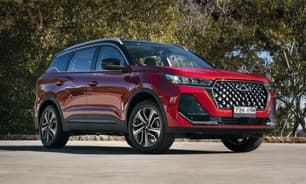
What's the difference?
The Chery Tiggo 7 Pro Elite is a part of the brand relaunch for Chery and it showcases the brand's commitment to safety with its five-star ANCAP rating, awarded in 2023.
The medium SUV market is well and truly saturated with options and the Tiggo 7 Pro has rivals like the GWM Haval H6, Hyundai Tucson and MG HS which offer affordable packages for families in an expensive economy.
So, does the newest offering from Chery hold its own? In this review I'll unpack what my little family of three thought after a week with the mid-spec Elite model. (And why I suddenly have a hankering for Cherry Ripes).
GWM’s Haval H6 has been a solid budget-oriented mid-size family SUV for years now, but now it might be a better package than ever.
This current model has just received a mid-life update that brings new looks inside and out, new powertrain options, as well as a revised trim level structure.
Competition in the mid-size SUV segment is hotter than ever with fierce rivals like the Toyota RAV4, Kia Sportage and Hyundai Tucson.
Is the updated GWM Haval H6 worth considering? Read on to find out.
The Chery Tiggo 7 Pro Elite has been a very surprising car for me. Its premium features, stylish design and practical space don't match the affordable price tag! But I'm all for it because you definitely get bang for your buck. The technology needs to be improved but everything else more than makes up for it. This medium SUV is a solid all-rounder.
My son likes the red paintwork and how much space he has in the back seat.
The GWM Haval H6 has always been a value buy as a mid-size family SUV and although it previously wouldn’t have been at the top of my shopping list, this mid-life update has changed my mind.
It’s now more stylish inside and out, has more ergonomic storage and most importantly remains a cut-price offering.
Things aren’t perfect, as you still need to rely on the touchscreen for many key features and the suspension tune isn’t quite right.
The Chery Tiggo 7 Pro looks great because it manages to do two things really well.
It's not boring to look at yet simultaneously blends into the sea of medium SUVs without ruffling any design feathers.
The Tiggo 7 Pro is well-proportioned and has some interesting focal points like the large grille that sports a dual-coloured 'diamond' motif.
It gives me some insect-like vibes while adding depth and dimension to the bonnet.
There is a full suite of exterior LED lights that look sharp, the 18-inch alloy wheels and the simplified rear rounds out the package.
The overall footprint is a good size at 4513mm long, 1862mm wide and 1696mm tall.
With those dimensions, the Tiggo earns its place in the medium-SUV category, yet it's still being easy to manoeuvre in tight city streets.
The interior style looks premium with the use of black synthetic leather upholstery and contrasting white piping.
The dashboard is headlined by a large curved screen housing the 12.3-inch touchscreen multimedia system and 12.3-inch digital instrument cluster.
There's also adjustable, coloured ambient lighting, a chunky shifter and a plethora of soft touchpoints throughout, accentuating an already pleasant cabin space.
Although the GWM Haval H6 has only received a mid-life update, it’s rather comprehensive.
At the front there’s a new front fascia that features a grille that's eerily similar to the outgoing Hyundai Palisade.
There’s also a new LED daytime running light signature that features a plunging light strip. You can tell it’s a little tacked on to the headlight unit which remains unchanged, though it’s a nice point of difference.
Around the side GWM has made a big point of removing all the pre-update car’s chrome highlights, which is a great step in the right direction. In its place is a swathe of black finishes. It’s noticeable around the wheel arches and door sills, as well as around the windows and on the roof rails.
At the rear there are more obvious changes, including the removal of the full-width LED light bar. This is fantastic to see because they're being done to death by car brands at the moment.
In its place are two regular LED tail-light units which still look great and inoffensive.
Other changes at the rear include a revised tailgate design that’s now more angular and sharp, plus there’s now ‘GWM’ badging where ‘Haval’ once was.
Inside there are even more changes. In fact, it’s hard to see what has carried over with this update.
One of the most obvious changes is the inclusion of a new cream synthetic leather upholstery option. It’s not to my personal tastes, nor would it be something I’d recommend for someone using this as a family car.
However, it’s a no-cost option and provides a nice point of difference from the drab-looking black synthetic leather that’s standard.
Ahead of the driver is a leather-wrapped steering wheel which now has a thicker rim than before and now features sculpted indentations at the 10 and two o’clock marks.
It’s nice, but I do prefer how the old thinner steering wheel feels in the hand, plus the spokes where the buttons are placed are still too thick and highly placed.
It’s clear GWM is still sticking with the screen-heavy approach with this updated Haval H6. There’s still a 10.25-inch digital instrument cluster, but a larger 14.6-inch touchscreen multimedia system that sits proudly on the dash like an iPad.
The centre console has been heavily redesigned and it now looks similar to the Leapmotor C10.
The rotary gear selector has been moved to a column-mounted unit behind the steering wheel, freeing up more space.
Overall the Haval H6 continues to present well inside with a wide range of soft-touch materials on the dashboard. There is now also a rubberised section on the centre console which feels modern and fresh for a car that’s so affordable.
The cabin space is practical and user-friendly, which is a great combo. Both rows have a decent amount of leg- and headroom (despite the massive sunroof).
Individual storage is great throughout the car with the front row enjoying an extra-deep middle console, undershelf storage cubby below it, a drink bottle holder in each door and two cupholders.
The rear row gets two map pockets, two cupholders in a fold-down armrest and drink bottle holder in each door.
There is also a (very) shallow storage nook at the back of the middle console… think packet of chewing gum or small wallet size.
The boot space is a great size at 626L but if you need extra space, you can bump it up to 1672L with the back seats folded.
The rear backrest has a 60/40 split with a level loading space. Impressively, underfloor storage is taken up by a full-sized spare wheel and you get a powered tailgate in this model.
Other amenities accentuate the premium-feeling the Elite is going for with the electric and heated front seats offering well-cushioned support, although I miss having adjustable lumbar support!
The rear seats aren't as comfortable as the front (a bit hard on the tush) but the back support is fantastic.
In terms of technology, you get a single USB-A port in each row but the front also gets a faster USB-C port, 12-volt socket and a wireless charging pad to choose from.
The multimedia system's touchscreen can be laggy at times, which is annoying while on the go and the onboard 'Hello Chery' assistant tech needs improving.
I managed to get a few voice commands to work but most of the time the response was 'I haven't learned that yet' or a garbled version of the request (despite using the same phrasing as previously approved requests).
The system has built-in satellite navigation supplied by Turbo Dog, which is easy to use and it's simple to connect to the wired Apple CarPlay.
It also has Android Auto, Bluetooth connectivity and AM/FM radio but misses out on digital radio.
As standard both the front seats in the top-spec Haval H6 Ultra have electric adjustment. In particular, the driver’s seat has six ways of electric adjustment, plus adjustable lumbar support.
The driver’s seat itself is comfortable enough, though on longer drives I look for a little more thigh support. You’re unable to adjust either front seat to get more thigh support.
However, there’s both heating and ventilation as standard for both front seats. The steering wheel is also heated which has been a godsend in the cold Melbourne weather.
The buttons on the new thicker steering wheel now control different functions. There’s no longer a stalk dedicated to the cruise control, instead this is now done on the steering wheel itself.
Also on the right-hand side of the steering wheel there are still buttons that change the volume, but when you click just above the volume rocker it changes their function to altering what’s on the digital instrument cluster. I’m sure you’d get used to this if you owned this car, but initially it messes with your head.
Another thing is given the gear selector is now behind the steering wheel, the wiper controls are now on the indicator stalk. This now also means there’s no proper buttons or stalk to adjust the headlights.
Instead you need to either use the touchscreen or press the ‘auto’ button on the dashboard. Unless you frequently change your headlight settings, this likely won’t be an issue.
The 10.25-inch digital instrument cluster now has updated graphics and looks high-resolution. The interface is still dark, however, and you can only adjust the content on the right-hand side.
Moving across the larger touchscreen multimedia system looks fantastic and is a breeze to navigate thanks to the shortcut keys on the right and the handy swipe-down control centre menu.
There’s now wireless Apple CarPlay and Android Auto functionality in this car which is fantastic to see. It’s particularly good because if you want to use the wired version of either, the USB-A port to access this is still on the passenger side of the centre console.
However, while you’re using smartphone mirroring you can’t access the handy swipe-down control centre menu. You need to exit and go back to the native interface to use it, which completely undermines its existence.
Another gripe is there still aren’t many physical buttons around the H6's cabin, with only a few for select climate control functions. To change the temperature, for example, you either need to use the touchscreen or the voice assistant, which isn’t always intuitive.
Thanks to the relocation of the gear selector, storage in the centre console has improved massively. There are two cupholders, a wireless charger that now features ventilation to keep your phone cool, as well as another storage nook for your keys.
Other storage highlights up front include a large space under the centre console, a centre console box, a glovebox, as well as big door pockets with bottle holders.
Moving to the second row, this is where Chinese SUVs shine. At a leggy 182cm I have plenty of space behind my own driving position.
The rear bench is reclined a touch and plenty comfortable enough for longer trips. You could easily fit three adults in the back thanks to the minimal centre tunnel intrusion.
Second-row amenities include centre console-mounted air vents, a USB-A and USB-C port, as well as a fold-down armrest with cupholders.
At the back there’s now a hands-free power tailgate that’s standard across the line-up, except for the entry-level H6 Lux petrol trim. It’s very easy to use and particularly handy if you’ve got full hands.
The boot area in the Haval H6 is decent and there’s no load lip, making lugging items in and out a lot easier. GWM claims there’s 560L of boot space with the rear seats upright, which is great for the segment.
There are few boot-related amenities besides a single hook, 12V socket and a cargo blind.
Disappointingly there’s no spare wheel under the boot floor of the H6 Hybrid. Instead there’s only a tyre repair kit, which is surprisingly common among hybrids as the space where a spare wheel would typically go is taken up by the high-voltage battery pack.
There are three variants for the Chery Tiggo 7 Pro with the range starting with the Urban base model for $39,990 drive-away, the Elite (our test model) for $41,990 drive-away and the top-spec Ultimate grade which sits at $45,990 drive-away.
The price tag for the Elite puts it on par with most of its rivals with the Hyundai Tucson being the most expensive competitor.
The Elite grade comes with a host of standard features which makes the price tag feel very reasonable. Think full-size spare wheel, keyless entry, keyless start, dual-zone air-conditioning, adjustable coloured ambient lighting and a full suite of LED exterior lights.
There are a lot of premium-ticket items, too, like a panoramic sunroof, electric and heated front seats, synthetic leather upholstery and built-in satellite navigation.
Technology and safety get some serious focus with dual 12.3-inch touchscreen multimedia screen and digital instrument cluster, 360-degree view camera system, powered tailgate, Apple CarPlay and Android Auto (both wired) plus an eight-speaker Sony sound system, to name a few.
However, it's the brand-spanking-new five-star ANCAP safety rating that should excite families out there.
The 2026 GWM Haval H6 range now only includes two trim levels – Lux and Ultra.
Pricing for carryover variants is down by up to $2000 over the pre-update model. The range now starts at $35,990 drive-away for the Lux petrol and extends to $50,990 drive-away for the new Ultra PHEV AWD.
It’s worth noting the variant we have on test here is the Haval H6 Ultra Hybrid which costs $43,990 drive-away. That’s incredibly affordable in this segment.
As standard all variants get 19-inch black alloy wheels, automatic LED headlights, LED tail-lights, heated and folding side mirrors, a hands-free power tailgate (exc. Lux petrol), 10.25-inch digital instrument cluster, 14.6-inch touchscreen multimedia system, wireless Apple CarPlay and Android Auto, voice assistant, 50W wireless phone charger, synthetic leather upholstery and electric driver’s seat adjustment.
It’s fantastic to see the multimedia system in the Haval H6 now supporting wireless smartphone mirroring, while also gaining a more powerful wireless charger that has ventilation.
Stepping up to the Ultra, as tested here, it gains rear privacy glass, a panoramic glass sunroof, head-up display, front stainless steel scuff plates, heated steering wheel, heated and ventilated front seats, as well as driver’s seat memory and lumbar support.
There’s a lot of nice kit in the Ultra that makes stepping up to it an easy choice. GWM even admits that’s what a lot of Australian buyers are doing, too.
The Elite variant has a 1.6-litre, four-cylinder turbo-petrol engine with a maximum power output of 137kW and 275Nm of torque. It also features a front-wheel drive drivetrain and a seven-speed dual-clutch auto transmission.
I wasn't expecting it to be as gutsy as it is and the Elite has adequate power for easy open-road driving.
Unlike the petrol and the soon-to-be introduced PHEV variants, the GWM Haval H6 Hybrid’s powertrain remains unchanged with this update.
It’s still powered by a 1.5-litre turbocharged four-cylinder petrol engine that runs the Miller cycle, as well as a single electric motor that’s fed by a 1.8kWh lithium-ion battery pack. Total system outputs are a massive 179kW of power and 530Nm of torque.
This is mated to a Dedicated Hybrid Transmission (DHT) with drive sent to the front wheels only.
It’d be great to see an all-wheel-drive version of the Haval H6 Hybrid because it would be better able to harness the amount of power and torque better than the front-wheel-drive version can.
The official combined cycle fuel consumption figure is 7.0L/100km and my real-world usage averaged 8.2L after doing some open-road, but mostly urban, driving.
The fuel economy is great considering the driving conditions and the fact I don't hold back in making use of its power.
Based on the combined cycle fuel figure and the 51L tank, expect a driving range of around 730km.
Chery recommends minimum 95 RON unleaded petrol be used.
GWM claims the Haval H6 Hybrid consumes 5.2L/100km on the combined cycle (ADR 81/02).
During my testing I matched this figure, according to the trip computer, which is surprising as not many hybrid cars actually achieve their fuel consumption claims.
All Haval H6 variants, excluding the PHEVs, have a 61L fuel tank and require a minimum of 91 RON regular unleaded petrol.
GWM claims you can travel 1000km on a full tank of petrol in the Haval H6 Hybrid, but using my as-tested fuel consumption you can theoretically travel up to 1170km.
The Tiggo 7 Pro is a fairly easy-going car to drive. It handles well in the city but also feels pretty solid on the road at higher speeds.
There is a good sense of power that always feel primed and ready to go, in the sense that you don't have much delay between putting your foot down and the car shooting forward.
However, if you're too aggressive with the accelerator, you will lose a bit of tyre traction which can make it feel jumpy.
The brakes aren't particularly sensitive, meaning you have to be firmer when applying pressure. This creates a jerky experience until you get used to it but is more noticeable in stop-start traffic.
Steering feel is not too heavy, not too light. There's a great balance and the car is responsive when manoeuvring, which is what makes its cornering behaviour so surprising.
It doesn't feel dynamic on a winding road, due mainly to the amount of roll the car exhibits.
The cabin is very quiet in terms of wind and road noise, accentuating the premium-feel but suspension is a little firm which can lead to some grunts over harder bumps.
I like medium SUVs because their size usually makes them easy to park and the Tiggo 7 Pro is no different.
With a super clear 360-degree camera system, you shouldn't have any issues parking it. However, I didn't notice the front and rear parking sensors sounding out all that much.
Starting the GWM Haval H6, it’s generally quiet, but if the engine is bone cold it’ll fire it up to get the fluids warmed up.
Once the engine reaches an operating temperature it’ll typically switch off allowing you to drive around on electric power alone.
Depending on how much charge the battery has and also how cold the weather is, it can be surprising just how electric-heavy the H6 Hybrid can be. There were times where I accelerated all the way from standstill to 60km/h on pure electric power, then others where I was travelling along at 80-90km/h and the engine would shut off.
When you’re driving around in EV mode the car is super quiet. Under 20km/h though the car emits a noise that’s meant to alert pedestrians. You’re able to choose from two different noises and while neither bothered me, they did frustrate my passengers.
When the battery charge starts to deplete, or when you push the accelerator a little harder, the engine does naturally turn on. You can’t feel any drop off in terms of acceleration, though you can hear the engine turn on and start whirring away under the bonnet. Thankfully it’s nowhere near as loud and droney as a RAV4 Hybrid, for example.
With a massive 179kW and 530Nm, that’s a lot for a car that’s just front-wheel drive. In practice however, acceleration is rather linear, though if you do punt the accelerator the front wheels can get overwhelmed. It’s by no means a sports car.
There are three levels of regenerative braking available, including an additional one for one-pedal driving, which is quite rare for a hybrid car. For the majority of my driving I used the normal regen mode because it felt the most natural.
Unlike some hybrids, there’s no awkward interaction between the regenerative braking system and the traditional friction brakes. It can sometimes be a little jerky navigating in tight spots, but slowing down to a stop generally feels linear and normal.
There are also three settings you can choose for the steering feel. Although I sampled them all, the middle Comfort setting felt the most natural as the Light setting was too light and Sport was too firm.
Unlike some Chinese SUVs, the Haval H6’s steering feels like it has some connection to the wheels, though it’s not the most direct or fun to steer.
This feeds into the suspension. It’s clear the Haval H6 is still tuned for comfort because while it does iron out a lot of bumps, it gets overwhelmed easily with harsh or more continuous bumps. When this happens it can jostle and wallow around a bit, making it feel a bit like a boat.
Hopefully GWM is working on something for this because it did hire ex-Holden Lead Engineer of Vehicle Dynamics, Rob Trubiani, earlier this year as a Product Engineering Manager.
On the parking front, the Haval H6 comes with front and rear parking sensors, as well as a surround-view camera with fantastic quality. There’s also a handy semi-autonomous parking assist and a reversing assist.
Despite this, the Haval H6 is on the upper limit of what’s typically regarded as a medium SUV and it feels like it. This isn’t helped by its wide turning circle, meaning you’ll likely have to do some three-point turns in tight carparks.
Visibility has always been a sore spot for the Haval H6 and this remains the case with the update. Although you have an elevated seating position, the bonnet sits high, making you feel like you’re sitting in the car, rather than on it.
This continues with the rear visibility as the rear window is quite small.
It’s nice GWM has gone to the effort of reducing the amount of bings and bongs the safety systems make in this updated Haval H6. There’s one for the speed limit assist, though it only chimes once and not very loudly.
However, when you activate or deactivate adaptive cruise control the car talks to you with an artificial Australian woman’s voice telling you it's either on or off and to pay attention. This feels a little unnecessary.
The safety list is fantastic for the Tiggo 7 Pro Elite with the standard features list including full LED external lights, daytime-running lights, adaptive cruise control, rear cross-traffic alert, rear collision braking, blind-spot monitoring, driver attention monitor, forward collision warning, lane departure alert, lane keeping aid, intelligent seatbelt reminders, child occupant alert, child rear door safety locks, traffic sign recognition, a 360-degree camera system plus front and rear parking sensors.
I found the driver attention monitor annoying as it's extremely sensitive. There's an audible alert and a badge pops up onto the digital instrument cluster for the smallest things: scratching your face, looking at the speedometer, looking at the steering wheel controls, adjusting sunnies … you get the idea.
Multiple alerts on every journey is distracting and takes away from the driving experience.
Annoyingly, you can't adjust the sensitivity but you can switch this function off. You just have to do it in every trip.
The Tiggo 7 Pro has eight airbags, which includes a driver's knee airbag and the newer front centre bag, which is great to see. And the five-star ANCAP safety rating, awarded in 2023, will surely entice families!
The AEB with pedestrian, cyclist and motorcyclist detection is operational from 5.0–80km/h and up to 135km/h for car detection.
There are ISOFIX child seat mounts on the rear outboard seats and three top tether anchor points but two seats will fit best. There is enough room for front occupants when a 0-4 rearward facing child seat is installed.
The pre-update GWM Haval H6 petrol and hybrid received a five-star ANCAP safety rating back in 2021. It remains unclear whether this rating will carry over to the updated model.
As standard there are seven airbags, autonomous emergency braking (AEB), blind-spot monitoring, rear cross-traffic alert, traffic sign recognition, driver fatigue monitoring, a surround-view camera and rear parking sensors.
Stepping up to the Ultra gets you additional safety features like front parking sensors, semi-autonomous parking assist and reversing assist. It’s worth noting none of these features are offered on Ultra PHEV variants.
The Tiggo 7 Pro comes with a seven-year/unlimited km warranty, which is longer than usual for the class.
There is a seven-year/105,000km capped priced servicing program and services average $294 per, which is very competitive.
Servicing intervals are reasonable at every 12 months or 15,000km, whichever occurs first.
The GWM Haval H6 continues to be covered by a seven-year, unlimited-kilometre warranty, while variants with a high-voltage battery pack have that covered under an eight-year, unlimited-kilometre warranty.
There’s also five years of complimentary roadside assistance and the first five services are capped priced.
Logbook servicing is required every 12 months or 15,000km, though the first service is required after 12 months or 10,000km.
During the five five years of ownership, servicing the updated Haval H6 Hybrid costs a total of $2145, which averages out to around $430 per service. That’s not bad but a Toyota RAV4 and a Honda CR-V are cheaper to service.