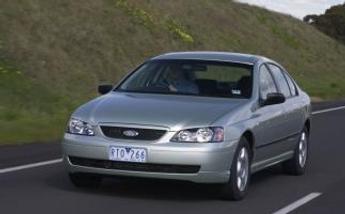
Most of the changes with the BA Mark II are under the skin and most are confined to the sporty XR models.
That is apart from cruise control and headlights that turn on and off automatically which are now both standard across the range, bringing the Falcon into line with competitors.
There's the obligatory badge of course plus a couple of new colours and some new wheel designs – but not a panel has been touched.


After struggling to find its way out of the wilderness, Ford is enjoying some of its best sales in years, with the Territory clocking up more than 2000 sales last month to become Australia's best selling sports utility vehicle (SUV).
In this context, the company obviously has no desire to upset the apple cart, keeping changes to a minimum and keeping a close eye on the competition and what customers have to say.
Perhaps the biggest change with Mark II is the addition of a six-speed manual transmission to the XR8 and XR6 Turbo models, which matches the six coggers in Holden's sporties.
The XR8 also gets a suspension upgrade with the addition of the rear setup from the FPV Falcon GT.
It is interesting to note here that XR models now account for 27 per cent of Falcon sales, up from 6.8 per cent a couple of years ago.
The new Tremec sourced T56 transmission is also used in cars such as Aston Martin and the Mustang Cobra R, but has been reworked for application in the Falcon.
It features different gear ratios for the Turbo and V8 models, with a longer first gear for the V8.
Customers had apparently complained about "running out" of first in the V8 and the new transmission addresses this problem.
In the Turbo the final drive ratio changes from 3.46 to 3.73, with a nine per cent reduction in the spread of gears.
And, in the V8, the final drive ratio changes to 3.46 (the same as the GT) with the spread of gears being reduced by 13 per cent.
That translates to more gears and closer ratios, with all gears apart from first slightly lower overall in the XR6 Turbo.
In designing the transmission, engineers adopted a philosophy of setting the first and sixth gear ratios, and then matching the mid-set.
It is also designed the box so that both cars can happily run around in fifth gear at 60km/h and sixth gear at 80-100km/h – for improved driveability.
One of the other major considerations for introducing the new transmission is that it can handle more torque which means larger and more powerful engines down the track.
We were lucky to sample almost the entire range of cars at the launch of the BA Mark II.
The Falcon continues to impress for its driveability, the big, smooth 4.0-litre straight six and the stylish yet practical layout of the interior.
Our favourite Falcon – and we make no apologies here – is the sensational XR6 Turbo (although we admit having a soft spot for the smooth Fairmont Ghia V8).
We reckon the responsive Turbo is a far more enjoyable car to drive than the bigger, heavier V8.
The punchy 240kW turbocharged six has a nice growl and and responds quickly to the boot, with better economy if driven sedately.
We checked the trip computers of two cars after the launch and found only one point of difference in economy between the V8 and the Turbo – 16.2L/100km compared to 16.1L/100km.
The new transmission is a useful addition to the XR range (standard XR6 retains the five cogger), with a better shift feel and shorter throws than Holden's own Tremec box.
The GT suspension has been added tot he XR8 to reduce diagonal pitching, with firmer spring rates to make the car sit flatter in corners.
With every new model comes a new price tag, but prices have not increased significantly.
The entry level XT model increases by $395 to $34,255, while the XR6 Turbo is $46,350 and XR8 is $51,275 – all prices exclude on-road costs.
Related cars for sale on CarsGuide
See more Ford Falcons for sale View cars for saleFord Falcon 2004: Xr6
| Engine Type | Inline 6, 4.0L |
|---|---|
| Fuel Type | Unleaded Petrol |
| Fuel Efficiency | 10.5L/100km (combined) |
| Seating | 5 |
| Price From | $4,070 - $5,940 |


Pricing Guides
.jpg)


.jpg)
.jpg)
.jpg)
.png)
.jpg)
.png)
.jpg)
.jpg)

.png)