What's the difference?
The BYD Shark 6 Premium has burst onto the scene with plenty of hype and a bit of side-eye from Aussie ute loyalists.
We’re a tough crowd, especially when it comes to vehicles that need to juggle family life, work gear, and weekend adventures.
So we put this handsome newcomer to the test to see whether it delivers genuine practicality and fun, or if it’s simply talking the talk in a ute-shaped body.
When the GWM Ora showed up in Australia last year, it seemed to rely somewhat on its divisive cutesy looks and sub-$40K entry price to draw attention - and to some extent it worked.
Convincing Australians to buy an electric car is hard enough for any car company, let alone one that doesn’t have the brand cachet of Tesla or the traditional companies.
But an entry price under $40,000 doesn’t apply here, this is the GWM Ora GT: the top of the range for the small electric car.
It’s just had a massive price cut, but is it worth paying more than $10,000 over the price of a base Ora for some extra goodies when simplicity and fun styling was the original selling point?
The BYD Shark 6 Premium is perfect for weekend camping trips or ferrying the family around the city, but the underpowered engine, mixed handling, and quirky safety tech hold it back. If it could match its rivals’ capability while keeping its sharp looks, it would be a near-perfect package but right now, it just doesn’t.
The GWM Ora is a solid electric car for the city with an extremely competitive price, balanced with some flaws that might frustrate some - Android phone owners especially. But the GT variant doesn’t offer enough to justify how much more expensive it is than the variants below.
It has a slightly lower range, no more performance (not that it needs more power), a features list almost identical to the Ultra and arguably loses its appealing cutesy looks.
While the rest of the Ora line-up has its strengths and a cute but daring design, the GT effectively offers only its bark-over-bite styling changes.
If the Ora is on your shopping list, it’s certainly worth checking out the $43,990 Ultra, or even the $40,990 Extended Range if its list of features suits you. But if you for some reason enjoy the GT’s styling, that extra spend might be worth it.
The BYD Shark 6 is a seriously handsome ute from almost every angle. It’s boxy and beefy enough to look tough in the school-pick-up line but not so over-styled that it feels try-hard. The wide lighting signature at the front and rear gives it a modern, tech-forward vibe which is a nice hint at what’s going on underneath.
From behind the wheel, space is the first thing you notice. The cabin feels huge and well thought out, finished in black synthetic leather with contrasting orange stitching that adds a sporty pop. You’ll spot the same orange highlights on the air vents, and together with the soft-touch trim and matt-metallic details, the Shark easily punches above its price point in terms of cabin quality.
And then there’s the centre console, which is one of my favourite parts of the interior. With its chunky grab handles, large gear selector and row of tactile switches, it has a bit of a cockpit-meets-ute look going on. The orange starter button is a fun touch too. The only quirk? The tailgate release button sits close enough that it’s a little too easy to tap by mistake and although you have to confirm the selection via the media display, it's still annoying to accidentally press.
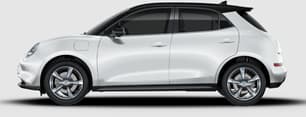
Yep, as a step-up from the Ora Ultra, the GT’s main selling point is its styling. For a car with a 400km driving range, it’s so non-threatening it looks like it would get beaten up and have its lunch money stolen by dual-cabs if it left the city - but cute works, just ask Mini or Fiat.
Its headlights have a splash of Porsche 911 in them. There are some angles that even look a little like someone had an Abarth explained to them then tried to draw it. More than one friend has told me it reminds them of a VW Beetle.
None of that bothers me in particular, but the GT-specific additions to the Ora make it feel like a deeply unserious car.
The fake carbon trim is tacky on a car that has no performance improvement over its base variant sibling, the red strip under the number plate looks like a tongue poking out under an overbite, the wheels look like Tony Stark designed them, and the rear ‘wing’ and diffuser just don’t feel at home.
One thing that didn’t bother me as much as I thought it would was the lack of ‘traditional’ tail-lights, instead a light bar under the rear window takes that role.
The rest of the Ora range is cute, fun, and looks at home in the city where the Ora is at its best. The GT’s features are mostly the same as the Ultra, so the extra $3000 for the GT exterior doesn’t really feel like value.
Inside, however, the design is less in-yer-face. A tidy set-up features a Mini-style row of switches (for some of the climate control) under a bar that spans the dash with the vents integrated.
The steering wheel is big, arguably too big, behind it is the 10.25-inch driver display attached to the central multimedia display. Everything’s very tidy and minimalistic inside, even the gear selector is a round dial.
It looks like a reasonably fashionable interior, but when it comes to the functionality, it starts to fall apart.
Comfort is clearly a priority in the Shark 6 Premium. There’s loads of cabin space and the powered front seats are properly plush for a ute, with four-way lumbar support plus heating and ventilation which is a luxe touch you really notice on long drives.
Up front, storage is excellent with a glovebox and dash cubby, large door bins, a deep centre console, two phone trays with a wireless charger, a USB-A and C port, cupholders and a sunglasses holder. Everything has its place, and it’s easy to keep the cabin tidy.
The rear bench is also impressive. Generous seat bases, thick padding, and a flat floor mean adults will be comfortable back there, and kids are happy too. Rear passengers score map pockets, cupholders, big door bins, directional air vents, a USB-A and C port and even a 230-volt outlet.
Despite the 230mm ground clearance, getting in and out is surprisingly easy thanks to big door apertures, side steps and grab handles. My nine-year-old found it easy to get in, though younger kids will still need a hand. He loves the great view, thanks to the low window line, but the doors feel heavy on a slope.
Tech-wise, the 15.6-inch touchscreen looks sharp and responds quickly. The system is simple enough to use once you spend some quality time with it but first-timers might get flustered initially. Wireless Apple CarPlay and Android Auto worked consistently, although most controls live inside the screen, including climate functions, which may frustrate some. The rotating display is clever, but I found portrait mode blocked some forward vision from my driving position. Also, fun fact, when CarPlay fills the full screen, everyone can see it, including cyclists who now know my husband’s nickname!
Out back, the tray is slightly smaller than key rivals but still practical, offering 790kg payload and a 1200L capacity. The soft-opening tailgate is handy but lacks gas struts, and without a step, climbing in requires a bit of a hop. On the plus side, the tub gets lighting, three 230-volt AC outlets and a full-size spare underneath.
I can see the appeal of the Ora, but there are some glaring issues that I suspect many will find frustrating over time during ownership.
I’ll start with the big one - Android Auto. Or the lack thereof. Apple CarPlay is available however, even wirelessly.
Being a car journalist in 2024 involves a lot of playing around with in-car tech, and it’s been an awfully long time since I wasn’t able to mirror my phone to a car’s central screen where those with an Apple iPhone could. About 70 per cent of the world uses a phone running Android, by the way. Mostly Samsungs, like mine, but pretty much anything else that isn’t an iPhone too.
It wouldn’t be as major an issue if there was a navigation function in the car’s native multimedia system, but there isn’t. Having only a Bluetooth connection and no map felt a little like taking a step back in time, with an old iPad tacked onto the dash. No Fruit Ninja though.
Smaller things come down to basic ergonomics. The touchscreen itself and the system on it are simple and easy enough to use, if a little unresponsive. The driver display is fairly simple and doesn’t fall too far into the trap of sub-menus on sub-menus.
Physically, the cabin is almost there - the seat and steering wheel adjustment, however, made it a little tricky for me to find a comfortable driving position.
I’m pretty much dead-on the average height of an Australian man, and the lack of tilt for the base of the seat meant no under-thigh support if I was to be the right distance to have a proper hold on the steering wheel - not telescopically adjustable, by the way.
Another interesting ergonomic fail is the placement of the drive mode select button (one of the GT’s few unique features) being to the right side of the steering column, near where you’d expect rarely-used controls like the headlight height adjust to be - or in this case a couple of centimetres from the button that kills the power to the battery if pressed while not in motion.
This caused severe embarrassment at a set of lights while searching for the drive mode switch, with no obvious way to start the car again, short of opening and closing the driver door.
Oh, and switching through the drive modes elicits a unique videogame-style chime or jingle for each mode. Gimmicky at first, potentially rather irritating after some time.
A positive of the interior layout, however, is the space in the rear seats is fairly generous for a small car - at almost six-feet tall behind my own seating position, I wasn’t lacking space to move and the seat itself is comfortable enough for a decent trip.
Behind that, a relatively limited 228-litre boot is probably less useful for a decent trip, though its 858L of space with the rear seats folded down is more handy in a pinch.
The BYD Shark 6 arrives in a single, well-equipped Premium grade, priced at $57,900 before on-roads, making it the most affordable PHEV dual-cab ute you can buy right now. Its closest rival, the GWM Cannon Alpha Lux, is $2K more, and the next step up is the Ford Ranger XLT Hybrid from $71,990. So before you even look inside, the Shark 6 already offers strong value.
Standard equipment is generous for the money, with synthetic leather upholstery, powered heated and ventilated front seats, dual-zone climate control, full LED exterior lighting, wireless phone charging, four USB-C ports and a 360-degree camera system. You don’t get everything as there’s no sunroof or heated steering wheel but you don't miss them too much.
Inside, the tech looks properly premium. There’s a 15.6-inch touchscreen that swivels between portrait and landscape (although wireless Apple CarPlay sticks to landscape), wireless Android Auto, built-in sat-nav, a 10.25-inch digital driver’s display, a coloured head-up display, and a digital key via the BYD app.
On the practical side you’ll find keyless entry, push-button start and a full-size spare tyre. There are four 230-volt AC outlets, three of them in the tray, which is brilliant for camping, tradies, or powering kids’ gadgets at sport. BYD also includes a portable home charging cable, which is handy if you’re not ready to commit to a wallbox just yet.
The GWM Ora GT was once a mid-$50K car, once you got it on the road. Its former sticker price of $51,990 before on-roads has, along with every other variant in the range, been dramatically knocked into a more budget-friendly shape: $46,990 drive-away.
That’s pretty cheap for a top-spec electric car, or for an electric car in general in Australia, but it’s still $11,000 more expensive than the entry-level Ora Standard Range ($35,990 DA).
The Ora GT also shares most of the key draw cards on its features list with the Ultra.
Its panoramic sunroof, electric tailgate, heated and ventilated seats with massage function and its heated steering wheel are all available in the Ultra for $3000 less.
One of the only things the GT has in terms of functionality in the cabin is a light for the driver visor vanity mirror.
There are a couple of differences when it comes to driving functionality, and we’ll get to that in a later section of this review, but the rest of the tech in the cabin is standard across the range.
The 10.25-inch touchscreen and same-sized driver display, six-speaker sound system, wireless phone charger, electrically adjustable synthetic leather seats - it’s all in the base-level Ora.
What is missing, very notably, is Android Auto functionality. The Ora does however feature wireless Apple CarPlay.
The Shark 6 pairs a 1.5-litre four-cylinder turbo-petrol engine with two electric motors - one on each axle. On its own, the petrol engine makes 135kW/260Nm, but the hybrid system boosts total outputs to a more impressive 321kW and 650Nm.
Despite the strong numbers, braked towing capability sits at a low 2.5 tonnes, which is a full tonne less than key rivals. If you regularly haul larger caravans, horse floats or big trailers, that’s worth keeping in mind.
It’s also worth noting the Shark 6 runs an AWD system rather than a full 4WD, with no low-range gearing or diff locks. So while it’ll handle gravel roads, campsites and wet grass just fine, it’s not aimed at hardcore off-road buyers. For a deeper look at its rough-terrain performance, check out Crafty’s recent Adventure review.
All four variants of the Ora have the same outputs from its front-mounted electric motor - 126kW and 250Nm. Yes, even the GT.
What the GT does have over at least the base model is a larger battery shared with the Long Range and Ultra variants, but despite having the same weights and outputs, the GT is, on paper, claimed to be a tenth of a second slower to 100km/h than the rest of the range: 8.5 seconds versus 8.4sec for the cheaper models.
Official combined fuel use for the Shark 6 in hybrid mode is 7.9L/100km, but after over 800km of mixed driving (starting with three-quarters charge and regen braking keeping the battery hovering around 25 per cent), I saw 8.9L/100km. So it’s a touch thirstier than the claim, but you’ll unlock its best efficiency when you charge daily and make full use of the 100km pure EV range for school runs, commuting and errands.
There is a 29.58kWh BYD Blade battery paired with a Type 2 CCS port. It takes up to 7kW on AC home charging and up to 55kW on a DC fast charger, where you can expect around 30 - 80 per cent in roughly 25 minutes. There’s also vehicle-to-load capability, so you can power tools, camping gear or larger tech items when you're out and about which is very handy for family trips and weekend adventures.
That aforementioned larger battery is a 63kWh lithium-iron phosphate (LFP) battery, over the 48kWh unit in the Standard Range base variant.
According to GWM’s brochure, the GT’s electric driving range under WLTP is 400km, 20km less than the Long Range and Ultra (and like the acceleration time, for no obvious reason).
With a 400km claimed range and 63kWh battery, the Ora GT should return a power consumption figure of around 15.75kWh/100km, though on test we saw 16.4kWh.
GWM claims charging with 11kWh AC power will take 6.5 hours to jump from 10 to 80 per cent charge, while 80kW DC charging takes 50 minutes to do the same.
On the road, the Shark 6 is a bit of a mixed bag. In EV or hybrid mode it’s genuinely impressive being smooth, quiet and quick off the line with a nice, immediate power delivery. But once the petrol engine fires up, things change. It becomes noticeably loud and whiny, and it can feel short on grunt, especially on hills. I wouldn’t rely on the petrol side alone if you regularly drive with heavy loads or tackle steep country roads.
Around town, the ride is comfortable and almost glides over the road, which sounds lovely, but in a big ute I prefer a bit more feedback. Out on regional roads, the Shark can start to feel less composed, particularly over big bumps or loose gravel, so it’s definitely happier in urban settings.
Visibility is mostly good thanks to the high driving position and big windows. The thick B-pillar does require a proper head-check, and parents take note: I can’t always see my son when he’s right up close to the vehicle, so extra awareness around kids is essential.
Regen braking is subtle but effective and the battery never dipped below 20 per cent and often gained charge on downhill runs. The lack of that grabby EV brake feel is also very nice.
Parking, however, is where things get entertaining and not always in a good way. With a 13.5m turning circle and at almost 5.5m long, it’s not what you’d call nimble. My mum and I genuinely had an Austin Powers three-point-turn moment in a tight ramp. It's also best to reverse into spaces to allow for the tray overhang. The saving grace? The 360-degree camera system is genuinely helpful due to its clear, wide feed.
As is the case with the GT’s outputs and features, there’s nothing to suggest the GT would be fundamentally better to drive than any other variant. Unless all those kids at school were right about red bits making cars go faster.
The Ora’s front-drive layout paired with relatively immediate electric torque delivery, however, means you probably wouldn’t want it to be much more powerful with this particular mechanical setup.
The Ora, as a city car, does its job reasonably well in standard drive modes, though its sport mode is possibly a little too eager for day-to-day affairs - and the way it quite conservatively understeers on corners suggests there’s not much ‘sport’ driving to be done in this cute EV.
The steering itself feels fairly numb (again, fine day-to-day) and becomes heavier or lighter in different drive modes, but with no real advantage - the wheel itself is also a little on the large side.
Its suspension tune is comfortable enough for the low-speed streets on which this car is likely to find itself most often, where most city cars aren’t exactly riding on clouds, though can more obviously start to feel a little underdone on rougher roads at high speed.
It’s not a light car, after all, a hatchback that weighs 1580kg and has a short wheelbase isn’t going to be a dynamic masterpiece, though it does at least feel stable enough through corners thanks to its low centre of gravity.
It’s not going to encourage any heroic driving, but it’s also more likely to deter rather than outright punish any silly behaviour behind the wheel.
The BYD Shark 6 has a maximum five-star ANCAP safety rating from testing done in 2025 and is fitted with seven airbags, including a front centre airbag and curtain airbags that cover both rows, which is great to see on a family ute.
There’s a suite of safety equipment including big ticket items like forward and rear collision warning, front and rear cross-traffic alert and braking, blind spot monitoring, lane keeping aid, lane departure warning, intelligent seat belt warning, driver attention warning and a super clear 360-degree camera system.
However, some systems don’t always feel properly dialled in. Traffic sign recognition occasionally displays the wrong speed (once showing 150km/h) and the lane keeping aid is pushy. The adaptive cruise control is quick to slow down but slow to get back up to speed. It’s also worth noting that while it does have child presence detection, ANCAP says it falls below their required functionality limits, which is something to consider if you have kids.
There are two ISOFIX child seat mounts and two top tether anchor points, so you’ll only be fitting a maximum of two child seats in the rear row.
The autonomous emergency braking has car, cyclist, pedestrian and motorcycle detection and is operational from 4.0 - 150km/h but it is usual to see the top figure hover closer to 180km/h.
Overall, the Shark 6 offers strong baseline protection, but a few calibration quirks are needed.
The GWM Ora’s safety features are almost all standard across the range, which is great even if you don’t opt for the GT.
This means its seven airbags (dual frontal, side chest, curtain and centre) are all standard, as well as autonomous emergency braking, secondary collision avoidance, rear cross-traffic alert and forward collision warning, lane keep assist, traffic jam assist and even a surround-view parking camera. The Ultra and GT are the only variants with a front parking sensor and auto parking assist.
The features are all there, but some finer tuning when it comes to some driver assistance could be looked at - thus the slightly lower side of the scoring scale for a car that’s ticking all the boxes on paper.
The BYD Shark 6 comes with a six-year/150,000km warranty, which is solid, though some rivals offer unlimited-kilometre terms and ongoing roadside assistance if you service through their dealer networks.
BYD provides a price guide for servicing rather than a fixed capped-price or pre-paid program, with average costs around $515 per service (subject to change). This method doesn't add the peace of mind its competitors do.
Finding somewhere to service your Shark 6 is fairly straightforward thanks to 46 BYD service centres across Australia, though most are concentrated in major cities. Regional owners will appreciate BYD’s partnership with select mycar Tyre and Auto service centres, which helps extend access outside metro areas.
GWM offers a seven-year/unlimited kilometre warranty, as well as an eight-year/unlimited kilometre battery warranty. The former is quite decent for the industry, the latter relatively par when it comes to battery warranties.
Five years or 150,000km of roadside assistance is also included.
The Ora’s first five services, each coming in at 12 month/15,000km intervals, are capped price, all at $99.