What's the difference?
BMW’s X1 has changed. In a good way. Especially if you’re thinking about buying one as a family car.
Yep, last year the third-generation X1 arrived and after 13 years and three different attempts on a design, BMW has nailed it. And by ‘it’ I mean built a super practical and spacious small SUV that’s great to drive.
See, as a dad of two kids, when it comes to cars and my family ‘it’ means something totally different to what ‘it’ meant 10 years ago.
And that’s what this review is about: does the BMW X1, and specifically this xDrive20i M Sport variant we’ve tested here, make a good family car?
If you're thinking of buying it for your family then you need to read this and also consider the likes of Audi’s Q3 and the Mercedes-Benz GLB.
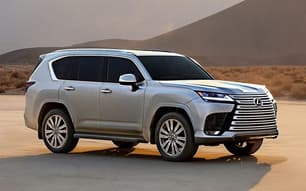
The Lexus LX line-up has a solid reputation as off-road vehicles and towing platforms.
And there’s plenty of excitement about the new-generation Lexus LX500d because it’s essentially a tarted-up version of the Toyota LandCruiser 300 Series – it’s built on the same platform as the 300 and even has that model’s 3.3-litre V6 twin-turbocharged diesel engine and 10-speed auto.
Sure, it’s not as tough looking as the new Prado-based Lexus GX, but if you like your off-roader with more than its fair share of posh trimmings then perhaps a Lexus LX500d is your cup of tea.
However, with a price-tag topping out at more than $150,000, does this luxury 4WD wagon actually deserve your attention or should you look elsewhere?
Read on.
This new BMW X1 feels like it's been built by a team of parents because it’s one of the most practical and easy to use small SUVs my family and I have ever lived with and, trust me, they’ve seen a lot of test cars come through the Berry garage.
We loved the roomy interior with high ceilings, the clever storage everywhere from the giant door pockets to the floating centre armrest up front and big boot for our pram.
Entry and exit is easy through the tall and wide doors, something my back was thankful for every time I had to put our baby into her car seat.
Driving is easy, with great visibility and the engine that comes in the xDrive20i M Sport makes this X1 sporty and fun to pilot, too.
The only drawback is the price, it's a bit expensive but at the same time you are getting a high-quality feeling SUV.
The Lexus LX500d is a luxury seven-seat 4WD wagon with a big price-tag to match its full-to-bursting standard features list.
The interior is now more cool than cheesy and as a daily driver and long-distance tourer the LX500d offers very impressive levels of comfort and refinement – and it’s no posh pretender off-road either.
Sure, it’s much more of a city conveyance than a country wagon, but the LX500d is spot-on for those who have a premium SUV on their mind.
This current generation of X1 arrived in late 2022 and finally looked more like part of the BMW SUV family with tall and boxy styling rather than the sleek, but raised hatchback it seemed to be before.
My test car had 'M Portimao Blue' metallic paint - a flattering hue that showed off the X1’s lines as you can see in the images.
I like the X1’s oversized grille which suits the angry looking front bumper that comes with the M Sport inclusions, but balanced by pretty headlights.
Inside, the X1 xDrive20i M Sport is modern and minimalist in design. I like the floating centre armrest in between the driver and front passenger and the way it creates a feeling of more space and adds more storage.
The double screens are nice, but we’re seeing this same design and tech now in budget cars such as the Chery Omoda 5 and Haval H6. BMW needs to be even slicker and more stylish if it wants to maintain its edge.
If you like your SUVs sporty looking then check out the BMW X2, X4 and X6. These are coupe style SUVs (but with four doors).
The LX500d, in keeping with its positioning in the luxury slice of the market, is an imposing, premium-looking vehicle.
Lexus puts the LX500d’s dimensions at 5100mm long (with a 2850mm wheelbase), 1990mm wide, and 1885mm high (1895mm in the Enhancement Pack-equipped LX500d). This is a big, classy SUV, inside and out, and it’s more than just a 300 Series LandCruiser in a shiny suit.
The optional 22-inch alloy wheels (part of the $5500 Enhancement Pack) add to the overall polished look.
The interior is a classy mix of woodgrain trim, Hazel leather accents, soft-touch surfaces, Shimamoku ornamentation, plush but supportive seating, and even comfortable arm-rests.
My family found the X1 xDrive20i to be one of the most practical small SUVs we’ve lived with thanks to its spacious interior, clever cabin storage and plenty of convenient features.
I need to point out the door pockets - they’re the biggest I’ve ever seen. They’re more door buckets than pockets and super helpful over the week not just for bottles but for everything else that I needed to dump out of my own pockets and into them.
The floating centre armrest up front looks like an ironing board and has a tonne of storage underneath.
The wireless charging is handy but the holster is a bit un-user friendly in terms of access, but it held the phone tight and stopped it becoming a projectile when driving, which is what you want.
There are power outlets galore, too, proximity unlocking, and a gesture tailgate.
Legroom in the back is excellent and there’s so much headroom throughout.
The X1’s 540-litre boot capacity is excellent for the class and meant we could fit our baby’s big pram and the seven-year old’s scooter and still have room for the grocery shopping.
The cabin is a cavernous, plush space and driver and passengers are all generally well served in terms of practicality and comfort.
The tech is simple enough to locate and operate – it was easy enough to get Apple CarPlay working – and the screens are big: the horizontal 12.3-inch multimedia unit upfront, an 8.0-inch screen (to monitor air-con, adaptive air-suspension height, the 4WD system, and other vehicle information), a head-up display, plus a 7.0-inch touchscreen for rear passengers.
Heating and cooling are managed via the climate concierge and everyone can keep themselves as comfortably hot or cold as they like with separate controls.
Storage is only reasonable for such a voluminous interior with a variety of door pockets, cupholders (eight in total), glove box, a deep centre console (with multiple ways to open the lids) as well as map pockets for the second row, cup-holders in the centre fold-down armrest and cupholders for the third row.
The Lexus has a Qi wireless charger and front and rear USB-C charging ports – one up front, two in the second row, and two in the third row.
There’s a 12V DC socket (front and rear) and a 220V socket in the rear cargo area.
Power-adjustable seats up front mean the driver and front passenger can dial-in their favourite seating position and these seats are very comfortable. Even the second row is plush, but the third row is not quite at that comfort level.
Second-row passengers have air con and entertainment controls, and an HDMI port.
The sunroof – an Enhancement Pack inclusion – is power-adjustable and allows plenty of natural light in through the top.
The Lexus LX500d has a claimed 174L (VDA) of cargo space when seven seats are in use; 982L when five seats are being used (that’s with each half of the power-folding third row stowed flat at the push of a button); and 1871L when all seats are stowed away (the 60:40 folding second-row seats tumble-fold forward), except for the driver and front passenger, of course.
The tailgate has a foot-swipe-to-open sensor (part of the $5500 Enhancement Pack).
In the space of driving this SUV and writing this review the list price of the X1 xDrive20i M Sport has risen from $68,900 to $73,400.
That price hike was part of an increase across the model range and all grades now cost more, even the entry-level sDrive18i which is now 13K less than the xDrive20i M Sport.
But you’re paying for the more powerful, athletic and only all-wheel drive one in the X1 range.
You’re also getting loads of standard features in the xDrive20i M Sport.
There’s the 10.25-inch instrument display with three different styles for your speedo and other gauges, while flowing into that is the 10.7-inch media screen with sat nav, wireless Apple CarPlay and Android Auto, and digital radio.
There are LED headlights, plus proximity unlocking, a head-up display, dual-zone climate control, a power tailgate, sports seats (the front ones are heated and power adjustable) and adaptive cruise control.
As the name suggests the xDrive20i M Sport is fitted with BMW M Sport goodies as standard. These include adaptive M Suspension, M leather steering wheel, M roof rails, M headliner and M interior trim.
My test car also had $8900 worth of options fitted including the sunroof, Harman Kardon stereo, the ‘Vernasca Black’ leather seats and 20-inch M light alloy multi-spoke wheels.
Is it good value? Well, you do get a lot of nice things here but at a $13,000 premium over the entry grade, plus the $3500 price jump in the past few weeks, I’d say the value isn’t great.
If you’re trying to keep the cost down, the sDrive18i is the budget pick.
The seven-seat LX500d is the base-spec in the three-variant diesel LX line-up – below the F Sport and Sports Luxury – but you wouldn’t know it from its price-tag.
The LX500d retails for $157,061 (excluding on-road costs), but our test vehicle has an optional Enhancement Pack (which includes 22-inch alloy wheels, sunroof, hands-free power tailgate with kick sensor, $5500) and has been fitted with a towing set-up (towbar etc, $1545 fitted) pushing its price up to $164,106 (excluding on-road costs).
As standard the LX500d features list includes a 12.3-inch multimedia touchscreen (with Apple CarPlay and Android Auto, and Bluetooth), a 25-speaker Mark Levinson sound system, heated and ventilated power-adjustable seats, woodgrain steering wheel trim, 8.0-inch multi-information driver display, four-zone climate control, 7.0-inch touchscreen and separate control panel for rear passengers, multi-terrain monitor with panoramic view, and 20-inch alloy wheels (but, as mentioned, our test vehicle has the Enhancement Pack with 22-inch alloy wheels).
It has a digital rear-view mirror, adaptive variable suspension with low, normal and two high settings, as well as full-time four-wheel drive, a low-range transfer case, locking centre differential, and a variety of driving modes (including off-road modes) and driver assistants.
Exterior paint choices include the no-extra-cost Onyx, or options such as Liquid Metal, White Nova (F Sport models only), Sonic Quartz (not available on F Sport models), Titanium, Graphite Black, and Khaki Metal (on our test vehicle), all of which incur an extra cost.
The X1 xDrive20i M Sport has a more powerful engine than the grades below it in the range - it’s a 2.0-litre, turbo-petrol, four-cylinder making 150kW and 300Nm.
A seven-speed dual-clutch automatic transmission does the shifting for you.
This is also the only all-wheel drive X1 currently in the range.
The Lexus LX500d has a 3.3-litre V6 twin turbo-diesel engine, producing 227kW at 4000rpm and 700Nm between 1600-2600rpm.
It has a 10-speed automatic transmission with manual shift mode, a permanent all-wheel-drive system, low-range transfer case and a lockable centre diff.
It also has six on-road drive modes – including Eco, Comfort, Normal, Sport S, Sport S+ and Custom – and off-road drive modes.
The V6 is an impressive fit in this behemoth, but even though this is a smooth-shifting SUV, there’s a leisurely, rather than lively, overall feel to how the engine and auto work together.
Because it is so hefty – with a listed 2690kg kerb weight – the Lexus does need a bit of heavy right boot to get going off the mark and during overtaking moves.
BMW says that after a combination of open and urban roads the X1 xDrive20i M Sport will use 7.4L/100km.
In my own testing my driving was mainly city and suburban, which uses quite a lot of fuel. We did dashes to birthday parties, the grocery shopping, school drop offs and all of it in busy traffic.
I recorded 8.9L/100km, but that’s not overly thirsty considering I was carrying two car seats with children, and all the gear that goes with them.
A small 45 litre tank means the xDrive 20i M Sport has a range of about 608km, which is on the shorter side.
The Lexus LX500d seven-seater has a listed fuel consumption of 8.9L/100km on a combined cycle.
Our actual fuel consumption on this test, from pump to pump, was 12.2L/100km. Note: our test included a lot of low-range 4WDing.
The LX500d has an 80-litre fuel tank – so, going by that on-test fuel consumption figure, you should be able to get a driving range of almost 656km from a full tank.
Only a week before testing the X1 xDrive20i M Sport I’d been reviewing a BMW 330e and going from the 3 Series to the SUV was like changing my seating position from being in a bathtub to sitting on a bar stool.
Actually, the X1’s seat is far more comfortable than a stool and the refined quality is what you’d expect from BMW.
But compared to the low slung 330e the visibility and the upright driving angle of the X1 is very different.
It’s something you want in an SUV that puts practicality before performance.
As much as I liked the sporty sedan, as a dad I preferred being able to see better when parking in the X1, and this made life a lot easier.
Easy is a good word to describe what the X1 xDrive20i M Sport is like to drive - from that visibility to the light steering, comfortable ride and that great engine with all-wheel drive.
That 2.0-litre four-cylinder has more than enough grunt to run up the steep hills in my neighbourhood without struggling, the transmission is smooth and the all-wheel drive system adds a bit more reassurance in the wet weather.
All of this makes for an easy, enjoyable drive.
This Lexus feels tighter and better controlled than previous iterations on sealed surfaces, but it’s still a big rig so it’s no surprise when body roll continually creeps in, with this hefty SUV revealing wallowing tendencies even at optimal ride height.
The suspension set-up – adjustable dampers, double wishbones at the front, a four-linkage rigid axle at the rear, stabiliser bars front and rear – irons out any major issues, but, even with consistent support from the adaptive variable suspension, it’s not perfect.
Steering is light and precise and adds to this posh 2690kg beast’s overall feeling of low-key composure.
This is a very nice cabin in which to spend time as NVH (noise, vibration and harshness) levels are kept to a minimum.
As mentioned earlier, the drive modes include normal, eco, sport and each adjusts throttle response, engine outputs, and gearshifts to suit the driver and the driving conditions.
Now for a few on-road niggles…
The brake pedals feel too spongy in their action – from stomp to stop – but the ventilated disc brakes front and rear do manage to wrench the Lexus to a controlled halt when needed.
The V6 and auto work well together, and though that transmission remains a smooth shifter, 10 gear ratios still seem like too many to me but, alas, that’s the way of the world.
To the off-road portion of this test…
The LX500d is a great open-road tourer but it does reveal some flaws when it comes to 4WDing – but more about those later.
As well as its robust mechanicals, the Lexus has off-road-capable Cruiser underpinnings with dirt-biased tech thrown into the mix as well.
There’s plenty of glass around so driver-to-track visibility is fine, steering feels light but takes on a clinical precision during low-speed, low-range 4WDing.
And ‘clinical’ is exactly how the Lexus continues to feel off-road – with multi-terrain select driving modes offering auto, dirt, sand, mud, deep snow, and rock options; with a multi-terrain monitor and panoramic view helping you ‘see’ everywhere on the track; with active height control helping you to lift the vehicle’s body in order to improve off-road angles at the push of a button; and don’t forget about downhill assist control, hill-start assist, crawl control, and off-road traction control.
The danger is that – with so much tech working away at making everything so easy and safe – the driver feels completely removed from the off-road experience. The LX500d isn’t the only culprit, not by a long shot; most of the current crop of off-road vehicles are increasingly offering a sanitised, hyper-controlled version of 4WDing rather than the visceral experience many of us know and love. I’m old and grumpy, sue me.
Our test vehicle has all-season Dunlop Grandtrek 265/50R22 112V tyres, which are fine for sealed surfaces, but they’re not at all suited to the demands of low-range 4WDing in tough conditions, even more so on these 22-inch rims.
Unbraked towing capacity is 750kg, braked towing capacity is 3500kg. The LX500d has a gross vehicle mass (GVM) of 3280kg and a gross combination mass (GCM) of 6780kg.
It has a full-size spare tyre and that’s mounted under the rear cargo area.
The X1xDrive20i M Sport like all X1s scored the maximum five-star ANCAP rating in 2022.
A score of 88 per cent was given to child protection and the ANCAP report found that a 10-year old and six-year old in the second row had adequate to good protection in a front offset collision and a side impact.
For child seats there are two ISOFIX points and three top tether anchor mounts across the second row.
As you would expect from a model that’s hasn’t even been around a year yet, the X1 xDrive20i M Sport has the very latest in advanced safety tech.
There’s AEB which is operational from 5.0km/h to 210km/h and also works at road junctions. There’s lane keeping assistance, blind-spot warning and rear cross-traffic alert.
There are curtain airbags for front and rear passengers, a centre airbag for the driver and co-pilot along with frontal airbags plus side chest and side pelvis airbags.
The Lexus does not have an ANCAP safety rating as it has not been tested.
Safety features include 10 airbags (driver and front passenger: front, knee, side; rear: side), AEB with pedestrian detection and daytime cyclist detection, front and rear parking sensors, reversing camera with rear camera washer, adaptive cruise control, road sign assist, blind spot monitor with rear cross traffic alert, tyre pressure warning system, and more.
The X1 xDrive20i M Sport is covered by BMW’s five-year/unlimited kilometre warranty.
A five-year/80,000km service plan through BMW will cost $2150. You’ll be looking to pay an average of $430 per service every 12 months.
The Lexus LX500d has a five-year/unlimited-kilometre warranty.
Capped-price servicing applies for three years or 60,000km, whichever occurs the soonest.
Service intervals are scheduled for every six months or 10,000km intervals with each appointment costing $495 a pop over that period.
Lexus Encore benefits – including a loan vehicle during services, service pick-up and return, as well as valet parking offers and fuel discounts – are standard for new Lexus owners.