What's the difference?
I think auto journalists are supposed to see vehicles a bit like parents see their children. You know, view them all as equals. No favourites. That kind of thing.
But I'm going to let you in on a tiny little secret, just between us. I liked this potent M2 before I even sat in it. And I like it just a little bit more than I love other bite-sized performance cars.
In fact, I like it more than I like bigger, more powerful, and more expensive models in the BMW M family.
In an era where internal combustion power appears to be rapidly disappearing into the rear-view mirrors along comes Audi, casually wheeling out a new RS5.
But the pride of Ingolstadt hasn’t completely sidelined its e-tron-style electrification, because while a fire-breathing 2.9-litre twin-turbo-petrol V6 sits under this newcomer’s bonnet, it’s now supported by a grunty electric motor in its eight-speed auto transmission and another on the rear axle to manage torque vectoring.
The result is mega-power and massive torque with all-wheel-drive quattro grip offered in four-door sedan and Avant wagon form.
And CarsGuide was invited to a launch drive program on Tasmania’s east coast, home to some of the best driving roads in the country, with a quick fang around the Symmons Plains race circuit included.
Time to see what this new, plug-in hybrid, 630hp beast has to offer.
Proving good things still come in small packages, the pint-sized M2 remains my pick of the BMW M range. It's not the perfect daily drive, but I reckon the fun outweighs the foibles.
Audi says this car’s shift to a plug-in hybrid powertrain represents a “defining moment” for Audi Sport enhancing the RS5’s character and performance.
After this first drive we can only agree. Its power, driving dynamics, refinement and quality apply a fierce blowtorch to the belly of its European hot rod rivals.
Note: CarsGuide attended this event as a guest of the manufacturer with travel, accommodation and meals provided.
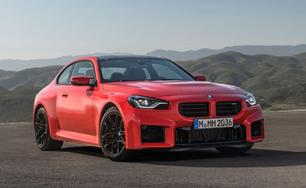
There have been mixed reviews of the design of the BMW M range, but I reckon this one looks pretty damn good. In fact, I've always thought this kind of hyper-aggressive styling looks better on smaller cars than it does on big ones.
And it certainly is aggressive, right? From the huge bonnet bulges to the meshed out grille and angry rear diffuser, to the staggered alloys and flared wheel arches, to the blocky rear end with its four massive exhaust exits.
But my favourite exterior item has to be the blacked-out carbon roof, which helps shrink the M2 visually, and makes the whole car look more potent.
Inside, it's plenty sporty feeling, with hard-backed sports seats, lashings of carbon-fibre-look trimmings and the bright red M buttons on the steering wheel.
It's nice, but some of the touch points – like the hard plastics on top of the doors, where, if you're like me, you rest your elbow when driving – feel less than premium.
Still, all the tech is present and accounted for, with its digital dash and huge centre screen, and there's no shortage of spaces to connect or charge your phone.
The new RS5 sedan and Avant wagon are beautifully proportioned, with big rims and rubber, pumped guards and a visual balance that matches a close to 50/50 front to rear mechanical weight distribution.
Instantly recognisable as an Audi, big ticket elements include a huge 3D honeycomb grille, front wheel-arch exit vents, a rear spoiler on both versions and RS-specific OLED tail-lights with a chequered flag signature.
Beauty is always in the eye of the beholder but I think this car exudes equal parts sophistication and menace.
Inside, the RS5 is all business, from the configurable multi-screen displays (including a lap analysis tool) to the flat bottom and top steering wheel as well as the beautifully sculpted seats and obvious attention to detail.
The driver’s the main event here and the interior treatment extends the exterior’s intense personality perfectly.
The M2 pocket rocket measures just over 4.5m in length, just under 1.9m in width, and just over 1.4m in height, and it rides on a 2747mm wheelbase. That makes it longer, wider and lower than the model it replaces.
Remember that 'lower' bit, as it will come up again in a moment.
Up front, you don't feel cramped, and there's the requisite cupholders, door pockets and hiding holes, as well as wireless device charging and USB connections.
But remember, this is a two-door, four-seat affair, which cuts into the practicality a little, or a lot.
Swing open the wide front doors, and push the front seat-back forwards, and the entire chair will slide forward automatically.
It does help create more room to climb into the back, but it's still a slightly embarrassing challenge to make getting back there look anything like graceful.
Once there, it's tight. I'm 175cm and my head was firmly pressed into the roof.
You do get your own vents and temp controls, but that's about it. Even the pull-down divider only gives you access to the 390-litre boot, rather than extra cupholders.
You do get two sets of ISOFIX attachment points, though, and let's be honest – if you're buying this to make Bunnings runs, you've probably got it wrong.
In terms of space and practicality, in the front, at 183cm tall I’ve got plenty of breathing space.
And for storage, there are pockets in the doors big enough to hold large bottles as well as a couple of cupholders in the centre console.
A tray ahead of the gearshifter is for wireless charging but if your phone isn’t in there it doubles as an oddments tray and there are two USB-C ports and a 12-volt socket inside it.
There’s a fairly shallow lidded storage box between the seats which doubles as an armrest between driver and passenger and there’s a medium-size glove box.
In the back, I’ve got plenty of foot and legroom although without too much effort I can touch my head on the roof lining, so I’d call that marginal.
For storage, there are decent bins in the doors, big enough for bottles. There’s a pull-down armrest in the centre, again with a pair of cupholders.
There are netted pockets on the front seatbacks, adjustable air vents with temperature control as well as another pair of USB-C outlets to keep everyone happy and charged up in the back seat.
Boot space is passable for a car of this size, with the sedan offering 331 litres VDA with five seats up and the Avant wagon at 361L in the same configuration.
Both feature a 40/20/40 split-folding rear seat for extra flexibility and space - 1170L with the second row folded in the sedan and 1302L in the wagon.
There are tie-down anchors, bag hooks as well as numerous extra storage spaces and braked trailer towing capacity is a handy 2.1 tonnes.
But there’s no spare wheel of any kind. A repair/inflator kit is your only option, which in this market, isn’t good enough.
First, the bad news. The M2 has only been getting more and more expensive over the years, and this new-generation model continues that charge.
Fun fact: When we first tested this model way back in 2016, you could get the Pure grade for less than $90K with a manual transmission.
Or you could spend just under $100K for the full-fruit version. This one, though, lists at $121,700, before on-road costs.
So, a little less bang for buck, but there's still a whole lot of bang on offer here.
You'll find staggered 19- and 20-inch lightweight alloys, while standard performance kit includes an 'Active M Differential', 'Adaptive M Suspension', 'M Compound Brakes' (with blue calipers), 'M Sport Seats' up front and, for the first time, a lightweight 'M Carbon' roof.
Elsewhere, there's adaptive LED headlights, a 12.3-inch instrument display and a 14.9-inch multimedia screen, a head-up display, a Harman Kardon 'Surround Sound' audio system and Android Auto and Apple CarPlay connectivity.
You'll sit on leather seats that adjust electrically and are heated up front. There's three-zone climate control, along with a heated steering wheel, wireless device charging and ambient interior lighting.
Before we get behind the wheel, it’s prudent to check in on cost-of-entry.
Sitting at $179,827, before on-road costs for the sedan and $182,827, BOC for the Avant, this third-generation RS5 is a relatively modest, roughly seven per cent step up in price from the second-gen Coupe and Sportback models it replaces.
Obvious rivals include fellow Bavarian, the BMW M3 (from $169,600) as well as the Mercedes-AMG C63 S E Performance ($193,100) with the Alfa Romeo Giulia Quadrifoglio (from $174,200) lurking in the shadows.
Aside from the performance and safety tech we’ll get to shortly, standard equipment highlights include:
Suffice it to say this machine meets the market when it comes to included features.
Besides, this is what we're really here for, isn't it? The M2 gets the 'M TwinPower' 3.0-litre twin-turbo inline-six engine, producing a sizeable 338kW and 550Nm, sending that power to the rear wheels via an eight-speed auto or six-speed manual.
BMW says this engine is very, very close to the engine that powers the M3 and M4, and says it will rocket the M2 from 0-100km/h in 4.1 seconds, and to 200km/h in either 13.5 seconds in the automatic, or 14.3 seconds in the manual.
The RS5 is powered by an updated version of the previous model’s all-alloy 2.9-litre, twin-turbo petrol V6 engine which produces 375kW/600Nm all on its own.
It features direct-injection and variable geometry turbos as well as variable intake and exhaust cam timing. And now it’s supported by an electric motor integrated into the eight-speed auto transmission that tips in 130kW/460Nm.
A mighty combination with overall outputs of 470kW/825Nm. Enough to propel either version of this car from 0-100km/h in a blistering 3.6 seconds.
A small fly in the ointment is fuel use, with the M2 said to use 9.7L/100km on the combined cycle. It also drinks 98 RON premium, and is home to a 52-litre fuel tank. Your theoretical driving range is around 540km.
Now, be warned, you'll be bored stiff if you drive it in the way that's required to get it that low. When we were being gentle, we were somewhere between 10.5 and 11.5 litres per hundred kilometres.
Emissions are pegged a 220g/km of C02.
Claimed combined cycle (urban/extra-urban) fuel economy is a miserly 4.2L/100km for the sedan and 4.4L for the Avant, which is amazing for a car with this much performance potential.
But it’s worth noting that number rises to (a still impressive) 10L/100km when the battery’s depleted.
On an enthusiastic section of the launch drive we saw an average of 17L/100km which dropped to 7.0L on a cruisier section.
What’s more, thanks to a 25.9kWh lithium-ion battery, it can cover 78km in EV-only mode at up to 140km/h if you’re game.
Charging capacity is 11kW AC, for a full top-up in two and a half hours and minimum fuel requirement is 98 RON premium unleaded.
With the battery fully charged you can expect a combined cycle range of around 1200km, which is more than useful.
Let's be totally up front here: the BMW M2 isn't the most comfortable vehicle to live with. In fact, I recently climbed out of the M3 Touring, and found that to be more comfortable on broken city streets.
The M2 is fitted with adaptive suspension, but even in its most comfortable settings it can feel rough, bumpy and jarring on bad roads (of which Australia has lots), and unless you're gentle with the accelerator, it can feel a little jumpy when first taking off – a by-product of its prodigious power.
Now, let's be totally up front again: I don't care. The M2 is fun, plain and simple, and for mine, the above is a fair price to pay for something that brings so much joy.
The steering is lovely, the power immediate and the soundtrack intoxicating, and it's the kind of car that's fun no matter where, how far or how fast you drive it.
In fact, fun seems to be the very centre of the M2 proposition, which definitely doesn't take itself too seriously.
For evidence, look no further than the 'M Drift Analyser', buried in a hopelessly busy multimedia system that will have you praising the CarPlay and Android Auto gods.
It will rate your best drift out of four stars, measure it for distance, and basically give you a pat on the back for doing your best hooligan impression (not on a public road, of course).
Fun, then, is the order of the day here. And I bloody love it.
This RS5 has 40 per cent more power and 40 per cent more torque than the model it replaces, which was no slouch. It is properly fast.
We gave it a red-hot go on the circuit and the car remained predictable, balanced and sharp.
The drivetrain, including the quattro all-wheel-drive system, centre diff and torque-vectoring across the rear axle keeps everything in hand and quietly turns you into a superhero.
The eight-speed auto transmission is a conventional torque converter type, and it’s quick on the up-change but it’s half a beat slower to pick up a ratio on the down-shift relative to a dual-clutch. Not much in it, but it’s there.
So, we’ve established this car’s fast; capable of accelerating from 0-100km/h in 3.6 seconds. But if you want full weapons-grade in an instant while cruising, try pressing the bright red Boost button on the steering wheel. Everything immediately goes to maximum and for 10 seconds you’ve got it all.
The RS Sport exhaust is an active, variable system, tuned specifically for the RS5, constantly adjusting according to your driving style.
Cruise along and it remains quietly civilised, but pin the throttle and all of a sudden you’re hearing that wonderful growl from the V6 engine.
Suspension is by multi-links at the front and the rear and there are dual-valve adaptive dampers all around. The car rides very nicely with three set-up choices - Sport, Balanced and Comfort.
We were in Balanced most of the launch drive program on fairly coarse B-roads as well as some main highways and we were surprised by the (285/30) Pirelli P Zero R tyres and how quiet they are. Exceptionally grippy on the circuit but very quiet on the open road.
And wind noise is minimal. So, as a GT this car is very comfortable, quiet and refined.
The steering is progressive rate and speed-dependent and it is just beautiful. Accurate and feelsome, you’ve got a great connection with the front wheels without any undue feedback coming up to your hands.
You can feel this car’s roughly 2.4-tonne weight, but it always feels buttoned-down, agile and responsive.
The Dynamic Torque Control system complies with the classic swan on the lake syndrome. Serene and calm on the surface but furiously doing its thing underneath. It keeps everything on track, almost magically.
It delivers 8.0kW and 40Nm, acting as a high‐voltage actuator within the rear transaxle, redistributing torque differences between the rear wheels within milliseconds.
And the quattro system features a redesigned centre diff with integrated preload function for continuous torque distribution, delivering sharper response during rapid throttle transitions.
When it comes to slowing, the brakes are professional grade. You’ve got dinner plate-size ventilated rotors (420mm fr - 400mm rr) and 10-piston callipers up the front.
You can stand the car on its nose as it washes off speed rapidly and progressively with fantastic pedal feel.
Under the heading of miscellaneous observations, the sports front seats look and feel fantastic. Comfortable after hours behind the wheel. But also, when you’re pushing on the open road, or really having a go on the circuit, their side bolsters are just right, providing enough support without pinching you or proving uncomfortable.
The BMW M2 hasn't been assessed by ANCAP, but it arrives with six airbags, as well as all your usual traction and braking aids.
Elsewhere, you'll find lane change and lane departure warning, active cruise control, front and rear parking sensors, tyre pressure monitoring, and AEB with pedestrian detection.
There's also blind-spot monitoring, rear cross-traffic alert and lane centring assist, as well as a tyre-pressure monitoring system.
The RS5 has not been assessed by ANCAP, but all the expected safety boxes are ticked, including but not limited to:
There are eight airbags, sadly not including a front centre bag. But for child seats there are three top tethers across the second row with ISOFIX lower anchors on both outboard positions.
The numerous advanced driver assistance systems (ADAS) are effective without being overly intrusive. Not always an easy balancing act to achieve.
The BMW M2 is covered by a five-year, unlimited kilometre warranty, and servicing is 'condition based', in that the vehicle will tell you what maintenance is required, and when.
You can prepay your service costs at the time of purchase for all BMW vehicles, covering the first five years of ownership, for $3480 (which means $695 per service).
The RS5 is covered by Audi’s five-year, unlimited km warranty, which lags the mainstream market but is still par for the course at the top end.
The traction battery is covered for eight years/160,000km and there’s a 12-year corrosion warranty.
Service interval is 12 months/15,000km and a five-year service plan is $3650 which isn’t outrageous for this kind of car in this part of the market.
Audi has more than 50 dealerships across Australia covering every state and territory as well as key regional and rural centres.