What's the difference?
The BMW 7 Series is Munich’s flagship, the car that fans of the blue and white roundel respect as peak plush motoring.
Now, for the seventh 7 Series, BMW has brought electric power to the table in the form of the i7 in order to stay ahead of the curve.
It’s still joined by a petrol-powered variant here in Australia, the 740i, which is a mild hybrid and shares a lot of the luxury specifications of the i7 - including a properly impressive rear seat theatre screen.
But is it forward-thinking enough to fend off the likes of the Mercedes EQS?
Peter Anderson road tests and reviews the 2016 Mercedes-AMG SL63 with specs, fuel consumption and verdict.
Well. They don't make cars like this anymore, do they? Time was, a big coupe or convertible were de rigeur for the well-heeled banker, with 12 cylinders almost a given and fuel consumption measured in super tankers, or more likely just not talked about at all.
The world has changed but Mercedes’ SL hasn't. That's not strictly true, of course. The SL63 may drop four of the SL65's 12 cylinders, but at just half a litre smaller and still with twin-turbos it generates the enormous thrust a luxo-barge like this needs. The things that made it an icon are indeed still there - lots of tech, a style all its own and a name everyone recognises.
While the new 7 Series won’t visually appeal to everyone, nor is it at the forefront of spirited driving dynamics, it’s hard to argue that it isn’t fit for purpose.
Its rear theatre screen and lounge layout might seem gimmicky at first, but it’s difficult to think of a more comfortable way to be transported on wheels short of putting a chassis under your loungeroom. Even then, you’d have to ask someone for a massage.
This is one of those cases where a car becoming larger isn’t such a bad thing, and BMW should feel like it’s achieved, seemingly, what it set out to do in building an electric limousine that doesn’t fall short in range or dynamics.
If BMW can bring this level of refinement down to its more affordable models, its electric future is looking promising.
Note: CarsGuide attended this event as a guest of the manufacturer, with meals provided.
The SL's overall score is somewhat skewed by everyday concerns, and rules are rules - an average punter will find the price of this car somewhat confusing and the devil-may-care attitude to fuel consumption bewildering.
If neither of these things are a problem, then the SL63 makes plenty of - well, not sense, because it's not a particularly clever or considered car - but it fills a niche that not so long ago we all thought would go the way of the dodo.
The fact it sells so few examples is betrayed by some of the cabin amenities and the fact that Mercedes hasn't put much effort into reducing the car's weight to improve its consumption or sharpen up the handling.
The fact it still exists at all is pretty damn cool, though, and for certain people an SL63 purchase is the culmination of a lot of hard work.
If it is your dream car, the SL63 won't disappoint. Everyone who rode with me said it was mightily impressive, but you've got to really want it. When you're not far off buying a Ferrari California T or Aston Martin V12 Vantage S for the money, you'll need a real yearning for the three-pointed star to go this way. And if you do, good luck to you - you've probably worked quite hard to get here.
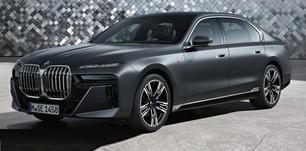
BMW freely calls the new 7 Series “monolithic” in its press material, and it’s hard to argue. The seventh-generation of its luxo limo is bigger in every dimension, and with a higher bonnet and bootlid, the car is convincingly imposing even when parked. Even more so in black.
From the front, the 7 Series clearly has a new face compared to its predecessor, with split headlights now an indicator of BMW’s luxury oriented models - the incoming XM SUV features the same.
Its LED daytime running lights feature Swarovski crystals, while the grille surround illuminates while the vehicle is parked and on. It’s currently unable to be illuminated while driving to comply with Australia’s laws.
It’s perhaps less elegant and more aggressive than previous generations, but that doesn’t mean there won’t be those who approve. It’s certainly emotive, especially when compared to the side and rear of the car.
The side profile of the 7 requires quite a few steps back from the car to really take in - it’s almost 5.4 metres long - though it's hard to hide the size of a car that allows its rear passengers to almost lay down.
From the rear, the 7 Series is probably at its most uninspiring, which is a reverse from the interior where the front feels more minimalistic than some of its rivals like the Mercedes-Benz S-Class.
BMW has used crystalline geometric shapes throughout the cabin, and the front ‘interaction bar’ is perhaps the best example.
In keeping with the minimalism, its screen sits in an almost freestanding style out from the dash, with no physical buttons seen around it.
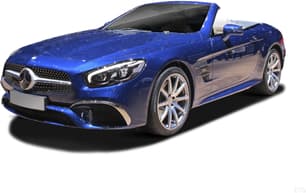
The SL has always been completely unapologetic about its size and seems to be designed to accentuate rather than hide its length and width. The long bonnet screams power and prestige, and get out of my way, and is reminiscent of the little-loved McLaren SLR project of some years ago.
The size of the Mercedes logo on the huge front grille leaves you in little doubt about the brand of car that’s about to pass you at speed and some might say (okay, I would) that its large surface area is a little vulgar.
Like the SLR, the design doesn't seem to have a particularly cohesive strategy, with a number of Mercedes elements from around the traps that climb over each other. Roof up it looks awkward because of the gigantic posterior while with the roof down it looks overly long and, again, tail-heavy.
Folding hardtops are notoriously cumbersome and need a lot of room to hide them, but the silent operation is something to behold.
Elements that are worth deleting if possible are the dodgy 'Biturbo' badges. It's that kind of bling that gets people raising their little finger at you.
If the word ‘practicality’ brings to mind simplicity, the 7 Series might require you to have a bit of a mental reset. If it means plenty of space and a long list of elements to keep you comfortable, you’d be closer to the money.
While it’s visually restrained in some ways, the space accessible to the driver is thought out reasonably well, as you’d expect from a car costing more than a quarter-million.
The front seats certainly aren’t the main event, but the Merino leather and cashmere wool combination seats are far from uncomfortable, with the heating, cooling, and massage functions accessible from the central multimedia screen.
The controls for those, as well as functions like the climate control, are easily accessible, though could probably be even easier with a physical climate control panel.
Controls for the individual vents, and even the glovebox are found along the BMW interaction bar, which can (frustratingly) reflect light thanks to its crystalline design, meaning it’s hard to see while driving on a sunny day.
Similarly, while the centre console where the main control dial for BMW’s 'iDrive' isn’t far removed from previous versions, it’s less tactile and requires a look sometimes to see what’s being pressed. Here, too, sunlight can reflect (this time off the dial) and make it more distracting.
Fortunately, the steering wheel controls remain physical buttons, and they’re laid out in a way that previous BMW owners or drivers will find familiar.
The 7 Series also now leans more heavily on voice activation, so if the lack of physical climate controls or the multimedia screen is a little distracting, much can be achieved by actually asking the car with a “hey, BMW… ”.
There’s a large storage unit in the centre console, as well as two cupholders and a phone charging platform in front of the multimedia controls.
The rear seats, especially the one behind the front passenger, are where the 7 Series begins to feel its worth. If you’re buying one with the intention of being the driver 100 per cent of the time, you’re missing a trick.
The ability for the front passenger seat to shift forward and maximise legroom while the rear seat reclines into a lounge position is nothing new, limousine sedans have been able to do this for years, but the 7 Series takes it to another level.
Not only is there plenty of space for even the tallest of humans to stretch out, but the positioning and angle of the huge 31.3-inch theatre screen is great, even if it impedes the driver’s rear view, and the ability to use it as a touchscreen for some functions means less need for the handy but sometimes fiddly door-mounted control screen.
If you plan on playing games, the controls (and the fact you’re likely in a moving car) can make it a little difficult, but the small control panel is overall easy to use and well-placed.
The cushioned armrest that folds down in place of a middle passenger is comfortable, features a phone charging pad and pop-out cupholders, as well as a storage space under the armrest.
Finally, the boot space in the BMW 7 Series is far from small, with the electric i7 offering 500 litres (VDA) of space, while the 740i boasts 540 litres thanks to its lack of battery.
“Practicality” is about as relevant to this car as a code of ethics is to a drug dealer or a contract killer, because the SL63 buyer is hardly worried about cupholders and boot space. For what it's worth, there are four cupholders in the two-seater cabin (which might explain why owners aren't worried about their liquid carrying prospects) and a minimum boot space of 364 litres and a maximum - with roof up - of 504, which is actually not bad.
Cleverly, there's a little robot-operated luggage cover inside the deep boot that stops your gear from being crushed when the roof goes down.
There's also space in the long doors where you might secrete a bottle of wine that would get a NSW Premier fired if he thanks you for it, and a bin in the console to hide your phone.
Given we’re in the realm of models where the price difference between two variants could pay for an entire new city car, what value means shifts a little bit.
The BMW 7 Series comes in two variants for the seventh generation, starting at $268,900 for the petrol-powered 740i, and $297,900 for the electric i7.
Previously, it was possible to get into the BMW 740i for $198,900 after BMW lowered the price of the sixth generation car.
However, the new 7 Series is larger and has more packed into it, with both variants highly specified and mostly differing in price due to their drivetrains and some more minor creature comforts.
The 740i starts with an already impressive list of standard features, with 20-inch M alloy wheels, remote start, a tyre pressure monitor, rear-wheel steering, 'crystal' headlights and an illuminated grille surround, a panoramic glass roof, heated seats and a massage seat for the driver with Merino leather, a 20-speaker Bowers & Wilkins sound system, as well the option to select the M Sport or M Sport Pro pack at no extra cost.
The more expensive i7 xDrive60 gains, on top of that, 21-inch wheels, active roll stabilisation, automatic opening and closing doors, multifunction seats with heating, cooling, and massage in the rear, plus a 39-speaker sound system and the impressive 31.3-inch theatre screen.
The i7 also comes with a BMW third-gen wallbox, home and public charging cables, and a five-year ChargeFox subscription. It also gains a six-year service package over the five included with the 740i.
If the i7’s extra features are tempting, but its drivetrain isn’t, 740i buyers can opt for a 'Connoisseur Lounge' pack for $27,900 which adds the auto doors, multifunction seats, rear theatre screen, and a 40-speaker sound system.
It’s difficult to ponder the idea of value when a car is already approaching $400,000 at a rapid rate even before you start piling on the options. On the plus side, for a list price of $368,715 you do get an extremely long list of standard equipment.
The SL has always been completely unapologetic about its size.
Edited highlights include leather on almost every available surface, heated and cooled electric seats with a fan heater for your neck, a B&O stereo that will shatter the windscreen on request, aluminium trim that's real aluminium (mostly), Active Ride suspension, sat nav, dual-zone climate control, active cruise, LED headlights and a huge swag of safety gear.
The 12-speaker stereo also has DVD, limited smartphone integration via Mercedes' COMAND system, a seven-inch screen and, of course, Bluetooth.
The BMW 740i is powered by a 3.0-litre turbocharged in-line six-cylinder petrol engine, as is the way with many of BMW’s larger cars. It’s also a mild hybrid, incorporating a 48-volt electric starter/motor combination.
The 740i makes 280kW between 5200-6250rpm, and 520Nm between 1850-5000rpm, which is transferred to the rear wheels via an eight-speed automatic transmission.
The electric i7 xDrive60 is the flagship model, with its dual-motor all-wheel drive powertrain good for 400kW and 745Nm, allowing for a claimed 0-100km/h time of 4.7 seconds - 0.7s faster than the 740i.
The SL63 is powered by Mercedes’ increasingly famous V8, with two turbos along for the ride to add oomph and cut the car's famous consumption, at least slightly. The 5.5-litre unit produces a massive 430kW and a scarcely believable 900Nm of torque.
All of that heads rearward via a seven-speed dual-clutch transmission that helps sling the 4.6m, 1848kg machine to 100km/h in 4.1 seconds.
BMW Australia hasn’t yet specified local figures for fuel consumption or energy efficiency for either variant of the 7 Series at the time of our review, but the international specifications for both i7 xDrive60 and 740i give a relatively accurate guide.
BMW claims the electric i7 has a power consumption of between 19.6 and 18.4kWh/100km, which means its 101.7kWh battery allows a range of between 591 and 625km according to the brand.
It’s claimed to charge from 10 per cent to full in less than 5.5 hours with a 22kW AC wallbox, or in 34 minutes to reach 80 per cent using DC fast charging at 195kW.
The petrol powered 740i will use between 7.0 and 8.0 litres per 100km, according to BMW, which equates to between 183 and 159g/km of CO2.
Much as is the case with the price, there's no real way to soften the blow here - the SL63 drinks like a footballer on Mad Monday, except it does it every day. The official combined cycle figure of 10.2L/100km is quite easy to double, as we did, averaging 21L/100km in mostly flowing suburban traffic. In the car’s defence, the accelerator pedal spent a good deal of time near the firewall.
The SL does have stop-start to help reduce its considerable environmental impact.
BMW hopes for two things for the new 7 Series: one, that it’s the best car to be driven in, and two, that it’s the best car to drive.
While one of those things could be argued to be true, we suspect there are some engineers in BMW’s M department who would be frustrated at the thought of a more-than 2.6-tonne limo being called better to drive than a car half that size with a manual gearbox.
But, perhaps unsurprisingly, the BMW 7 Series is rather refined from the driver’s seat, especially on roads where the speed limit is high and the corners are long.
The two variants Australia has available, the i7 xDrive60 and the 740i, differ in their drivetrains as mentioned above, and the dynamics of each are slightly different.
The all-wheel drive electric i7, despite its extra heft (the 740i is almost 600kg lighter) the EV feels more nimble thanks to its immediate torque delivery and higher outputs give it more flexibility in dynamic driving.
The lower centre of gravity, even with the extra weight, helps the electric i7 hold its own against the turbo six-powered 740i.
Both variants come standard with BMW’s rear-wheel steer system, or ‘Integral Active Steering’, which is vital to providing the agility needed for keeping the 7 Series in shape on tight roads, where it tightens the turning circle below 60km/h, though its 3215mm wheelbase does a lot to keep it feeling stable.
Above 60km/h, the rear-wheel steering improves stability further by turning slightly with the front wheels as opposed to against them, allowing for smoother flowing cornering and highway lane changes.
In either case, the 7 Series is easy to drive, with the steering able to be set to Comfort regardless of the drivetrain’s intensity (Sport and Comfort are the only options), which leaves the wheel feeling lighter.
The ride, whether from the front or the back, is impressive, even when being chauffeured through rough backroads.
The 7 Series, despite not being engineered specifically for Australia’s sometimes shockingly pockmarked roads, manages to soak up impacts before they transfer from the tyre into the seats, and that goes for the sound and road noise, too.
Unfortunately, our launch test drive was hampered by some roadworks out of BMW’s control, so stay tuned for a more in-depth drive soon.
There are a number of impressive things about the way the SL drives. Firstly, astronauts will be familiar with the galactic thrust of the V8. It seems endless, seamless and ready to sling the big coupe into the outer atmosphere. Few engines of any kind can match the relentless go on offer in the SL and much of the credit should go to the seven-speed twin-clutch transmission.
When you jump on the brakes and shift down, the exhaust keeps the show going with angry crackles and pops.
Containing a torque figure like the twin-turbo V8's requires a lot of electro-trickery to stop you from being launched off the road. The great thing about all that stuff is that it works unobtrusively and smoothly.
Mashing the carpet in an SL without traction control would create much sound and smoke but little forward progress, such is the twist on tap. The SL has a range of modes from full-nanny (which is meant to keep you on the slippery Alpine road you've chosen to get you to some Swiss ski resort) while turning the dial all the way around to Race loosens the bonds.
It's in this mode you'll have the most fun and it does seem that the intermediate settings are a bit of a waste of time. Race mode does little to diminish the amazing ride quality provided by the active suspension setup, but relaxes the reins on the huge rear tyres. Exiting roundabouts is suddenly a huge laugh, with the tail cheerfully breaking traction and the two-mode exhaust thundering in a most pleasant way.
Better still is that when you jump on the brakes and shift down, the exhaust keeps the show going with angry crackles and pops, with more on the way when you lift off. There's little to match the aural pleasures of a properly tuned V8 and Mercedes has resisted the temptation to quieten it down on the outside and generate a fake noise for the inside. Although that would be stupid in a convertible, if you think about it.
The SL63, despite its AMG badge, isn't about all-out handling, of course. The Ferrari California would definitely show it how it’s done on a winding country road. The SL is more about flow, building momentum and rarely shifting down to second gear. The monstrous torque is enough to keep things rolling but should you wish for a bit more of the exhaust bellow, second is there for the taking.
Hustling the big convertible feels wrong, not because it can't do it, but because it's not really what it's for. Having said that, it offers a kind of fun that nothing else on Earth will provide, not even a Bentley GTC.
With the roof up, the SL63 is a quiet place but not remarkably so. The huge sticky tyres do the cabin's hush no favours, with an annoying roar on a wider range of surfaces than you might expect.
Roof down, it's hardly a paragon of virtue. A lot of wind noise reaches the cabin, even well below the huge speeds the SL can reach. So if you want to talk, it's windows up you'll need to deploy the mesh screen that bridges the roll hoops.
The new BMW 7 Series hasn’t been crash tested by ANCAP, nor does it seem likely it will be, given the small number that are likely to be sold here.
But the car itself isn’t short on safety features, and BMW has a good recent history of scoring the maximum five stars for its cars.
The 7 Series features front and side airbags for driver and front passenger, curtain airbags for both front and rear seats, crash sensors, and a tyre pressure indicator.
Of course, the standards like active cruise, AEB, and sensors for collision warnings are all standard, plus BMW also offers active roll stabilisation as an option, which uses 48-volt motors to steady the car and account for the road surface and body roll through corners.
Six airbags, ABS, stability and traction controls, blind-spot sensor, lane-departure warning, brake assist, active safety bonnet, lane-keep assist, driver attention detection, AEB.
BMW offers a five year, unlimited kilometre warranty and that extends to both variants of the 7 Series.
BMW also offers servicing packs for its new cars, though the pricing for each group of models excluded the 7 and 8 Series and its M cars.
Given the most expensive servicing pack listed is the BMW X7’s $2800 five-year, 80,000km pack, expect anything similar for the 7 Series to cost more.
In terms of when servicing is required, BMWs are condition-based, meaning the car’s own systems detect whether something like an oil change or part replacement is required, and provides that data to your BMW service centre to help calculate an estimate for work needed, ahead of time.
The SL63 is covered by Mercedes' three-year/unlimited kilometre warranty. And, er, that's it.