What's the difference?
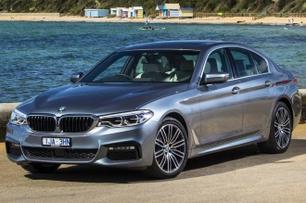
Andrew Chesterton road tests and reviews the new BMW 5 Series 520d, 530i, 530d and 540i sedans with specs, fuel consumption and verdict at its Australian launch in Victoria.
When we're all living under the cruel rule of our robot overlords, the few remaining human historians will track the genesis of our downfall to the technology explosion that occurred in 2017's new-car market.
Never before have car companies focused so hard on producing cars that can't just be driven, but that can drive themselves, negotiating corners, unexpected obstacles and changing traffic conditions without ever needing to consult the human actually sitting behind the steering wheel.
And BMW's all-new 5 Series sedan takes yet another a step forward, eliminating the need for said human to even be sitting in the car. Owners can instead move their 5 Series in and out of tight parking spaces simply by pressing a button on their key.
The Active Key function is admittedly a $1,600 cost option, but it proves the techno-focus applied to the seventh-generation of BMW's executive express, which will land in Australian dealerships this month. Every car is also fitted with what the German brand calls its personal co-pilot; a series of nifty cameras and radars that allow the car to be driven completely autonomously for spells of 30 seconds.
But the question is, has all this new technology come at the cost of regular, old-school driver enjoyment?
Large SUVs like the Toyota LandCruiser, Nissan Patrol and Land Rover Defender have dominated in Australia for decades now, however there’s now something new to shake up the segment.
BYD’s luxury spin-off brand, Denza, has launched in Australia with two plug-in hybrid (PHEV) off-road SUVs. The B8, which is the larger of the two, is on test here.
With three rows of seating, a bucketload of standard equipment and a jaw-dropping starting price, the B8 is being pitched as a PHEV alternative to the currently diesel-only LandCruiser 300 Series among other more premium alternatives like the Land Rover Discovery and Mercedes-Benz GLS.
We’ve already driven the B8 over in China and this is the first time we’re getting to test it out on Australian roads, so let’s see how it stacks up.
Sleek and attractive in the city, engaging on a country back road and with plenty of clever technology, the 5 Series sedan ticks all the right boxes as an executive express. If you can stomach the price hike, the six-cylinder 540i is our pick of the bunch.
The Denza B8 is an incredibly luxurious car that has a lot going for it, including three rows of seating, a 3.5-tonne braked towing capacity and an eye-popping price tag, but it's held back by its overall heft and cumbersome ride.
If you don’t absolutely need the third row of seating, the smaller B5 is arguably the better pick and while it’s also not perfect, it’s a very compelling package and you’ll be saving thousands of dollars in the process.
Note: CarsGuide attended this event as a guest of the manufacturer, with travel, accommodation and meals provided.
Hardly a revolution, the 5 Series has instead undergone a few nips and tucks. But if it ain't broke and all that. It might not be the most head-turning offering, but the 5 Series sedan remains sleek, powerful and understated, and it is undeniably handsome on the road.
Its 8mm wider, 28mm longer and 2mm taller than the car it replaces, but it's also around 95kg lighter, thanks to its aluminium doors and boot and a clever magnesium frame for the instrument panel that saved another two kilograms. There's some other clever design elements, too. The kidney grille has active air flaps that open when extra cooling is required, closing when it isn't, reducing drag and helping accleration.
Inside, the 5 Series offers a beautifully crafted yet joyously understated cabin, with quality materials joining modern technology in a seamless way.
There’s no way around it, the Denza B8 is a big car. It’s almost 5.2 metres long which makes it larger than a LandCruiser 300 Series and more in line with the likes of the Land Rover Defender 130.
It looks quite boxy and tough on the outside, though it doesn’t have any features that define it specifically as a Denza beyond the inconspicuous badging. There are many angles that are reminiscent of the aforementioned Defender.
The body lines look crisper than the smaller B5, as does the semi closed-off grille and LED light script that connect the big LED headlights.
Unlike the B5, the tailgate-mounted spare wheel is much more prominent in the B8 and this therefore exaggerates its heft, not in a good way.
Inside, it’s luxurious and high-end with lots of visual appeal. I particularly like the amount of soft-touch finishes around the cabin and the overall lack of glossy piano black.
While luxurious, there’s also a rugged edge to the interior. This is most present in the large grab handles which you do need to use when getting in and out.
The amount of physical buttons and switches inside is a nice touch as you don’t need to relate on the touchscreen all the time. The fact the gear shift lever rises up when you turn on the car also adds to the special, luxurious feel.
This is a full-size sedan, and every seat feels spacious and airy. The sloping, slightly coupe-style roofline does cut into headroom in the back, but human-sized people will have little trouble, even sitting behind a tall driver.
Each trim offers two cupholders in the front, with another two housed in a pull-down divider that seperates the rear seat. And there's two ISOFIX attachment points, one in each window seat in the back.
The 5 Series' boot opens to rival a surprisingly sizeable storage space, offering 530 litres with the 40:20:40 rear seats in place.
Hopping into the B8 you need to acquaint yourself with how the flush door handles operate. Generally they pop open when you unlock the car but sometimes they can be a little delayed.
Also inside the car there are electronic door release buttons which are nowhere near as intuitive as regular door pull handles. Sure you’d likely get used to this over time but you’ll need to explain it to new passengers all the time.
The seats in Chinese cars usually look nice but aren’t that comfortable or supportive for long-distance journeys. The B8’s are the opposite, offering great support and almost limitless adjustability. Adding to this is the standard heating, ventilation and massage functions.
Ahead of the driver is a leather-wrapped steering wheel which feels nice and has plenty of physical buttons with a tactile click when pressed.
Behind this, the digital instrument cluster is clear and high-resolution and offers a number of different layouts and informative pages you can cycle through. This allows you to customise the display.
In the centre of the dashboard is the mammoth 17.3-inch touchscreen multimedia system which is the largest central screen I have seen in a car to date. It’s a big screen for a big car and Apple CarPlay satisfyingly takes up the entire screen.
Thankfully, the screen is snappy and has a native user interface that is easy to navigate around without getting lost. I particularly like the swipe-down control centre menu that allows you to change key settings without diving into sub-menus.
My only hassle with the screen is I struggle to reach the far left-hand side due to its overall size. Perhaps a trackpad would solve this.
As I noted previously, the amount of physical switchgear around the cabin makes adjusting key functions easy. Examples include physical buttons to change the drive mode, activate the surround-view camera, adjust the suspension position and switch between EV and hybrid driving.
In terms of storage up front there are two non-ventilated 50W wireless phone chargers, two cupholders with adjustable depths, a shallow storage section under the centre console, plus a fridge/hotbox under the centre armrest.
Moving to the second row and the luxury continues. The seven-seat model features a three-seat bench that three people can easily fit across as the floor is flat, whereas the six-seat model gets uber-plush captain’s chairs.
Regardless of variant, there’s plenty of room in the second row, even for adults.
Second-row amenities include a small screen on the back of the centre console box that allows you to change the climate control and change the seat heating/ventilation, among other functions.
There’s also a button that opens the fridge/coolbox so the second-row passengers can access it. This is a nifty touch though you’d want to make sure small fingers don’t get caught as the anti-pinch function isn’t the strongest.
A feature that’s unique to the six-seat version is a massaging function on the second-row captain’s chairs. This is a very cool touch that no other SUV at this price point offers.
Accessing the third row in the six-seat version is rather easy as you only need to walk down between the captain’s chairs. It’s also simple enough in the seven-seat version as long as you access it from the kerb side.
Third-row space is decent for adults, but this shouldn’t be surprising as the B8 is such a hulking vehicle. The backrests also recline allowing for extra comfort. Amenities include air vents in the headliner, USB-C ports and scattered storage. It’s enough for seats that will likely only get occasional use.
Around the back the B8 has a side-hinged tailgate which is a little problematic as you need to allow space for it to open up in parking spaces. This is hard when the car is already 5.2m long…
With all three rows upright there is 147L of boot space, which is fine, but this expands to a much more usable 920L with the third row folded.
The boot space is square and usable, though there is a large load lip which is body-coloured and would easily get scratched if you drop something on it. Not the best in a family-oriented vehicle.
Boot-related amenities include buttons to electronically fold the second and third row seats and lower the suspension to make things easier to load into the boot, a 12V socket, scattered hooks, as well as a small underfloor section to store the changing cables.
Although it stands out like a sore thumb, it’s great to have a full-size spare wheel on the back of the tailgate. This is very helpful in the unlikely and unfortunate event you get a puncture.
BMW's venerable 5 Series is now 45 years old, and this all-new model arrives in four distinct flavours, with a fifth - an incoming M5 performance sedan - still some way off.
For now, though, the range kicks off with the 520d, before stepping up what BMW hopes to be the big seller of the range, the 530i (replacing the outgoing 528i). Next up is biggest diesel, the 530d (replacing the the 535d), before the current range tops out with the petrol-powered 540i (replacing the old 535i).
Be warned though, there's been some pretty serious price increases right across the line up, ranging from $9,145 to a whopping $19,245. In fact, only the 530d has seen its price come down, now $3,755 cheaper than the outgoing 535d. BMW justifies the hikes by pointing to an increase in standard inclusions across the range.
It might not be the most head-turning offering, but the 5 Series sedan remains sleek, powerful and understated.
The 520d kicks off from $93,900, and arrives predictably well equipped for your money. Expect 18-inch alloys, leather trim, dual-zone climate control and a 12-speaker stereo. You'll also get a technology overhaul, with a bigger and upgraded Head Up display (it can now read street signs and beam that info onto the screen), a 10.25-inch touchscreen and a wireless (insert link to chi charger story) charging pad.
Step up to the 530i ($108,900) or 530d ($119,900) and you'll add 19-inch alloys, adaptive dampers with dynamic mode (that reads both driver input and navigation data and tweak suspension, gear and steering settings automatically) a 16-speaker Harman Kardon stereo and a crystal-clear 12.3 high-resolution digital display in the driver's binnacle. You'll also find heated front seats, a powered boot and sports seats in the front.
Finally, spring for the 540i ($136,900) and you'll get 20-inch alloys, a sunroof and electric blinds for the rear windows. You'll also find better Nappa leather on the seats, which now also offer a cooling function. Under the skin, you'll get an active anti-roll bar at each axle designed to keep the car from rolling side-to-side on the twisty stuff.
One quirk, however, is the fact that BMW's very cool wireless Apple CarPlay is a cost option on every trim level, and one that will set you back $479.
The 2026 Denza B8 line-up starts at $91,000, before on-road costs, for the seven-seat version, which is strategically just under the Luxury Car Tax (LCT) threshold, whereas the flagship six-seat version is $97,990, before on-road costs.
Despite nearing $100K, this notably undercuts key rivals like the Toyota LandCruiser 300 Series and Land Rover Defender by a considerable margin, especially once you take the level of standard equipment into account.
The B8’s closest rival is currently the slightly smaller GWM Tank 500 PHEV which is priced even more competitively at $77,990, drive-away.
As a base there are 20-inch alloy wheels, adaptive LED headlights, soft-close doors, a 12.3-inch digital instrument cluster, a 17.3-inch touchscreen multimedia system, 18-speaker Devialet sound system, tri-zone climate control, leather upholstery, plus heated and ventilated seats in the first and second row.
Moving up to the six-seat version brings second-row captain’s chairs with adjustable legrests and a massage function, as well as a digital rear-view mirror, head-up display and Nappa leather upholstery.
This amount of standard equipment in a car that’s under $100K is wild and should definitely be enough to put in your consideration list if you’re after a big, three-row SUV. The smaller B5 offers similar levels of specification but goes without the third row.
The hunt for efficiency sees all but the most expensive 5 Series models equipped with four-cylinder engines, including the entry-level 520d, which is fitted with a 2.0-litre diesel unit that will produce 140kW at 4,000rpm and 400Nm from 1,750rpm. That's enough to push the cheapest 5 Series to 100km/h in a not particularly inspiring 7.5 seconds, topping out at 235km/h.
The cheapest petrol, the 530i, arrives with a turbocharged 2.0-litre engine good for 185kW at 5,200rpm and 350Nm from 1,450rpm. That will see you clip 100km/h in 6.2 seconds and push on to a limited top speed of 250km/h.
The turbocharged six-cylinder feels right at home in a car this size, with acceleration effortless and freeway overtaking manoeuvres an absolute breeze.
The 530d introduces the first six-cylinder engine, a 3.0-litre unit that will produce 195kW at 4,000rpm and an impressive 620Nm from 2,000rpm. That's enough to knock off the sprint in in 5.7 seconds and offers a top speed limited to 250km/h.
Finally, the top-spec petrol, the 540i, will produce 250kW at 5,500rpm and 450Nm from 1,380rpm from its 3.0-litre turbocharged straight-six engine. Those are healthy numbers, and enough to welcome 100km/h in a sprightly 5.1 seconds before topping out a limited 250km/h.
Every model is paired with an eight-speed torque converter automatic transmission.
Power comes from a plug-in hybrid set-up combining dual electric motors and a 2.0-litre turbo-petrol four-cylinder engine.
Total system outputs are a meaty 425kW and 760Nm. They need to be, as the B8 has a kerb weight of 3.3 tonnes. Despite this, Denza claims it can still do the 0-100km/h sprint in just 4.8 seconds.
Power is sent to all four wheels with a rear mechanical diff lock as standard across the line-up. A front diff lock is only offered on the six-seat version.
What’s most surprising about this big beast is it offers a segment-meeting 3500kg braked towing capacity. It also has up to 700kg of payload, depending on the variant.
BMW quotes a combined 4.3 litres per hundred kilometres from the 520d, which will also spit out 114g per kilometre of C02. The 530d lifts that number to 4.7 litres per hundred kilometres (which seems a small price to pay for all that extra torque), with C02 pegged at 124g per kilometre. Both diesels get a slightly smaller tank, at 66 litres.
The 530i will sip a claimed/combined 5.8 litres per hundred kilometres, with C02 emissions a claimed 132g per kilometre, while the big 540i requires 6.7 litres per hundred kilometres, with C02 pegged at 154g per kilometre. Both petrol models get a 68-litre tank and require 95RON fuel.
Feeding the dual electric motors is a 36.8kWh lithium iron phosphate (LFP) battery. Denza claims it allows for an electric range of 115km, according to NEDC testing.
The battery can also be used as a power source for appliances using vehicle-to-load (V2L) functionality at rates up to 6.6kW.
AC charging is offered at rates up to 11kW, whereas DC fast-charging is offered at rates up to 120kW.
Additionally, there’s a 91L fuel tank. Denza claims this allows the B8 to have a total range of 1040km (NEDC).
Fuel consumption depends on how often you charge the battery. Denza claims the B8 will use 2.0L/100km from 100 to 25 per cent battery charge and 9.9L/100km under 25 per cent battery charge, both according to NEDC testing. Regardless, this is better than all similarly sized petrol- or diesel-powered SUVs.
BMW's pre-drive briefing was so technology focused we half expected the black turtle neck and dad jean-wearing ghost of Steve Jobs to emerge from behind a curtain clutching an iPad. Only a minuscule portion was dedicated to the cars' drivetrains, with BMW instead hammering home autonomy functions, technology upgrades and the fact that its car was a preview to "the future".
But once we'd slipped behind the wheel of the all-new 5 Series, it all started to make more sense. Having briefly sampled three models (the 530i, 530d and 540i), we can safely report there's nothing particularly revolutionary about their on-road behaviour. That's not necessarily a bad thing - they do everything you could ask of a car in this bracket. They're mostly smooth and always quiet, the new chassis has done nothing to dampen engagement when you start to ask a little more of it, and it's generally a luxurious experience. But then so was the old car.
But what's new is the technology poured into the 5 Series. Every car gets what BMW is calling its personal co-pilot, for example, which is a set of tricky systems (there's six cameras, five radar sensors and 12 ultrasonic sensors scattered around the car) that work with the active cruise control and allow the car to be driven completely autonomous for 30-second intervals. Now, it's not quite as advanced as some of its competitor's systems - it can't change lanes for example - but if you're out on a country road or on a highway, it will stay within its lane, turn around corners and keep up with the traffic, even if they stop in front of you.
This is a full-size sedan, and every seat feels spacious and airy.
While the cheapest diesel model has historically been the best seller, BMW is hoping the new 530i will prove the most popular this time around. And while you couldn't describe it as fast, the power from its four-cylinder engine is ample for all that will likely be asked of it, and it feels sorted and composed on more challenging roads. It's a smooth and comfortable ride, too, even with the optional 20-inch alloys fitted, though that's undoubtedly thanks to the adaptive dampers and ever-changing dynamic ride function, both of which are fitted as standard. In fact, we're yet to drive a car without those options fitted, so we're forced to reserve judgement on the as-standard ride quality of the cheaper models.
Be warned though, none in the 5 Series range offer the disconnected and perfectly smooth conveyance you might find in some true luxury offerings, and you'll still know when you're diving into deep pockmarks in the road. But the trade off is a an engaging ride and steering set up that always feels planted, with enough feedback to ensure you feel connected to what's happening beneath the tyres. And that's a trade we're more than willing to make.
Step up to the 540i and things take a much sportier turn. The turbocharged six-cylinder feels right at home in a car this size, with acceleration effortless and freeway overtaking manoeuvres an absolute breeze. And while we didn't find roads quite brutal enough to really test the active anti-roll bars housed at each axle, there's a wonderful and stable flatness to the way the biggest petrol handles corners.
It's not cheap, but thanks to the bigger engine and sorted dynamics, the 540i feels most like a 5 Series probably should.
Behind the wheel, the Denza B8 primarily acts as an electric vehicle (EV), meaning it’s largely quiet inside the cabin when driving around normally.
Once the battery charge gets down lower, the petrol engine typically switches on to top up the battery. It largely acts as a generator and a lot of the time you can’t tell whether it’s on or off.
You’ll likely only notice it if you floor the accelerator or go up a steeper hill. Even then the engine largely stays quiet and in the background.
When the battery charge gets down low enough and you gun it, the petrol engine can directly power the front wheels. This is rare, though, because the car leaves at least 25 per cent battery charge in reserve.
With 425kW and 760Nm thanks to the dual electric motors and 2.0-litre turbo-petrol engine, the B8 is far from slow. In fact, for a 3.3-tonne beast it absolutely hauls thanks to the instantaneous torque the electric motors provide.
However in the standard drive mode there is a noticeable input lag from when you push the accelerator pedal hard and when the car starts accelerating. This is reduced in the 'Sport' drive mode.
Although the B8 may produce lots of power and torque, it feels its weight. When you accelerate hard it pitches back dramatically, much like the Jeep Grand Cherokee. It’s much more pronounced than in the smaller B5, but still smile-inducing.
As standard, the B8 line-up gets an adaptive hydraulic suspension system that is claimed to be able to self-level the car. Despite this, the B8 gets a considerable amount of body roll regardless of which drive mode you select.
Many Chinese cars have floaty, comfort-oriented suspension tunes over firmer and a more dynamic-feeling ride, and the B8 is no exception. It feels like a 3300kg+ SUV.
The kicker is, like many body-on-frame vehicles, the ride gets busy on harsher roads with more frequent bumps. As a passenger you get jostled about in the cabin.
The steering tries to disguise the overall heft of this SUV but as a result it can feel overly assisted and vague at certain points. Depending on the drive it either artificially adds or reduces resistance.
Unlike the related BYD Shark 6, the B8 gets diff locks and a low-range mode which uses a clutch pack on the rear electric motor to allow for more controlled, low-speed crawling.
The adaptive hydraulic suspension allows the car to be lowered down or lifted up. In its highest mode there is a 890mm maximum wading depth.
Interestingly, compared to the smaller B5, the B8 feels more sorted off the beaten path. Its added heft helps round off bumps more easily, plus there’s added momentum behind it.
Lastly, in terms of noise, vibration and harshness (NVH), the B8 is a very quiet car to drive. As I mentioned above, the electric-first nature automatically makes this a quiet car.
Surprisingly, given the B8 is a huge 3.3-tonne box on wheels, there is very little road and wind noise. It seems Denza has put a big emphasis on sound insulation.
Expect plenty of clever safety gear, with every 5 Series sedan arriving with six airbags (dual front and full-length side airbags, along with head protection bags for front passengers). You'll also find a surround-view reversing camera and parking sensors.
But the high-tech stuff arrives courtesy of active cruise control, cross-traffic alert, lane keep assist and cross-road alerts.
The Denza B8 received a maximum five-star ANCAP safety rating based on testing conducted on the related B5 in 2025.
There are 14 airbags which notably includes coverage for the third row, plus autonomous emergency braking (AEB), blind-spot monitoring, front and rear cross-traffic alert, adaptive cruise control, front and rear parking sensors and a surround-view camera.
The majority of the active safety systems do a good job, remaining in the background and only activating when absolutely necessary. However, the driver attention monitor is over zealous and struggles to detect your eyes when you’re wearing sunglasses.
Thankfully, you can turn this off using the touchscreen but it needs to be done every single time you drive the car.
The BMW 5 Series is covered by a three year, unlimited-kilometre warranty, and requires condition-based servicing (rather than a pre-defined service interval).
You can also prepay your maintenance costs for five years/80,000kms, with prices ranging from $1,640 for the basic package, and climbing to $4,600 for the all-inclusive option.
The Denza B8 is covered by a six-year, 150,000km warranty, whereas the battery pack is covered by an eight-year, 160,000km warranty. There’s also three years of roadside assistance.
This isn’t a standout warranty in the mainstream market, though compared to premium marques it’s a notable step up.
Logbook servicing is required every 12 months or 20,000km, whichever comes first.
The first five years' of servicing totals $3762, which averages out to just over $750 per service. This is just a tad more than the smaller B5, but it’s much cheaper than premium rivals.